
 Worksheets
OPERATING SYSTERM
Total questions: 160
Worksheet time: 40hrs 0mins
Q1: The purpose of the operating system is:
a) Process management, and memory management.
b) File management, import/export equipment management
c/ To help users use computers simply and effectively.
d) All are true.
Question 2: The components of a computer system include :
a) Hardware, operating system, application /system programs, users
b/ Commercial software, hardware, and programs.
c) Software, operating system, application programs
d) Operating system, hardware, and software.
Q3: The basic components of the operating system are:
a) System programs, system calls, command interpreters
b) Application programs, system programs, control programs
c/ The Ministry of resource allocation, control programs, and Kernels.
d) File management system, network management system, and interrupt management system.
Question 4: Operating systems are divided into the following types
a) Distributed operating system, parallel processing, and network operating system.
b) Parallel processing, network operating system, real-time processing, embedded operating system.
c) Multi-process operating system, multitasking processing, multi-processing, distribution, real-time processing, dip.
d) Batch processing, multi-programming processing, multitasking, multi-processing, dispersion, real-time processing, embedded operating system.
Question 5: Batch processing system is a system that is:
a) At a time there is only one job in memory.
b) At one time there are many jobs in memory.
c) When one work is completed, another work will be automatically loaded into memory and for execution.
d) A and c are correct
Question 6: A multi-programming processing system is a system:
a) At a time there are many jobs in memory
b) When a job is being performed , if there is an import/output request , the CPU does not rest the operating system will let the CPU do other work.
c) a and b are true
d) When one work (task) is completed, another will be automatically loaded into memory and for execution.
Question 7: Multi-chapter processing system, needs to provide the following functions :
a) CPU scheduling , memory management, equipment allocation, input/output routines
b) Memory management, disk management, device (equipment) management.
c) CPU management, I/O management, equipment management.
d) Process management, virtual memory management
Question 8: In a multitasking system, job switching occurs when:
a) The work under execution expires at the specified time for CPU usage.
b) The work being performed requires import/export.
c) The work is being carried out and completed.
d) All a, b, and c are true
Question 9: Multitasking processing system is a system:
a) Have multiple CPUs
b) The work will actually take place simultaneously.
c) Called parallel processing system.
d) It's all wrong
Question 10: A multiprocessor system is a system:
a) Computers with many CPUs sharing peripheral transmission lines.
b) The work will not actually take place simultaneously.
c) The failure of one processor will affect the entire system
d) Called a time-sharing system.
Question 11: A multiprocessor system is a system:
a) The failure of one processor will affect the entire system.
b) Multi-processing system performs slower than multitasking system
c) Communication between jobs is difficult.
d) All a, b, and c are wrong
12/ Symmetric multiprocessing system is a system:
a) Each processor runs with a copy of the operating system
b) The processors are peer-to-peer
c) a and b are true
d) Having a main processor controlling and assigning work to other processors.
Question 13: An asymmetric multiprocessing system is a system:
a) Having a main processor to control and assign work to other processors.
b) The processors are peer-to-peer.
c) Communication between jobs via a network connection.
d) The failure of one processor will affect the entire system.
14/ Distributed processing system is a system:
a) There are multiple processors, each with its own memory .
b) The failure of one processor will affect the entire system.
c) The processors communicate with each other through network lines
d) a and c correctly
a) The processors communicate with each other via shared memory, increasing the speed of calculation.
b/ Sharing resources, increasing calculation speed, safety, and easy information transmission.
c) Sharing memory, clock, and CPU sharing data transmission lines
d) A and B are both correct
Question 16: A real-time processing system is a system:
a) Give accurate results in the fastest time.
b/ The works are completed at the prescribed time.
c) Each task(work) has its own priority and will be implemented according to priority.
d) a, b, c are all wrong
Question 17: An embedded system is a system:
a) Simple, compact operating system, embedded in household appliances, game machines,...
b) Embedded systems are also known as handheld systems.
c) Depends on each type of equipment
d) a, b, c are all correct
Question 18: At one time there is only one job in memory. When done a jobs and jobs will be automatically loaded and executed. It:
a) Batch processing system.
b) Multi-programming processing system.
c) Multitasking processing system.
d) Multi-processing system.
Question 19: At one time there are many jobs in memory and when one job is
to perform, if there is an I/O request, the CPU does not rest but the system will perform and continue other work. It:
a) Batch processing system.
b) Multi-programming processing system.
c) Multitasking processing system.
d) Multi-processing system.
Question 20: The extended [system of the multichapter system. Every job is done in a rotation session through the CPU switching mechanism, each conversion time is very fast, so there is a feeling that the work is being done at the same time. It:
a) Batch processing system.
b) Multi-tasking processing system.
c) Multi-processing system.
d) Real-time processing system
Question 21: The system has many processors sharing the same data transmission system, clock, memory, and peripherals are systems:
a) Batch processing system
b) Multi-programming processing system
c) Multi-tasking processing system
d) Multi-processing system
23/ The system must give accurate results in the fastest time is the system :
a) Batch system
b) Multi-chapter system
c) Multitasking system
d) Real-time system
24/ The services of the operating system include:
a) Process management, main memory management, and secondary memory management.
b) Import/export management, file system management, and system protection.
c) Command line system, network management, system calls.
d) a, b, c are all correct
25/ The process is:
a) An ongoing program.
b) There may be multiple processes at a time
c) When the process is finished, the operating system will recover the allocated resources
d) a, b, c are all correct
26/ The functions of process management services include:
a) Create, cancel, pause, and re-implement the process.
b) Synchronization, communication between processes, and congestion control.
c) a and b are true
d) Allocation, recovery of resources, memory management
27/ The functions of the main memory management service include:
a) Keep information about locations in used memory and which processes are in use.
b) Decide which processes will be loaded into main memory when the main memory is available.
c) Allocate memory to the process and recover it when the process is executed.
d) a, b, c are all correct
28/ The functions of secondary memory management service include:
a) Manage free space on the disk, determine the location of data storage, and schedule the disk.
b) Manage the list of empty blocks and schedule disks.
c) Data management, list management of empty blocks
d) a, b, and c are all wrong.
29/ The components of an import/export system include:
a) Import/output programs of ROM-BIOS, cache system.
b) Cache system, equipment control programs, and communication programs
with device control programs.
c) User import/export programs, ROM import/export programs
BIOS.
d) Independent import/export programs for equipment, and programs for controlling equipment.
30/ The functions of file system management services include:
a) Operations on files and folders.
b) File mapping on the sub-storage system.
c) Back up files on storage devices.
d) a, b, c are all correct
31/ System calls are:
a) The script provided by the operating system is used to communicate between the user's process and the Operating system
b) System calls, also known as interrupts.
c) a and b are both correct
d) A script and a command interpreter for communication between the user and the operating system.
32/ The command line interpreter system is:
a) A script with a command interpreter, provided by the operating system, for communication between people
Usage and operating system
b) A script, provided by the operating system, is used to communicate between the user's process and the operating system.
c/ Being a script provided by the hardware used to control equipment.
d) a, b, and c are all correct.
33/ Operating system structure is simply structure:
a) Be divided into distinct classes.
b) Not divided into distinct classes.
c) A class can call the function of any other class.
d) b and c are correct
34/ Layered operating system structure is:
a) Not divided into distinct classes, one class can call the function of any class
different.
b) Divided into several classes, each of which can call the function of any other class.
c) Divided into several layers, the bottom layer is hardware, the next layer of hardware layer is particle Multiply, the top layer is the layer that communicates with the user. Each class uses only those functions that are the lower layer provides.
d) a, b, c are all wrong.
35/ Virtual machine structure is the structure:
a) A machine is emulated into many virtual machines, sharing the system's resources.
b) The operating system kernel is copied into several copies, each virtual machine has its own kernel.
c) Do not share resources directly.
d) All a, b, c are true
36/ Client-Server structure is:
a) The operating system is divided into several server processes, each server process executes one service.
b) Client processes that send requests to a server process, the server process executes and
Send the result back to the client process.
c) The kernel is responsible for controlling the communication process between client and server processes.
d) All a, b, c are true
37/ The advantages of Client-Server structure are:
a) Very small nuclear; a server process fails, the system is still working; Server Process
no direct retrieval of hardware; suitable for distributed modeling.
b) The kernel does not directly access the hardware; A server process fails, the system still operational, suitable for distributed modeling.
c) The kernel directly retrieves the hardware; A server process fails, the system is not working dynamic, suitable for centralized processing model.
d) a, b, c are all wrong.
38/ The operating system design objectives include:
a) Easy to write, easy to fix errors, easy to upgrade and highly transferable
b) Easy to install, maintain, error-free and efficient.
c) Easy to use, easy to learn, safe, highly reliable, and fast to implement.
d) All a, b, c are true.
39/ LAN and WAN belong to any of the following operating systems:
a) Batch processing system
b) Multi-chapter processing system
c) Multitasking processing system
d) Distributed treatment system
40/ Operating system is:
a) A communication program between the user and the hardware of the computer.
b) A communication program between the user and the computer software
c) A communication program between software and hardware.
d) All a, b, c are true.
41/ MS-DOS operating system has the structure:
a) Simple structure
b) Layered structure
c) Virtual machine structure
d) It's all wrong
42/ What are the types of import/export equipment?
a/ Block equipment, sequential equipment, and other equipment.
b) Printers, monitors, keyboards.
c) Rats, scanners, brushes.
d) b and c are true.
43/ What are the characteristics of I/O equipment?
a) Data transmission method, data transmission speed, cost.
b) Uses, data transmission speeds, data transmission units, data representation, situation
error status.
c/ Size, color, use and cost.
d) Use, data transmission rate, size.
44/ Controller of I/O equipment?
a) Being the hardware that directly controls the input/output equipment.
b) The CPU cannot access the input/output device directly but must go through the controller device.
c) The input/output device and the controller must comply with the same communication standards.
d) All a, b, c are true.
45/ What are the programs to perform import/export?
a) Equipment-dependent import/export program, equipment independent import/export program, etc driver program.
b) Equipment import/export program, equipment independent import/export program, chapters driver.
c) User import/export program, equipment independent import/export program, chapter
device drivers.
d) Equipment control program, equipment independent import/export program,
program import/ export depends on the device.
46/ What classes is the import/export management system organized into?
a) Driver programs, equipment independent import/export programs, import/export programs section of the operating system, the import/output program of the ROM-BIOS.
b) Equipment-dependent import/export program, equipment independent import/export program, device control program.
c) User programs, device-independent I/O programs, device drivers program, interrupt handlers, hardware.
d) Import/export program of the operating system, import/export program of ROM-BIOS,
device control program.
47/ Suppose it is necessary to read blocks in the order of 98, 183, 37, 122, 14, 124, 65, 67 and now at the reader that is in position 53, the FCFS (first-come, first-served) algorithm will move the reader in order are:
a) 53, 98, 183, 37, 122, 14, 124, 65, 67
b) 53, 183, 37, 98, 122, 124, 65, 67, 14.
c) 53, 98, 37, 122, 14, 124, 65, 67, 183.
d) 14, 53, 98, 183, 37, 122, 124, 65, 67.
48/ Suppose it is necessary to read blocks in the order of 98, 183, 37, 122, 14, 124, 65, 67 and now at the reader that is in position 53, the SSTF (shortest-seek-time-first) algorithm will move
The readers in order are:
a) 53, 98, 183, 37, 122, 14, 124, 65, 67
b) 53, 65, 67, 37, 14, 98, 122, 124 and 183
c) 53, 98, 37, 122, 14, 124, 65, 67, 183.
d) 14, 53, 98, 183, 37, 122, 124, 65, 67.
49/ Suppose it is necessary to read blocks in the order of 98, 183, 37, 122, 14, 124, 65, 67 and now At the reader position 53, the SCAN algorithm moves the reader in order:
a) 53, 98, 183, 37, 122, 14, 124, 65, 67
b) 53, 65, 67, 37, 14, 98, 122, 124 and 183.
c) 53, 37, 14, 65, 67, 98, 122, 124 and 183.
d) 14, 53, 98, 183, 37, 122, 124, 65, 67.
50/ Suppose it is necessary to read blocks in the order of 98, 183, 37, 122, 14, 124, 65, 67 and now at the reader position 53, the C-SCAN algorithm moves the reader in the same order:
a) 53, 98, 183, 37, 122, 14, 124, 65, 67
b) 53, 65, 67, 37, 14, 98, 122, 124 and 183.
c) 53, 37, 14, 65, 67, 98, 122, 124 and 183.
d) 53, 65, 67, 98, 122, 124, 183, 14, 37.
51/ Assuming the system has 17 sectors/tracks, and the interweaving factor is 4, then the sectors are arranged In what order?
a) 1, 10, 6, 2, 15, 11, 3, 16, 12, 8, 4, 17, 13, 9, 5, 14, 7
b) 1, 14, 2, 10, 6, 15, 11, 7, 3, 16, 12, 8, 4, 17, 13, 9, 5
c) 1, 14, 2, 15, 11, 7, 3, 6, 16, 12, 8, 4, 17, 13, 9, 5, 10.
d) 1, 14, 10, 6, 2, 15, 11, 7, 3, 16, 12, 8, 4, 17, 13, 9, 5
52/ Ram Disks?
a) Is the main memory part for storing disk blocks.
b) Ram Disk has many blocks, each block is the size of the block on the disk
c) When the driver receives the block read/write command, it will find in the Ram Disk the location of the block, and perform the read/write in it instead of from the disk.
d) All a, b, c are true
53/ What is the folder structure?
a) Used to manage files/folders on disk.
b) Used to manage folders on disk.
c) Used to manage partitions.
d) All a, b, c are true.
54/ What is a bibliographic table?
a) The folder table has multiple items, each of which stores information of a partition.
b) The folder table has multiple items, each of which stores information of a subfolder.
c) The folder table has many items, each item stores information of a file/folder.
d) All a, b, c are wrong.
55/ If the memory block is allocated continuously, each item in the directory table, in addition to those belonging to the regularity of the file, what additional information is needed?
a) The starting block number and block number issued to the file.
b) All block numbers issued to the file.
c) Start block number.
d) Number of blocks allocated to the file.
56/ If the memory block is allocated intermittently, using the link list, then each item
In the directory table, in addition to the usual properties of the file, additional information is required what to believe?
a) The starting block number and block number issued to the file.
b) The number of the first block and the number of the end block.
c) All block numbers issued to the file.
d) Number of blocks issued to the file.
57/ If the memory block is allocated intermittently, using the index table, then each item in the directory table, in addition to the usual attributes of the file, needs more information what?
a) Number of the first block and number of the end block.
b) The block number containing the index table of the file.
c) The starting block number and the number of blocks issued to the file.
d) All block numbers issued to the file.
58/ The hard disk has a capacity of 32 GB, the size of 1 block is 512 bytes. If a block is allocated remember discontinuously, using index tables, what is the size of an index table what if you want to manage files as large as 256K?
a) 1 KB
b) 2 KB
c) 3 KB
d) 4 KB
59/ If the memory block is allocated intermittently, using the file allocation table, then each item in the directory table, in addition to the usual properties of the file, additional information required what to believe?
a) Number of the first block and number of the end block.
b) Number of the first block
c) The starting block number and the number of blocks issued to the file.
d) All block numbers issued to the file.
60/ If the memory block is allocated intermittently, using the file allocation table, then the grant table what information does the file broadcast contain?
a) Number of the first block and number of the end block.
b) Number of the first block.
c) All block numbers issued to the file, except the first block number.
d) All block numbers issued to the file.
61/ If the memory block is allocated intermittently, using the I-nodes allocation table, then each what information does the item in the folder table have?
a) File name and number of the first block.
b) The number of the first block and the number of the end block.
c) The i-nodes of the file and all block numbers issued to the file.
d) File name and i-node number of the file.
62/ If the memory block is allocated intermittently, using the I-nodes table, then each item in what additional information does the I-nodes table, in addition to the usual attributes of the file?
a) The first block number of the file, the block number containing the single table, the block number containing the table
b) Number of blocks issued to the file, first block number, end block number.
c) The first 10 block numbers of the file, the block number containing the single table, the block number containing the table double, the block number containing the triple table.
) File name and all I-node numbers issued to the file.
63/ One 20M disk with 1 KB disk block, if managing the list of empty blocks by list link book and when the disk is completely empty, how many disk blocks does the link list need?
a) 40 blocks.
b) 50 blocks
c) 30 blocks
d) 20 blocks
64/ One 20M disk with 1 KB disk block, if managing the list of empty blocks by vector bit and when the disk is completely empty, how many disk blocks does the link list need?
a) 2 blocks.
b) 3 blocks.
c) 4 blocks
d) 5 blocks
65/ If managing the file system with FAT table 32, the largest capacity on one how much is a manageable system partition?
a) 1 GB
b) 2 GB
c) 3 GB
d) 4 GB
66/ What is the order of tables in the file system management model using FAT tables?
a) Boot sector, dir table, fat table, data section
b) Boot sector, fat table, backup fat table, dir table, data section
c) Boot sector, dir table, fat table, backup fat table, data section
d) Boot sector, dir table, sub dir table, fat table, data section
67/ A 1.4 MB disk with 1 cluster is a sector, how many clusters to manage?
a) 2880
b) 2870
c) 2860
d) 2858
68/ 1.4 MB disk, managed by FAT 12, how many sectors does a fat table need?
a) 6
b) 7
c) 8
d) 9
69/ The 1.44 MB disk has a root directory table occupying 14 sectors, each item in the table is 32 bytes. The maximum number of files/subfolders in the root directory is.
a) 220
b) 224
c) 226
d) 228
70/ 1.44 MB disk use fat 12, if writing in the 2nd item of the fat table the value F2Ah and the item the third BC5h value, then the 3-byte consecutively consisting of the 3rd,4,5th byte of fat has a value of is.
a) BC5F2A
b) 2A5FBC
c) F2ABC5
d) BCF2
71/ Does the process coordinator function?
a) Decide when to stop the operation of the process under process and select the process
next to take.
b) Allocate priority to the process.
c) Manage the memory allocated to the process.
d) a, b, c are all correct
72/ What is the purpose of having multiple processes run simultaneously in memory?
a) Increase memory usage efficiency, increase multi-programming level, increase processing speed.
b) Increase CPU usage performance, increase multitasking level, increase processing speed.
c) Increase processing speed, hardware usage efficiency, parallel processing.
d) All a, b, c are true.
73/ What is a sub-submission?
a) A process can create multiple sub-processes, each of which performs a function and performs simultaneous execution by sharing CPU.
b) Sub-processes belonging to the same process share the same process address space but
has its own instruction pointer, set of registers, and stack.
c) Subroutines communicate through global variables of the process. A possible subroutine create subroutines.
d) All a, b, c are true.
74/ The states of the process include:
a) Begin, End, Resume, Wait.
b) New, Wait, Start, Blocked, End.
c) New, Ready, Running, Blocked, End.
) Ready, Blocked, Pause, Resume.
75/ At a time?
a) A process is in a running state if there is a processor.
b) Many processes are blocked or ready.
c) Many processes are in the running state if there are multiple processors.
d) All a, b, c are true.
76/ When is the process going to the blocked state?
a) The process requires a resource but has not yet been served.
b) The process of waiting for the import/export operation to complete.
c) The process of waiting for an event (interrupt signal).
d) All a, b, c are correct.
77/ When will the process be switched to ready?
a) A new process is created.
b) The process is paused because the CPU usage time expires.
c) Resources for which the requested process becomes available or events or I/O operations
that the pending process is complete.
d) All a, b, c are true.
78/ When does process coordination occur?
a) The process is being implemented and completed; or the process is in execution, out of use time CPU usage.
b) The process is being implemented, requiring a resource but has not yet been met; or forward the executing process needs to wait for the import/export operation to complete.
c) The process is in execution waiting for an event to occur.
d) All a, b, c are true.
79/ Archival process management block?
a) Identification of the process and process state.
b) The context of the process.
c/ Communication and statistical information.
d) All a, b, c are true.
80/ What processes are carried out in privileged mode
a) Operating system process, application process.
b) User process, application process.
c) Operating system process.
d) Operating system process, user process.
81/ What tasks need to be done when creating a process?
a) Identify the process, put the process in the management list of the system.
b) Determine the priority for the process and allocate resources for the process
c) Create a process management block to store process information.
d) All a, b, c are true.
82/ What are the operations on the process?
a) Create process, end process (destroy).
b) Suspend, reactivation of the process. (resume)
c) Change the priority of the process. (Change priority)
d) All a, b, c are true.
83/ What tasks need to be done at the end of the process?
a) Recovery of resources allocated for the process.
b) Remove the process from all management lists of the system.
c) Remove the PCB of the process.
d) All a, b, c are true.
84/ Storage resource management block? (Resource Control Block: RCB)
a/ Identification of resources and status of resources.
b) Queues on resources, resource allocators.
c) A and B are true.
d/ Context of resources, communication and statistical information.
85/ The objectives of the resource allocation are:
a) Ensure a valid number of simultaneous retrieval processes to undivided resources;
sparrow.
b) Allocate resources for the process within an acceptable delay period.
c) Optimizing the use of resources.
d) All a, b, c are true.
86/ The objectives of the process coordinator are:
a) Fairness, Efficiency, Response Time
, the minimize amount of time in the system, the maximum number of jobs processed in a unit
time.
b) Minimize the implementation time of each process, giving priority to the interaction-oriented process.
c) Priority is given to the process of processing direction, minimizing the implementation time of each process.
d) Priority is given to the process of import/export direction, the maximum number of works to be processed in an application taste of time.
87/ The characteristics of the process are:
a) I/O-boundedness, CPU-boundedness, calculation
direction of interaction, priority of the process, time spent/time remaining to be used
CPU usage.
b) Time stored in the system, time used/remaining time to use CPU.
c) Timeout in the system, time saved in the system.
d) All a, b, c are true.
88/ Preemptive coordination is:
a) The executing process occupies the CPU until it is completed or the usage time expires
CPU.
b) The executing process occupies the CPU until completion or waits for import/output or pending an event occurs.
c) If another process with higher priority occurs, the operating system will allow the process has a higher priority for CPU usage of the process being executed.
d) There can be no situation where the process needs a short processing time, waiting for the process with very long time complete.
89/ Nopreemptive coordination is:
a) The process occupies the CPU until the completion or expiration of CPU life.
b) The process in execution occupies the CPU until completion or waits for import/output or standby; An event occurs. But if there is another process with a higher priority, then the operator will give the process a higher priority to CPU usage.
c) There may be a situation where the process needs a short processing time, must wait for the process with time; very long time complete.
d) b and c are true.
90/ Coordination at the time:
a) The transition from running to blocked or from running to ready.
b) The transition from blocked to ready or the process ends.
c) Higher priority processes emerge (non-exclusive coordination)
d) All a, b, c are true.
91/ When a process is created, will the process's PCB be inserted?
a) Job list
b) Ready list
c) Waiting list:
d) All a, b, c are true.
92/ To perform coordination, what operating system to use?
a) Multiple job lists, multiple ready lists, multiple lists waiting list.
b) One task list, multiple ready lists, multiple waiting lists.
c) One task list, one ready list, multiple waiting lists.
d) a, b, c are all wrong.
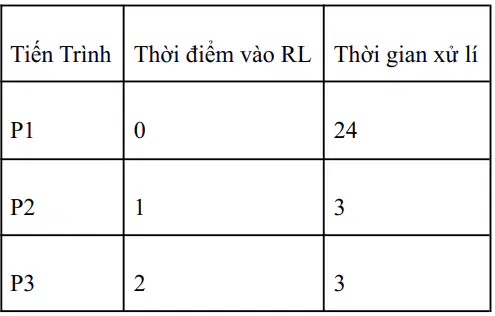
93/ The system has three processes P1, P2, P3 as follows:
The average time that pending processes are processed by the orchestration algorithm. What does FIFO mean?
a) 15
b) 16
c) 17
d) 18
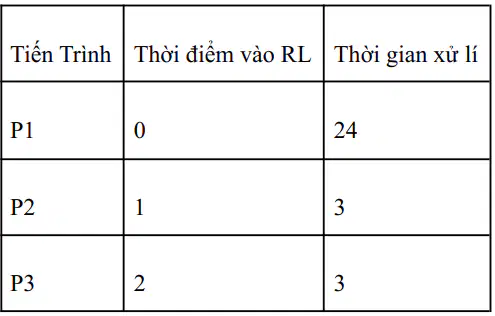
94/ The system has three processes P1, P2, P3 as follows:
If using quantum is 4 milliseconds, calculate the average time that processes take waiting to be processed by the Round Robin coordination algorithm ?
a) 4.66
b) 4.67
c) 4.68
d) 4.69
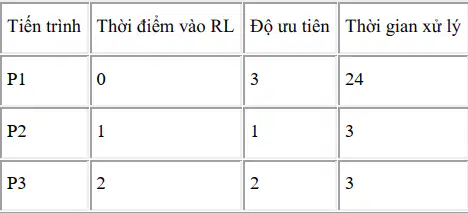
95/ The system has three processes P1, P2, P3 as follows:
The average time that pending processes are processed by the orchestration algorithm according to. What is the exclusive priority?
a) 14
b) 15
c) 16
d) 17
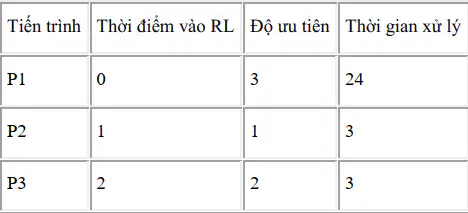
96/ The system has three processes P1, P2, P3 as follows:
The average time that pending processes are processed by the orchestration algorithm according to. What is a non-exclusive priority?
a) 2.3
b) 2.4
c) 2.5
d) 2.7
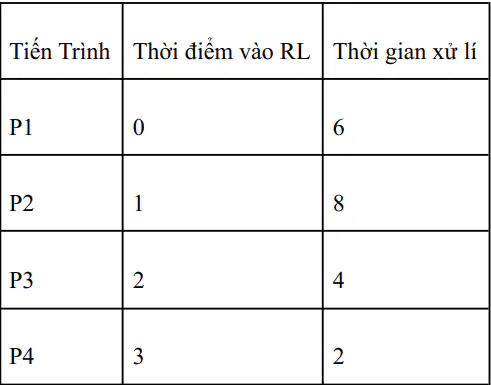
97/ The system has four processes P1, P2, P3, P4 as follows:
The average time that pending processes are processed by the orchestration algorithm according to. What is SJF exclusive?
a) 3
b) 4
c) 5
d) 6
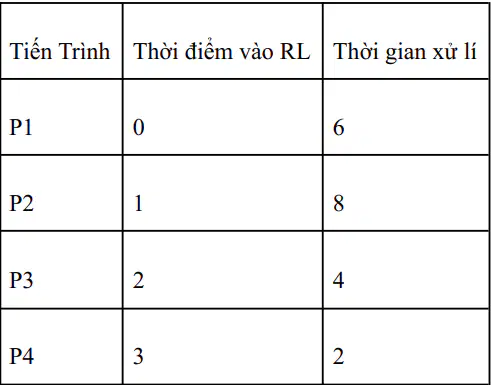
98/ The system has four processes P1, P2, P3, P4 as follows:
The average time that pending processes are processed by the orchestration algorithm according to. What is non-exclusive SJF ?
a) 6.33
b) 6.34
c) 6.35
d) 6.36
e) 4.75
99/ The domain glove is the code:
a) There is a possibility of errors when retrieving shared resources.
b) Likely to be attacked when carried out over the network.
c/ Having access to shared databases on the network.
d) Retrieval of shared resources.
100/ Communication mechanisms between processes include:
a) Communication by signal (Signal), communication by pipe (Pipe).
b) Communication via shared memory, communication by message.
c) Communication via socket.
d) All a, b, c are true
101/ The solutions for the domain that need to meet the conditions are:
a) There are no two processes at the same time in the glove domain.
b) There are no assumptions about the speed of processes, nor about the number of processors.
c) A process outside the domain must not prevent other processes from entering the domain glove. There is no process that has to wait indefinitely to get into the glove domain.
d) a, b, c are all correct
102/ When is the process switched to running?
a) The process is in a ready state and is allocated CPU by the dispatcher.
b) The process is in a blocked state and is allocated CPU by the dispatcher.
c) The process is in a new state and is allocated CPU by the dispatcher.
d) All a, b, c are true.
103/ What is TSL (Test and Set Lock) command?
a) Hardware instructions, allowing checking and updating a memory area in one operation non-exclusive.
b) Operating system command, allowing checking and updating a memory area in one operation monopoly.
c) Hardware instructions, allowing checking and updating a memory area in one operation monopoly.
d) Operating system commands, allowing checking and updating a memory area in one operation non-exclusive.
104/ What are the requirements of Down and Up operations in Semaphore?
a) Sequential execution
b) Parallel implementation
c) Exclusive exercise
d) Non-exclusive execution
105/ What mechanism does the operating system use to decide when to stop working of the process being processed to serve another process, and select the next process. Will Theo serve?
a) Scheduler
b) Regulator
c) Coordinator
d) Ministry of Management
106/ Solutions to synchronize processes?
a) Use of shared variables
b) Use of semaphore structure, monitor
c) Use of TSL directive, use of messages
d) All a, b, c are true
107/ The congestion is (DEADLOCKS):
a) A group of processes where each process in the group waits for resources due to the process other in the group is occupying.
b) A group of processes to which each process in the group has access to the resource used general.
c) A group of processes where each process in the group has resource requirements but has not yet be met.
d) All a, b, c are wrong.
108/ Conditions for the occurrence of obstruction are:
a) Use non-shareable resources and request additional shared resources, no Resource can be recovered from the process holding the resource, there are no cycles in the level graph allocate resources.
b) Use shared resources and request additional resources that cannot be shared, possibly recall resources from processes holding resources, no cycles in the level graph distribute resources.
c) Use of resources that cannot be shared, occupied and require additional resources that cannot be shared, unable to revoke resources from the process holding the resource, has cycles in resource allocation graph.
d) All a, b, c are wrong.
109/ Congestion treatment methods include:
a/ Allocate resources in such a way as to ensure that no congestion occurs.
b) Allow congestion to occur and seek to repair it.
c) Neglect of congestion treatment.
d) All a, b, c are true
110/ Solutions to repair congestion include:
a) Cancel processes that hold shared resources and recover all granted resources issue.
b) Cancel processes that are being congested or recover resources allocated and re-allocated.
c) Cancel processes that hold resources that cannot be shared and re-allocate resources.
d) All a, b, c are wrong.
111/ When a process ends, the operating system performs the following tasks in order:
a) Recovery of resources allocated to the process, cancellation of PCB of the process, cancellation of progress removed from all system management lists.
b) Revoke resources allocated to the process, cancel the process from all lists
management book of the system, cancel RCB's process.
c) Revoke resources allocated to the process, cancel the process from all lists
management of the system, cancel the PCB of the process.
d) It's all wrong.
112/ Each resource is managed by the operating system through a data structure, called be:
a) PCB (Process Control Block)
b) RCB (Resource Control Block)
c) TCB (Trusted Computing Base)
d) It's all wrong
113/ The operating system manages the processes in the system through the block:
a) PCB
b) RCB
c) TCB
d) It's all wrong.
114/ When the process requires a resource but has not been met because of the resource not ready; or the process has to wait for an event or wait for import/export. State transitions occur:
a) Ready-------> Running
b) Running----> End
c) Running----> Blocked
d) Running-----> Ready
115/ A process is waiting to be allocated CPU, it is in the state:
a) New
b) Running
c) Blocked (wait)
d) Ready
116/ Mutual exclusion:
a) At a time, only one process is entitled to access a shared resource.
b) Only one process is entitled to access multiple resources at a time; shareable
c) At one time, only one process is entitled to access an impossible resource share.
d) All a, b, c are wrong.
117/ The mechanism that allows data exchange processes in structured form is:
a) Signal
b) Pipe
c) Shared memory
d) Message exchange
118/ The fastest method to exchange data between processes is:
a) Pipe
b) Shared memory
c) Exchange of messages
d) Sockets
119/ The order of data transmitted through pipe is preserved according to the principle:
a) LIFO
b) FIFO
c) None of the sentences are correct
d) FCFS
120/ Pipe is:
a) A direct communication channel between many processes, the output data of this process is go to as input for the other process as a stream of bytes.
b) An indirect communication channel between the two processes, the output data of this process is go to as input for the other process as a stream of bytes.
c) A direct communication channel between the two processes, the output data of this process is transferred to as input for the other process in the form of a stream of bytes.
d) It's all wrong.
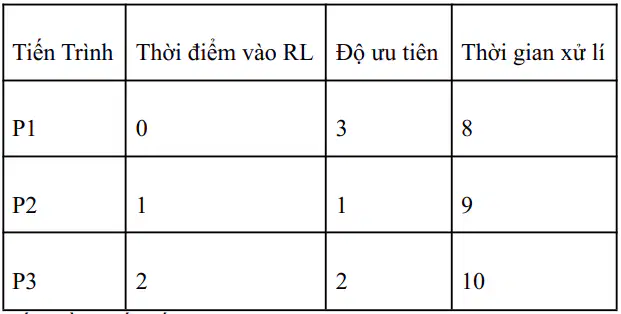
121/ Suppose there are the following processes:
If coordinating the process according to the FIFO algorithm , the waiting period to be processing in the system of processes P1, P2, P3 in order will be:
a) 18, 9, 10
b) 18, 10, 9
c) 0, 7, 15
d) 7, 15, 0
122/ Problems arising when managing memory.
a) Address conversion, allocation/unallocated memory management, kit allocation requirements remember.
b) Fragmented memory, memory dispute processes, memory allocation requirements.
c) Memory is full, select the "victim" process, manage allocated/unallocated memory
d) All a, b, c are wrong.
123/ At what point the relative address transfer to absolute.
a) The time of loading or the time of accumulation of memory or the time of execution.
b) Compilation time or load time or processing time (Execution Time).
c) The time of processing or the time of execution or the time of translation.
d) The time of calculation or the time of accumulation of memory or the time of loading.
124/ Virtual address (logical address) created by.
a) Compiler
b) Operating system
c) Processor (CPU)
d) All a, b, c are true
125/ Physical address is also called.
a) Physic address
b) Physical address
c) Absolute address
d) All a, b, c are true
126/ Virtual address was born at the time.
a) Time to deposit the Program.
b) Time of implementation of the Program.
c) Time of compilation of the Program.
d) Time of memory accumulation.
127/ The relative address was born at the time.
a) Time to deposit the Program.
b) Time of implementation of the Program.
c) Time of compilation of the Program.
d) Time of memory accumulation
128/ The absolute address was born at the time.
a) Time to deposit the Program.
b) Time of implementation of the Program.
c) Time of compilation of the Program.
d) b or c true.
129/ The algorithm chooses the best piece of free memory.
a) The algorithm selects the first piece of free memory that is large enough. (First-fit)
b) The algorithm selects the smallest piece of free memory but large enough to satisfy the demand. (Best fit)
c) The algorithm selects the largest piece of free memory. Worst-fit
d) It can be a or b or c
130/ Memory allocation model Linker_Loader.
a) The program is loaded into a continuous memory area. The relative address is converted to the absolute address at the time of loading the Program.
b) The memory is not fragmented.
c) Cannot move processes in memory, cannot protect the memory of a process
so as not to be illegally retrieved by another process.
d) A and C are correct.
131/ Base & Limit memory allocation model.
a) The program is loaded into a continuous memory area. The relative address is converted to the absolute address at the time of loading the Program.
b) The program is loaded into a continuous memory area. The relative address is converted to absolute address at the time of execution of the Program.
c) Can move processes in memory, can protect the memory of a process to
not be unauthorised by another process.
d) b and c are true.
132/ Defects of the continuous memory allocation model.
a) The size of the process is difficult to develop during implementation. Possible memory fragmentation.
The number of concurrent processes in memory will be limited by memory size and size of processes.
c) Cannot move processes in memory, cannot protect the memory of a process
so as not to be illegally retrieved by another process.
d) A and B are true.
133/ Memory allocation according to segmentation model.
a) The program is divided into several segments, segments are loaded into regions
Memory can be intermittent.
b) When the Program loads into memory, the MMU writes the storage location and segment size to segment table, the CPU converts relative addresses to virtual addresses.
c) Each virtual address consists of two parts (s, d), where s is the segment number, d is the relative address in segment s.
d) All a, b, c are true
134/ Memory allocation according to the paging model.
a) Physical memory is divided into equal size page frames, Program divided into pages by page frame size, the pages will be loaded into the page frames may not be continuous.
b) When the Program is loaded into memory, the MMU (Memory Management Unit) records the number page frame contains page to page table, CPU converts relative address to address imaginary.
c) Each virtual address consists of two parts (p, d), where p is the page number, d is the relative address in page P.
d) All a, b, c are true.
135/ A 32-bit, sized computer system. 1 white frame is 4K. Ask the System
Manage what the maximum size process is.
a) 2 GB
b) 4 GB
c) 6 GB
d) 8 GB.
136/ A 64-bit computer, with 256MB RAM, size. 1 page frame is 4KB. Number of sections element of the regular page table.
2 mũ 52
2 mũ 32
2 mũ 20
2 mũ 10
137/ Number of elements in inverse page table
a) Less than the number of physical page frames
b) Equal to the number of physical page frames.
c) Larger with the number of physical page frames
d) Equal to the number of regular page frames.
138/ Memory allocation according to the "paging combination segment" model
segmentation)"
a) The program is divided into several segments, each segment is divided into several
pages, archived to page frames may be discontinuous.
b) When the Program is loaded into memory, the MMU records the size of each segment and the position store each segment's page table in the segment table and write the page frame numbers contains the pages of the segment to the page table of the corresponding segment, CPU switch relative addresses to virtual addresses.
c) Each virtual address consists of three parts (s, p, d'), where s is the segment number,
p is the page number of for segments S, D is the relative address in page P.
d) All a, b, c are true.
139/ Advantages of the intermittent memory allocation model.
a) The size of the process is easily developed during execution.
b) Very little memory fragmentation. Can move processes in memory.
c) Easily protect the memory of one process so that it is not accessed by another process
permission.
d) All a, b, c are true.
140/ General disadvantages of continuous and intermittent memory allocation models.
a) The size of the process is difficult to develop during execution.
b) The process size is limited by the size of the physical memory, difficult to raise the level multi-Chapter of the system.
c) It is difficult to protect the memory of one process from being accessed illegally by another process.
d) Memory fragmentation, unable to move processes in memory.
141/ What is virtual memory.
a) A technique that uses auxiliary memory to store processes.
b) Portions of the process are transferred in and out between main and secondary memory
c) Allows the execution of a process without loading the entire process into physical memory.
d) All a, b, c are true.
142/ Virtual memory allocation according to the model of "paging on demand (Demand paging)"
a) A process is divided into several pages, residing on secondary memory (usually disk
hard) and a page is loaded into main memory only when required.
b) A process is divided into several pages, residing on main memory and one page
Extra memory is only given upon request.
c) A process is stored on the secondary memory and when the main memory has enough space, the process loaded.
d) All a, b, c are wrong.
143/ A process is given 3 page frames, initially all 3 frames are blank, progress
Access to pages in turn in the following order: 7, 0, 1, 2, 0, 3, 0, 4, 2, 3, 0, 3, 2, 1, 2, 0, 1, 7, 0, 1. Applying the FIFO algorithm to select the victim page, the number of page errors is.
a) 14
b) 15
c) 16
d) 17
144/ A process is given 3 page frames, initially all 3 frames are blank, progress
Access to pages in turn in the following order: 7, 0, 1, 2, 0, 3, 0, 4, 2, 3, 0, 3, 2, 1, 2, 0, 1, 7, 0, 1. Apply the Optimal Page Replacement Algorithm to select the victim page Multiply, the number of page errors is.
a) 7
b) 8
c) 9
d) 10
145/ When installing segment tables, STBR (Segment Table Base Register)
used to.
a) Save the end address of the segment table
b) Save the starting address of the segment table
c) Save the segment number.
d) It's all wrong.
146/ A process is given 3 page frames, initially all 3 frames are blank, the process
Access to pages in turn in the following order:7, 0, 1, 2, 0, 3, 0, 4, 2, 3, 0, 3, 2, 1, 2, 0,
1, 7, 0, 1. Applying the LRU (Least-recently-used) algorithm to select the victim page, the number of errors page is.
a) 11
b) 12
c) 13
d) 14
147/ When installing page tables, the PTBR (Page Table Base Register) is used to.
a) Save the end address of the page table
b) Save the starting address of the page
c) Save the number of elements in the page table
d) Save the starting address of the page table.
148/ When installing page tables, the PTLR (Page Table Limit Register) is used to.
a) Save the end address of the page table
b) Save the starting address of the page
c) Save the number of elements in the page table
d) Save the starting address of the page table.
149/ When installing segment table, STLR (Segment Table Limit Register)
used to.
a) Save the starting address of the segment table.
b) Save the end address of the segment table.
c) Save the number of segments used by the Program.
d) All a, b, c are wrong.
150/ A process is given 3 page frames, initially all 3 frames are blank, progress
Access to the pages in turn in the following order:1 2 3 5 1 3. Application of FIFO algorithm to select the victim page, the page error number is.
a) 2
b) 3
c) 4
d) 5
151/ A process is given 3 page frames, initially all 3 frames are blank, progress
Access to the pages in turn in the following order:1 2 3 5 1 3. Application of the optimal algorithm to select the victim page, the page error number is.
a) 2
b) 3
c) 4
d) 5
152/ A process is given 3 page frames, initially all 3 frames are blank, progress
Access to the pages in turn in the following order:1 2 3 5 1 3. Application of LRU algorithm to select the victim page, the page error number is.
a) 2
b) 3
c) 4
d) 5
Considering an address space of 8 pages (2 mũ p), each page is 1K (2 mũ d) in size radiating into physical memory there are 32 page frames (2 mũ F). How many bits does the logical address consist of.
a) 12
b) 14
c) 13
d) 11
154/ Consider an address space of 8 pages, each 1K in size mapped to
The physical memory has 32 page frames. How many bits does the physical address consist of.
a) 12
b) 14
c) 13
d) 15
155/ A process is given 3 page frames, initially all 3 frames are blank, progress
Access to the pages in turn in the following order:1 2 3 5 1 3. Application of LRU algorithm to select the victim page, the page error number is.
a) 2
b) 3
c) 4
d) 5
In pagination techniques, each access to data or directives is required
How many memory retrievals?
a) 1 time
b) 2 times
c) 3 times
d) 4 times
With regard to the paging technique, the following statements are correct
a) The paging technique eliminates peripheral fragmentation.
b) Pagination techniques eliminate internal fragmentation.
c) Pagination techniques still have the phenomenon of intrapheral fragmentation.
d) A and c are correct
Suppose the main memory currently has empty segments in the order of 600K, 500K, 200K, 300K, indicating processes of size 212K, 417K (in order) will be allocated how memory, if using the First fit algorithm.
a) 600, 500
b) 300, 500.
c) 300, 600.
d) 500, 600.
The purpose of logic is to.
a) Minimize the complexity of the physical processor for the user
b) Make the most of resources inside the processor
c) Allow calculations for more sub-processes at the same time
d) Both b and c
Here are some corresponding events that will occur when an interruption occurs.
(1) The operating system obtains control.
(2) The operating system saves the state of the interrupted process. In many systems, the
This message is stored in the process control block of the interrupted process.
(3) The operating system analyzes interrupts and transfers control to a corresponding procedure to execute current interruption.
(4) The procedure for performing the interrupt proceeds with the interrupt.
(5) The interrupted process is executed.
Let's arrange the above events in the order in which they occur.
a) (1), (2), (3), (4), (5).
b) (1), (3), (2), (4), (5).
c) (1), (2), (3), (5), (4).
d) (1), (3), (2), (5), (4).

