wayground logo

Free Printable Worksheets

Font size

S
M
L
XL
Worksheets

Geometry EOC Review - Part A

Total questions: 100

Worksheet time: 33mins

Name
Class
Date
1.

What is this? (a)  

Choose from the below words
Compass
Circle creator
Pencil swingy-thing
Arc maker
2.

Which of the following shows parallel lines?

a)
b)
c)
d)
3.

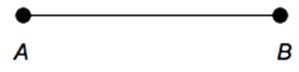
Which of the following is a segment?

a)
b)
c)
d)
4.

Which image shows a ray?

a)
b)
c)
d)
5.

Which of these is a set of perpendicular lines?

a)
b)
c)
d)
6.

What do you call the common endpoint of two rays?  (a)  

Choose from the below words
Angle
Segment
Ray
Vertex 
7.
What does the word BISECT mean?
a)
To cut something into more than five pieces.
b)
It is a plane with two sets of wings.
c)
A shape that has three sides. 
d)
To cut something into two congruent pieces or in half.
8.

Which image shows the construction of a perpendicular bisector?

a)
b)
c)
d)
9.

Which of the following shows the construction of an angle bisector?

a)
b)
c)
d)
10.

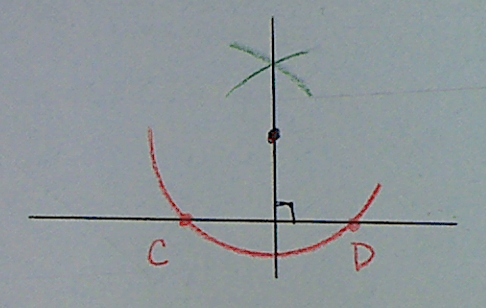
Which of these illustrates the construction of a perpendicular line through a given point

a)
b)
c)
d)
11.

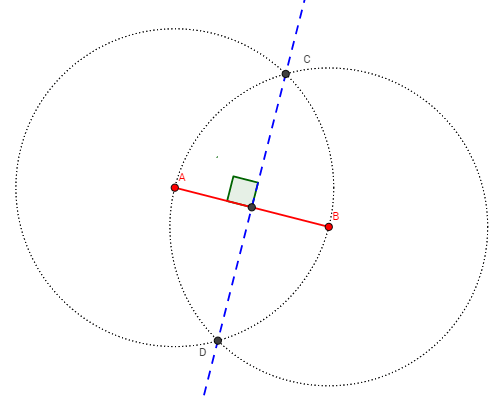
What geometric construction is shown in the diagram below?

a)

an angle bisector

b)

a line parallel to a given line

c)

an angle congruent to a given angle

d)

a perpendicular bisector of a segment

12.

Which of the following constructions is illustrated?

a)

An angle is congruent to a given angle

b)

The bisector of a given angle

c)

equilateral triangle

d)

The perpendicular bisector of a given segment.
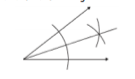
13.
Which of the following constructions is illustrated?
a)
An angle is congruent to a given angle
b)
The bisector of a given angle
c)
The bisector of a given segment
d)
The perpendicular bisector of a given segment.
14.

By using a compass, D and G were marked equidistant from Vertex E. The compass was then used to locate point F, distant from E, so that F is equidistant from D and G. For all constructions defined by the above steps, the measures of DEF and GEF (a)  

Choose from the below words
are equal
are NOT equal
sum to 45°
sum to 30°
15.

What kind of construction is displayed in this picture? (a)  

Choose from the below words
A circle inscribed in a hexagon
A hexagon inscribed in a circle
A hexagon
A circle
16.

Eric was attempting to construct a perpendicular bisector to the segment AB with a compass and straight edge. Which of the below statements explains what Eric may have done wrong?

a)

Eric should have started by putting the compass needle point at the midpoint of the segment AB.

b)

On the second step, Eric should have placed the compass needle point where the first arc intersected the segment AB.

c)

Erick just needed to open the compass more to create arcs that have a radius of more than half the length of the segment AB.

d)

Erick didn’t do anything wrong he just needs to connect the opposite endpoints of each arc to finish the construction.
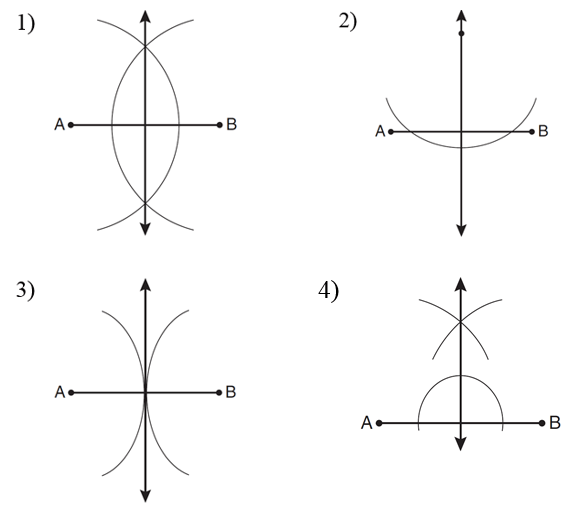
17.

Which one is the correct construction for a perpendicular bisector?

a)

1

b)

2

c)

3

d)

4

18.
To inscribe a square inside a circle, first you must draw a diameter anywhere across the circle. What should your next step be?
a)
Construct a perpendicular bisector
b)
Draw a second diameter to the circle
c)
Construct a line tangent to the circle
d)
Set your compass the length of the radius.
19.
The picture represents a compass and straightedge construction of _________?
a)
Copy an angle
b)
Bisect an angle
c)
Copy a line segment
d)
Bisect a line segment
20.
When constructing a line parallel to a given line, you will be
a)
copying a segment
b)
bisecting a segment
c)
copying an angle
d)
constructing a perpendicular 
21.

Which image best represents an angle?

a)
b)
c)
d)
22.
When copying line segment AB using a straight edge and a compass, the compass should be used to:
a)
Draw an arc above point A
b)
Measure the length of segment AB
c)
Draw an arc between point A and point B
d)
Measure half the length of line segment AB
23.

Which construction illustrates “copy an angle”?

a)
b)
c)
d)
24.

3 or more points on a line

a)

plane

b)

angle

c)

collinear

d)

points

25.

Which is a diameter shown in the circle?

a)

AD

b)

AC

c)

BC

d)

DO

26.

Which of the following shows a construction of a 45o angle?

a)
b)
c)
d)
e)

All of the constructions show a 45o angle
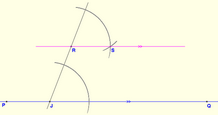
27.
In the image, line RS is _______ to line JQ.
a)
parallel
b)
congruent
c)
similar
d)
perpendicular
28.
Name the construction.
a)
Angle bisector
b)
Perpendicular line to a point not on a line
c)
Perpendicular line to a point on the line
d)
Perpendicular bisector of a line segment
29.
Name the construction.
a)
Angle bisector
b)
Perpendicular line to a point not on a line
c)
Angle median
d)
Perpendicular bisector of a line segment
30.

Name the construction.

a)

midpoint

b)

perpendicular through a point on the line

c)

perpendicular through a point NOT on the line

d)

Circumcenter of a right triangle

31.
a)

A line perpendicular to one of two parallel lines is perpendicular to the other.

b)

Two lines are perpendicular if they intersect to form congruent adjacent angles.

c)

When two lines are intersected by a traversal and alternate interior angles are congruent, the lines are parallel.

d)

When two lines are intersected by a transversal and the corresponding angles are congruent, the lines are parallel.

32.
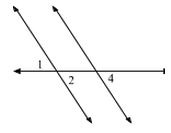
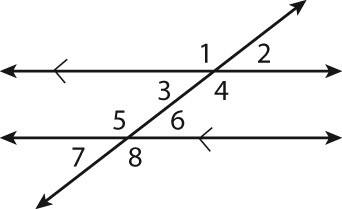
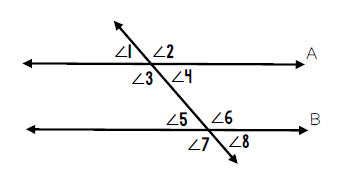
What is the Angle Relationship?
a)
Alternate Interior
b)
Alternate Exterior
c)
Corresponding
d)
Vertical
33.
What is the Angle Relationship? 
a)
Alternate Interior
b)
Alternate Exterior
c)
Corresponding
d)
Same Side Interior
34.
What is the relationship of the Angles
a)
Alternate Interior
b)
Alternate Exterior
c)
Corresponding
d)
Same Side Interior
35.
What is the Angle Relationship
a)
Alternate Interior
b)
Alternate Exterior
c)
Corresponding
d)
Same Side-Interior
36.

Angle 1 = 27o Find the measure of angle 4?

37.
What is the value of x?
38.
Which is a pair of corresponding angles?
a)
∠4 and ∠3
b)
∠4 and ∠1
c)
∠4 and ∠2
d)
∠4 and ∠8
39.
Which pair of angles are congruent?
a)
A and C
b)
C and L
c)
B and W
d)
D and W
40.
Which of these angles is NOT congruent to angle 5?
a)
Angle 6
b)
Angle 8
c)
Angle 1
d)
Angle 4
41.
Find y.
42.

Angle 1 and Angle 5 are examples of which type of angle pair?

a)

Alternate exterior angles

b)

Alternate interior angles

c)

Vertical angles

d)

Corresponding angles

43.

Angle 3 and Angle 6 are examples of which type of angle pair?

a)

Alternate exterior angles

b)

Alternate interior angles

c)

Vertical angles

d)

Corresponding angles

44.

Which of the following angles would NOT be congruent to the measure of 7\angle7 ?

a)

2\angle2  

b)

3\angle3  

c)

6\angle6  

d)

8\angle8  

45.

Which of the following is an example of corresponding angles?

a)

8 and 4\angle8\ and\ \angle4  

b)

5 and 7\angle5\ and\ \angle7  

c)

1 and 7\angle1\ and\ \angle7  

d)

3 and 5\angle3\ and\ \angle5  

46.

Which of the following is NOT an example of supplementary angles?

a)

7 and 8\angle7\ and\ \angle8  

b)

2 and 3\angle2\ and\ \angle3  

c)

1 and 7\angle1\ and\ \angle7  

d)

6 and 4\angle6\ and\ \angle4  

47.

If the  m1 = 57°,m\angle1\ =\ 57\degree,  find the measure of  6.\angle6.  

48.

If the  m5 = 63°,m\angle5\ =\ 63\degree,  find the measure of  3.\angle3.  

49.

If the  m7 = 115°,m\angle7\ =\ 115\degree,  find the measure of  2.\angle2.  

50.
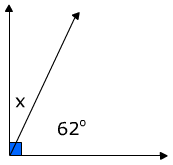
Find the missing angle.
51.
What is the measure of the missing angle?
52.
Which of these angles is NOT congruent to angle 5?
a)
Angle 6
b)
Angle 8
c)
Angle 1
d)
Angle 4
53.
Vertical angles are always
a)
acute
b)
total 180 degrees
c)
congruent (equal measures)
d)
adjacent angles
54.
Two angles are suppplementary if the sum of their angles is 180o
a)
True
b)
False
55.
Complementary angles are angles that add up to ___________. 
a)
180 degrees
b)
90 degrees
c)
360 degrees
d)
100 degrees
56.
Find the value of x.
57.
What is the measure of ∠2?
58.
Find what the value of x.
59.

What is the correct postulate for the figure?

a)

AM+MB=AMB

b)

AB+AM=MB

c)

AM+MB=AB

d)

A+B=AMB

60.

Type the Segment Addition Postulate for the image.

(a)  

61.

What is the length of PR?

62.

What is the length of AC?

63.

What is the length of AB?

64.

What is the length of YZ?

65.

Solve for x.

66.
Find measurement for QT.
67.

Write an equation that correctly models the lengths shown.

a)

2x + 20 + x + 21 = 9

b)

2x + 20 + 9 = x + 21

c)

9 + x + 21 = 2x + 20

d)

2x + 20 - 9 = x + 21

68.
a)

Segment

b)

Arrow

c)

Line

d)

Ray

69.

Including the Reflexive Property, state whether the triangles are congruent and why.

a)

no, not enough information

b)

yes, SAS

c)

yes, ASA

d)

yes, HL

70.

Including Vertical Angles are Congruent, state whether the triangles are congruent and why.

a)

yes, AAS

b)

yes, SAS

c)

yes, ASA

d)

no, not enough information

71.
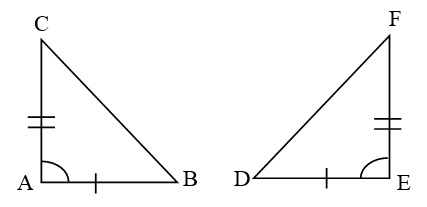
State if the triangles are congruent and why.
a)
AAS
b)
SAS
c)
ASA
d)
SSS
72.

Including the Reflexive Property, state whether the triangles are congruent and why.

a)

yes, SSS

b)

yes, ASA

c)

yes, AAS

d)

yes, HL

73.
State if the triangles are congruent and why.
a)
Not congruent
b)
AAS
c)
SSS
d)
ASA
74.
State if the triangles are congruent and why.
a)
AAS
b)
ASA
c)
Not congruent
d)
SSS
75.

Using the fact that Vertical Angles are congruent, state whether the triangles are congruent and why.

a)

yes, ASA

b)

yes, AAS

c)

yes, SAS

d)

Not congruent, not enough information.

76.

Including the Reflexive Property, which theorem proves the triangles are congruent.

a)

ASA

b)

SSS

c)

SAS

d)

AAS

77.

Using the fact that Vertical Angles are congruent, state whether the triangles are congruent and if so, why.

a)

yes by HL

b)

yes, by SAS

c)

No, not congruent there is no AAA theorem

d)

yes, by AAS

78.

Using the Reflexive Property, which theorem proves that the triangles are congruent.

a)

SAS

b)

AAS

c)

ASA

d)

HL

79.

What additional information is needed to prove the triangles congruent by HL?

a)

A

b)

B

c)

C

d)

D

80.

Using the fact that vertical angles are congruent, which theorem proves the triangles are congruent.

a)

SAS

b)

ASA

c)

AAS

d)

HL

81.
Name the postulate, if possible, that makes the triangles congruent.
a)
SSS
b)
SAS
c)
ASA
d)
AAS
82.
Name the postulate, if possible, that makes the triangles congruent.
a)
SAS
b)
ASA
c)
AAS
d)
Not Possible
83.
Name the postulate, if possible, that makes the triangles congruent.
a)
SAS
b)
ASA
c)
AAS
d)
Not Possible
84.
What is the justification (reason)?
a)
reflexive property
b)
definition of segment bisect
c)
definition of a midpoint
d)
substitution property
85.
If <1 and <2 are complementary, then m<1 + m<2 = 90
a)
Addition POE
b)
Subtraction POE
c)
Def of right angle
d)
Def of Complementary Angles
86.
IF <ABC ≅ <DEF, then m<ABC = m<DEF
a)
Reflexive POE
b)
Addition POE
c)
Def. of congruent angles
d)
Def. of right angles
87.
If X is between R & T on a line,
then RX + XT = RT
a)
Addition POE
b)
Substitution POE
c)
Angle Addition Post.
d)
Segment Addition Post.
88.
What is the reason?
a)
Definition of Complementary
b)
Definition of 180 
c)
Definition of supplementary
d)
Angle Addition
89.
Which property justifies the next step?
a)
Segment addition postulate
b)
Definition of an angle bisector
c)
Angle addition postulate
d)
Definition of right angles
90.
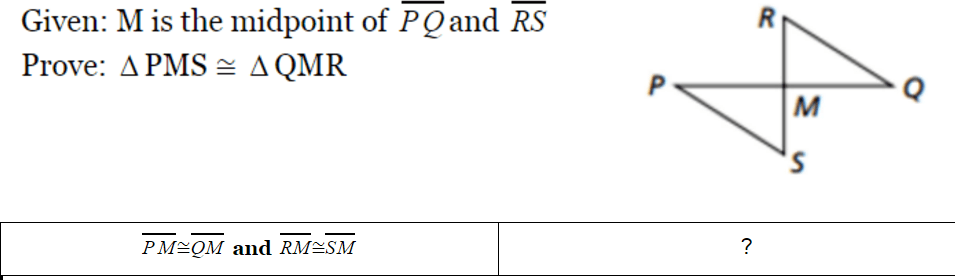
Identify the  missing statement or reason
a)
Reflexive Property
b)
Definition of Midpoint
c)
Given
d)
Vertical Angles Theorem
91.
Identify the  missing statement or reason
a)
Given
b)
Vertical Angles Theorem
c)
Definition of Angle Bisector
d)
Alternate Interior Angles Theorem
92.
Identify the  missing statement or reason
a)
Definition of Angle Bisector
b)
Alternate Interior Angles Theorem
c)
Reflexive Property
d)
Definition of Midpoint
93.
What would be the correct "given" statements for this diagram?
a)
T is the midpoint of segment BG and
∡B≅∡G
b)
∡B≅∡G and ∡A≅∡W
c)
T is the midpoint of segment BG and ∡A≅∡W
d)
T is the midpoint of segment AW and ∡A≅∡W
94.
What would be the correct "given" statements for this diagram?
a)
∡A≅∡C, and segment DB is the angle bisector of ∡CDA
b)
BD=BD, and DB=DB
c)
∡A≅∡C, and segment DB is the angle bisector of ∡CBA
d)
∡B≅∡D, segment DB is the angle bisector of ∡DCA.
95.
Fill in the missing proofs.
a)
Transitive Property, SAS(Side-Angle-Side)
b)
Reflexive Property, SAS(Side-Angle-Side)
c)
Reflexive Property, Vertical Angles Thm.
d)
Transitive Property, SSS(Side-Side-Side)
96.
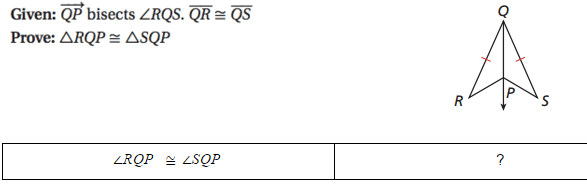
What is the "reason" for step 5 of the proof?
a)
Vertical Angle Theorem
b)
proof
c)
def. of angle bisector
d)
CPCTC 
97.
What is the "statement" for step 3 of the proof?
a)
HA=HA
b)
HA=AH
c)
MA=AM
d)
MA=MA
98.
What is the "statement" for step 3 of the proof? 
a)
∡EDA≅∡DCB
b)
∡AED≅∡BEC
c)
DE=CE
d)
∡AED≅∡CED
99.
What is the "reason" for step 4 of the proof?
a)
proof
b)
AAS
≅ Thrm
c)
ASA
≅ Thrm
d)
SAS
≅ Thrm
100.
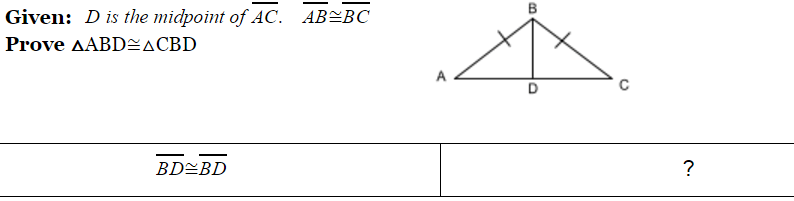
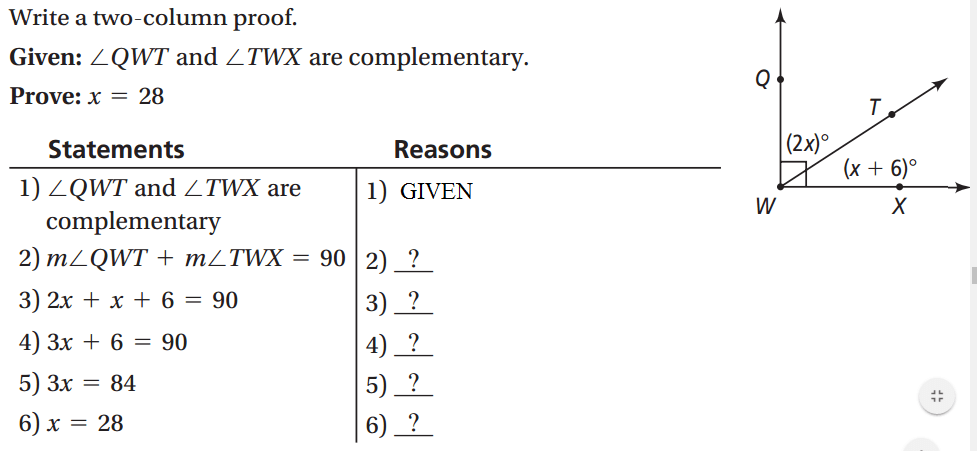
What is the REASON for Statement #2?
a)
Given
b)
Definition of Complementary Angles
c)
Substitution Property
d)
Reflexive Property of Congruence