
NEW
Font size
 Worksheets
Unit 5 Test Review
Total questions: 45
Worksheet time: 8mins
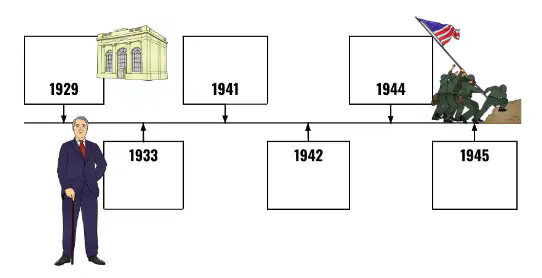
What event happened in 1929?
FDR's New Deal policies to help Americans
The Stock Market crashed
Japan attacked Pearl Harbor
The U.S. dropped atomic bombs on Japan
D-Day invasion of Normandy, France
What event happened in 1933?
FDR's New Deal policies to help Americans
The Stock Market crashed
Japan attacked Pearl Harbor
The U.S. dropped atomic bombs on Japan
D-Day invasion of Normandy, France
What event happened in 1941?
FDR's New Deal policies to help Americans
The Stock Market crashed
Japan attacked Pearl Harbor
The U.S. dropped atomic bombs on Japan
D-Day invasion of Normandy, France
What event happened in 1944?
FDR's New Deal policies to help Americans
The Stock Market crashed
Japan attacked Pearl Harbor
The U.S. dropped atomic bombs on Japan
D-Day invasion of Normandy, France
What event happened in 1945?
FDR's New Deal policies to help Americans
The Stock Market crashed
Japan attacked Pearl Harbor
The U.S. dropped atomic bombs on Japan
D-Day invasion of Normandy, France
This is a share of ownership in a corporation
Consumer Good
Stock Market
Stock
Prohibition

The 18th Amendment; This banned the production, sale, and transportation of Alcohol
The Roaring 20's
Harlem Renaissance
Great Migration
Prohibition

Things that are intended for personal use like automobiles and refridgerators.
Consumer goods
Assembly Line
Pop Culture
Prohibition
Used the Assembly Line to mass Produce the Model T Automobiles
Henry Ford
Langston Hughes
Flappers
Teddy Roosevelt
Current trends, ___ _______ was shared by media and it aimed for young people
Prohibition
Pop Culture
Consumer Goods
Stock Market
Referred to young women in the 1920's, Short Hairstyles and dresses, drove cars, attended college, found jobs
Harlem Renaissance
Pop Culture
Prohibition
Flappers

African American Writer, wrote books, plays, and poetry
Woodrow Wilson
Flappers
Henry Ford
Langston Hughes

A Music Style, gained popularity in the 1920's, Blended African Rhythms with ragtime and blues
The Great Migration
Roaring 20's
Jazz Age
Prohibition
African American Movement, Left the South to live in Northern cities
Great Depression
Great Migration
Harlem Renaissance
Pop Culture
A Period of creativity among African American writers, artists, and musicians
Harlem Renaissance
Great Migration
Prohibition
Roaring 20's
What unintended consequence did Prohibition have on the United States?
Organized crime increased
People stopped drinking alcohol
Banks refused to loan money to people of color
People invested money in stocks
What was a pull factor that drew Black Americans to move to Northern cities?
Nightclubs featuring Jazz music
Job opportunities in factories
Sharecropping jobs on plantations
Redlining and segregated neighborhoods

What was significant about Black Tuesday?
It's the nickname for the day the Stock Market opened.
It's the nickname for the day the Stock Market crashed.
It's the nickname for the day of shopping after Thanksgiving.
It's the nickname for the day the banks closed.
Who was president when the Great Depression began and was criticised for not responding faster to help more Americans?
Teddy Roosevelt
Calvin Coolidge
Herbert Hoover
Franklin D. Roosevelt
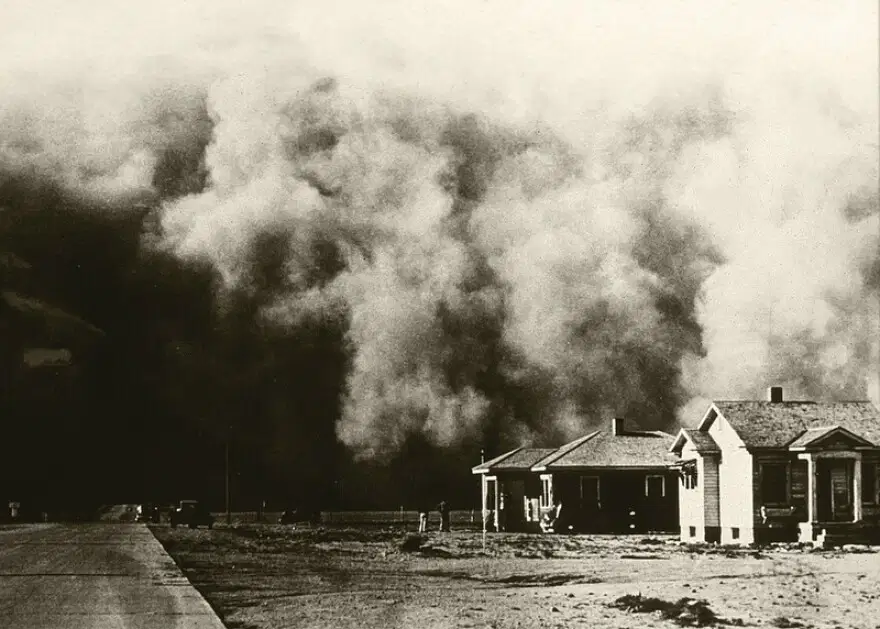
Which was NOT a cause of the Dust Bowl?
Cattle overgrazing
The Great Migration
Severe drought
Farmer's overplanted
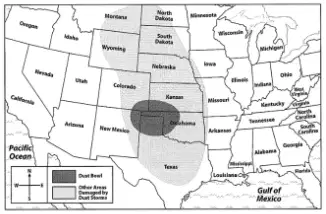
What region of the United States was most severely hurt by the Dust Bowl?
New England
West Coast
Rocky Mountains
Central Plains
What was NOT a cause of the Great Depression?
Flappers challenging gender roles
People made risky stock market investments
Banks loaned people money they couldn't repay
High Tariffs on goods exported to foreign countries
What is FALSE about the Great Depression?
It was solved quickly once Franklin Roosevelt took office.
It was the longest economic depression in US history.
It led to very high unemployment for American workers.
The U.S. didn't fully recover until World War II.

What is NOT one of the ways President Franklin D. Roosevelt took action to boost Americans' confidence in our government?
He temporarily closed banks to allow them to stabilize.
He sent homeless Americans to live in Hoovervilles.
He used the radio to give Fireside Chats to reassure people.
He pushed a record 15 relief bills through Congress in his first 100 days as president.
What is FALSE about the New Deal?
It increased the role of the federal government.
It provided relief, recovery, and reform for Americans.
It reduced government programs to help people.
It was started in 1933 by President Franklin D. Roosevelt.
The Civilian Conservation Corps created temporary jobs for young men in state and national parks. What type of New Deal program is this?


The Securities and Exchange Commissions made new laws to regulate the stock market to prevent the problems that caused the Great Depression. What type of New Deal program is this?
The Home Owners Loan Commission gave families low interest loans to help prevent them from losing their houses. What type of New Deal program is this?
The Federal Emergency Relief Act provided cities and states with government funds to run soup kitchens and bread lines. What type of New Deal program is this?
The Social Security Act provides a monthly income for people who are disabled or retired. What type of New Deal program is this?
What was the policy called when Britain compromised with Hitler as he defied the Treaty of Versailles to avoid another world war?
anarchy
archenemies
appeasement
animosity

Adolf Hitler was the leader of what country?
Germany
Italy
United States
Soviet Union

Benito Mussolini was the Fascist dictator of which country?
Germany
Italy
United States
Soviet Union

Joseph Stalin was the Communist dictator of which country?
Germany
Italy
United States
Soviet Union

Hideki Tojo was the leader of which Axis power?
Germany
Japan
United States
Soviet Union
Denying rights of German citizenship to Jewish people is an example of:
Anti-establishmentarianism
Anti-colonialism
Anti-Americanism
Anti-semitism
Which of the following countries remained neutral at the beginning of World War II?
Great Britain
Japan
Italy
United States
The attack on Pearl Harbor
The Holocaust
Atomic Bomb
Germany invaded Poland

What military strategy did the Allies use to fight the Japanese in the Pacific region?
Island Hopping
Battle of the Bulge
D-Day invasion of Normandy
Blitzkrieg Lightning War

In which region of fighting did the Allies cut off oil reserves to the Axis and win access to the Mediterranean to attack Italy?
Europe
North Africa
The Pacific
The U.S.

What cultural icon was used to inspire women to work in US. factories? It was a form of propaganda.
Rosa the Riveter
Rosa Parks
Rosie The Riveter
Women of America

Which group was imprisoned in internment camps because Americans feared they might be spies?
German Americans
Japanese Americans
Italian Americans
Jewish Americans
Which is NOT an example of how average Americans contributed to the war effort during WWII?
Rationed food
Bought new cars
Recycled rags and metal
Grew Victory Gardens

This massive land-sea-air invasion of Normandy, France was successful in threatening Germany's control of Europe.
Iwo Jima
D-Day
The Holocaust
Pearl Harbor

