
NEW
Font size
S
M
L
XL
 Worksheets
7th Grade Post Assessment
Total questions: 50
Worksheet time: 38mins
Name
Class
Date
1.

The diagram includes an ocean in the water cycle. How does salt water from the ocean end up as fresh water in precipitation?
a)
Runoff leaves salt in the soil
b)
Precipitation leaves salt in the clouds
c)
Evaporation leaves salt in the ocean
d)
Condensation leaves salt in the water vapor
2.
What is the primary energy source that drives the Earth’s water cycle between the atmosphere, oceans, and land?
a)
Wind
b)
Sunlight
c)
Ocean Currents
d)
Rotation of Earth
3.
Water gains energy during evaporation. During what process in the water cycle is this energy released?
a)
Infiltration/percolation through the soil
b)
Transpiration from plants
c)
Runoff into the lake and ocean
d)
Condensation that forms clouds
4.
The subatomic particle with a positive charge is called a(n)
a)
electron
b)
neutron
c)
nucleus
d)
proton
5.
Which of the following is a biotic factor?
a)
Animals
b)
Air
c)
Sunlight
d)
Soil
6.
What are all of the individuals of one species that live in the same area at the same time called?
a)
Ecosystem
b)
Population
c)
Biosphere
d)
Organism
7.
Most energy in an ecosystem begins with the __________.
a)
Sun
b)
Pyramids
c)
Food
d)
Humans
8.
A(n) ___________ is any nonliving factor in the environment such as air, water, and soil.
a)
Biotic
b)
Abiotic
c)
Fear
d)
Niche
9.
______________ is a conclusion about an observation.
a)
Inference
b)
Observation
c)
Theory
d)
Law
10.
The design of the periodic table consists of rows called:
a)
Periods
b)
Columns
c)
Groups
d)
Families
11.
Long hair in the laboratory must be
a)
cut short
b)
kept away from the experiment with one hand
c)
always neatly groomed
d)
tied back or kept entirely out of the way with a hair band, hairpins, or other confining device.
12.
A group of students is given the procedures for an experiment and data collected by another class that previously did the experiment. The group of students is asked to check the accuracy of the other class’s data. How could the students check the other class’s data for accuracy?
a)
by graphing data that the other class collected
b)
by drawing conclusions from the other class’s data
c)
by repeating the experiment with the same procedures and comparing data
d)
by adding another variable and repeating the experiment with modified procedures
13.
The study of interactions among organisms and their environment is called
a)
Ecology
b)
Sociology
c)
Psychology
d)
Archeology
14.
What main two factors determine an area's climate?
a)
Landforms and ocean currents
b)
Bodies of water and landforms
c)
Temperature and precipitation
d)
Mountains and large cities
15.
What are the tundra and desert examples of?
a)
Biomes
b)
Habitats
c)
Communities
16.

Which organism gets food energy directly from both plants and animals?
a)
Fox
b)
Grass
c)
Grasshopper
d)
Snake
17.
Which of the following is the coldest biome?
a)
Taiga
b)
Tundra
c)
Desert
d)
Deciduous Forest
18.

The illustration below represents what type of succession?
a)
Primary succession
b)
Secondary succession
19.
A community of plants that is relatively stable and undisturbed and has reached an end stage of succession is called a(n):
a)
Pioneer organism
b)
Parasitism
c)
Ecology
d)
Climax Community
20.
Secondary succession occurs after __________________ in the ecosystem.
a)
Hurricanes
b)
Fires
c)
Tornadoes
d)
All of the Above
21.
A new island is formed from a volcanic eruption. Which species probably would be the first to grow and survive?
a)
Palm Trees
b)
Lichens
c)
Grasses
d)
Ferns
22.
Which of the following is a physical change?
a)
Cutting a piece of paper
b)
A bicycle rusting
c)
Burning wood
d)
Fireworks
23.

The illustration below represents what type of succession?
a)
Primary succession
b)
Secondary succession
24.
Which action demonstrates a chemical change?
a)
Long hair is cut and dried.
b)
A wooden pencil is sharpened and breaks.
c)
An ice cube melts and becomes a clear liquid.
d)
An iron nail becomes orange and flaky on the surface.
25.
Two galaxies are interacting with each other. What is the force that draws these two galaxies toward each other?
a)
Friction
b)
Gravity
c)
Electricity
d)
Magnetism
26.
Matter is defined as anything that __________________
a)
can be seen and touched
b)
has mass and takes up space
c)
can be weighed
d)
contains kinetic energy
27.
Which of the following is an element?
a)
steel
b)
bronze
c)
iron
d)
brass
28.
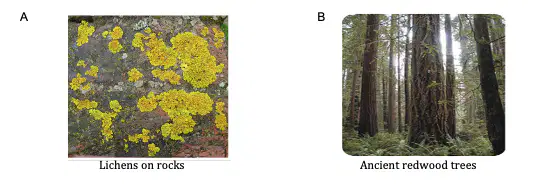
Which of the following statements best describes what is represented by picture A?
a)
Primary succession is occurring.
b)
Secondary succession is occurring.
c)
A forest fire has probably occurred.
d)
The climax stage has been reached.
29.

Which of the following statements best describes what is represented by picture B?
a)
The climax stage has been reached.
b)
Pioneer species are forming soil.
c)
Bare rock covers most of the area.
d)
Secondary succession is occurring.
30.
The order of elements in the modern periodic table is based on an element’s ______________.
a)
atomic number
b)
name
c)
chemical symbol
d)
atomic mass
31.

A ball is released from rest at position 1. The diagram shows the ball in four positions as it rolls along a track from left to right. In which position does the ball have its minimum gravitational potential energy and maximum kinetic energy?
a)
1
b)
2
c)
3
d)
4
32.
Which statement about the atom's nucleus is correct?
a)
The nucleus is made of protons and neutrons and has a negative charge.
b)
The nucleus is made of protons and neutrons and has a positive charge.
c)
The nucleus is made of electrons and has a positive charge.
d)
The nucleus is made of electrons and has a negative charge.
33.
Knowing the chemical properties of a substance will tell you how the substance ___________.
a)
looks
b)
can be broken down into atoms
c)
smells
d)
reacts with other substances
34.
As a dropped penny falls toward the ground, __ energy is converted to __ energy.
a)
thermal; potential
b)
kinetic; vibrational
c)
kinetic; heat
d)
potential; kinetic
35.
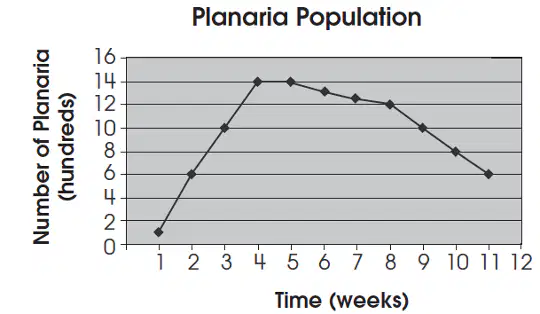
Planaria are flatworms that are found in shallow streams, often attached to the bottoms of rocks. A class is studying a population of planaria in a nearby shallow stream. The graph below shows data collected over 11 weeks. The population started to decrease after 5 weeks. The students concluded that the stream did not have enough food to support a large population of planaria. If this trend continues, how many planaria will be living in the stream by the 12th week?
a)
600
b)
500
c)
400
d)
300
36.
The law of conservation of energy states that energy _______________.
a)
is created from motion
b)
is always equal and opposite
c)
cannot be created or destroyed
d)
can only be converted into heat
37.
Heat always moves from an object of ___ temperature to an object of ____ temperature.
a)
moderate; high
b)
higher; lower
c)
lower; higher
d)
zero; high
38.
The transfer of energy by the movement of fluids or gases with different temperatures and occurs in the ocean, earth and air is called ___________________.
a)
convection
b)
conduction
c)
contact
d)
radiation
39.
Water vapor forming droplets that form clouds directly involves which process?
a)
condensation
b)
respiration
c)
evaporation
d)
transpiration
40.
Plants take in CO2 and water using chlorophyll in leaves and energy from the sun, and releases oxygen during _____________.
a)
combustion
b)
photosynthesis
c)
respiration
d)
osmosis
41.
Animals take in sugar and oxygen and release CO2 during what process?
a)
combustion
b)
photosythesis
c)
respiration
d)
osmosis
42.
What kind of eclipse occurs when the moon blocks sunlight from reaching the Earth?
a)
solar
b)
lunar
43.
Heat transferred from the sun to the Earth is an example of what process?
a)
conduction
b)
convection
c)
radiation
44.
Which of the following is an example of heat transfer by conduction?
a)
water moving in a pot of boiling water
b)
the warmth you feel holding a cup of hot cocoa
c)
a sunburn
d)
warm air rises and cool air sinks
45.
Which of the following families/groups from the periodic table does not normally combine with other elements to form compounds?
a)
alkali metals
b)
alkaline earth metals
c)
oxygen
d)
noble gases
46.
Which of the following elements is a metal?
a)
neon
b)
chlorine
c)
sodium
d)
boron
47.
Which of the following is a property of a metal?
a)
good conductor of heat and electricity
b)
brittle solid at room temperature
c)
poor conductor of heat and electricity
d)
low melting point
48.
What level of a food chain has the most energy?
a)
herbivores
b)
producers
c)
decomposers
d)
carnivores
49.
Muscles perform what type of energy transformation?
a)
kinetic to potential
b)
kinetic to electrical
c)
thermal to radiant
d)
chemical to kinetic
50.
Most ________ are malleable, have high melting points, are usually solid a room temperature and are good conductors of heat and electricity.
a)
noble gases
b)
nonmetals
c)
metals
d)
none of the above
Reset

