Wayground logo

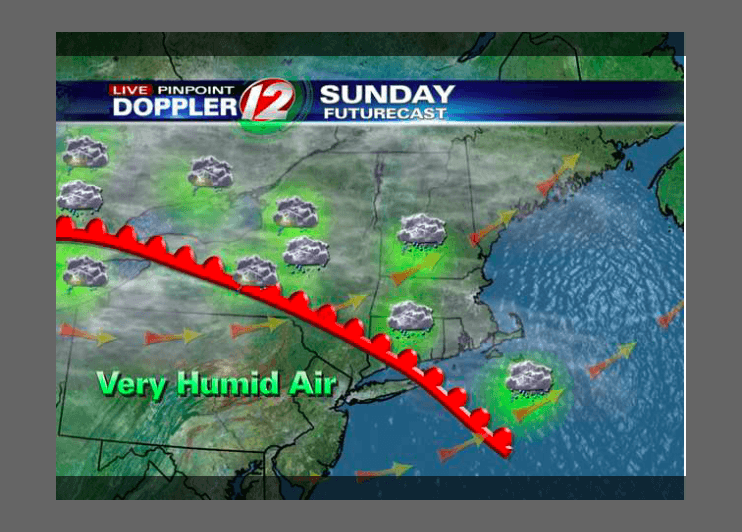
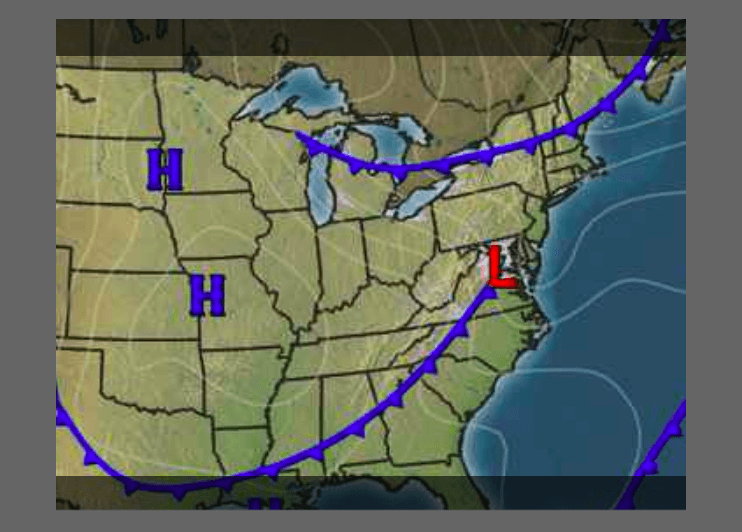
Free Printable Worksheets

Font size

S
M
L
XL
Worksheets

Question Bank for Grade 6 Science

Total questions: 207

Worksheet time: 2hrs 49mins

Name
Class
Date
1.
1. A student observes a clear sky and a temperature reading is 95 F at 8:00 a.m. What is the most likely prediction about the days weather?
a)
The day's weather will be cold.
b)
The day's weather will be rainy.
c)
The day's weather will be hot.
d)
The day's weather will be snowy.
2.
2. A meteorologist used radar to analyze the wind during a storm in the central plains of the United States. The winds were measured at 145 mph and were moving in a circular pattern. According to the data, which event was the meteorologist most likely observing?
a)
lightening storm
b)
tornado
c)
rainbow
d)
cloud formation
3.
3. On a summer evening, a barometer reading shows a gradual increase in air pressure. The humidity is 80%. The thermometer reading is slightly increasing. Based on these data, what type of weather should be expected for the next day?
a)
clear and sunny
b)
humid and rainy
c)
rainy and windy
d)
cloudy and cool
4.
4. The barometer reading on a local weather forecast was 29.80 in Hg and falling. What type of weather conditions are most likely about to occur?
a)
clear and cool
b)
clear and warm
c)
fair skies
d)
cloudy skies
5.
5. Students collected weather data every two hours between 9 a.m. and 3 p.m., as shown in the table below. Based on these data, what type of weather should the students predict for later in the afternoon?
a)
hot and dry
b)
calm with clearing skies
c)
freezing rain and snow
d)
windy with precipitation
6.
6. The graphs below show the trend in wind speed and atmospheric pressure changes over a 6-hour period in coastal area. Based on these data, which will most likely occur next in this area?
a)
clear sky
b)
dense fog
c)
high tide
d)
hurricane
7.
7. The diagram represents air circulating over coastal land and the ocean. What most likely causes the air rising from land to be warm?
a)
heat from electicity
b)
heat from the sun
c)
heat from hot springs
d)
heat from decomposition
8.
8. Two students think that wintertime thunderstorms are always followed by snow. Which of the following would be the best way to test this hypothesis?
a)
Measure the snowfall after the first winter thunderstorm
b)
Compare data collected for one week with data from another group
c)
Record a show on tornadoes and their destruction
d)
Analyze winter weather records from the past five years
9.
9. A stationary front is moving into the area. The temperature is 70 degrees.
a)
It will snow for a day.
b)
It will be rainy for a day.
c)
It will rain for several day.
d)
There will be severe storms in the area.
10.
10. At 1:00 p.m., the air temperature was 78 F, and air pressure was 30.0 in. Hg with partly cloudy skies. By 4:00 p.m., the temperature dropped to 62 F, and the pressure dropped to 29.5 in Hg. Which best predicts the weather for later that afternoon?
a)
snowstorms
b)
rain showers
c)
sunny and mild
d)
hot and humid
11.
11. Atmospheric pressure (air pressure) begins to fall slowly during the afternoon on a clear summer day. the pressure continues to drop overnight. What kind of weather will most likely occur the next day?
a)
sunny and warm
b)
sunny and cold
c)
cloudy with rain
d)
cloudy with snow
12.
12. A wilderness area has a moderate climate. This area receives a light to medium amount of rain and snow each year. Fires burn the area every few years. Bison and deer live in the area. Which biome is most likely being described?
a)
desert
b)
grassland
c)
Arctic Tundra
d)
tropical rainforest
13.
13. Plants in the tundra biome grow close to the ground and have shallow root systems. Which statement best explains why these plants have shallow root systems?
a)
The plants are eaten before they mature.
b)
The plants can be easily transplanted.
c)
The ground is frozen much of the year.
d)
The seeds must be spread quickly.
14.
14. A student collected the following weather data: Air Pressure- Rising Temperature: 70 F and Rising Humidity: 32 percent and falling What was the most likely weather condition at the time the student collected this data?
a)
cloudy
b)
clear
c)
snow
d)
rain
15.
15. A student measured air temperatures at noon for 5 days. The student recorded the data in the table below. Which graph best represents the data from the table?
a)
Option 1
b)
Option 2
c)
Option 3
d)
Option 4
16.
16. Students recorded the temperature outside their classroom every day for 2 months. Then they calculated the average weekly temperature. Their data is recorded in the table below. Which graph best shows their results?
a)
Option 1
b)
Option 2
c)
Option 3
d)
Option 4
17.
17. The data table below lists the amount of rainfall measured during a six-month period at a particular location. Which bar graph below correctly displays the data shown in the table?
a)
Option 1
b)
Option 2
c)
Option 3
d)
Option 4
18.
18. The weather map shows an area of high(H) air pressure and an area of low(L) air pressure.What is the most likely wind direction at Point X?
a)
west to east
b)
north to south
c)
east to west
d)
southeast to northwest
19.
19. The table below shows some weather conditions on a Wednesday. Based on the data table, which weather prediction is best for Thursday?
a)
warm with a possibility of rain
b)
cold with a possibility of snow
c)
hot with clear skies
d)
cool with gusty winds
20.
20. The diagram shows the movement of air during a thunderstorm. The rising and falling of air during a thunderstorm directly results from
a)
lightening
b)
precipitation
c)
heat convection
d)
cloud formation
21.
1. A wilderness area has a moderate climate. This area receives a light to medium amount of rain and snow each year. Fires burn the area every few years killing much of the grasses. Bison and deer live in this area. Which biome is most likely being described?
a)
desert
b)
grassland
c)
Arctic Tundra
d)
tropial rainforest
22.
2. Which parts of an Arctic tundra biome are abiotic?
a)
moose
b)
grasses
c)
conifer trees
d)
cold temperatures
23.
3. Hawks, grasses, songbirds, and caterpillars are some organisms found in an ecosystem. Which is the correct order for energy to transfer in this ecosystem?
a)
caterpillar ---> hawks--->grasses--->songbirds
b)
grasses --->caterpillars ---> songbirds --->hawks
c)
hawks ---> caterpillars--->grasses ---> songbirds
d)
songbirds --->grasses ---> hawks ---> caterpillars
24.
4. A polar bear hunts a seal. After the polar bear is done feeding, an Arctic fox consumes the remaining meat. Which describes the role of the Arctic fox in this situation?
a)
scavenger
b)
predator
c)
producer
d)
decomposer
25.
5. Plants in the tundra biome grow close to the ground and have shallow root systems. Which statement best explains why these plants have shallow root systems?
a)
The plants are eaten before they mature.
b)
The plants can be easily transplanted.
c)
The ground is frozen much of the year.
d)
The seeds must be spread quickly.
26.
6. A grassland biome contains many abiotic and biotic factors. What is an example of a biotic factor of this biome?
a)
water
b)
plants
c)
air
d)
clouds
27.
7. Which process begins the transfer of materials and energy throughout a forest ecosystem?
a)
photosynthesis
b)
metamophosis
c)
growth
d)
reproduction
28.
8. Nematodes are round worms that can live in the intestines of marine fish. The nematodes are helped by living in the fish, but the fish are harmed by the nematodes. Which term describes the role of the nematodes in a marine biome?
a)
parasite
b)
host
c)
predator
d)
prey
29.
9. Which of these is an abiotic factor in a tropical rainforest?
a)
kapok tree
b)
high humidity
c)
bucket orchid flower
d)
blue mountain butterfly
30.
10. The fur of Arctic foxes and Arctic hares is white in the winter. The fur of both species becomes brown in summer. This adaptations helps camouflage these animals. In which biome can a predator prey relationship between Arctic foxes and Arctic hares be found?
a)
desert
b)
rainforest
c)
wetland
d)
tundra
31.
11. Which of these are biotic factors found in freshwater biomes?
a)
minerals
b)
sediments
c)
oxygen levels
d)
pond snails
32.
12. Blue-green algae are organisms that convert sunlight into food through photosynthesis. What is the role of blue-green algae in a food chain?
a)
consumer
b)
scavenger
c)
producer
d)
decomposer
33.
13. In a certain biome, wildflowers and herbs are some of the most common plants. Bison and prairie dogs consume the wildflowers and herbs. Coyotes and eagles hunt the prairie dogs. Which biome is most likely being described?
a)
coniferous forest
b)
temperate grassland
c)
tropical rainforest
d)
Arctic Tundra
34.

Which of these would NOT describe an invasive species?

a)

alien

b)

non-native

c)

intruder

d)

natural

35.
15. The diagram below below shows a food chain.Which statement correctly describes energy flow through this food chain?
a)
The frog receives energy from the caterpillar.
b)
The snake receives energy from the owl.
c)
The thistle receives energy from the caterpillar.
d)
The caterpillar receives energy from the snake.
36.
16. Which organisms are most important for adding nutrients to the soil?
a)
consumers
b)
scavengers
c)
producers
d)
decomposers
37.
17. The soil in a deciduous forest typically contains many nutrients and supports the growth of various plants. Which statement explains why the soil is so nutrient rich?
a)
The daily rainfall adds minerals to the soil.
b)
The temperature of the soil is perfect for plants to grow.
c)
The amount of sunlight the soil gets is perfect for plants to grow.
d)
The soil is high in organic matter from decomposers.
38.
18. The Arctic tundra provides a habitat for caribou and arctic hare. Which best describes the climate in which these animals live?
a)
cold and humid
b)
warm and dry
c)
cold and dry
d)
warm and humid
39.
19. A feeding diagram is shown below. Which of these best describes the role of the shark in this feeding diagram?
a)
producer
b)
consumer
c)
decomposer
d)
prey
40.

Remoras are small fish that swim close to or attach themselves to sharks.  Remoras eat small scraps left as the sharks feed and the sharks are unaffected. 

a)

Parasitism

b)

mutualism

c)

Commensalism

d)

Predation

41.

Yucca flowers are pollinated by yucca moths. The moths lay their eggs in the flowers where the larvae hatch and eat some of the developing seeds. Both species benefit.

a)

Mutualism

b)

Commensalism

c)

Parasitism

d)

Predation

42.
22. Which is a biotic factor of an alpine forest?
a)
elk
b)
rainfall
c)
soil
d)
mountains
43.

Kudzu has overgrown in many parts of Tennessee. What type of relationship does Kudzu have with the native ground plants?

a)

Predation

b)

Commensalism

c)

Parasitism

d)

Competition

44.
24. A food chain is shown below. Which organism in the food chain is a producer?
a)
grass
b)
mouse
c)
snake
d)
hawk
45.

Why do populations of invasive species grow so quickly?

a)

They are prey to many animals.

b)

They help to keep the ecosystem in balance.

c)

They are native to the area.

d)

They have no predators.

46.
26. A grassland food web is shown below. The owl most directly obtains energy from
a)
vole
b)
insects
c)
deer
d)
grasses
47.
27. An energy pyramid shows how energy flows through a community. The shape show how the amount of energy available to the next level decreases. Which level of the pyramid must contain producers?
a)
Level 1
b)
Level 2
c)
Level 3
d)
Level 4
48.
28. A grassland food web is shown below. Which organism in the food web is a producer?
a)
snake
b)
toad
c)
grass
d)
spider
49.
29. Which factor is a biotic element of an Arctic tundra?
a)
strong wind
b)
cold temperatures
c)
snowy owl
d)
frozen soil
50.
30. A new organism has been discovered in an isolated forest area. This new organism is multicellular and receives nutrition from dead trees. How will this organism most likely be classified?
a)
producer
b)
decomposer
c)
scavenger
d)
predator
51.
31. Which question would best help a student classify an organism as a decomposer?
a)
Does it feed on plants?
b)
Does it break down dead material?
c)
Does it use sunlight to make its own food?
d)
Dies it have parts that attract pollinators.
52.
32. The diagram shows a food web. Which animal from this food web receives energy directly from producers?
a)
Hawk
b)
Snake
c)
Owl
d)
Mouse
53.
33. Leeches usually live in fresh water ecosystems. Leeches feed on the blood of other animals, such as fish. The leeched do not kill the fish, but the fish are weakened by the leeches. Which best describes the relationship between leeches and fish?
a)
predator-prey
b)
consumer-scavenger
c)
producer-decomposer
d)
parasite-host
54.
34. In addition to rain, which other factor most helps plants grow all year in a tropical rain forest?
a)
low humidity
b)
warm temperatures
c)
cloudy summers
d)
windy conditions
55.
35. A coniferous forest biome has long, cold, snowy winters. It contains pine and spruce trees, elk, moose, and gray wolves. Which factor is an abiotic element of this biome?
a)
moose
b)
spruce trees
c)
snow
d)
gray wolves
56.
36. Which set of abiotic factors is typical in rain forest biomes?
a)
warm temperatures and large amounts of precipitation
b)
hot temperatures and very little precipitation
c)
cool temperatures and low amounts of precipitation
d)
extremely cold temperatures and freezing precipitation
57.
37. A food web is shown below. Which two organisms from this food web are both classified as consumers?
a)
tree and bird
b)
insect and fox
c)
rabbit and grass
d)
grass and tree
58.
38. An ocean food chain is shown. What is the role of krill in this food chain?
a)
scavenger
b)
producer
c)
consumer
d)
decomposer
59.

Invasive species alter the ecosystem by ______ in number quickly. This leads to ______ food for the native species.

a)

increasing, less

b)

increasing, more

c)

decreasing, less

d)

decreasing, more

60.

TRUE or FALSE? Invasive species can be introduced to an ecosystem accidentally/

a)

True

b)

False

61.

TRUE or FALSE? Invasive species can be introduced to an ecosystem intentionally (on purpose).

a)

True

b)

False

62.

Invasive plants compete with native plants for --- [choose 3]

a)

sunlight

b)

water

c)

oxygen

d)

space

63.

What is an invasive species?

a)

A native (naturally found) species which are added to an area

b)

An organism that is new to an environment and has a negative effect on that environment.

c)

A keystone species in an environment

d)

none of the above

64.

What is biodiversity?

a)

Different types of life in an ecosystem.

b)

Different types of animals in an ecosystem.

c)

Different types of plants in an ecosystem.

d)

Different abiotic factors in an ecosystem.

65.

Which of the following is an example of an invasive species?

a)

Trout

b)

Kudzu

c)

Mosquito

d)

Daisy

66.

Kudzu has overgrown in many parts of Tennessee. What type of relationship does Kudzu have with the native ground plants?

a)

Competition

b)

Predator-Prey

c)

Commensalism

d)

Mutualsim

67.

The field mice population has grown so fast that they eat an average of $4 billion of wheat every year. Their fast growth is caused by...

(Choose 2!)

a)

The mice like to reproduce.

b)

A lack of native species to eat the field mice.

c)

Abundant food supply.

68.

Why do populations of invasive species grow so quickly?

a)

They are prey to many animals.

b)

They are native to the area.

c)

They help keep the ecosystems in balance.

d)

They have no predators.

69.

A group of friends gather around a fire to stay warm. This is an example of ________.

a)

conduction

b)

convection

c)

radiation

70.

Which describes what can happen as a result of radiation?

a)

A piece of wood burns in a fire.

b)

A shirt is hot after having been ironed.

c)

A can of soup is heated in a pot on a stove.

d)

A car’s inside temperature rises to over 100 degrees on a sunny day.

71.

In heat transfer, heat always flows from the _______________ substance to the _______________ substance.

a)

hotter to colder

b)

colder to hotter

c)

hotter to hotter

d)

colder to colder

72.

Which is an example of heat being transferred by conduction?

a)

a furnace heating the air in a school

b)

an ice cube melting in a person’s hand

c)

a pot of water on a stove boiling

d)

the sun heating water in a swimming pool

73.

The baby chickens kept warm by the heat lamps. This is an example of ________.

a)

conduction

b)

convection

c)

radiation

74.

The handle of a metal spoon warms up when it is placed in a hot bowl of soup because of ________.

a)

convection

b)

conduction

c)

radiation

75.

You get sunburned due to __________ from the sun.

a)

conduction

b)

convection

c)

radiation

76.

Near the ceiling of a room the air is warmer. The warm air rises because of ________.

a)

conduction

b)

convection

c)

radiation

77.

The heat from a lamp allows a lizard to remain warm. This is an example of which type of heat transfer?

a)

radiation

b)

conduction

c)

convection

78.
Which best describes the process of convection?
a)
Convection is the primary way  heat travels  through rays.
b)
Convection is the primary way heat travels  through metals.
c)
Convection is the primary way heat travels  through appliances.
d)
Convection is the primary way heat travels  through liquids and gasses.
79.

Hot coffee is stirred with a spoon; the spoon gets hot due to ________.

a)

conduction

b)

convection

c)

radiation

80.

The kind of heat transfer that travels through space in electromagnetic waves is ______________________.

a)

convection

b)

radiation

c)

conduction

81.

The type of heat transfer that creates currents in water is called ________.

a)

conduction

b)

convection

c)

radiation

82.

A huge rock at the state park gets so hot during the day because of ________.

a)

conduction

b)

convection

c)

radiation

83.
a)

Conduction

b)

Radiation

c)

Convection

84.

The heat transferred from the Sun to the Earth by waves is called ________.

a)

conduction

b)

radiation

c)

convection

85.
Which direction will the heat flow while this person holds a hot cup of tea?
a)
from the cup to her hand
b)
from her hand to the cup
c)
no heat is transferred
86.
Which direction will the heat flow while this ice cap melts?
a)
there is no heat transfer
b)
from the icecap to the water
c)
from the water to the icecap
87.

A pot is placed directly on a stove. The pot gets hot due to ________.

a)

conduction

b)

convection

c)

radiation

88.

What form of heat transfer circulates the warm and cool air in a house?

a)

Conduction

b)

Radiation

c)

Convection

89.

Thermal energy moves from areas of _________ to ___________.

a)

cold to hot

b)

cold to cold

c)

hot to hot

d)

hot to cold

90.

 Where can Earth's atmosphere be heated by conduction?

a)

In the upper atmosphere, where warm air rises and cooler air sinks.

b)

On the surface of the Earth, where the air is touching the surface of the Earth.

91.

 Why is air warmer near Earth's surface?

a)

The sun heats Earth's surface and in turn the air above it is heated.

b)

Warm air is more dense and sits on top of the Earth's surface.

c)

Warm air is less dense and sits on Earth's surface.

92.

Convection takes place in

a)

solids and liquids

b)

liquids and gases

c)

solids and gases

d)

none of these

93.

 When convection occurs in the atmosphere:

a)

warm air sinks and cool air rises.

b)

warm air rises and cool air sinks.

c)

warm air sinks and cool air sinks.

d)

warm air rises and cool air rises.

94.

In which type of symbiotic relationship do both species benefit?

a)

Commensalism

b)

Parasitism

c)

Mutualism

d)

Predation

95.

In which type of symbiotic relationship does one species benefit while the other species is unaffected?

a)

Commensalism

b)

Parasitism

c)

Mutualism

d)

Predation

96.

In which type of symbiotic relationship does one species benefit while the other species is harmed?

a)

Commensalism

b)

Parasitism

c)

Mutualism

d)

Predation

97.

In which type of symbiotic relationship does the predator eat it's prey?

a)

Commensalism

b)

Parasitism

c)

Mutualism

d)

Predation

98.

A certain species of bird follows cows through a pasture and eats insects that cows stir up. The cows are not affected. Which type of symbiotic relationship is described?

a)

Commensalism

b)

Parasitism

c)

Mutualism

d)

Predation

99.

A shrimp is warned of danger by a fish and the fish gets a home dug by the shrimp. Which type of symbiotic relationship is this?

a)

Commensalism

b)

Parasitism

c)

Mutualism

d)

Predation

100.

A bear hunts for a fish down by the river and captures one. Which type of symbiotic relationship is described?

a)

Commensalism

b)

Parasitism

c)

Mutualism

d)

Predation

101.

Which statement is true about symbiotic relationships?

a)

Both species benefit

b)

Neither species benefit

c)

At least one species benefits

d)

At least one species is harmed

102.

Which statement is true about parasitism?

a)

Most animal species are host to at least one parasite

b)

The host is always killed

c)

Plants are never parasitic

d)

Parasites always live inside their host

103.

True or False: Symbiosis only works with animals.

a)

True

b)

False

104.

The sun creates which type of energy

a)

Solar

b)

Radiant

c)

Electromagnetic

d)

Elastic

105.

A microwave uses this type of energy to heat your food.

a)

Chemica

b)

Radiant/Electromagnetic

c)

Gravitational

d)

Sound

106.

The energy that is in these matches is

a)

nuclear

b)

radiant

c)

mechanical

d)

chemical

107.

The kind of energy transmitted in these wires is

a)

electrical

b)

sound

c)

thermal

d)

nuclear

108.

a monkey high up in a tree

a)

elastic

b)

sound

c)

thermal

d)

gravitational

109.

A child riding a bicycle

a)

Mechanical

b)

sound

c)

nuclear

d)

elastic

110.

The energy from these

a)

thermal

b)

sound

c)

mechanical

d)

nuclear

111.

Gas molecules are very hot and move quickly

a)

mechanical

b)

radiant

c)

chemical

d)

thermal

112.

A trampoline bends when you jump on it.

a)

gravitational

b)

elastic

c)

nuclear

d)

mechanical

113.

The ball bounces in the Newton's Cradle

a)

chemical

b)

sound

c)

elastic

d)

Mechanical

114.

What is energy?

a)

Energy can be created and destroyed.

b)

The ability to do work or cause change.

c)

Energy due to position.

d)

Energy from the movement of electrons.

115.

Energy is measured in

a)

Joules

b)

Meters

c)

Watts

d)

Feet

116.

Energy from the movement of electrons

a)

Elastic

b)

Sound

c)

Electrical

d)

Thermal

117.

Energy comes from a vibrating source and travels through solids, liquids, and gases. Cannot travel through space.

a)

Elastic

b)

Sound

c)

Electrical

d)

Thermal

118.

Energy comes from the vibrating atoms and molecules. All atoms and molecules are always moving and vibrating, except at Absolute Zero.

a)

Nuclear

b)

Gravitational

c)

Thermal

d)

Radiant

119.

Energy due to the position. Based on height and mass.

a)

Gravitational

b)

Chemical

c)

Elastic

d)

nuclear

120.

Any kind of potential or kinetic energy.

a)

sound

b)

electrical

c)

chemical

d)

mechanical

121.

Energy from atoms combining or splitting.

a)

Nuclear

b)

Radiant

c)

Mechanical

d)

elastic

122.

Energy from the entire electromagnetic spectrum, including visible light. Can travel through space.

a)

Nuclear

b)

Radiant

c)

Elastic

d)

Sound

123.

Energy stored in bonds and released or absorbed during reactions.

a)

Nuclear

b)

Radiant

c)

Elastice

d)

Chemical

124.

Energy from compressing or stretching an object.

a)

Nuclear

b)

Elastic

c)

Sound

d)

Electrical

125.

Surface currents are a result of

a)

Global Wind Patterns

b)

Earth's Rotation

c)

Density

d)

All of the above

126.

Deep Ocean currents are a result of

a)

Global Wind Patterns

b)

Earth's Rotation

c)

Density

d)

All of the above

127.

The Coriolis Effect is caused by

a)

Earth rotating around the sun

b)

Earth rotating on its axis

c)

The tides

d)

Gravity

128.

The Gulf stream carries _____________ water from the east coast of The United States to the West coast of Europe.

a)

Cold

b)

Warm

c)

Freezing

d)

Fresh

129.

Due to the Coriolis Effect, water in the northern hemisphere moves

a)

clockwise

b)

counter clockwise

c)

both

d)

neither

130.
Regular movements of water far below the oceans surface are called
a)
Warm Currents
b)
Deep Currents
c)
Shallow Currents
d)
Surface Currents
131.

Constantly moving system of deep-ocean circulation driven by temperature and salinity. It moves water around the globe.

a)

California Current

b)

Global Conveyor Belt

c)

Surface Currents

d)

Gulf Stream

132.

The more scientific name of the Global Conveyor Belt is _____.

a)

halinethermal circulation

b)

thermohaline circulation

c)

thermodensity circulation

133.

________ and _______ affect the ocean's density and cause deep ocean currents.

a)

gravity and the Coriolis Effect

b)

temperature and salinity

c)

wind and climate

d)

temperature and the Coriolis Effect

134.
Where is ocean water the densest.
a)
The surface
b)
The middle
c)
The bottom
d)
Lake Michigan
135.
What causes surface currents north and south of the equator to move in different directions? 
a)
Gases in the ocean
b)
The rotation of the Earth
c)
Temperature differences
d)
Continental deflection
136.
Why are surface currents at the surface of the ocean?
a)
colder temperature
b)
colder temperature & more salinty
c)
warmer temperature & less salinty
d)
less salinty
137.

Ocean currents affect climates around the world. Based on the map, which area MOST likely has a warmer climate than expected?

a)

1

b)

2

c)

3

d)

4

138.
Ocean currents bring warm water from the equator towards Earth's
a)
Southern Hemisphere
b)
Continents
c)
Equator
d)
Poles
139.

Which three things affect surface currents?

a)

The Coriolis Effect

b)

Tides

c)

Continental Deflection

d)

Global Winds

140.

What is continental deflection?

a)

The surface currents bounce off of the continents.

b)

The surface currents jump off of the continents.

c)

The continents bump into one another.

d)

Deep ocean currents run into the continents. This causes them to go straight.
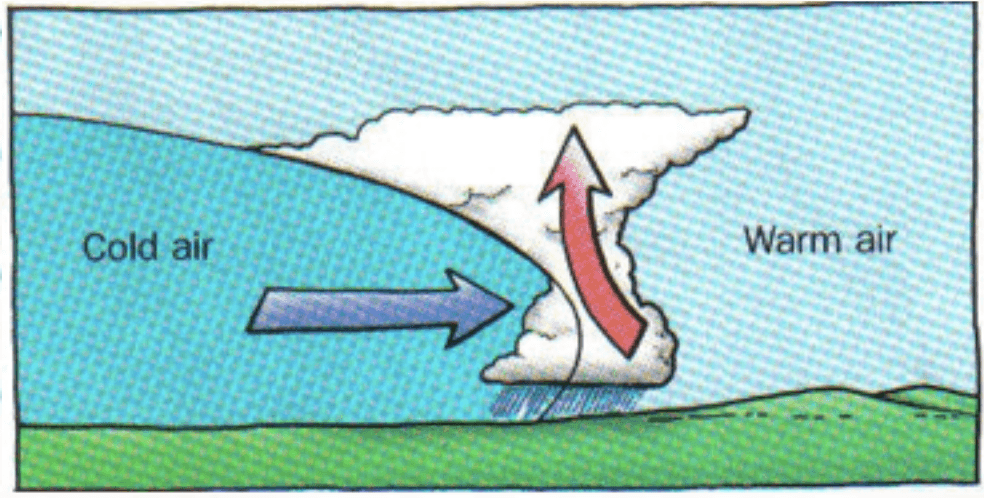
141.

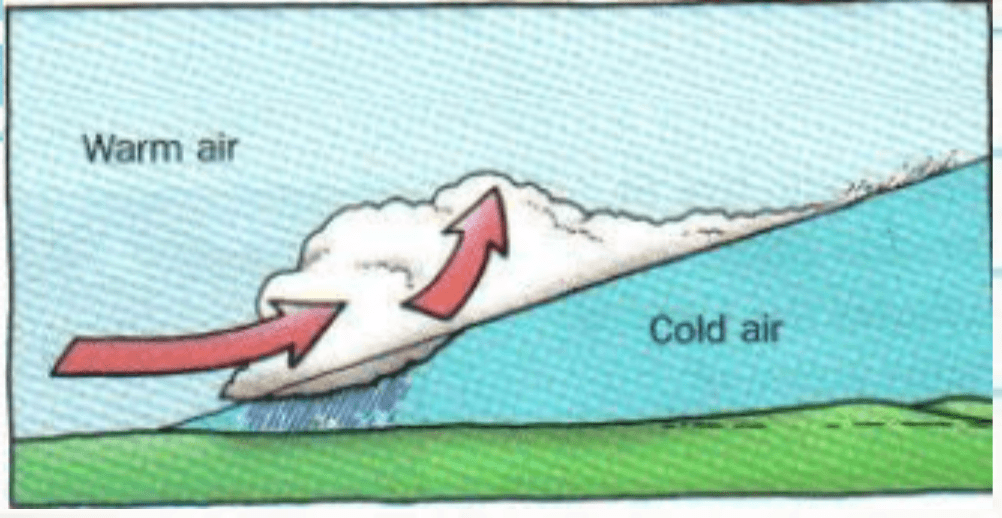
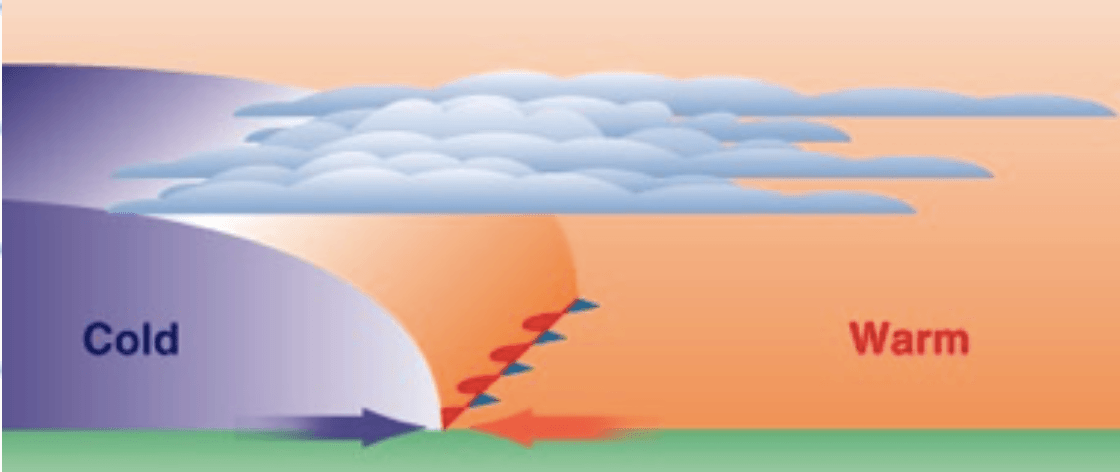
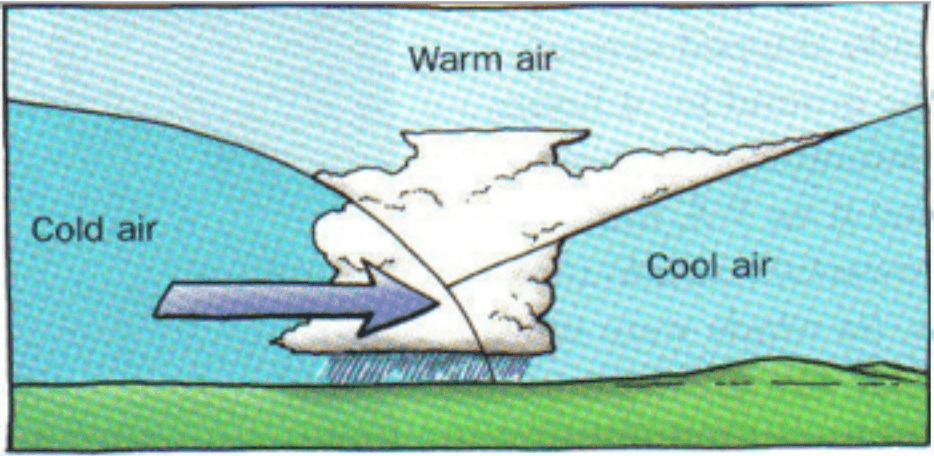
Name that front.

a)

Cold Front

b)

Warm Front

c)

Stationary Front

d)

Occluded Front

142.

Name that front.

a)

Cold Front

b)

Warm Front

c)

Stationary Front

d)

Occluded Front

143.

Name that front.

a)

Cold Front

b)

Warm Front

c)

Stationary Front

d)

Occluded Front

144.

Name that front.

a)

Cold Front

b)

Warm Front

c)

Stationary Front

d)

Occluded Front

145.

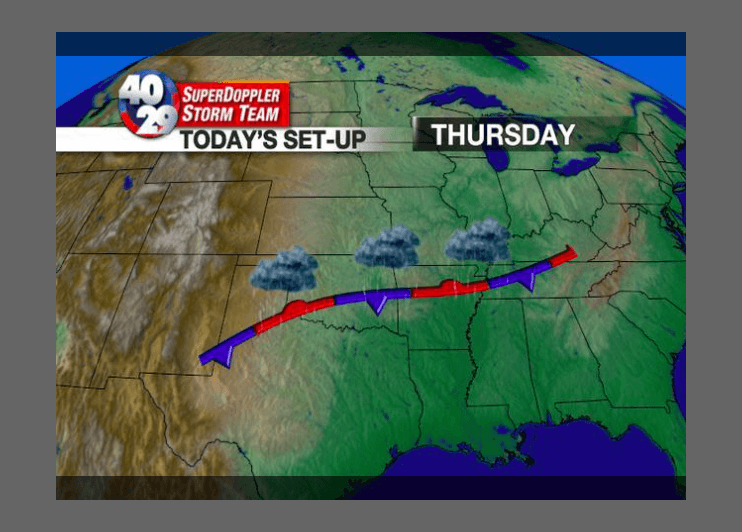
Name that symbol.

a)

Cold Front

b)

Warm Front

c)

Stationary Front

d)

Occluded Front

146.

Name that symbol.

a)

Cold Front

b)

Warm Front

c)

Stationary Front

d)

Occluded Front

147.

Name that symbol.

a)

Cold Front

b)

Warm Front

c)

Stationary Front

d)

Occluded Front

148.

Name that symbol.

a)

Cold Front

b)

Warm Front

c)

Stationary Front

d)

Occluded Front

149.

Brings some clouds and gentle rains.

a)

Cold Front

b)

Warm Front

c)

Stationary Front

d)

Occluded Front

150.

Cold dense air slides underneath warm air. The warm air is forced up, cools, and condenses.

a)

Cold Front

b)

Warm Front

c)

Stationary Front

d)

Occluded Front

151.

Neither air mass really takes over the other.

a)

Cold Front

b)

Warm Front

c)

Stationary Front

d)

Occluded Front

152.

A cold front pushes a warm front up and out of the way and then meets another cold front.

a)

Cold Front

b)

Warm Front

c)

Stationary Front

d)

Occluded Front

153.

Where do MARITIME air masses form?

a)

Over water

b)

Over land

154.

Where do CONTINENTAL air masses form?

a)

Over water

b)

Over land

155.

What is an air mass?

a)

large body of air that has about the same characteristics

b)

large body of air that has different characteristics

156.
How do we name air masses?
a)
Water and temperature
b)
Air pressure
c)
Humidity and temperature
d)
Cold and warm
157.
Which abbreviation of an air mass can be identified as dry and cold?
a)
cP
b)
mP
c)
cT
d)
mT
158.
Which abbreviation of an air mass can be identified as warm and moist?
a)
cP
b)
mP
c)
cT
d)
mT
159.
Which abbreviation of an air mass can be identified as cold and moist?
a)
cP
b)
mP
c)
cT
d)
mT
160.
Which abbreviation of an air mass can be identified as dry and hot?
a)
cP
b)
mP
c)
cT
d)
mT
161.
Which type of front is displayed?
a)
Cold
b)
Warm
c)
Stationary
d)
Occluded
162.

What type of weather does a high pressure system bring to an area?

a)

happy, sunny clear weather

b)

lousy, cold, rainy weather

c)

fog, lots of fog

d)

lightning

163.

What type of weather does a Low Pressure system bring?

a)

happy, sunny clear weather

b)

lousy, cold, rainy weather

c)

lightning

d)

rainbows and unicorns

164.

What is the name of the weather instrument that measures air pressure?

a)

Barometer

b)

Thermometer

c)

Psychrometer

d)

Anemometer

165.

clear, sunny skies

a)

high pressure

b)

low pressure

166.

stormy weather (clouds and precipitation)

a)

high pressure

b)

low pressure

167.
a)
Low Clouds
b)
Low Temperatures
c)
Light Wind
d)
Low Air Pressure
168.
a)
High Air Pressure
b)
High Temperatures
c)
Heavy Rain
d)
Hail
169.

A cold front is approaching Minneapolis. What will happen to the air temperature?

a)

stay the same

b)

increase

c)

decrease

170.
Choose the best forecast for Seattle on Saturday.
a)
rain
b)
sunny skies
c)
warmer temperatures
d)
snow
171.
Choose the best forecast for Chicago on Saturday.
a)
rain
b)
warmer temperatures
c)
snow
d)
sunny skies
172.
Choose the best forecast for Dallas on Saturday.
a)
thunderstorms
b)
snow
c)
warmer temperatures
d)
clear skies
173.
Choose the best forecast for Los Angeles on Saturday.
a)
cooler temperatures
b)
warmer temperatures 
c)
low pressure
d)
snow
174.

Air masses have properties from where they...

a)

were formed

b)

end up

175.

Where do MARITIME air masses form?

a)

Over water

b)

Over land

176.

Where do CONTINENTAL air masses form?

a)

Over water

b)

Over land

177.

Which type of air mass brings WARM and DRY weather?

a)

Maritime Polar (mP)

b)

Maritime Tropical (mT)

c)

Continental Polar (cP)

d)

Continental Tropical (cT)

178.

Which type of air mass brings WARM and WET weather?

a)

Maritime Polar (mP)

b)

Maritime Tropical (mT)

c)

Continental Polar (cP)

d)

Continental Tropical (cT)

179.

Which type of air mass bring COLD and WET weather?

a)

Maritime Polar (mP)

b)

Maritime Tropical (mT)

c)

Continental Polar (cP)

d)

Continental Tropical (cT)

180.

Which type of air mass bring COLD and DRY weather?

a)

Maritime Polar (mP)

b)

Maritime Tropical (mT)

c)

Continental Polar (cP)

d)

Continental Tropical (cT)

181.

An air mass is a portion of the atmosphere that has similar...

a)

Water and temperature

b)

Air pressure and wind speed

c)

Humidity and temperature

d)

Humidity and air pressure

182.

Which air mass would be classified as Maritime Polar (mP)?

a)

purple

b)

green

c)

blue

d)

yellow

e)

red

183.

Which air mass would be classified as Maritime Tropical (mT)?

a)

purple

b)

green

c)

blue

d)

yellow

e)

red

184.

Which air mass would be classified as Continental Tropical (cT)?

a)

purple

b)

green

c)

blue

d)

yellow

e)

red

185.

Which air mass would bring warm and wet weather?

a)

purple

b)

green

c)

blue

d)

yellow

e)

red

186.

Which air mass is higher in humidity?

a)

purple

b)

blue

187.

Which air mass is warmer?

a)

red

b)

yellow

188.

Which of the following is NOT a producer?

a)

Trees

b)

Flowers

c)

Spider

d)

Grass

189.

Which level of this food pyramid has the most energy?

a)

1

b)

2

c)

3

d)

4

190.

At which level of the energy pyramid would you find primary consumers?

a)

1

b)

2

c)

3

d)

4

191.

Herbivores only eat plants. What category will they always belong to?

a)

producers

b)

primary consumer

c)

secondary consumer

d)

tertiary consumer

192.

Which organism in the food chain pictured is the tertiary consumer?

a)

grass

b)

rat

c)

snake

d)

eagle

193.

What type of consumer is the lion?

a)

primary consumer

b)

secondary consumer

c)

tertiary consumer

194.

If the lion population goes up, what do you predict would happen to the wildcat population

a)

It will increase

b)

It will decrease

c)

It will stay the same

d)

Not enough information to answer

195.

If the lion population increases, what do you predict will happen to the population of rabbits? (Hint, think about how the lions will impact the wildcats first)

a)

It will increase

b)

It will decrease

c)

It will stay the same

d)

Not enough information

196.

Of the options below, which would have the MOST energy

a)

primary consumer

b)

secondary consumer

c)

producer

d)

consumer

197.

Where do producers get their energy from?

a)

The ground

b)

Other organisms

c)

Seeds

d)

The sun

198.
What is a producer?
a)
Organism that makes its own energy
b)
Organism that breaks down dead organisms
c)
Organism that eats other organisms for food & energy
199.
What is a decomposer?
a)
Organism that makes its own energy
b)
Organism that breaks down dead organisms
c)
Organism that eats other organisms for food & energy
200.
Which one are you?
a)
Producer
b)
Consumer
c)
Decomposer
201.
What are "trophic levels"?
a)
Levels in a food web/food chain
b)
Levels of land in a mountain
c)
Animal diets
202.
An animal that hunts other animals for food is a ___________
a)
herbivore
b)
predator
c)
prey
d)
omnivore
203.
Energy increases as you move up the food pyramid (from bottom to top).
a)
True 
b)
False
204.
An organism that needs to eat other organisms to obtain energy is known as a:
a)
Autotroph
b)
Producer
c)
Consumer
d)
Mutualist
205.

A diagram that shows the energy flow in an ecosystem is called a (a)   .

206.

A diagram that shows the different food chains in an ecosystem is called a (a)   .

207.
The arrows in a food chain or web represents what?
a)
They point to the organism that is being eaten.
b)
It shows how sunlight flows within an ecosystem.
c)
They show what direction the energy is flowing between organisms. 
d)
They represent how water is transferred within a habitat.