
 Worksheets
Science EOG review
Total questions: 60
Worksheet time: 3600secs
Name
Class
Date
1.
1. Which is a compound?
a)
lithium
b)
glucose
c)
oxygen
d)
air
2.
2. Which is classified as an element?
a)
gold
b)
carbon monoxide
c)
baking soda
d)
water
3.

3. This table provides information about some group 17 elements. Which is the best estimate of the boiling point of Iodine(I)?
a)
-90 °C
b)
15 °C
c)
185 °C
d)
410 °C
4.
4. Which best describes the sequence of the elements in Period 3 of the periodic table?
a)
highly reactive metals, transition metals, metalloids, reactive nonmetals, nonreactive gases
b)
highly reactive metals, metalloids, reactive nonmetals, nonreactive gases
c)
nonreactive gases, metalloids, nonreactive metals, highly reactive metals, highly reactive gases
d)
nonreactive gases, nonreactive metals, highly reactive metals, metalloids, reactive nonmetals, reactive gases
5.
5. Bromine has 7 valence electrons. With what group of elements will bromine most readily bond?
a)
group 1
b)
group 2
c)
group 16
d)
group 18
6.
6. Iron filings are weighed and left in a humid room for one year. They appear rusty and when weighed again it is found that they have become slightly heavier. Which best explains this observation?
a)
Some atoms in the air have combined with the iron, adding weight to the iron filings.
b)
Some new iron atoms were created.
c)
Some of the iron atoms became heavier.
d)
Some of the atoms during the reaction changed to a different kind of atoms.
7.
7. Which is the best example of a chemical change?
a)
ice melting
b)
bread toasting
c)
glass shattering
d)
dry ice sublimating
8.

8. The chemical reaction for the double displacement reaction of sodium carbonate with silver nitrate to yield sodium nitrate and silver carbonate is shown below. How does the reaction support the Law of Conservation of Mass?
a)
Two molecules of silver nitrate are created.
b)
The mass of sodium atoms is reduced during the reaction but the mass of silver atoms increases by the same amount to keep the total mass the same.
c)
The number of atoms in the reactants equals the number of atoms in the products.
d)
The mass of oxygen atoms is the only thing that remains the same before and after the reaction.
9.
9. Which statement is true about a chemical reaction?
a)
If the reactants are all liquids, the products must all be liquids.
b)
Some of the atoms in the reactants may be lost to the air in an open container and will not be part of the products.
c)
All of the atoms in the products can be found in the reactants.
d)
If there are two different reactants, there will always be two different products after a chemical reaction takes place.
10.
10. Which chemical equation best follows the Law of Conservation of Mass?
a)
a.
b)
b.
c)
c.
d)
d.
11.
11. Which best describes a method for using an energy resource that creates waste which must be isolated for tens of thousands of years?
a)
burning gasoline in a car
b)
burning wood in a fireplace
c)
installing solar panels on the roof of a business
d)
generating electricity in a nuclear power plant
12.
12. Which contributes the most to climate change?
a)
nuclear power plants
b)
coal-burning power plants
c)
solar thermal power plants
d)
wood-burning power plants
13.
13. Which is most likely a major concern associated with hydroelectric power plants?
a)
Hydroelectric power plants damage ecosystems and block fish breeding routes.
b)
Hydroelectric power plants contribute to climate change.
c)
Hydroelectric power plants heat up the water, causing oxygen levels to get very low, killing fish.
d)
Hydroelectric power plants produce large amounts of smog, which causes respiratory illnesses.
14.
14. Which is a renewable energy resource?
a)
natural gas
b)
uranium
c)
coal
d)
ethanol
15.

15. Which conclusion is best supported by these graphs?
a)
Coal use is increasing, especially in the production of electricity.
b)
Most of the petroleum that is used in this country is used to produce electricity.
c)
Compared to natural gas and coal usage, total petroleum use has stayed fairly constant.
d)
Natural gas is primarily used for transportation.
16.
16. Which of the following would be most likely to lead to increased conservation of nonrenewable energy resources by the public?
a)
lower gasoline prices
b)
government subsidies for the installation of solar panels
c)
expanded hydraulic fracturing of petroleum and natural gas
d)
elimination of government fuel economy standards for automobile manufacturers
17.
17. Which best explains why all of the Earth's water is not available for human consumption?
a)
Most of the Earth's water is polluted by nitrates and phosphates.
b)
Most of the Earth's water is trapped underground.
c)
Most of the Earth's water is frozen.
d)
Most of the Earth's water is salty.
18.
18. Where do most North Carolina cities get their drinking water?
a)
estuaries
b)
surface water sources, such as lakes, rivers, and streams
c)
groundwater sources or aquifers deep underground
d)
ocean water desalination
19.
19. How can the atmosphere be considered part of the hydrosphere?
a)
It contains water vapor.
b)
It allows sunlight to pass through, allowing the water cycle to continue.
c)
It contains the oxygen necessary for life on Earth.
d)
It traps pollutants that would otherwise harm the Earth.
20.
20. Which of the following is true of hydrothermal vents?
a)
Hydrothermal vents are found in the ocean's deepest trenches.
b)
Hydrothermal vents are often found above rich deposits of petroleum.
c)
Hydrothermal vents are blamed for most of the climate change experienced on the Earth in the past 150 years.
d)
They are often surrounded by organisms in a food web that relies on chemosynthesis for its food source.
21.
21. Which of the following statements are usually true of surface ocean currents.
a)
They are driven by wind and transport cold water.
b)
They are driven by wind and transport warm water.
c)
They are driven by gravity and transport cold water.
d)
They are driven by gravity and transport warm water.
22.
22. Which of the following factors is the LEAST important when determining the health of a lake used as a source of freshwater?
a)
pH
b)
presence of bioindicators
c)
depth
d)
nitrate levels
23.
23. Which of the following most increases the risk of algal blooms in freshwater sources?
a)
enforcement of pollution standards
b)
overfishing of lakes
c)
petroleum spilled into a river
d)
overuse of fertilizer on crops
24.
24. Septic tanks are most often used by...
a)
rural homes.
b)
large cities.
c)
schools.
d)
businesses.
25.
25. Scientist find a dinosaur fossil in an undisturbed rock layer. What could help the scientist determine the approximate age of the fossil?
a)
the age of the trees living closest to the fossil discovery
b)
the length of the longest bone in the dinosaur fossil
c)
the pH of the soil found above the fossil
d)
index fossils found in the same rock layer as the dinosaur fossil
26.
26. A scientist finds the bones of an unknown reptile in a layer of sedimentary rocks below a layer of volcanic rock which has an absolute age of 45 million years. What is the most likely conclusion that the scientist can draw?
a)
The reptile lived less than 45 million years ago.
b)
The reptile lived 45 million years ago.
c)
The reptile lived more than 45 million years ago.
d)
The reptile died from the eruption of a volcano.
27.
27. The Law of Superposition is most useful for...
a)
determining the half-life of a radioactive isotope.
b)
determining the relative age of undisturbed rock layers.
c)
determining the absolute age of volcanic ash.
d)
identifying index fossils.
28.

28. The diagram below shows a cross section of a cliff. Which of the following rock units is the youngest?
a)
igneous unit
b)
sandstone unit
c)
shale unit
d)
limestone unit
29.
29. A scientist analyzes a sample of granite and finds that is contains small amounts of Uranium-238 and Lead-206. She is able to measure the quantities of these two isotopes present in the rock and determine...
a)
the composition of the atmosphere when the rock formed.
b)
the Law of Superposition.
c)
the absolute age of the rock.
d)
the half-life of Uranium-238.
30.
30. Which best describes a finding that scientists have discovered by studying ice cores?
a)
The dinosaurs are extinct because of a meteorite that hit the earth about 65 million years ago.
b)
The levels of carbon dioxide in the atmosphere were higher during the ice ages than they are currently.
c)
The levels of carbon dioxide in the atmosphere were higher during the time of the dinosaurs than they are today.
d)
The levels of carbon dioxide currently in the atmosphere are higher than any time in the past 500,000 years.
31.
31. Paleontologists have discovered fossil remains of Cynognathus, a land reptile in both South America and Africa. The fossils are believed to be approximately 250 million years old. What conclusion can be drawn from these discoveries?
a)
Cynognathus adapted to marine life and was able to swim across the Atlantic Ocean.
b)
Cynognathus evolved separately on the two continents.
c)
Both South America and Africa were below sea level 250 million years ago.
d)
South America and Africa were connected to each other and moved to their current location over millions of years.
32.
32. What is the main way that COVID-19 spreads through a community?
a)
contact with an infected animal
b)
respiratory droplets breathed out by an infected person
c)
eating contaminated food
d)
contact with a contaminated surface
33.
33. How is malaria spread through a community?
a)
inhalation of contaminated respiratory droplets
b)
contact with an infected person
c)
contact with a contaminated object
d)
contact with an infected animal
34.
34. What is an important way for you to avoid contracting ringworm?
a)
get the ringworm vaccine
b)
wash fruits and vegetables before eating them
c)
keep your skin clean and dry
d)
wear a cloth mask over your nose and mouth
35.
35. A doctor diagnoses a patient with the flu. Is the doctor likely to prescribe an antibiotic for the patient?
a)
Yes, since antibiotics are often prescribed for viral infections such as the flu.
b)
Yes, since antibiotics are often prescribed for bacterial infections such as the flu.
c)
No, since antibiotics are ineffective for treating viral infections such as the flu.
d)
No, since antibiotics are ineffective for treating bacterial infections such as flu.
36.
36. Ebola is a very rare, viral hemorrhagic fever of humans and other primates. Between December 2013 to January 2016, over 28,000 cases and 11,000 deaths were reported. Nearly all of the cases were confined to five countries in West Africa. During that time, the disease spread would probably best be defined as...
a)
an epidemic.
b)
an outbreak.
c)
a blight.
d)
a pandemic.
37.
37. Which of the following is an example of gene therapy?
a)
A patient given a vaccine to prevent influenza.
b)
A diabetic patient is given an injection of insulin that had been produced by bacteria that had been genetically altered.
c)
A drug is injected into a cancer patient, introducing a new gene into the patient’s own white blood cells that enables them to find and kill cancer cells.
d)
A patient is fed genetically modified rice which has been genetically modified to provide vitamin A to counter blindness and other diseases.
38.
38. How has biotechnology helped reduce the spread of disease?
a)
by creating crops that resist certain insects.
b)
by developing male Aedes aegypti mosquitoes that carry a “self-limiting” gene that prevents their offspring from surviving to adulthood.
c)
by developing N-95 masks.
d)
by creating hand sanitizer that kills >99% of all bacteria.
39.
39. A seed company has developed a rice variety by inserting a gene into standard rice strains. What possible advantage might the new rice plants have?
a)
resistance to pests
b)
increased nutritional value
c)
increased crop production
d)
all of the above
40.
40. In some environments, bats prey on mosquitoes. If all of the bats are removed from the environment, what would be the most likely result in the mosquito population?
a)
The mosquito population would decrease due to an increase in disease.
b)
The mosquito population would increase due to the presence of fewer predators.
c)
The mosquito population would decrease due to a shortage of food.
d)
The mosquitoes would have to adapt to new predators.
41.
41. Which of the following are considered abiotic factors in an ecosystem?
a)
bacteria
b)
oxygen
c)
insects
d)
water
e)
sunlight
42.
42. A population of barn owls lives in a marsh ecosystem. These owls prey mostly on a large population of mice. Recently, numbers of pythons, an invasive species, have increased dramatically in the area. The pythons also feed on mice. If the number of pythons continues to increase, which of these is most likely to happen to the owl population over time?
a)
It will decrease in size due to competition with the pythons.
b)
It will increase in size due to cooperation from the pythons.
c)
It will decrease in size due to climate change.
d)
It will increase in size due to the availability of a new food source.
43.
43. Tapeworms live inside a host organism and absorb nutrients from the host's digestive system. The host is unable to use these nutrients and must ingest more nutrients than normal. This is an example of what kind of relationship?
a)
competition
b)
commensalism
c)
predator-prey
d)
parasitism
44.
44. Rhizobium bacteria live in nodules on the roots of legumes such as peanuts and beans. They fix nitrogen for the plant and the plant provides the bacteria with carbohydrates for food. What type of relationship does this represent?
a)
Parasitism
b)
Cooperation
c)
Mutualism
d)
Commensalism
45.
45. Two different species of finches live together on the Galapagos Islands. One species has a small beak and eats small seeds. The other has a large beak and eats large seeds. They do not consume each other's food sources. What type of relationship exists between the finch species?
a)
Competition
b)
Cooperation
c)
Predator/Prey
d)
Coexistence
46.
46. On average, consumers at each trophic level convert on average only about 10% of the chemical energy in their food to their own tissue. What happens to the rest of the energy?
a)
It is used by the consumer or is lost as heat.
b)
It is left as waste and is not eaten.
c)
It is destroyed when the consumer eats the food.
d)
It is stored as food for consumers in the next higher trophic level.
47.
47. Which has had the largest effect on carbon dioxide levels in the atmosphere over the past 100 years?
a)
increased use of biomass
b)
increased use of fossil fuels
c)
increased use of nitrogen-rich fertilizers
d)
increased numbers of livestock in captivity
48.
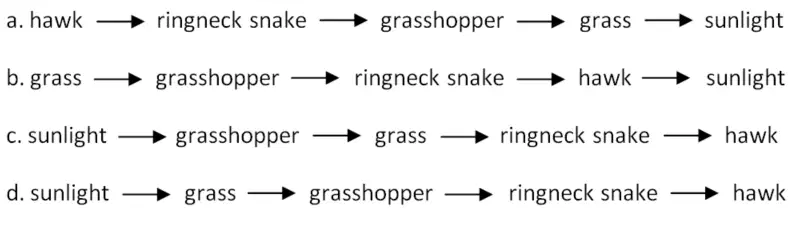
48. Which best represents the flow of energy within a terrestrial ecosystem?
a)
a.
b)
b.
c)
c.
d)
d.
49.
49. The fossil record shows that life on Earth has changed over time. For example, the oldest fossils (i.e. more than 3 billion years old) that have been found are...
a)
more complex than any alive today.
b)
only simple organisms.
c)
only preserved in igneous rocks.
d)
larger than any organisms that are alive today.
50.
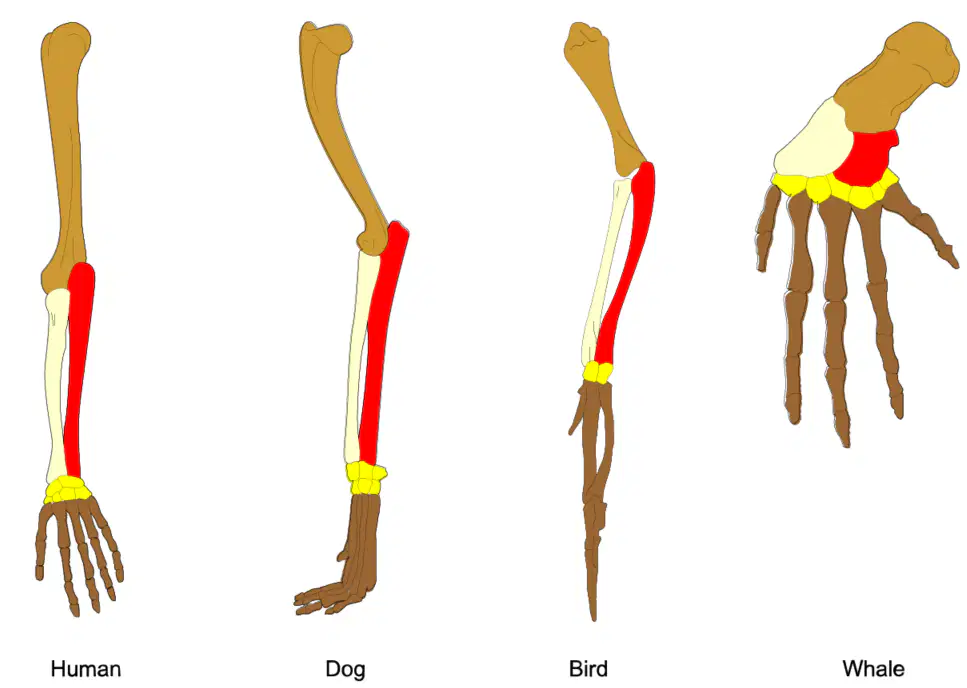
50. The picture below shows the forelimbs of four different organisms. Similar bones are highlighted in the same colors. What do these similarities suggest? Drawing by Волков Владислав Петрович - Own work, CC BY-SA 4.0, https://commons.wikimedia.org/w/index.php?curid=37704829
a)
The limb structures evolved independently from each other and this shows that there is an ideal arrangement of forelimb bones.
b)
Humans, dogs, birds, and whales share a common ancestor.
c)
Dogs and whales share a common ancestor but not with birds.
d)
The common ancestor of dogs and birds was a whale.
51.

51. Praying mantis legs and cat legs are useful for walking and climbing while whale flippers and water boatman flippers are both useful for swimming. Similar bones are highlighted in the same colors. Using the picture below, what is the most logical conclusion? Drawing by Vanessablakegraham, CC BY-SA 4.0 , via Wikimedia Commons
a)
Cats and whales are closely related since they share similar anatomies.
b)
Whales evolved from water boatmen.
c)
The common ancestor of cats and whales was an insect.
d)
Cats and preying mantises are closely related since their legs have similar functions.
52.
52. Madagascar is a large island which lies about 400 km off the southeast coast of Africa. Approximately 90% of all plant and animal species in Madagascar are found nowhere else on earth. How do plate tectonics and evolution explain the unique species found in Madagascar?
a)
Madagascar was never connected to other lithospheric plates and its species evolved completely on their own.
b)
Madagascar was connected by a land bridge during the last ice age, about 15,000 years ago and its species have evolved since then.
c)
Madagascar has moved away from Africa over millions of years and its species have evolved separately from those found in Africa.
d)
The species that are now found only in Madagascar could not survive in Africa once the two lithospheric plates drifted apart.
53.
53. A rabbit is born with the ability to hear predators better than the other rabbits in its population can. As a result, this rabbit has a few extra seconds of warning every time coyotes or other predators approach. This trait may be selected by natural selection because it increases the rabbit's __________________.
a)
ability or find a mate.
b)
ability to survive.
c)
ability to find food.
d)
feeling of safety.
54.
54. In order for natural selection to occur in a population, what must be true?
a)
One population must become extinct so that another can take its place.
b)
All members of a population must have a new trait that is beneficial.
c)
There must be a change in the environment which forces the population to change.
d)
Organisms within the population must have some genetic variation.
55.
55. A new antibiotic has been developed which appears to be an effective treatment against strep throat, a contagious bacterial infection. The first year that it's used in patients it cures over 99% of cases. During the second year, it cures 97% of cases. Each year, the antibiotic becomes less effective and by the tenth year, doctors stop prescribing it for patients because it is usually not effective. Why did the antibiotic become less effective over time?
a)
Over time, the bacteria became less resistant to the antibiotic.
b)
Bacteria that were naturally resistant to the antibiotic lived and reproduced.
c)
Doctors started prescribing it for other diseases besides strep throat.
d)
The antibiotic evolved and became less effective over time.
56.
56. Kudzu is an invasive plant which has spread across much of the Southeastern United States during the past 100 years. The vine climbs on trees and grows so rapidly that it smothers and kills the trees by heavily blocking sunlight. If some members of a beetle population are able to eat kudzu, what might you expect to happen over many generations?
a)
Trees will grow taller to be able to reach sunlight.
b)
Kudzu will evolve so that it no longer kills trees.
c)
The beetles that are able to eat kudzu will have a biological advantage and will increase in numbers.
d)
New species will evolve to control the kudzu.
57.
57. Which of the following statements concerning cellular respiration is true?
a)
Animals use cellular respiration but plants do not.
b)
Plants use cellular respiration but animals do not.
c)
Both plants and animals use cellular respiration.
d)
Neither plants nor animals use cellular respiration since it is only used by single celled organisms.
58.
58. Cells obtain the energy they need to function and the chemicals they need to grow and divide from ____________.
a)
water
b)
sunlight
c)
air
d)
food
59.
59. Person 1 and person 2 are the same weight, age, and sex. However, person 1 takes in 300 more calories of food per day compared to person 2. If they continue to keep the same weight as each other, what is the most likely explanation?
a)
Person 1 is more active than person 2.
b)
Person 2 is more active than person 1.
c)
Person 1 has longer hair than person 2.
d)
Person 1 and person 2 are identical twins.
60.

60. What food might you find labeled with this nutrition label?
a)
potato chips
b)
honey
c)
peanuts
d)
milk
100 %

