
 Worksheets
Unit 7 AP Bio
Total questions: 72
Worksheet time: 42mins
Who is the "father of evolution"?
Aristotle
Darwin
Lamarck
Mendel
Which of the following evolves?
Individuals
Populations
Peppered moths became darker during the industrial revolution due to the trees becoming darker. What type of selection describes the peppered moth population?
Directional
Disruptive
Sexual
Stabilizing
Birth weight averages between 6 to 8 pounds. Which type of selection describes birth weight of humans?
Directional
Disruptive
Sexual
Stabilizing
Drought causes an absence of food for medium beaked birds. Which type of selection describes the bird population?
Directional
Disruptive
Sexual
Stabilizing
What is natural selection?
Organisms with less favorable traits are more likely to live
Organisms with more favorable traits are more likely to live
Nature selects for the less favorable traits
Nature selects against the most favorable traits
Evolution produces perfect organisms
True
False
Which level does natural selection act on?
Individual Genotype
Individual Phenotype
Population Genotype
Population Phenotype
What level does natural selection select?
Individual Genotype
Individual Phenotype
Population Genotype
Population Phenotype
What level does natural selection cause change?
Individual Genotype
Individual Phenotype
Population Genotype
Population Phenotype
An individual evolves to better match its environment.
True
False
What is a phenotype?
Genes
Physical Characteristics
What does natural selection MODIFY?
Genotype
Phenotype
What does natural selection act on?
Act on means that is selected for or against.
Genotype
Phenotype
Convergent evolution is due to common ancestry
True
False
How is artificial selection different than natural selection?
Artificial picks best traits for past events
Artificial picks best traits for future events
Artificial picks traits based on humans' interests
Artificial picks traits based on predator/prey interests
Peppered moths are an example of artificial selection
True
False
If a dog breeder only mates dalmatians with perfect spots, what type of selection is this?
Artificial
Natural
Convergent evolution
Different structures, common ancestor
Different structures, different ancestor
Similar structure, common ancestor
Similar structure, different ancestor
Which population is better able to overcome genetic drift (as in, which one will have less of an effect on the allele frequency)?
Small
Large
Bottleneck is an example of natural selection
True
False
Genetic drift. . .
Frequency changes due to natural selection
Immigration into/emigration out of occur in a population
Random events cause the change in the gene frequency
Slight movement of alleles from transposition
What is the bottleneck effect?
Decrease in population size due to natural disaster
Increase in desirable alleles and decrease in undesirable
Natural selection decreases population size to fix allele
Small group of individuals separated from the rest of the population
In the founder effect, the new population is
not representative of the original population
representative of the original population
What is gene flow?
Alleles found in a population
Immigration/emigration
Natural frequency changes in a population
Random changes in allele frequencies due to nature
An increase in mutations
Decreases genetic variation
No effect on genetic variation
Increases genetic variation
For Hardy-Weinberg, the population size should be
Small
Large
Should there be gene flow in Hardy-Weinberg equilibrium?
Yes
No
Should there be mutations in Hardy-Weinberg equilibrium?
Yes
No
What type of mating should occur in Hardy-Weinberg equilibrium?
Random
Nonrandom
Dominant allele frequency
p
q
p^2
q^2
Homozygous recessive
p
q
p^2
q^2
What does it mean if the population remains in Hardy-Weinberg equilibrium?
Population is not evolving
Population is genetically diverse
Population is undergoing gradual equilibrium
Population is undergoing punctuated equilibrium
What is allele frequency?
The number of different alleles possible in a population
The number of individuals with each allele
The percent of individuals in the population with a trait
The percent of the allele in a population
The frequency of the recessive allele
p
q
p^2
q^2
What is genotype frequency?
The number of individuals with each genotype
The number of individuals with each phenotype
The percentage of individuals with each genotype
The percentage of individuals with each phenotype
How do you know the population is in equilibrium?
p = q
p^2 = q^2
p + p^2 = q + q^2
Frequencies remain the same between each generation
Which of these structures demonstrates common ancestry?
Analogous structure
Convergent structure
Homologous structure
Nucleotide structure
Vestigial structures show common ancestry
True
False
Which type of molecular data is more accurate?
Amino acid sequences
Nucleotide sequences
Why is DNA more accurate for determining relationships than proteins?
4 nucleotides make up DNA
20 amino acids make up protein
Introns are removed from mRNA before making proteins
Silent mutations change DNA without change in protein
When comparing protein sequences. . .
Two organisms with the greatest differences are more closely related
Two organisms with the least differences are more closely related
Homologous structures
Show common descent
Show a convergent event
Are structures that are similar due to similar environments
Are structures that are different due to similar environments
Analogous structures
Show common descent
Show convergent evolution
Shares an ancestral trait
Shares the same body structure

Sugar glider vs Flying squirrel
Analogous structure
Embryological structure
Homologous structure
Vestigial structure
Convergent evolution shows common ancestry
True
False
Eukaryotic DNA is:
Circular with multiple chromosomes
Linear with multiple chromosomes
Circular with a single chromosome
Linear with a single chromosome
All eukaryotic cells have
Mitochondria
Chloroplast
Why are eukaryotic cells able to be bigger than prokaryotic cells?
Compartmentalization due to membrane bound organelles
Eukaryotes are more robust to scare the prokaryote away
Endosymbiotic theory required a larger cell
Why can eukaryotic DNA store more information than prokaryotic DNA in the same amount?
Eukaryotes have introns and no mRNA processing
Eukaryotes have introns and mRNA processing
Prokaryotes have introns and no mRNA processing
Prokaryotes have no introns and mRNA processing
What is an intron?
Coding segment of DNA
Coding segment of mRNA
Noncoding segment of DNA
Noncoding segment of mRNA
Which are removed during mRNA splicing?
Exons
Introns
Phylogenetic trees and cladograms both show lineage
True
False
What does a node represent?
A divergent event leading to two related lineages
A convergent event leading to two unrelated lineages
A divergent event leading to two unrelated lineages
A convergent even leading to two related lineages

Which two are most closely related?
Human and Gorilla
Human and Orangutan
Human and Gibbon
Human and Chimpanzee

Which organism would be at position D on the cladogram?
Human
Gorilla
Orangutan
Chimpanzee
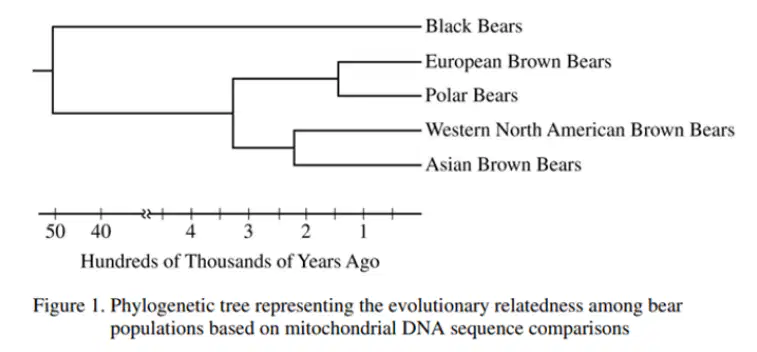
How many hundreds of thousands of years ago was the common ancestor of brown bears?
2
3
4
5
At which position would you find the outgroup?
A
B
C
D
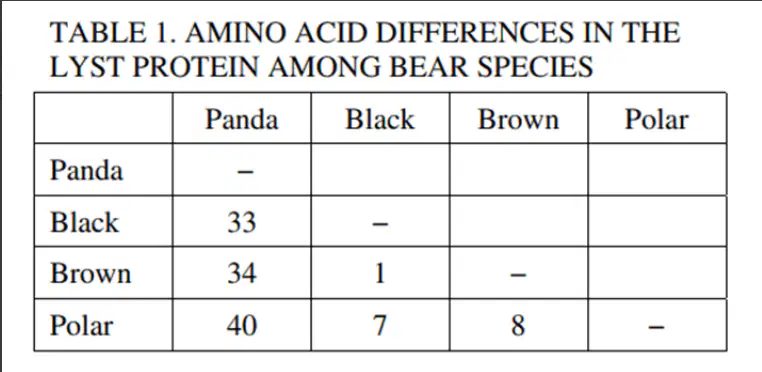
Which organism would be the outgroup?
Black
Brown
Panda
Polar
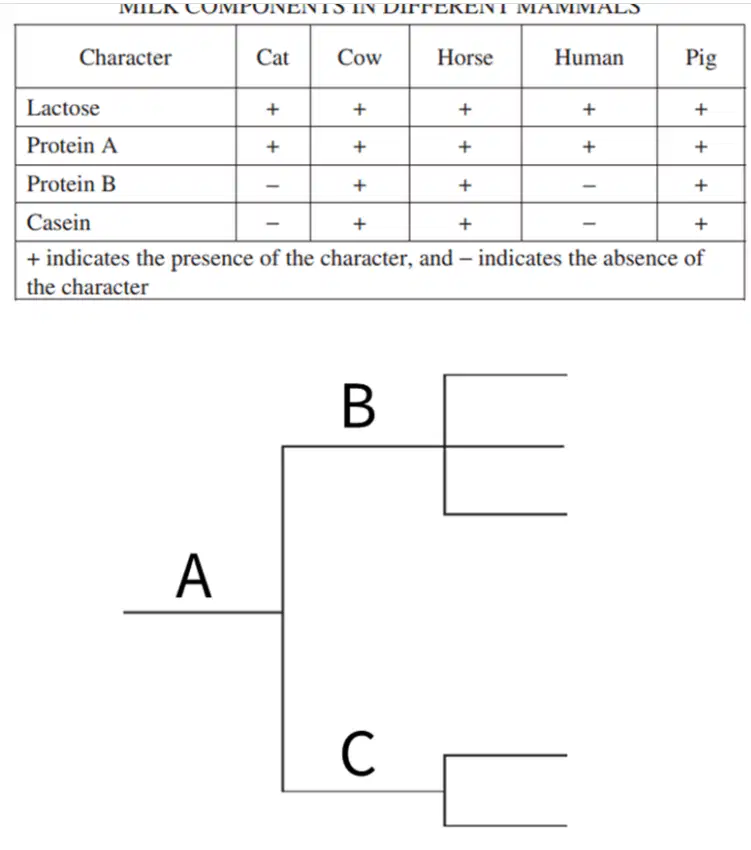
At what position were the lactose and protein A traits gained?
A
B
C

At what position might the protein B trait have been gained?
A
B
C
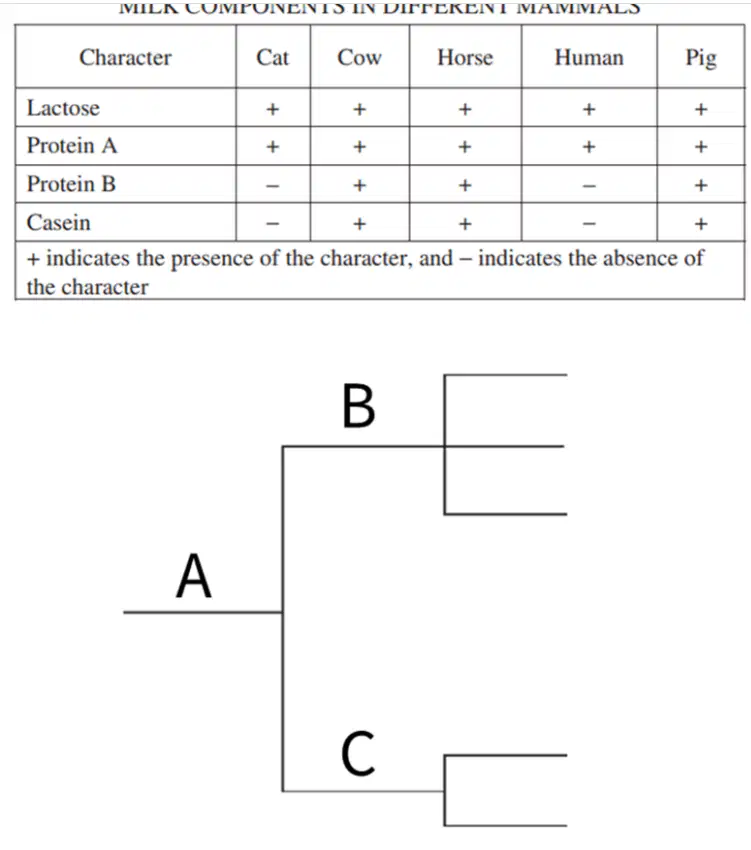
If casein was gained at position A, when was it lost?
A
B
C
What type of data is most effective to develop a tree?
Biogeography
Ecological
Fossil
Molecular
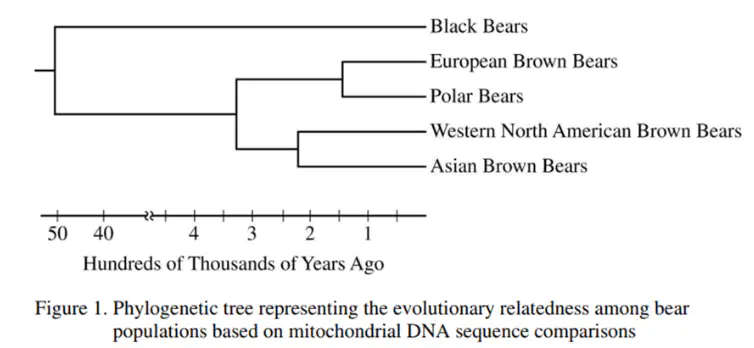
Which is the outgroup?
Asian Brown Bear
Black Bear
European Brown Bear
Polar Bear

What is most closely related to the polar bear?
Asian Brown Bear
Black Bear
European Brown Bear
Western North American Brown Bear
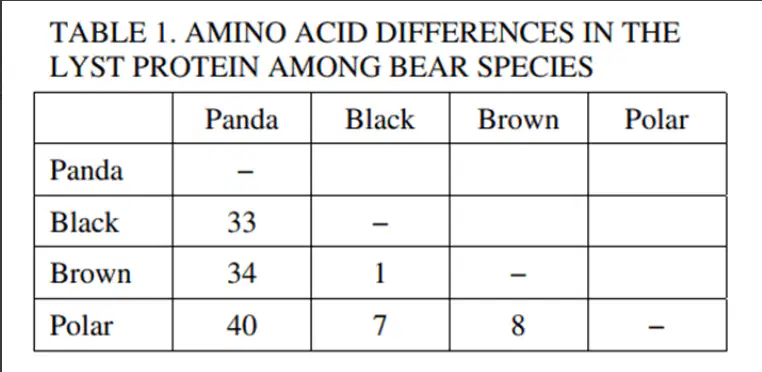
Which two are closely related?
Panda and Black
Black and Brown
Brown and Polar
Polar and Panda
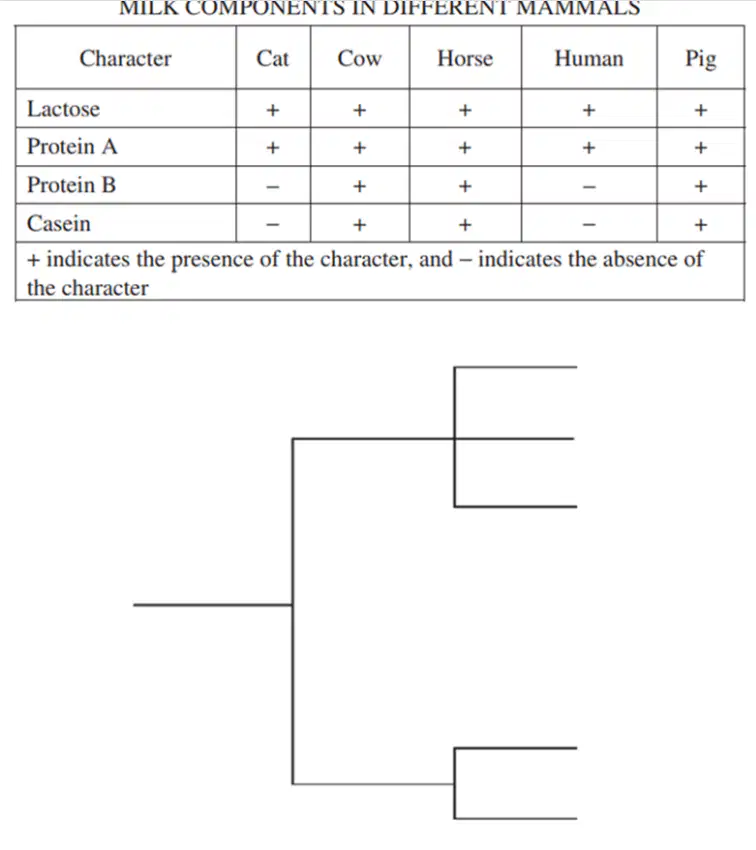
Which two organisms would be grouped together on the branch with two placements?
Cat and Cow
Cow and Horse
Horse and Human
Human and Cat
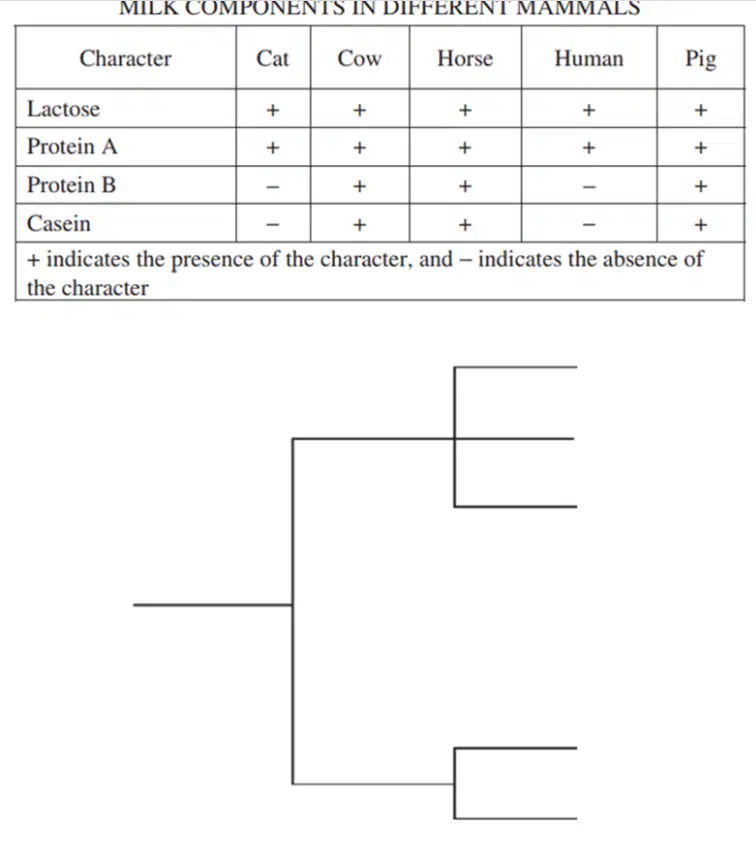
Which three organisms would be grouped together on the branch with three placements?
Cat
Cow
Horse
Human
Pig
To withstand selective pressures, populations need
low genetic diversity
high genetic diversity
Which could cause harmful allele to become fixed?
Bottleneck effect
Founder effect
Gene Flow
Natural Selection
An advantageous trait will always be advantageous
True
False
What increases genetic variation?
Crossing Over
Independent Assortment
Mutations
Random Fertilization

