
 Worksheets
Unit 12 Review
Total questions: 45
Worksheet time: 30mins
What are the three currently recognized domains?
Archaeabacteria, Bacteria, and Eubacteria
Archaea, Bacteria, and Eukarya
Plantae, Protista, and Bacteria
Plantae, Animalia, and Fungi
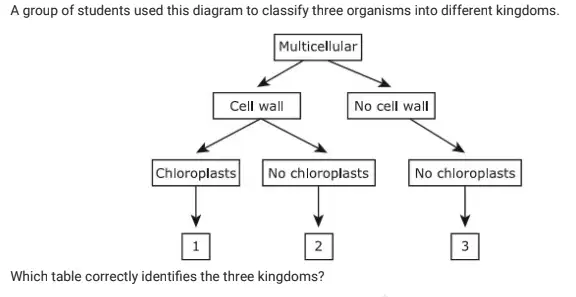
Students observe an unknown species during a field study. They observe that the organism is multicellular, is autotrophic, and can reproduce both sexually and asexually.
Which kingdom does this organism most likely belong to?
Plantae
Bacteria
Animalia
Archaea
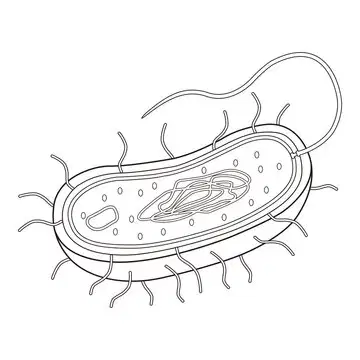
The drawing below was sketched by a student who was observing cells under a microscope.
This cell is classified as
eukaryotic
meiotic
nucleotic
prokaryotic
All living things are divided into one of three —
classes
phyla
domains
kingdoms

The characteristics of a particular organism are listed below.
In which kingdom should this organism be classified?
Animalia
Plantae
Eubacteria
Fungi
Which group is the broadest group in the modern classification system of living organisms?
Phylum
Domain
Class
Kingdom
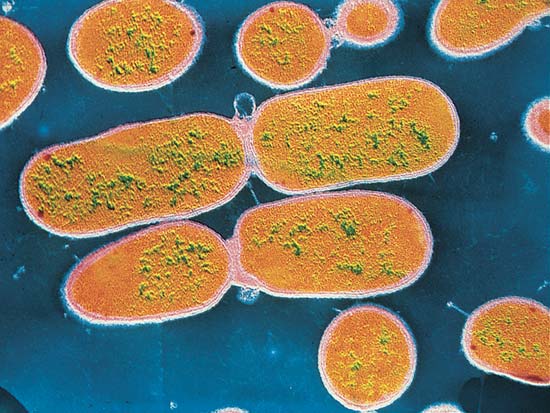
The picture shows one type of cell.
The presence of which cell structure will determine whether this cell is a prokaryote or eukaryote?
DNA
Chloroplast
Nucleus
Cell wall
Which list of characteristics describes organisms classified as animals?
Multicellular, eukaryotic, heterotrophic
Unicellular, prokaryotic, autotrophic
Unicellular, eukaryotic, heterotrophic
Multicellular, eukaryotic, autotrophic


In which domain are humans classified?
Fungi
Bacteria
Eukarya
Archaea
What do a mushroom, an amoeba, and a 6th grader have in common?
They all belong to the Animal Kingdom.
They are all composed of one or more cells.
They are composed solely of gases and liquids.
They are all classified as invertebrates.

Analyze the image of the cell below.
Complete the statement about the cell by moving the answers to the correct boxes.
The cell pictured is a ______ becasue it ______ .
Scientific names are always written in ___________ or ______________ so that they can be understood in any language.
English
Latin
Spanish
Greek

The smallest part of this chart represents a:
Species
Genus
Class
Order
Dr. McDonald walks out into the courtyard and sees a multicellular organism that can move about freely, and is clearly heterotrophic as it is moving towards the cafeteria to eat lunch. Which kingdom must this organism belong?
Kingdom Plantae
Kingdom Animalia
Kingdom Homospaien
Kingdom Protista

The scientific name for an organism is made from the:
class and family name
genus and species name
domain and kingdom name
kingdom and phylum name

The diagram shows taxonomic groups and a major distinguishing characteristic of all but two of them. Which characteristics will be used to complete the chart?
nonphotosynthetic - photosynthetic
autotrophic - heterotrophic
no nucleus - nucleus
motile - nonmotile

_______________ was the first scientist to say that only 2 names were needed to classify organisms.
Linnaeus
Newton
Aristotle
Carolus


According to the branching dichotomous key given, the next step for a chocolate candy with no nuts should be
a. The candy is round
b. The candy is rectangular
a. The candy is caramel
b. The candy is not caramel
a. The candy is square
b. The candy is long and skinny
a. The candy is with nuts
b. The candy is without nuts
Jamal is doing an observational study. He sees and organism that is multicellular, can't move and is autotrophic. Where should he classify this organism?
Kingdom Plantae
Kingdom Animalia
Kingdom Protista
Kingdom Fungi
The discovery of the cell was made possible by the invention of the microscope. In
1665, Robert Hooke first discovered and named the cell as he was observing dead
plant cell walls of cork under a microscope. Over the next century Matthias
Schleiden, Theodor Schwann, and Rudolph Virchow contributed to this work.
Eventually, in 1839, the cell theory was formulated. It states that living organisms
are composed of one or more cells, the cell is the basic unit of structure and
organization in organisms, and cells arise from pre-existing cells.
Only plants and animals are made of cells.
Only animals are made of cells.
All organisms are made of cells.
Only Eukarya are made of cells.
What do a mushroom, an amoeba, and a 6th grader have in common?
They all belong to the Animal Kingdom.
They are all composed of one or more cells.
They are composed solely of gases and liquids.
They are all classified as invertebrates.

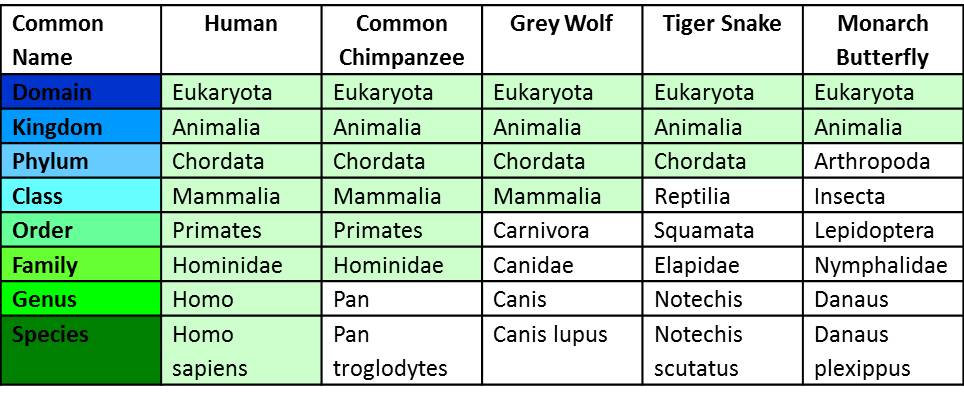
Use the table to determine the scientific name of a rattlesnake written in the correct scientific format.
Crotalus Viridis
Crotalus Viridis
Crotalus viridis
Crotalus viridis
Viperidae viridis
Which of these big cats are most closely related to each other?
A. Lions (Panthera leo)
B. Cheetahs (Acinonyx jubatus)
C. Snow leopards (Panthera uncia)
D. Puma (Puma concolor)
Lions and Cheetahs
Snow leopards and Pumas
Lions and Snow leopards
Cheetahs and Pumas
Which of the following is NOT one of the six kingdoms?
Animal
Human
Plant
Fungus
Which of the following characteristics is NOT one of the seven characteristics required to be present in all living beings?
Take and use energy
The ability to maintain homeostasis
Have a heart
Composed of one or more cells
What is the genus name here:
Canis lupus
Canis
lupus
Name them:

Heterotrophs- obtain food from other animals.
Observing the table above, Fungi and Animals are________?

What is the order of the taxonomic levels from least specific to most specific?
Kingdom, Family, Species, Order, Class, Phylum, Genus
Kingdom, Phylum, Class, Order, Family, Genus, Species
Species, Order, Kingdom, Family, Genus, Phylum, Class
Species, Genus, Family, Order, Class, Phylum, Kingdom

Which of the following is the correct order for least related to most related?
Domain
Kingdom
Phylum
Class
Order
Family
Genus
Species
Species
Kingdom
Phylum
Class
Order
Family
Genus
Domain
Species
Genus
Family
Order
Class
Phylum
Kingdom
Domain
Domain
Kingdom
Class
Phylum
Order
Genus
Family
Species

Based on the dichotomous key, which bird is Certhidea? (Slender = thin; stout= round)
Bird W
Bird X
Bird Y
Bird Z

Which organisms are most closely related?
A and B
B and C
C and A
not enough info given

Using a light microscope, a student identified the following characteristics of 4 organisms found in a sample of pond water. (look at the picture) Based on the table, which organisms most likely belong to the taxonomic group for bacteria?
organisms 1 and 2
organisms 2 and 3
organisms 1 and 4
organisms 3 and 4


Question #2
F
G
H
J

