
 Worksheets
Unit 3 and 4 Practice
Total questions: 115
Worksheet time: 6hrs 45mins
y = -2x2 + 4x + 3
f(x) = 2(x - 5)2 + 12
f(x) = x2 - 8x + 15.
y = 3x2 - 6x + 4
f(x) = -x2 - 4x + 12.


f(x) = 2(x - 5)2 + 12
f(x) = -2x2 + 4x - 6
What is the standard form formula?
y=mx+b
y=ax2+bx+c
y=a(x-h)2+k
What is the vertex form formula?
y=ax2+bx+c
y=mx+b
y=a(x-h)2+k

Is the graph shown above a max or min?
Maximum
Minimum

What is the domain of the graph shown above.
x=19
all real numbers
y=3
Maximum

What are the zeros of the graph shown above?
2 and 6
4 and 2
6 and 9
5 and 1
What is a axis of symmetry?
all real numbers
y=5
the line that divides the graph in equal halves
y=mx+b

Is the graph shown above a max or min?
Minimum
Maximum

What is the y-intercept of the graph shown above?
all real numbers
(0,6)
(0,2)
(0,-6)

What is the vertex of the graph shown above?
(7,6)
(-1,2)
(2,-1)
(5,0)
Graph the following equation:
y=x2-2x-3


What does the h term tell you?
left or right
left or right, opposite sign, axis of symmetry, x-value of the vertex.
axis of symmetry, x-value of the vertex
nothing.
What does the k term tell you?
up.
down.
up/down, y-value in the vertex
nothing
Describe the transformations below: (x+1)2−4
left: 1, up: 4
left: 1, down: 4
right: 1, up: 4
right: 4, up: 1
Describe the transformation below: −(x+3)2+6
reflect over the x-axis
reflect over the x-axis, left: 3, up: 6
stretch, left: 3, down: 6
left: 3, down: 6
Describe the transformation below: −3(x+4)2−1
stretch by 3, right: 4, down: 1
reflect over the x-axis, right: 4, down: 1
reflect over the x-axis, stretch by 3, left: 4, down: 1
stretch by 4, down: 3, left: 1
Identify the a, h, and k term from the following equation: (x+3)2+2
a=-1, h=3, k=2
a=3, h=3, k=3
a=1, h=-3, k=2
a=1, h=-3, k=-2
Identify the a, h, and k terms in the following equation: 2(x+4)2−1
a=2, h=-4, k=-1
a=-2, h=4, k=1
a=2, h=4, k=1
a=-2, h=-4, k=1
Identify the a, h, and k terms in the following equation: (x+4)2−3
a=-1, h=4, k=3
a=-1, h=-4, k=3
a=1, h=4, k=3
a=1, h=-4, k=-3
Determine the vertex from the following equation: −3(x−4)2+1
Vertex: (4,1)
Vertex: (-4, -1)
Vertex: (4, -1)
Vertex: (-4, 1)
Determine the vertex from the following equation: −(x+1)2−1
Vertex: (1,-1)
Vertex: (-1, 1)
Vertex: (-1, -1)
Vertex: (1, 1)
Determine the vertex from the following equation: 21(x+4)2+1
Vertex: (-4, 1)
Vertex: (-4, -1)
Vertex: (4, 1)
Vertex: (4, -1)
Determine the axis of symmetry from the following equation: −(x−2)2+4
A. O. S: 2
A. O. S: 4
A. O. S: -2
A. O. S: -1
Determine the axis of symmetry of the following equation: −2(x+2)2+3
A. O. S: 3
A. O. S: -2
A. O. S: 2
A. O. S: 1
Determine if the parabola has a maximum or minimum, if it opens up (+) then it will have a minimum, if it opens down (-) then it will have a maximum. 3(x+3)2−2
Maximum
Minimum
Determine if the following equation has a maximum or minimum: −(x−2)2+7
Maximum
Minimum
Determine if the following function will be narrow (stretch) or wider (shrink): 4(x−3)2+4
Narrow
Wider
Determine if the following is narrow or wider: 32(x+3)2+6
Narrow
Wider
What is a quadratic funtion in the form of f(x)=a(x−h)2+k called?
Factored Form
Standard Form
Vertex Form
Determine the values of a, b, and c for the quadratic equation:
4x2 – 8x = 3
a = 4, b = -8, c = 3
a = 4, b =-8, c =-3
a = 4, b = 8, c = 3
a = 4, b = 8, c = -3
Use the quadratic formula to find the solutions for
y = -x2 - 5x + 12
No Real Solution


What should you do first in solving this equation?
x2 + 6x - 13 = 3
Factor
Write down: a = 1, b = 6, c = -13
Subtract 3 from both sides.
Add 3 to both sides.
2x2 - 9x - 35 = 0
2m2=−2m+12
Solve using the quadratic formula.
x=2,−3
x=3,−2
x=1±13
No Solution
Solve using the quadratic formula...
9x2 = 4 + 7x


No solution
What is the "c" value in the equation..
4
18
0
-18
w2+7w+4=0
2−7±33
2−7±65
27±33
2−7±311
5x2+3x−3=0
10−3±i51
10−3±69
23±69
10−3±323

Which of the following functions shows an initial amount of $15 and an decrease of 35% each year?
y = 15(0.35)x
y = 15(1.35)x
y = 15(0.65)x
y = 35(20)x
Samantha's hair was known to grow very rapidly. It began at a length of 6 in and grew at a rate of 14% a week.
How many times a year is annually?
1
4
52
365
Emily’s parents put $1,500 in her bank account for college tuition. At an interest rate of 8.25% compounded semiannually,what will be the balance after 18 years? (round to the nearest cent)
$6,273.50
$6,314.08
$6,385.72
$6,427.94
The Henley's took out a loan for $195,000 to purchase a home. At a 4.3% interest rate compounded annually, what will be the balance after 30 years? (round to the nearest cent)
$412,749.79
$429,305.61
$689,547.00
$689,546.99
f(x) = 1(3)(x-2)+7
Which number represents a HORIZONTAL translation?
f(x) = 1(3)(x-2)+7
Which number represents a VERTICAL translation?
f(x) = 1(4)(x-6)+10
What is the horizontal translation?
f(x) = 1(4)(x-6)+10
What is the vertical translation?
g(x) = 200(1.25)x
What was the initial dollar amount put in the bank?
g(x) = 200(1.25)x
What is the common ratio?
g(x) = 200(1.25)x
What is the rate the bank is paying?
*Remember the rate is added or subtracted to 1 inside parenthesis*
Which function models this situation?
Represents the number of pets at a pet store.
Which statement is true about this function?
What type of function is f(x)=2(1/7)x ?
quadratic
Linear
Exponential
How many times a year is quarterly?
1
4
52
365

This is an example of:
Linear Growth
Linear Decay
Exponential Growth
Exponential Decay

This is an example of:
Linear Growth
Linear Decay
Exponential Growth
Exponential Decay

This is an example of:
Linear Growth
Linear Decay
Exponential Growth
Exponential Decay

This is an example of:
Linear Growth
Linear Decay
Exponential Growth
Exponential Decay
This is an example of: f(x)= 25 ( 0.20)x
Linear Growth
Linear Decay
Exponential Growth
Exponential Decay
How do you know that this was exponential decay? f(x)= 25 ( 0.20)x
Because the 25 was bigger than one
Because the 0.20 was bigger than one
Because the 25 was less than one
Because the 0.20 was less than one
This is an example of: f(x)= 0.25 ( 1.3)x
Linear Growth
Linear Decay
Exponential Growth
Exponential Decay
How do you know that this was exponential growth? f(x)=0 .25 ( 1.3)x
Because the 0.25 was bigger than one
Because the 1.3 was bigger than one
Because the 0.25 was less than one
Because the 1.3 was less than one
This is an example of: f(x)=90 ( 21)x
Linear Growth
Linear Decay
Exponential Growth
Exponential Decay
How do you know that this was exponential decay? f(x)=90 ( 21)x
Because the 90 was bigger than one
Because the 1/2 was bigger than one
Because the 90 was less than one
Because the 1/2 was less than one
This is an example of: f(x)=3 ( 25)x
Linear Growth
Linear Decay
Exponential Growth
Exponential Decay
How do you know that this was exponential growth? f(x)=3 ( 25)x
Because the 3 was bigger than one
Because the 5/2 was bigger than one
Because the 3 was less than one
Because the 5/2 was less than one
This function represents the number of ants in a colony f(x)=3 ( 2)x How many ants did you begin with?
There was 2 ants
There was 3 ants
The equation doesn't tell us
This function represents the number of ants in a colony f(x)=3 ( 2)x What is the growth rate?
The ants are growing by 3 times
The ants are growing by 2 times
The equation doesn't tell us
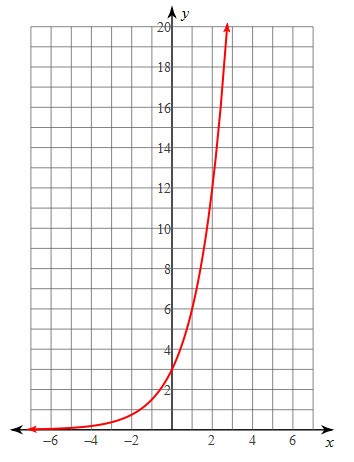
How do we know that is an example of an exponential growth?
Its a line going up
Its a line going down
Its a smooth curve going down
Its a smooth curve going up

How do we know that is an example of an exponential decay?
Its a line going up
Its a line going down
Its a smooth curve going down
Its a smooth curve going up

What is the equation of the horizontal asymptote for following exponential function?
y = -4
y > -4
y < -4
(0, -3)

What is the equation of the horizontal asymptote for following exponential function?
y = -2
y > -2
y < -2
(0, -2)

What is the equation of the horizontal asymptote for following exponential function?
y = 1
y = 2
y > 1
(0, 2)

What is the equation of the horizontal asymptote for following exponential function?
y = 6
y = 5
y < 5
(0, 5)
What type of function is
f(x)=(71)x
Exponential Growth
Linear
Exponential Decay
The horizontal line that a exponential function approaches but never touches
Asymptote
Growth Factor
Axis of Symmetry
What is the asymptote of the parent function y=2x?
x=0
y=0
x=2
y=2

What is the Domain of this exponential function?
y=1
x=0
All Real Numbers
x>0

What is the Range of this function?
y> 0
x> 0
All Real Numbers
y= 1
What is the Domain of this exponential function?
y > 0
y < 0
All Real Numbers
y > 0

What is the range of the exponential function?
all real numbers
y > -1
y < -1
x > -1

What is the range of the exponential function?
all real numbers
y > -3
y < -3
x > -3

What is the Range of the exponential?
y > -8
y ≥ -8
All real numbers
y < -8

Name the asymptote.
x = -4
y = -5
y = -4
x = -5
Name the range.
All Real Numbers
y > -5
y ≥ -5
y < -5
Name the domain.
x> -4
y > -5
y < -4
all real numbers
Is the population of elephants increasing or decreasing?

The value of a car purchased for $20,000 decreases at a rate of 12% per year. What will be the value of the car after 3 years?
$12,800.00
$13,629.44
$17,600.00
$28,098.56

Find the balance in an account that has $300 invested at 6.5% for 4 years compounded semi-annually.
$387.47
$496.50
$7,800.00
$385.94

Katy deposited $90 in a savings account earning 5% interest, compounded quarterly. Which of the following equations could represent the amount of money in her account yearly?


y=10,000*(0.76)x

