
NEW
Font size
 Worksheets
Integumentary Final Exam Review
Total questions: 15
Worksheet time: 8mins
You are treating a patient with a stage 4 pressure injury. The wound has improved and no bone is showing now. How would you stage this wound now?
Stage 1
Stage 2
Stage 3
Stage 4
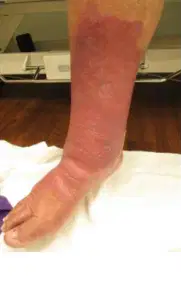
A patient presents to your clinic with a fever and chills. You examine his legs and see the image below. This is likely_______.
Hemosiderin Staining
A DVT
Cellulitis
A large Bruise
Which stage of lymphedema is defined as dissipation of edema with elevation of the limb?
Stage 0
Stage 1
Stage 2
Stage 3
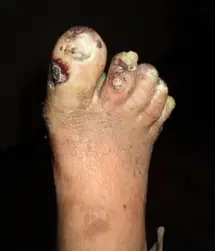
A patient comes to you with the wound below. She reports 10/10 pain upon rising her legs while in supine. This is likely a__ wound.
Arterial wound
Venous wound
Neuropathic wound
Pressure injury Wound
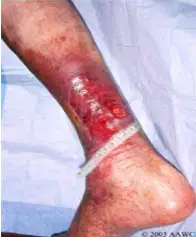
A patient comes to you with the following wound. Which of the following choices is most consistent with the wound in the image?
Arterial ulcer
Neuropathic ulcer
Venous statis ulcer
Pressure ulcer
A pressure injury with exposed dermis, but no subcutaneous fat, muscle, ligament, or bone exposed is considered a _____.
Stage 1 pressure injury
Stage 2 pressure injury
Stage 3 pressure injury
Stage 4 pressure injury
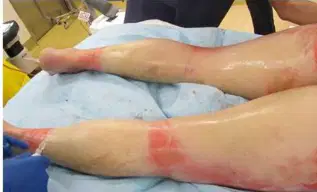
A 50 year old patient is seen with the anterior and posterior burns to the entire right and left Les. What is the percent burned according to the rule of 9’s?
18%
27%
36%
45%
A burn that extends into the papillary layer of the dermis of skin is a _____.
Superficial Burn
Superficial partial-thickness burn
Deep partial-thickness burn
Full-thickness burn
What type of burn is most likely to cause cardiovascular and nervous system issues?
Electrical
Thermal
Chemical
Radiation
Which of the following is a type of debridement where the body uses its own enzymes to destroy necrotic tissue?
Enzymatic Debridement
Biologic Debridement
Mechanical Debridement
Autolytic Debridement
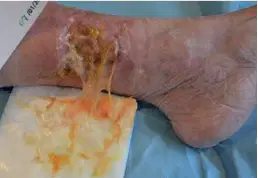
Your patient presents with an infected and heavy exudating wound. Which of the following dressings would be BEST to use?
Calcium Alginate
Silver Calcium Alginate
Hydrogel
Film
Your pt. has an ankle wound with heavy exudate that is thick and white in appearance. What type of exudate is present?
Purulent exudate
Serosanguineous Exudate
Serous Exudate
Sanguineous Exudate
Which of the following wound dressings would be appropriate to use for a non-infected wound with no exudate that is extremely dry with tendon exposure?
Film
Hydrofiber
Hydrogel
Silver Calcium Alginate

The patient with chronic lymphedema would most likely have a negative Stemmers sign.
True
False
A pt. presents with lymphedema. Compression is vital for long-term management. What type of compression is MOST appropriate?
Short stretch bandages to promote a high working pressure and low resting pressure
Long stretch bandages to promote a high resting pressure and low working pressure
Short stretch bandages to promote low working pressure and high resting pressure
Long stretch bandages to promote low resting pressure and high working pressure

