
 Worksheets
Nucleic Acid review
Total questions: 257
Worksheet time: 3hrs 13mins


What is the outcome of DNA transcription and translation?
Make muscles
Make protein
Make cells
Make DNA
What is the basic unit (monomer) of DNA?
Phosphate Group
Nucleotide
Amino Acid
Monosaccharide
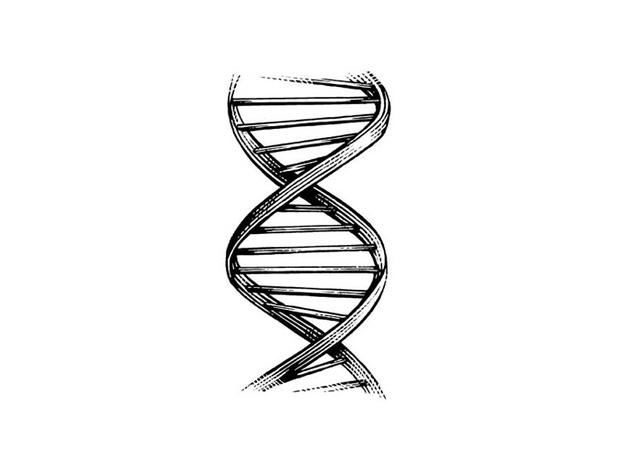
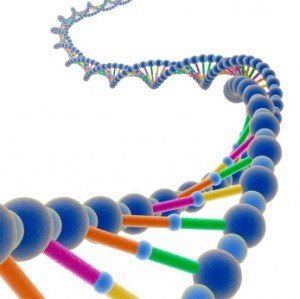
What shape is DNA?
Alpha Helix
Double Helix
Tangled
Flat
DNA is the (a) of life .
DNA is found in the (a) . This is also where mRNA is created.
What is true of RNA? (select all that apply)
Single Strand
Contains uracil
Ribose Sugar
Deoxyribose Sugar
What is true of DNA?
Double Helix
Contains Thymine
Deoxyribose Sugar
Ribose Sugar
The m in mRNA stands for (a)
What subunits comprise a ribosome?
large and small
big and little
big and small
large and little
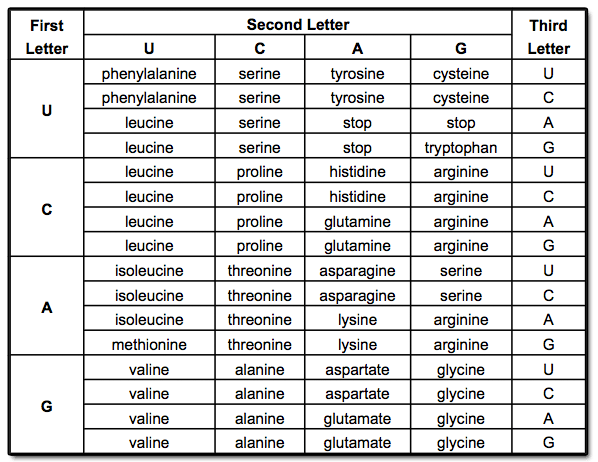
Which amino acid will be added to a protein chain if the codon is UAA?
Ser
Lys
Ala
STOP
The process by which the genetic code of DNA is copied into a strand of RNA is called
Translation
Transcription
Replication
Transformation
One strand of DNA is ____ to the other side to form its structure
Translated
Transformed
Replicated
Transcribed
What is the process in which protein synthesis happens?
DNA-->RNA--> Proteins
DNA-->Proteins-->RNA
Protein--->DNA--->RNA
Protein Synthesis--> Transcription-->Translation
Transcription take place in the
Cytoplasm
Cell Membrane
Nucleus
Ribosome
Translation takes place in the
Ribosome
Nucleus
Cytoplasm
Mitochondria
A group of 3 bases is known as
Anticodon
Codon
Organelle
A strand
In mRNA, each codon specifies for a particular
nucleotide
Enzyme
Amino Acid
Monomers
mRNA occurs during translation
True
False
tRNA has anticodons and amino acids attached to it
True
False
A chain of amino acids is called
Polymer chain
Polypeptide Chain
RNA chain
Protein Synthsis Chain
DNA is made up of
Ribosomes
Amino Acids
Nucleotides
None of these
The structure of a nucleotide consists of a
A phosphate, A deoxyribose sugar, a nitrogenous base
A phosphate base, Ribose sugar, a nitrogen
DNA, RNA, Protein
DNA, Protein, Amino Acids
How many nitrogenous bases are there
5
2
3
4
Who discovered the structure of DNA
Francis/Crick
Crick/ Williams
James/Watson
Crick/Watson
Structure of a DNA strand is
Helix
Double Helix
Intertwined Strands
Strands
Base Pairing for DNA means the what bases are attracted to each other
(A)denine->(T)hymine, (G)uanine->(C)ytosine
(A)denine-> (C)ytosine,
(T)hymine->(G)uanine
(A)denine->(U)racil, (G)uanine-> (C)ytosine
None of these
What is considered to be our blueprints?
DNA
RNA
Nucleus
Protein
Which one is not a stopping Codon?
UAG
UAA
AUG
UGA
What is the rule for base pairing in RNA
A-->T
C--->G
A-->U
U--->T
CAT TCA CTG


Replicate the following strand of DNA:
AATCATGGA
AATCATGGA
TTAGTACCT
UUAGUACCU
GGATAUCUA
Replicate the following strand of DNA:
AATCATGGA
AATCATGGA
TTAGTACCT
UUAGUACCU
GGATAUCUA
Which RNA bases would pair with CCG TAA in transcription?
AUG CUU
GGC AUU
GCU ACC
GCA ATT

How would the DNA sequence GCTATA be transcribed to mRNA?
GCUAUA
CGATAT
CGAUAU
GCUTUT
Which RNA bases would pair with TACGAA in transcription?
AUGCUU
ATGCTT
GCATCC
GCAUCC
Transcribe the following DNA strand: CTG AAT
GAC TTA
CTG AAT
GAC UUA
CUG AAU
How would the DNA sequence GCTATA be transcribed to mRNA?
GCUAUA
CGATAT
CGAUAU
GCUTUT
How would the DNA sequence GCTATA be transcribed to mRNA?
GCUAUA
CGATAT
CGAUAU
GCUTUT


What is the peptide chain that results from this strand of DNA?
What is the role of mRNA in protein synthesis?
it makes the bases that makes up DNA
it copies a section of DNA and uses the information to create the appropriate protein
it helps DNA perform replication
it makes the amino acids used in protein synthesis
Where is mRNA made?
in the nucleus
in the ribosome
in the mitochondria
in the vacuole
How is mRNA made?
it forms when chromosomes are cut into sections or genes
it forms when the DNA molecule is separated into its single DNA strands
it "reads" the code (base sequences) in the DNA and forms a molecule of complementary bases
it randomly gathers nitrogen bases in the nucleus and joins them via peptide bonds
Does DNA have to replicated before mRNA can be made?
No, DNA replication and mRNA synthesis are totally independent processes
Yes, DNA needs to be replicated before the mRNA molecule can be formed
Yes, these two processes are dependent upon each other

The long string of bases at the bottom of the diagram is
tRNA
mRNA
an anticodon
an amino acid

The orange structure in this diagram is
an anticodon
the large subunit of the ribosome
the small subunit of the ribosome
tRNA

Transfer RNA is indicated by which structure in the diagram?


The multicolor string of spheres represents
a sugar
a protein
a nitrogen base
phosphate group

The bottom of the tRNA molecule joins with the mRNA molecule because it has the _____________ to the mRNA's codon.
ribosomes
anticodon
nitrogen bases
sugars

The job of the "t-shaped" molecule in this diagram is to
copy the genetic code from DNA
bring amino acids to the ribosome so they can be made into a protein
bring the code from DNA in the nucleus to the ribosome in the cytoplasm
synthesize amino acids
Ribosomal RNA is a form of RNA that
makes up a ribosome and catalyzes protein synthesis
carries amino acids to the ribosome
transfers the genetic code to the nucleus
copies the genetic code from DNA
Which nitrogen base is not a part of RNA molecules?
thymine
uracil
adenine
cytosine
guanine
In order for protein synthesis to occur, mRNA must leave the nucleus and travel to
a ribosome in the cytoplasm
a mitochondria in the cytoplasm
a vacuole in the cytoplasm
a chloroplast in the cytoplasm
What must happen to the DNA molecule before mRNA can be created?
DNA must duplicate itself
the 2 DNA strands must separate
DNA needs to exchange bases with RNA
nothing needs to happed to the DNA molecule
What enzyme in the nucleus helps mRNA form?
DNA polymerase
RNA polymerase
pepsin
nuclease
AAG CTT TGC
TCG ATA CGA


AATCATGGA
Transcribe the following DNA strand: CTG AAT
GAC TTA
CTG AAT
GAC UUA
CUG AAU


Which of the following make up a nucleotide?
Sugar, phosphate, and base
Sugar, nitrate, and base
Lipid, phospate, and sugar
Protein, phosphate, and base

GAT-TAC-AGA-TTA-CAT?
What will be the complementary DNA sequence resulting from the following:
GAT-TAC-AGA-TTA-CAT?
CTA-ATG-TCT-AAT-GTA
GAU-UAG-UGA-UUA-GUT
CUA-AUG-UCU-AAU-GUA
CAT-ACA-TAC-ATA-TAG
How are DNA and RNA different? (CHECK ALL THAT APPLY)
Only DNA can leave the nucleus
RNA contains Thymine; DNA contains Uracil
DNA is double stranded, RNA is a single stranded
DNA contains Thymine, RNA contains Uracil
Which organelle contains rRNA and reads the mRNA to synthesize a protein?
Ribosome
Nucleus
Cytoplasm
Nucleotide
Choose the sequence of the mRNA strand that would match up with to the following DNA strand:
GTACAT
CATGTA
GAUCUA
CAUGUA
CUTGTU
How many nucleotides code for 1 amino acid?
1
2
3
4
When these bond together, they form a protein
Amino Acids
Peptide Bonds
Ribose
Nucleotides
What is the monomer of a protein?
monosaccharide
glycerol/fatty acid
amino acid
nucleotide
How many different amino acids are there?
10
18
20
Thousands
Which of the following is NOT a function of proteins?
Catalysts
Long term energy
Transport
Structure
What is the name for a chain of amino acids?
Polypeptide chain
Triglycerides
Polysaccharides
Nucleotides
What does a catalyst do?
slows down a chemical reaction
speeds up a chemical reaction
stops a chemical reaction
starts a chemical reaction
What happens when an enzyme is heated to a high temperature?
The enzyme remains the same.
The enzymes amino acid sequence changes.
The shapes of the enzyme are altered or denatured.
The enzyme dies.
What happens to a protein when it is denatured?
Which of the following is NOT a factor that could lead to denaturing in a protein?
Too hot
Too Cold
Too Acidic
Too much protein
How do we denature the proteins we eat?
Store them in the pantry
Cook them
Wash them
Which process takes the directions of the DNA and turns into a RNA sequence?
Transcription
Translation
Transformation
Three nucleotides come together to form a
enzyme
Codon
DNA
RNA


DNA is related to
Carbohydrates
Photosynthesis
Cellular Respiration
Genetics

What do organisms have in common?
DNA sequence made of A,C,T,G
DNA sequence is in the same order
DNA sequence between organisms have nothing in common
DNA sequence made of A,U,C,T,G

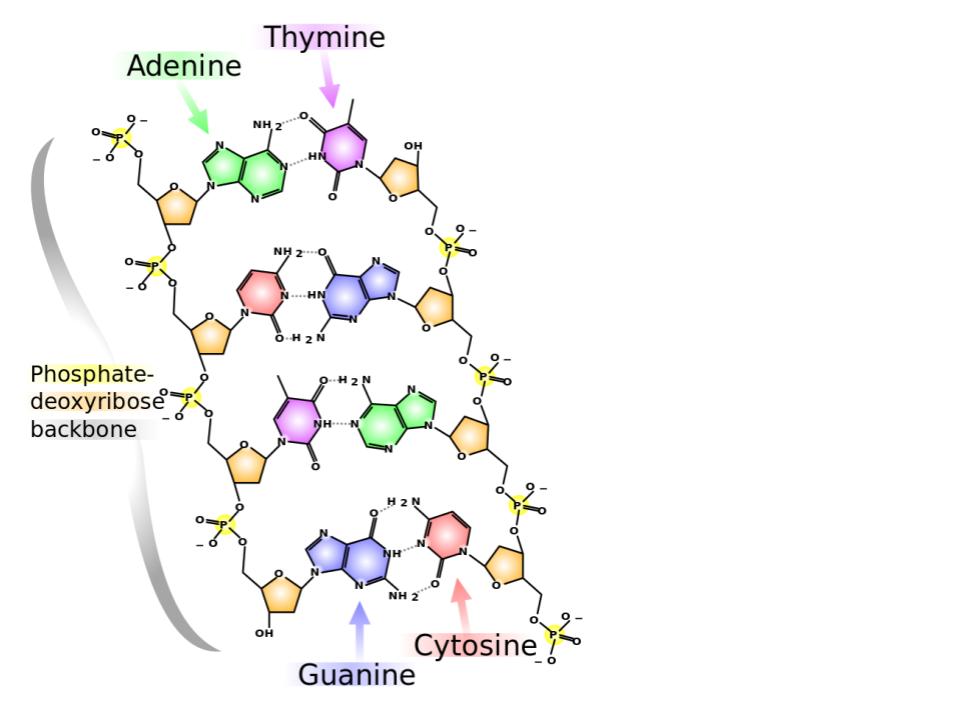
What is "A"?
Nucleotide
Deoxyribose Sugar
Nitrogenous base
Phosphate
What is "B"?
Nucleotide
Deoxyribose Sugar
Nitrogenous base
Phosphate
What is "C"?
Nucleotide
Deoxyribose Sugar
Nitrogenous base
Phosphate
What is the molecule in the image?
Nucleotide
Deoxyribose Sugar
Nitrogenous base
Phosphate
What is the complimentary sequence of the following sequence:
GATCAG
TGACAT
GACATG
CTAGTC
CGACTA

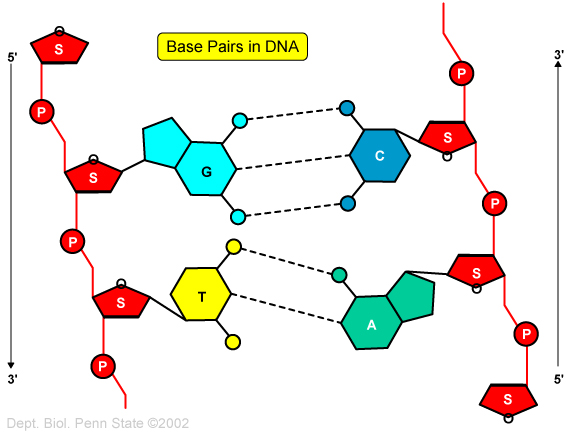
What do the dotted lines between the nitrogenous bases (A,T,C,G) represent in the image provided?
Covalent bonds
Ionic bonds
Peptide bonds
Hydrogen bonds

What is bonded to Adenine in the image to form a section of the DNA molecule?
Guanine and Phosphate group
Cytosine and Deoxyribose sugar
Thymine and Deoxyribose sugar
Deoxyribose sugar and Phosphate group
What determines the specific traits in an organism?
The number of carbons in the DNA molecule.
The number of hydrogen bonds that hold the strands of DNA together.
The sequence of nucleotide bases in the DNA molecule.
The sequence of phosphates along each DNA strand.
In eukaryotes, DNA is usually found in the (a) , while in prokaryotes, DNA is found in the (b) .
ribose, hydrogen, nitrogen base
deoxyribose, oxygen, nitrogen base
deoxyribose, phosphate, nitrogen base
ribose, phosphate, protein


Which of these are purines (larger nitrogenous bases?) CHOOSE 2
Adenine
Thymine
Cytosine
Guanine
Which of these are pyrimidines (smaller nitrogenous bases?) CHOOSE 2
Adenine
Thymine
Cytosine
Guanine

The sugar in DNA is called
glucose
deoxyribose
ribose
phosphate
Avery
Genetic material is DNA (not protein)
Hershey & Chase
Viruses have DNA too
Miescher
Discovered the DNA molecule
Chargaff
discovered the base pairing rules for DNA
Griffith
Discovered transformation using pneumonia bacteria
Chargraff's Rule says that
A pairs with C
C pairs with G
G pairs with T
T pairs with A

