wayground logo

Free Printable Worksheets

Font size

S
M
L
XL
Worksheets

final exam review

Total questions: 252

Worksheet time: 4hrs 29mins

Name
Class
Date
1.

Describes the front or direction toward the front of the body

a)

Anterior

b)

superior

c)

posterior

d)

Inferior

2.

describes a position closer to the surface of the body.

a)

Distal

b)

Medial

c)

Lateral

d)

Superficial

3.

It describes a position in a limb that is nearer to the point of attachment or the trunk of the body.

a)

Inferior

b)

Proximal

c)

Superior

d)

Anterior

4.

It describes the middle or direction toward the middle of the body.

a)

Medial

b)

Lateral

c)

Anterior

d)

Superior

5.

Describes the back or direction toward the back of the body.

a)

Posterior

b)

Anterior

c)

Superior

d)

Inferior

6.

It describes a position in a limb that is nearer to the point of attachment or the trunk of the body.

a)

Proximal

b)

Distal

c)

Medial

d)

Superficial

7.

It describes the side or direction toward the side of the body.

a)

Medial

b)

Superficial

c)

Lateral

d)

Deep

8.

It describes a position farther from the surface of the body

a)

Superficial

b)

Deep

c)

Proximal

d)

Distal

9.

Meaning toward the feet.

a)

Cephalic

b)

Caudal

c)

Lateral

d)

Medial

10.

Meaning toward the head.

a)

Cephalic

b)

Caudal

c)

Lateral

d)

Medial

11.

Which side is facing you?

a)

Ventral

b)

Dorsal

c)

Lateral

d)

Medial

12.

Which side is facing you?

a)

Ventral

b)

Dorsal

c)

Lateral

d)

Medial

13.
What is the symbol for an Affected Male? 
a)
Half Circle 
b)
Half Square 
c)
Full Shaded Circle 
d)
Full Shaded Square 
14.
How many affected females are present? 
a)
1
b)
2
c)
3
d)
4
15.
How many offsprings did generation 2 have? 
a)
5
b)
8
c)
9
d)
10
16.
How are mates identified in a Pedigree? 
a)
Vertical Line 
b)
Horizontal Line 
17.
How many Homozygous Dominant males are present? 
a)
2
b)
4
c)
6
d)
8
18.
What would the genotype be for the blonde son in generation 2?
a)
BB
b)
Bb
c)
bb
d)
Not enough information 
19.
How many carrier males are present? 
a)
2
b)
4
c)
6
d)
8
20.
What is the possible genotypes for both children in generation 3? 
a)
BB & BB
b)
Bb & bb
c)
bb & bb
d)
Bb & Bb 
21.
How many children in generation III are homozygous dominant? 
a)
1
b)
2
c)
3
d)
4
22.
Which generation connects these two pedigrees? 
a)
1
b)
2
c)
3
23.
Offsprings are represented by....
a)
Horizontal Line 
b)
Vertical Line 
24.

a photograph or picture of chromosomes grouped in ordered pairs is a ______________

a)

pedigree

b)

Punnett Square

c)

Venn Diagram

d)

Karyotype

25.
Which sex chromosomes would indicate a typical human male?
a)
XX
b)
X
c)
XY
d)
XXY
26.

A normal human zygote should have _____ chromosomes inside.

a)

46

b)

23

c)

92

d)

64

27.

You are viewing a patients karyotype. You see 23 chromosomes total. There are no homologous chromosomes. Which type of cell are you viewing?

a)

Egg cell

b)

Zygote

c)

Skin cell

d)

White blood cell

28.
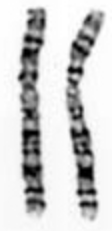
What is the gender of the individual whose karyotype is seen in the image?
a)
Male
b)
Female
29.

Based on the karyotype, what is the sex of this baby?

a)

Male

b)

Female

30.
Is this Karyotype human?
a)
Yes
b)
No
c)
Impossible to Determine
31.
Which structure is labeled as A in the diagram?
a)
Centromere
b)
Chromosome
c)
Sister chromatids
32.
Which structure is labeled as B in the diagram?
a)
Centromere
b)
Chromosome
c)
Sister chromatids
33.
A pair of identical chromosomes shown in a karyotype, one inherited from mom, and one inherited from dad are called
a)
sister chromotids
b)
centromeres
c)
homologous chromosomes
d)
autosomes
34.
What is the haploid number for this Karyotype?
a)
26
b)
27
c)
52
d)
54
35.

If the Diploid number for carrots is 18, the haploid number is

a)

18

b)

9

c)

27

d)

36

36.
The haploid number of human chromosomes is
a)
11
b)
12
c)
23
d)
46
37.
The union of egg and sperm to form a new offspring is
a)
zygote
b)
fertilization
c)
homologous pairing
d)
meiosis
38.
Vertebrates don't have a backbone
a)
True
b)
False
39.
Animals that have hair or fur are...
a)
Mammals
b)
Birds
c)
Fishes
d)
Reptiles 
40.
Vertebrates are divided into five groups: Mammals, birds, fish, reptiles and amphibians.
a)
True
b)
False
41.
Birds are viviparous (born from the mother's womb)
a)
True
b)
Flase
42.
The spider is...
a)
Vertebrate
b)
Invertebrate
43.
Octopus is...
a)
Vertebrate
b)
Invertebrate
44.
The snake is classified into...
a)
Mammals
b)
Reptiles
c)
Amphibians
d)
Birds
45.
Frogs are classified into...
a)
Amphibians
b)
Mammals
c)
Reptiles
d)
Insects
46.
Arthropods are
a)
Vertebrates
b)
Invertebrates
47.
Molluscs have a soft body
a)
True
b)
Flase
48.
_____ are animals with backbones 
a)
Invertebrates
b)
Vertebrates
49.
Invertebrates don't have internal skeletons made of bone. 
a)
True
b)
False
50.
Invertebrates may have fluid-filled skeletons like jellyfish and worms. 
a)
True
b)
False
51.
_____ is an adaptation that fools other animals with sounds, behaviors, or colors. 
a)
camouflage
b)
mimicry
c)
perch
d)
internal
52.
Animals that live on both land and in water are:
a)
mammals
b)
insects
c)
amphibians
d)
fish
53.
It is a group of fish whose skeletons are made up of cartilage rather than bones. They have jaws,tough scales and breathe through the spiracles on top of their heads. 
a)
Jawless fishes
b)
Cartilaginous fishes
c)
Bony fishes
54.
Which group is an egg-laying mammal?
a)
Marcupial
b)
Monotreme
c)
Placental
55.
Arthropods are coelomate animals with jointed segments and an exoskeleton made of chitin. 
a)
TRUE
b)
FALSE
56.
______ are also called flatworms. They are bilaterally symmetrical, dorsoventrally flattened worms that include planaria, flukes and tapeworms. 
a)
Cnidarians
b)
Platyhelminthes
c)
Nematodes
d)
Mollusks
57.
Earthworms and leeches are common examples of? 
a)
Nematodes
b)
Annelids
c)
Mollusks
58.
Hydras, jellyfishes and corals are examples of?
a)
Sponges
b)
Platyhelminthes
c)
Cnidarians
59.
Vertebrate animals are under what phylum?
a)
Arthropoda
b)
Chordata
c)
Porifera
60.
What does the term echinoderm mean?
a)
tube feet
b)
star shaped
c)
spiny skin
d)
stomach foot
61.
What type of symmetry do adult echinoderms exhibit?
a)
Asymmetry
b)
Pentaradial symmetry
c)
Bilateral symmetry
d)
Trilateral symmetry
62.
The larva of echinoderms have _____ symmetry.
a)
Asymmetrical
b)
Bilateral
c)
Radial
d)
None
63.
Echinoderms have an internal skeleton and a system of fluid-filled tubes called a(n)...
a)
water vascular system
b)
nervous system
c)
notochord
d)
ampulla
64.
Sea stars feed by
a)
Injecting poison that digests the prey 
b)
Everting their stomach to digest prey
c)
Chewing their prey with jaws and teeth
d)
squeezing their prey until it dies
65.
What phylum do echinoderms belong to?
a)
Cnidaria
b)
Porifiera
c)
Echinodermata
d)
Chordata
66.
The nerve that runs down each arm of a starfish is the _____
a)
nerve ring
b)
stone nerve
c)
radial nerve
d)
ampulla
67.
With regard to body cavities, how are echinoderms classified?
a)
Deuterostome coelomate
b)
Protostome coelomate
c)
Deuterostome acoelomate
d)
Protostome acoelomate
68.

Adult amphibians are ______________.

a)

omnivorous

b)

herbivorous

c)

carnivorous

69.

Amphibians live in water in the _________ part of their life stage.

a)

herpetology

b)

pupae

c)

larva

d)

amniotic

70.

The class Amphibia includes

a)

frogs, toads and salamanders

b)

frogs, toads and lizards.

c)

frogs and toads

d)

frogs, toads and snakes

71.

The term "ectothermic" means amphibians, fish and reptiles are all

a)

warm blooded.

b)

cold blooded.

c)

filled with ectoplasma.

72.
Does a reptile lay eggs?
a)
Yes
b)
No
c)
Sometimes
d)
Nothing
73.
Is a reptile cold-blooded or warm blooded?
a)
Warmblooded
b)
Cold-blooded
c)
Neither
d)
Both
74.
Which word means having a backbone?
a)
Invertebrates
b)
Shark
c)
Vertebrates
75.
Do reptiles have gills?
a)
Yes
b)
No
c)
Some do, some do not
76.
Which of these is a reptile?
a)
Toad
b)
Turtle
c)
Frog
d)
Newt
77.
Which type of feather is responsible for covering and streamlining a bird's body?
a)
Filoplume
b)
Contour
c)
Down
d)
Tail
78.
Why is it important for birds to digest their food quickly?
a)
If they absorb too much fat from their diet, they can impair their livers.
b)
If they take too long, they are susceptible to predators.
c)
They can't afford the extra weight in flight.
d)
They often swallow prey alive. Fast digestion ensures minimal injury to digestive system.
79.
All birds lay eggs that develop outside the body. This means they are...
a)
Viviparous
b)
Ovoviviparous
c)
Oviparous
d)
Ovuliparous 
80.
Which vertebrate groups are warm blooded (have a constant body temperature)?
a)
only mammals and birds
b)
mammals, birds and reptiles
c)
only mammals
d)
all vertebrates are warm blooded
81.
I breathe with lungs, lay eggs, and am endothermic (warm-blooded).  What am I?  
a)
birds
b)
fish
c)
mammals
d)
amphibians 
82.
Mammals are animals that
a)
Don't have a backbone
b)
Have live young
c)
Lay eggs
d)
Live in the jungle
83.
What are mammals?
a)
coldblooded
b)
warmblooded
c)
hotncoldblooded
d)
noblooded
84.
Which of the following is a characteristic that all mammals share?
a)
they all have a pouch
b)
they all have a cloaca
c)
they all have hair
d)
they all have a short gestational period
85.
Female mammals have this unique feature...
a)
They have long tails
b)
They are cold-blooded
c)
They have special milk glands
d)
They can run very fast
86.

The animal's digestive tract forms from the _______.

a)

endoderm

b)

mesoderm

c)

ecotoderm

d)

protostome

87.

The embryo layer that forms the skin and nervous tissue is the _____.

a)

endoderm

b)

mesoderm

c)

ectoderm

d)

deuterostome

88.

The innermost layer of the blastocyst is the

a)

endoderm

b)

gastrula

c)

ectoderm

d)

mesoderm

89.

The middle layer of the blastocyst is the

a)

endoderm

b)

ectoderm

c)

mesoderm

d)

deuterostome

90.

If the opening in the gastrula turns into the organisms mouth then it must be a

a)

deuterostome

b)

protostome

c)

human

d)

dog

91.

Animal with a mouth that does NOT develop from the opening in the gastrula.

a)

deuterostome

b)

protostome

c)

insect

d)

snail

92.

Animal in which the mouth does NOT develop from the opening in the gastrula

a)

deuterostome

b)

protostome

93.

Single layer of cells surrounding a fluid-filled space that forms during early development

a)

morula

b)

gastrula

c)

blastocyst

d)

blastula

94.

The third cell layer formed in the developing embryo

a)

endoderm

b)

mesoderm

c)

ectoderm

95.
What is the translation of the Phylum Porifera?
a)
Stinging cells
b)
Filter feeders
c)
Soft bodied
d)
Pore bearing
96.
Specialized feeding cells of a sponge
a)
Gonads
b)
Nematocysts
c)
Spongin 
d)
Choanocytes
97.
Hard fibers that provide a sponge structural support
a)
Spicules
b)
Bones
c)
Cartilage
d)
Ossicles
98.
Attached to one spot their entire adult life is referred to as
a)
Stuck
b)
Medusa
c)
Bipinnaria
d)
Sessile
99.
Sponges are:
a)
Unicellular & prokaryotic
b)
Multicellular & eukaryotic
c)
Unicellular & eukaryotic
d)
Multicellular & prokaryotic
100.
Sponges have this type of symmetry
a)
Unilateral
b)
Bilateral
c)
Radial
d)
Asymmetric
101.
The immature stage of an organism
a)
Larva
b)
Nekton
c)
Benthic
d)
Sessile
102.
Which is NOT a Cnidarian?
a)
Jellyfish
b)
Anemones
c)
Sea Urchin
d)
Corals
103.
Stinging cells of a Cnidarian are called:
a)
Collar cells
b)
Choanocytes
c)
Cnidocytes
d)
Gonads
104.
Cnidarians have which type of symmetry?
a)
Unilateral 
b)
Bilateral
c)
Radial
d)
Asymmetric
105.
Anemones and Corals are in which kingdom?
a)
Protista
b)
Cubozoa
c)
Animalia
d)
Cnidaria
106.
Some Cnidarians can reproduce asexually by:
a)
Expelling gametes
b)
Internal fertilization
c)
External fertiliztion
d)
Budding
107.
If an organism has a vestigial structure, that structure likely once had a function in a(n)
a)
close relative
b)
early ancestor
c)
unrelated organism
d)
embryological stage
108.
Mutations are important because they bring about
a)
death of the organism in which they develop
b)
genetic variation needed for a population to evolve
c)
benefits for the individual, not for the population
d)
Hardey-Weinberg equilibrium within a population
109.
Finches on the Galapagos Islands had different beaks in order to help them do what?
a)
Build nests
b)
Fight off predators
c)
Collect food sources
d)
Compete with rivals
110.
This scientist came up with the idea of natural selection.
a)
Jean Baptiste Lamarck
b)
Gregor Mendel
c)
Charles Darwin
d)
Thomas Malthus
111.
A remnant or trace of an organism from the past is called a _______.
a)
Ancestor
b)
Skeleton
c)
Fossil
d)
Imprints
112.
Inherited trait that helps an organism survive is a(n) __________.
a)
Fossil
b)
Adaptation
c)
Ancestor
d)
Natural selection
113.
Survival of the fittest or when favorable adaptations reproduce faster is called what?
a)
Evolution
b)
Adaptation
c)
Natural selection
d)
Fossilization
114.
This occurs when no more of a species is living.
a)
Fossilization
b)
Adaptation
c)
Extinction
d)
Natural selection
115.
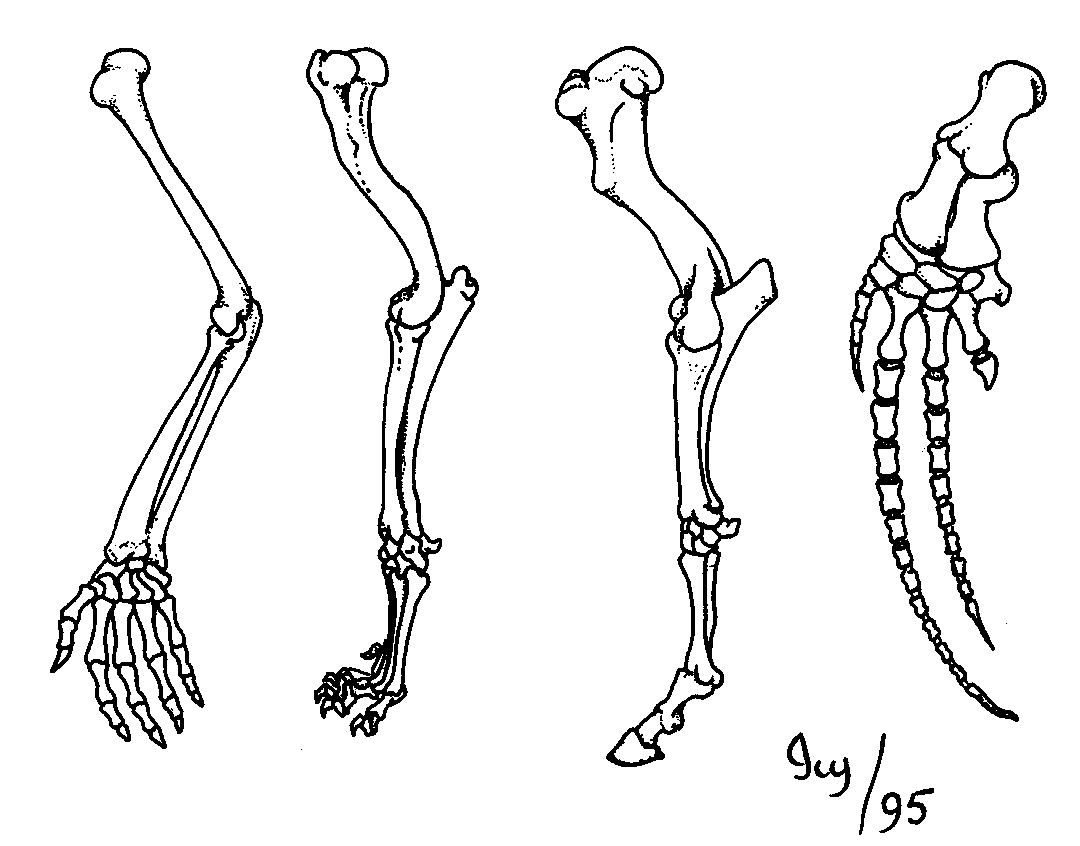
Structures with the same parts have different functions; suggests that organisms share a common ancestry
a)
vestigial structures
b)
homologous structures
c)
adaptive radiation
d)
fossil
116.
The ability of an organism to survive and reproduce in its specific environment 
a)
diversity.
b)
evolution
c)
adaptation
d)
 fitness
117.
Farmers breed cows to produce high amounts of milk. This is an example of...
a)
Natural Selection 
b)
Variations in a species 
c)
Selective Breeding 
d)
inbreeding
118.
What do viruses need to reproduce?
a)
they need genetic material
b)
They need a host cell
c)
They need  bacteria
d)
They need insulin
119.
How does a virus cause a person to develop the common cold?
a)
invades the host cell to reproduce
b)
removes energy from the host cell
c)
produces toxins in the host cell
d)
protects the host cell from bacteria
120.
A virus can be classified by its type of
a)
mitochondria
b)
chromosomes
c)
nucleic acid
d)
carbohydrates
121.
A(n) _____ is a virus that enters a bacterial cell.
a)
endospore
b)
decomposer
c)
plasmid
d)
bacteriophage
122.
When a virus invades a living cell, its _______
takes over the cell's functions.
a)
outer coat
b)
genetic material
c)
core
d)
cytoplasm
123.
Antibiotics kill viruses
a)
True
b)
False
124.
What part of a virus is the protein capsule that houses the genetic material (DNA/RNA)?
a)
tail
b)
nucleus
c)
capsid
d)
glycoprotein
125.
Which viral life cycle kills its host cell by lysing?
a)
lytic
b)
mitosis
c)
lysogenic
d)
S phase
126.
Which viral life cycle allows viral genetic material to lay dormant while the host cell reproduces?
a)
lytic
b)
mitosis
c)
lysogenic
d)
S phase
127.
Is a virus considered living or non-living?
a)
Living
b)
Non-Living
c)
Neither
128.
What is a host?
a)
Organism that lives on the cell and causes it harm 
b)
Something that causes harm to the cell 
c)
Cell that the virus invades and takes over
129.
Why do scientists classify viruses as non-living?
a)
They DO respond to a stimulus
b)
They need a host's energy because they do not have their own energy 
c)
They produce wastes
d)
They are really small 
130.
Which is not a shape that viruses can come in?
a)
Round
b)
Triangle
c)
Bacteriophage
d)
Threadlike 
131.
What is the first step of the virus reproduction cycle?
a)
The viruses genetic material (DNA) starts to take over the functions of the cell
b)
The host cell bursts open, releasing the new viruses
c)
The virus injects its genetic material into the cell
d)
A virus attaches to the surface of a host cell
132.
What is the last step in the viral reproduction cycle?
a)
A virus attaches to the surface of a host cell
b)
The proteins and genetic material start to assemble in the cell
c)
The host cell bursts open, releasing the new viruses
d)
The virus injects its genetic material into the cell
133.
Which is bigger, a bacteria or a virus?
a)
Bacteria
b)
Virus
134.
Most bacteria are surrounded by a strong structure that acts like a shield for the virus called the…?
a)
Cell Wall
b)
Cell Membrane
c)
Protein Coat
135.
Where do viruses reproduce?
a)
Outside of a cell
b)
Inside of a cell
c)
They do not reproduce
136.
Reasons that viruses are considered to be nonliving is because
a)
They are not cellular
b)
They cannot reproduce on their own
c)
They cannot make proteins
d)
all of the above
137.
Which can be treated with antibiotics?
a)
Virus
b)
Bacteria
c)
Mutagen
d)
Parasite
138.
Viruses are cells. 
a)
True 
b)
False
139.
Viruses are...
a)
prokaryotic
b)
eukaryotic
c)
non-living
d)
endospores
140.
What is a way to become immune to a disease without first having the disease?
a)
antibiotics
b)
Anti-retroviral drugs
c)
Vaccinations
d)
Exposure Therapies
141.
Viruses trick host cells into making copies of the virus
a)
True
b)
False
142.
Which of the following occurs after a virus attaches to a host cell
a)
The host cell dies
b)
The virus dies
c)
The virus inserts its genetic information into the host cell
d)
the virus eats the cell
143.
Viruses can reproduce on their own
a)
False
b)
True
144.
All cells are either prokaryotic or eukaryotic.
a)
true
b)
false
145.
Which of the following is one important difference between a virus and a bacterial cell?
a)
a virus is much larger in size than a bacterial cell
b)
a virus always causes more severe disease than a bacterial cell
c)
a virus can never reproduce on its own, but a bacterial cell can
d)
a virus does not contain genetic material, but a bacterial cell does
146.

Transcription converts a gene into a double stranded molecule.

a)

True

b)

False

147.

What is the correct order to make a protein?

a)

Protein, DNA, RNA

b)

RNA, DNA, Protein

c)

DNA, RNA, Protein

d)

Protein, RNA, DNA

148.

Where is DNA and RNA made?

a)

nucleus

b)

cytoplasm

c)

mitochondria

d)

ER

149.

Where are proteins made?

a)

ER

b)

nucleus

c)

cytoplasm

d)

mitochondria

150.

DNA contains the template to make RNA

a)

True

b)

False

151.

RNA contains which sugar?

a)

deoxyribose

b)

Ribose

c)

glucose

d)

fructose

152.

RNA has what base that is instead of thymine?

a)

guanine

b)

adenine

c)

thymine

d)

uracil

153.

What enzyme does transcription use?

a)

DNA polymerase

b)

ligase

c)

RNA polymerase

d)

helicase

154.

Which RNA brings amino acids?

a)

rRNA

b)

tRNA

c)

mRNA

155.

Which RNA forms part of the ribosomes?

a)

tRNA

b)

mRNA

c)

rRNA

156.

Which RNA carries the message?

a)

mRNA

b)

rRNA

c)

tRNA

157.

Transcription and DNA replication both involve complex enzymes and complementary base paring.

a)

True

b)

False

158.

Replication makes one copy and transcription makes many.

a)

True

b)

False

159.

The goal of transcription is to make RNA.

a)

True

b)

False

160.
What do we call the process of turning DNA into mRNA?
a)
Translation
b)
Transcription 
c)
Replication
161.
When DNA is transcribed to RNA.... 
a)
A pairs with U
b)
C pairs with U
c)
A pairs with T
d)
C pairs with T
162.
Amino acids are the building blocks of... 
a)
DNA
b)
RNA
c)
Atoms
d)
Proteins
163.
What is a Codon?
a)
4 base pairs that transfer to amino acids
b)
3 base pairs that transfer to amino acids
c)
3 base pairs that transfer to DNA
d)
3 base pairs that transfer to mRNA
164.
When transferring tRNA to amino acids, the process cannot begin until it reaches a...
a)
Beginning codon
b)
Start codon 
c)
Initiator codon
d)
Anticodon
165.
The process of transferring the codons to the amino acids ends with what codon?
a)
Stop
b)
Terminal
c)
End
d)
Cancel 
166.
In translation, C pairs with 
a)
U
b)
G
c)
A
d)
T
167.
The job of tRNA is to...
a)
carry amino acids to the ribosomes 
b)
carry ribosomes to the ER
c)
carry mRNA out of the nucleus
d)
carry glucose to mitochondria
168.
What is the correct amino acid sequence for the mRNA code AUGCCAGUAUGA?
a)
 Met-Pro-Val-Stop
b)
Met-Pro-Arg-Stop
c)
 Tyr-Gly-His
d)
Tyr-Gly-Arg-His
169.
Which of the following best describes a DNA molecule? 
a)
contains ribose 
b)
made of amino acids
c)
contains Uracil
d)
double helix
170.
Which RNA bases would pair with TACGAA in transcription? 
a)
AUGCUU 
b)
ATGCTT
c)
GCATCC
d)
GCAUCC
171.
Where does Translation occur?
a)
Proteins
b)
Mitochondria
c)
Ribosomes
d)
Cytoplasm
172.
What process does the energy come from to fuel protein synthesis?
a)
Cellular respiration
b)
ADP
c)
Carbohydrates
d)
Mitochondria
173.
A sugar, a phosphate group, and a nitrogen base form the building blocks of which organic compound?
a)
carbohydrates
b)
nucleic acids
c)
lipids
d)
proteins
174.
Which of the following is the template for the production of RNA within a cell?
a)
DNA
b)
protein
c)
ATO
d)
carbohydrate
175.
which process is shown?
a)
diffusion
b)
repiration
c)
recombination
d)
translation
176.
When an extra base is inserted into the DNA sequence of a gene, the protein doesn't work. Which explains why?
a)
the base increases rate of translation
b)
the base causes DNA to be transcribed in opposite direction
c)
the inserted base causes the codons in the sequence to be incorrect for the desired protein
d)
the base signals enzymes to translate DNA rather than RNA
177.
Which of the following best describes how DNA and RNA are similar?
a)
they both contain A and T
b)
They both have a double helix
c)
They are both composed of 5 different nucleotides
d)
they both have C and G
178.
The DNA sequence ATCAGCGCTGGC is part of a gene. how many amino acids are coded for by this message?
a)
4
b)
8
c)
12
d)
20
179.
A scientist puts nucleotide chains of UUUUUU in a test tube under conditions allowing protein synthesis. Soon they are only amino acids chains of phenylalinine. What does the experiment indicate?
a)
phenylalanine is composed of uracil
b)
UUU codes for phenylalanine
c)
protein synthesis malfunctions in test tubes
d)
proteins contain one kind of amino acids
180.
One human disease is caused by a change in one codon in a gene from GAA to GUA. The disease is a result of 
a)
a mutation
b)
crossing-over
c)
a meiosis error
d)
polyploidy
181.
What is the relationship between a protein, the cell, and DNA?
a)
DNA is produced by protein which is produced in the cell
b)
Protein is composed of DNA which is produced in the cell
c)
DNA controls the production of protein in the cell
d)
A cell is composed of DNA and protein
182.
Genetic info flows in one direction. Which best represents this flow?
a)
DNA-protein-RNA
b)
Protein-RNA-DNA
c)
RNA-protein-DNA
d)
DNA-RNA-protein
183.
Which process?
a)
mutation
b)
transcription
c)
respiration
d)
translation
184.

Where does TRANSCRIPTION occur?

a)

Nucleus

b)

Ribosome

c)

Cytoplasm

d)

Mitochondria

185.

Why must transcription occur where DNA can be found?

a)

because DNA can't leave

b)

because ribosomes are in the nucleus

c)

because DNA polymerase is found there

d)

because helicase unzips the DNA

186.

Which of the following is a codon?

a)
b)

ATG

c)

AUG

d)

AUT

187.

How many codons equals 1 amino acid?

a)

1

b)

2

c)

3

d)

4

188.

How many nucleotides equal 1 amino acid?

a)

1

b)

2

c)

3

d)

4

189.

On which molecule can an anticodon be found?

a)

mRNA

b)

DNA

c)

tRNA

d)

rRNA

190.

Where is the anticodon located?

a)

at the top of the molecule it's found on

b)

at the bottom of the molecule it's found on

c)

on the right of the molecule it's found on

d)

on the left of the molecule it's found on

191.

What is the purpose for anti-codons?

a)

to ensure the correct amino acid is dropped off

b)

to match the strand of DNA

c)

to decode a sequence of 4 nucleotides into an amino acid

d)

to make me hate biology

192.

A polypeptide is a sequence of ____________________ held together by a ______________ bond.

a)

amino acids; peptide

b)

fatty acids; ionic

c)

proteins; hydrogen

d)

fatty acids; covalent

193.

Which two thing are found on a molecule of tRNA?

a)

amino acids; anticodons

b)

amino acids; codons

c)

ribose sugar; proteins

d)

deoxyribose sugar; codons

194.

How do you know when to begin translating a strand of mRNA?

a)

look for AUG

b)

start at the beginning

c)

look for ATG

d)

when Ms. H tells me to

195.

TRANSCRIBE this DNA sequence: TACGTTACT

a)

AUGCAAUGA

b)

ATGCAATGA

c)

AUGGATUGA

d)

TACGTTACT

196.

TRANSLATE this RNA sequence: AUGCAAUGA

a)

Met-Glu-Stop

b)

Met-His-Stop

c)

Thr-Glu-Stop

d)

Thr-Pro-Stop

197.
Does the order of amino acids in a protein matter?
a)
YES!
b)
NO!
198.

Which of the following units are repeatedly joined together to form a strand of DNA? (This is the MONOMER of DNA.)

a)

amino acids

b)

nucleotides

c)

fatty acids

d)

polysaccharides

199.

The important enzyme related with transcription is;

a)

gyrase

b)

DNA polymerase

c)

RNA polymerase

d)

ligase

200.

A mutation is defined as:

a)

A change in the cell's structure

b)

Anything that changes in an embryo

c)

Any change in the physical features of a human

d)

A change in the DNA sequence

201.
Where do mutations occur?
a)
DNA and RNA
b)
DNA 
c)
RNA
d)
mRNA and tRNA
202.

A mutation can occur if a base pair is ____________, deleted, or substituted for another.

a)

modified

b)

added

c)

transferred

203.

A mutation in which only one nucleotide is altered is called a:

a)

Frameshift Mutation

b)

Deletion Mutation

c)

Point Mutation

d)

Insertion Mutation

204.

Another name for a point mutation is:

a)

Substitution

b)

Frameshift

c)

Insertion

d)

Deletion

205.

ATTTGAGCC- Original

ATTGAGCC - Mutated

The example above is an example of a

a)

Insertion

b)

Point mutation

c)

Deletion

d)

Substitution

206.

Mutations are SOMETIMES helpful to the organism.

a)

true

b)

false

207.

In order for offspring to get a genetic mutation, the mutation must occur in what type of cell?

a)

Cells with no nucleus.

b)

Any body cell after birth.

c)

Cells with no cell wall or cell membrane.

d)

Cells like eggs or sperm cells that are undergoing reproduction.

208.

Which type of mutation occurs when there is an addition or removal of a base?

a)

missense mutation

b)

nonsense mutation

c)

frameshift mutation

d)

point mutation

209.

What type of mutation is shown in the diagram?

a)

Point mutation - missense

b)

Frameshift Mutation - deletion

c)

Frameshift Mutation - addition

d)

Point mutation - nonsense

210.

TRUE or FALSE. The removal of one base to the DNA sequence might lead to a change on the succeeding (next) codon.

a)

True

b)

False

211.

DOES THE DNA MUTATION ALWAYS ALTER THE AMINO ACID SEQUENCE?

a)

Yes

b)

No

212.

Which of the following statement is NOT true?

a)

Point mutation involves a chemical change in just one base pair.

b)

Frameshift mutation occurs when there is an addition or removal of a base.

c)

Nonsense mutation occurs when the DNA change creates a stop codon that causes the translation to terminate early.

d)

Point mutation affect every codon beyond the point of mutation .
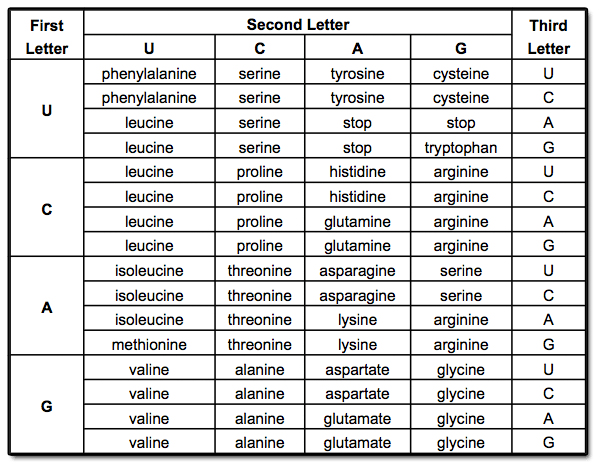
213.
What amino acid is represented by the codon UUA?
a)
Phenylalanine
b)
Tyrosine
c)
Leucine
d)
Stop codon
214.
original chromosome
ABC-DEF
mutated chromosome
ABBC-DEF
a)
duplication
b)
point
c)
frameshift
215.
original chromosome
ABC-DEF
mutated chromosome
AED-CBF
a)
duplication
b)
translocation
c)
inversion
216.
What are the building blocks of proteins called?
a)
DNA
b)
RNA
c)
Ribosomes
d)
Amino Acids
217.
Why are insertion and deletion (frameshift) mutations so harmful?
a)
They change all of the codons from the mutation on down the line, which changes the amino acid sequence
b)
They insert things that an organism doesn't need.
c)
They often delete things that organisms need.
d)
Insertion and deletions are not any more harmful than substitution mutations.
218.

Which of the following is NOT a characteristic of arthropods?

a)

Exoskeleton

b)

Jointed appendages

c)

Segmented body

d)

Endoskeleton

219.

What type of circulatory system do arthropods have?

a)

open

b)

closed

220.

The exoskeleton of an arthropod is made of which of the following?

a)

chitin

b)

dentin

c)

protin

d)

chlorotin

221.

Since the exoskeleton limits the growth of arthropods, they have to shed their exoskeletons and form a new one. This is called ____.

a)

defecating

b)

molting

c)

morphing

d)

excreting

222.

Which class of arthropods are mainly aquatic?

a)

Crustacea

b)

Insecta

c)

Diplopoda

d)

Chilopoda

223.

Arthropods have ____________ symmetry.

a)

radial

b)

none

c)

jointed

d)

bilateral

224.
What does the name Arthropod mean?
a)
"Suit of Armor"
b)
"Hard Cover"
c)
"Jointed Foot"
d)
"Tough Foot"
225.
Spiders, scorpions, horseshoe crabs, and other members of their subphylum typically have _____________________ as a feeding appendage. 
a)
Mandible
b)
Tusks
c)
Chelicerae
d)
Incisors
226.
Spiders, ticks, scorpions all belong to...
a)
Crustacean
b)
Arachanids
c)
Chilopoda
d)
Insecta
227.
Which group of arthropods have 3 body segments: head, thorax, and abdomen?
a)
Diplopoda
b)
Chilopoda
c)
Arachnids
d)
Insecta
228.
What two characteristics do all Arthropods have?
a)
two legs per body segment
b)
jointed legs and a cephalothorax
c)
three body segments and metamorphosis
d)
jointed legs and segmented bodies
229.
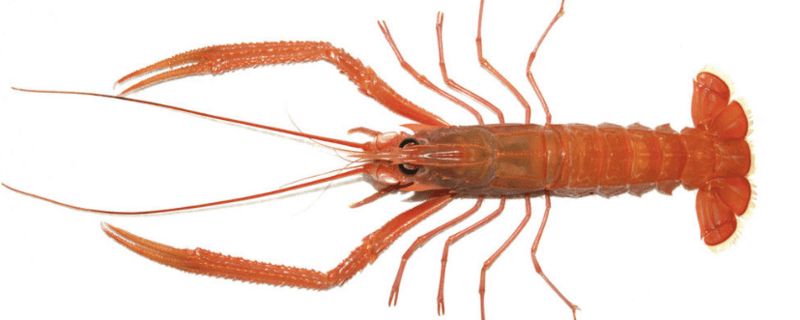
Lobster, shrimp, and crabs are examples of what group of Arthropods?
a)
Chilopoda
b)
Diplopoda
c)
Crustaceans
d)
Arachnida
230.
All arthropods have segmented bodies, jointed appendages, and ________________. 
a)
tails
b)
lungs
c)
wings
d)
an exoskelton
231.
?
a)
Crustacea
b)
Arachnida
c)
Insecta
d)
Myriapoda
232.
The malpighian tubules are organs associated with which system?
a)
skeletal
b)
Digestive
c)
Reproductive
d)
Excretory
233.
Organs on spiders that are modified as fangs and used to inject venom into prey 
a)
chelicera
b)
antennae
c)
spinnerets
d)
chelipeds
234.
?
a)
Arachnida
b)
Insecta
c)
Crustacea
d)
Myriapoda
235.
?
a)
Myriapoda
b)
Insecta
c)
Arachnida
d)
Crustacea
236.
Which group contains the largest number of animal species?
a)
Arthropods
b)
fish
c)
vertebrates
d)
jellyfish
237.
An insect that looks like a small adult when it hatches from the egg is called a
a)
larva
b)
nymph
c)
pupa
d)
adult
238.

This is an animal with one line of symmetry

a)

bilateral symmetry

b)

radial symmetry

c)

mathematical symmetry

d)

symmetry schmimmetry

239.

An animal with this symmetry has many lines of symmetry

a)

bilateral symmetry

b)

radial symmetry

c)

mathematical symmetry

d)

give me a freebie point

240.

Usual mode of reproduction: Sexual

Type of fertilization: External

Embryology: Blastopore contributes to the formation of anus; cleavage is radial

Symmetry: Immature form is bilateral; mature form is five-part radial

Body cavity: Lined with tissue derived from mesoderm

Segmentation: No evidence

Skeleton: Spiny exoskeleton secreted by the dermis and covered with a thin epidermis

Habitat: marine


Into what phylum should this organism be placed?

a)

Chordata

b)

Echinodermata

c)

Mollusca

d)

Nematoda

241.

Coelomate, exoskeleton and jointed appendages are characteristics of

a)

Annelida

b)

Arthropoda

c)

Mollusca

d)

Chordata

242.

The ciliated, free-swimming larva of the cnidarian is called a _______________.

a)

blastula

b)

planula

c)

meusa

d)

polyp

243.

Which of the following group of animals is sessile?

a)

jellyfish

b)

cockles

c)

sponge

d)

coral

244.

The nematodes are also called _________________.

a)

flatworms

b)

roundworms

c)

tapeworms

d)

earthworms

245.

All chordates have _________ at some stage in their life cycle

a)

myosin

b)

pharyngeal gills

c)

notochord

d)

anus

e)

dorsal hollow nerve cord

246.

The notochord is most closely associated with the

a)

Skin system

b)

Skeletal system

c)

Spinal cords

d)

Nervous system

247.

The characteristics of tapeworm, Taenia, include

a)

possess scolex

b)

Body divided into proglottids

c)

metameric segmentation

d)

a type of ectoparasite

248.

Which of the following is an advantage of having a jointed skeleton?

a)

A location for muscle attachment

b)

Flexibility

c)

Support

d)

All of the above

249.

The figure above shows a cross section plan for the body shape of an organism. X is the

a)

intestinal lumen

b)

coelom

c)

pseudocoelom

d)

enteron

250.

Which of the following is not a function of the amoebocytes in a sponge?

a)

Secretion of skeletal materials

b)

Control of pores by contraction

c)

Transport of food to the epidermis cells

d)

Participation in reproduction.

251.

Phylum Mollusca (class Cephalopoda) have three tissue layers, a digestive cavity and a fluid filled cavity within the mesoderm. They are called

a)

Acoelomate

b)

Pseudocoelomate

c)

Coelomate

d)

Pseudo-acoelomate

252.

Phylum platyhelminthes have three germ layer and one body cavity- the digestive cavity.

a)

Pseudo-acoelomate

b)

Pseudocoelomate

c)

Coelomate

d)

Acoelomate