
 Worksheets
8th - Force and Motion
Total questions: 208
Worksheet time: 3hrs 42mins

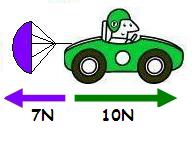
What is the net force?
3 N
3 N, right
17 N, right
3 N, left


A ____________ is a push or a pull on an object.
friction
force
magnet
gravity
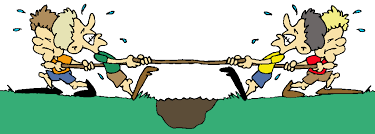

Forces that have a net force of zero Newtons
Balanced force
Unbalanced force
When the vectors (arrows) point away what function do you use?
Dividing
Multiplying
Subtracting
Adding

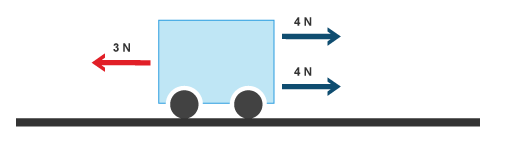
What is the net force on the object pictured?
3 N
5 N
4 N
8 N



You try to push your laptop across a table but it is not moving. What force might prevent the laptop from sliding?
friction
gravity
magnetism
normal

What does letter C represent
object providing force
object receiving force
gravity
friction
What does letter B represent
object providing force
object receiving force
gravity
friction


A moving object can be brought to rest by?
Applying force in same direction
Applying force in opposite direction
By not applying any force
What force holds the planets in motion around the sun?
Electrical
Magnetic
Graviational
Air Reistance
all objects in he universe have a gravitational attraction to each other
true
false
What force brings a pencil down when you throw it up in the air?
applied
normal
magnetic
graviational
What force ultimately slows a roller coaster to a stop
friction
applied
magnetic
normal
an ______ force must act on an onject for it to change it's motion
electrical
graviational
unbalanced
balanced
Jupiter has about 317 times more mass than Earth. What can you infer from this fact?
That Jupiter’s gravitational force is much weaker than on Earth’s gravitational force.
That Jupiter’s and Earth’s gravitational forces are equal.
That Jupiter’s gravitational force is much stronger than Earth’s gravitational force
Mass has no effect on the gravitational force between two objects
If the net force is equal to zero, the forces acting on the object are
balanced
unbalanced
balanced forces do not change the objects speed or
time
mass
direction
distance
Jonny and Patty are pushing against a basketball. Both of them push against theball on opposite sides with a force of 20 N to keep the ball still. What is the net force?
40 N
0 N
400 N
24 N
What are the 3 things that can happen as a result of an unbalanced force?
Change in Direction
Change In Speed
Change in Position
Change in Time
What is the first part of the definition for force?
(a)
What is the definition of force in science?
A push or pull of one object onto another
What the jedi use
coercion or compulsion, especially with the use or threat of violence.
make a way through or into by physical strength
What is the net force?
3 N
3 N, right
17 N, right
3 N, left
A ____________ is a push or a pull on an object.
friction
force
magnet
gravity
When the vectors (arrows) point away what function do you use?
Dividing
Multiplying
Subtracting
Adding
What is the net force on the object pictured?
3 N
5 N
4 N
8 N
You try to push your laptop across a table but it is not moving. What force might prevent the laptop from sliding?
friction
gravity
magnetism
normal
What does letter C represent
object providing force
object receiving force
gravity
friction
What does letter B represent
object providing force
object receiving force
gravity
friction
A moving object can be brought to rest by?
Applying force in same direction
Applying force in opposite direction
By not applying any force
What force holds the planets in motion around the sun?
Electrical
Magnetic
Graviational
Air Reistance
all objects in he universe have a gravitational attraction to each other
true
false
What force brings a pencil down when you throw it up in the air?
applied
normal
magnetic
graviational
What force ultimately slows a roller coaster to a stop
friction
applied
magnetic
normal
an ______ force must act on an onject for it to change it's motion
electrical
graviational
unbalanced
balanced
Jupiter has about 317 times more mass than Earth. What can you infer from this fact?
That Jupiter’s gravitational force is much weaker than on Earth’s gravitational force.
That Jupiter’s and Earth’s gravitational forces are equal.
That Jupiter’s gravitational force is much stronger than Earth’s gravitational force
Mass has no effect on the gravitational force between two objects
If the net force is equal to zero, the forces acting on the object are
balanced
unbalanced
balanced forces do not change the objects speed or
time
mass
direction
distance
Jonny and Patty are pushing against a basketball. Both of them push against theball on opposite sides with a force of 20 N to keep the ball still. What is the net force?
40 N
0 N
400 N
24 N
What are the 3 things that can happen as a result of an unbalanced force?
Change in Direction
Change In Speed
Change in Position
Change in Time
What is the first part of the definition for force?
(a)
What is the definition of force in science?
A push or pull of one object onto another
What the jedi use
coercion or compulsion, especially with the use or threat of violence.
make a way through or into by physical strength
A push or a pull is called a
Gravity
Force
What is Newton's 2nd Law?
For every action there is an equal and opposite reaction.
Acceleration depends on two variables, the mass of the object and the amount of force.
What is Newton's 3rd Law?
For every action there is an equal and opposite reaction.
Acceleration depends on two variables, the mass of the object and the amount of force.
What explains why objects resist changes in their state of motion?
gravity
inertia
force
friction

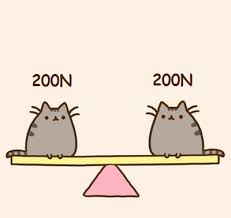
Looking at the image. Decide if this is balanced or unbalanced.
Unbalanced
Balanced

Looking at the image. Decide if this is balanced or unbalanced.
Unbalanced
Balanced

The girl on the sled will remain in motion unless
her motion is changed by magnetic forces.
she is stopped by an outside force.
she accelerates at a constant speed.
the force of friction forcer her to move faster.
"A body at rest tends to remain at rest, and a body in motion, tends to remain in motion, unless acted upon by an unbalanced force."
This is describing the law of
forces
inertia
velocity
gravity

The picture shows a spinning water sprinkler.
Water comes through the hose and is sprayed by the sprinkler.
Which principle best explains why the sprinkler spins?
Energy is released when water condenses.
Most substances expand when heated and contract when cooled.
Every action has an equal and opposite reaction.
Solid substances are usually more dense than liquid.

The picture shows a weightlifter holding the barbell over his head.
The force of gravity pulling down on the barbell is 756 newtons.
How many newtons of force are exerted by the weightlifter to hold the barbell up?
No Newtons
756 Newtons
368 Newtons
14767 Newtons

An inflated balloon released from rest moves horizontally.
The law that best explains this event is
Newton's 1st Law
Newton's 2nd Law
Newton's 3rd Law
Law of Gravity
A dictionary weighing 15 Newtons is placed on a desk.
What is the force that the desk exerts on the dictionary?
none
15 N
1.5 N
150 N

The diagram below shows unequal opposing forces.
Which way will the wagon move?
The cart will move to the right.
The wagon will move to the left.
The wagon will remain stationary.
The wagon will move left and then right and then stop.
Which of the following is an example of balancing forces?
A Book resting on the table.
A pencil is knocked off the desk.

What is the speed of an object that travels 20 meters in 2 seconds?
10 m/s
40 m/s
10 mph

Total distance divided by total time, for an object shows:
acceleration
the size of one's toupee
absolute speed
average speed
Force=Mass x Acceleration
Newton's First Law
Newton's Second Law
Newton's Third Law
Isaac Newton stated for every action there is an
_________ and _________ reaction.
equal and same
equal and opposite
unequal and same
unequal and opposite
What determines an object’s mass?
amount of matter
amount of friction
amount of force
amount of gravity
What is inertia?
The tendency for an object to move
The tendency for an object to never move
The tendency for an object to remain unchanged
None of the above
Your friend kicks a soccer ball, and it stops a few feet from you. What needs to happen to it in order for it to return to your friend?
Friction has to be applied to the ball.
Force has to be applied to the ball.
Speed has to be applied to the ball.
Inertia has to be applied to the ball.
What does friction do to a moving object?
Makes it rise
Slows it down
Speeds it up
All of the above
How is velocity different from speed?
Velocity is when an object goes in reverse.
Velocity is the direction an object moves in, and it has nothing to do with speed.
Velocity is speed and direction together.
Velocity is not at all different from speed.
You are riding in the car with your grandfather, and he turns left. Why do you shift to the right?
It takes you a moment to catch up with the new velocity of the car.
You have more inertia than the car, so it take longer for you to turn left.
You had been sitting at rest until the force of the turn set you in motion.
The car continued in the same velocity, but you had a different inertia.
The rate at which an object’s velocity changes is called what?
inertia
actualization
acceleration
completion
Your neighbor is riding her bike around the block. When she slows down and turns a corner, what changes about her?
velocity
friction
speed only
balance
A softball and a volleyball collide with equal speed, and then they accelerate at the same rate. What must be true about the masses of the objects?
The softball has more mass than the volleyball.
The softball and the volleyball have equal mass.
The volleyball has more mass than the softball.
It is impossible to compare the mass of the softball and the volleyball

Isaac Newton developed these 3 laws concerning ______________.
Velocity.
Mass
Acceleration.
Motion
What explains a quantity that has BOTH speed and direction?
Inertia
Force
Speed
Velocity
The force that prevents a ball rolling on the ground from continuing on it's path forever is...
Friction
Gravity
Inertia
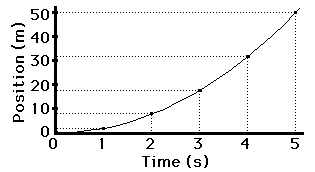
Which of the following is the correct position - time graph for an object moving with a constant velocity?


When you are running. your foot exerts force on the ground and the ground exerts force back onto you. Which of Newton's laws is represented
1st
2nd
3rd
All of these are examples of force except for
air resistance
gravity
friction
jumping
Force is a ________ or ________ that is required to change the motion of an object.
up/down
push/pull
sliding/shifting
The unit used to measure force is called ________________
mass
acceleration
net force
newton
30 mph west is an example of ________
Force
Speed
Velocity
Acceleration
A car traveling 65 mph is an example of its _____.
Force
Speed
Accerelation
Velocity
Newton's 2nd Law says that the acceleration of an object depends on its _____ and _____.
Force
Gravity
Weight
Mass
You are testing a slingshot with different objects. You try it with a mini-marshmallow, a quarter, and a large marble. If you pull it back with the same force each time, which object should leave the slingshot with the most acceleration?
Marshmellow
Quarter
Marble
A rocket pushes extremely hot gas (propellant) out of its thrusters, and the propellant pushes back on the rocket, allowing it to take off. Which of Newton's Laws is this an example of?
Newton's 1st
Newton's 2nd
Newton's 3rd
Newton's 4th
A force can____________.
make an object move
make a moving object stop moving
slow an object down
all of the above
True or false: An object resting on the ground can move without force.
True
False
Imagine you kick four balls with the same amount of force. Which one will go the farthest?
a 3 pound ball
a 5 pound ball
a 15 pound ball
a 25 pound ball
What does the force of gravity do to objects?
It makes them float
it makes them jump
it pulls them to the center of earth
it pushes them apart

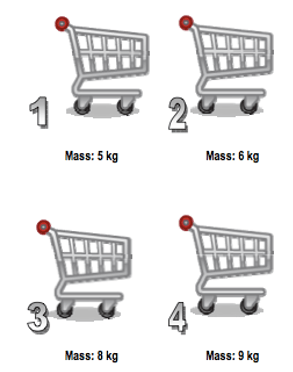
If the man pushes with an equal amount of force, which object will accelerate more?
Car because it has more mass
Lawnmower because it has less mass
Car because it has less mass
Lawnmower because it has more mass

Carleton walked for a while, stopped to sit on a bench in the park, and then ran the rest of the way home.
Carleton ran all the way from school to home going the same constant speed and never stopping.
Carleton waited around after school for his friend, and then they ran home together.
Carleton ran for a long time, then slowed down to walk the rest of his trip. Once he got home, he sat down on the couch.

Jessica ran all the way from school to home going the same constant speed and never stopping.
Jessica waited around after school for her friend, and then they ran home together.
Jessica ran for a long time, then slowed down to walk the rest of her trip. Once she got home, she sat down on the couch.
Jessica walked for a while, stopped to sit on a bench in the park, and then ran the rest of the way home.
Problem
Which of the following best describes the speed of an object?
14 m/s2
14 m/s south
14 m/s
14 m south

Sam ran for a long time, then slowed down to walk the rest of his trip. Once he got home, he sat down on the couch.
Sam waited around after school for his friend, and then they ran home together.
Sam walked for a while, stopped to sit on a bench in the park, and then ran the rest of the way home.
Sam ran all the way from school to home going the same constant speed and never stopping.


How Far did object A travel from 0-7 seconds?
1 meter
2 meters
3 meters
4 meters


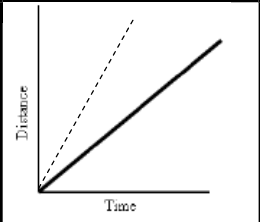
Deb walked to the ice cream shop. Sat and ate her ice cream and then went for a run.
Which graph matches this motion?
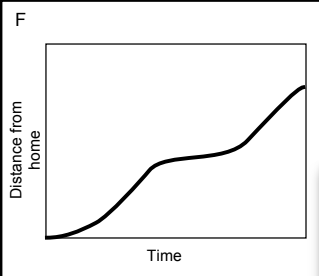
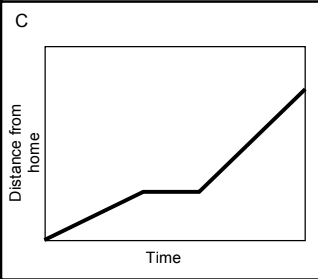
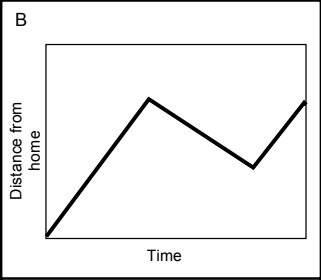
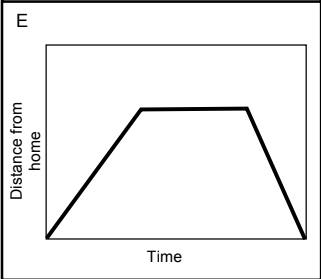

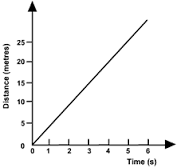
Examine the distance vs. time graph below and determine which of the following statements best describes the motion displayed on the graph.
The object is moving away from the starting point at a constant speed.
The object is increasing in speed.
The object is not moving.
The object is decreasing in speed.

What is speed?
How far you go
How fast you accelerate
How much distance is covered over a period of time
The change in location of an object.

The sum of all movements from start to the end of motion is best described as____.
distance
displacement
motion
donkey
The change in an objects position from the final position to initial position.
displacement
distance
motion
reference point
A man walks 5 miles forwards, 6 miles backwards and then 2 miles forwards. What is his displacement?
1 mile forward
13 miles
3 miles forward
1 mile
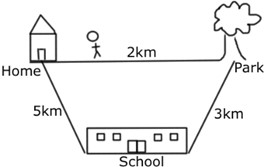
Jerry walked from home to school, then from the school to the park. What is his total distance?
2 km
5 km
8 km
10 km
After completing one trip on a roller coaster, the roller coaster's ________ is zero.
displacement
reference point
length
distance
A student needs 10 Newtons of force to lift a box to the top of a 2 meter shelf. How much work do they do?
12 J
8 J
20 J
5 J
A worker climbs a ladder and does 8 J of work on a 2 N object. What is the distance they lift the object?
18 m
4 m
10 m
6 m
4. The ability to do work is called________.
force
machine
energy
work

7. Frictional force ______ the motion of an object7.
opposes
help

It is done scientifically when an object moves towards the same direction as the force
Energy
Power
Work
Accelaration
Pulling a bow. Is it an example of work?
NO
YES
MAYBE
I am not sure
Lifting your bag. Is it an example of work?
NO
YES
MAYBE
I am not sure

A waiter carrying a tray while walking. Is it an example of work?
NO
YES
MAYBE
I am not sure

Pushing against the wall. Is it an example of work?
NO
YES
MAYBE
I am not sure
It stays in place.

A flag sits at the top of a flagpole. (1) Is work being done? (2) Why?
Yes.
No.
Force was applied over a distance
There is no movement

This kid drags your bookbag around the room. We don't know whose kid it is or how he got in, but man is he determined to haul that bookbag behind him. (1) Has work been done? (2) Why?
Yes.
No.
Force was applied over a distance
There was no movement

The family raises a flag in their yard. (1) Has work been done? (2) Why?
Yes.
No.
Force was applied over a distance
There was no movement

A tow truck hauls a car. (1) Has work been done? (2) Why?
Yes.
No.
Force was applied over a distance
There was no movement

How some of you look when we hear an airplane go by. Assuming you're already at the window: (1) Has work been done? (2) Why?
Yes.
No.
Force was applied over a distance
There was no movement
Which of the following is an example of NO work being done?
holding an object still above the floor of a room
lifting an object from the floor of the room
pushing an object across the floor of a room
bouncing an object on the floor of a room
Which of the following is an example of work being done?
standing at your desk
holding a 100-pound barbell
pushing against a stationary wall
pushing a lawnmower 100 yards
Then how much work is done if it takes 20N to move a box 10 meters

