wayground logo

Free Printable Worksheets

Font size

S
M
L
XL
Worksheets

Science-Survivor

Total questions: 65

Worksheet time: 36mins

Name
Class
Date
1.

What are organisms that eat other organisms?

a)

Consumers

b)

Producers

c)

Omnivores

d)

Decomposers

2.

______ are animals that eat both plants and animals

a)

Producers

b)

Consumers

c)

Omnivores

d)

Herbivores

3.

Matter from dead organisms is broken down and consumed by organisms called ______________.

a)

consumers

b)

producers

c)

carnivores

d)

decomposers

4.

The main source of energy for producers in an ecosystem is the sun.

a)

True

b)

False

5.

Plants are a type of _________ because they make their own food.

a)

decomposer

b)

producer

c)

herbivore

d)

system

6.

An __________ is a complex community made up of living and non living things.

a)

system

b)

environment

c)

ecosystem

d)

subsystem

7.

What part of the plant soaks up water for photosynthesis?

a)

roots

b)

petals

c)

leaf

d)

stem

8.
What gas  do plants give off after conducting photosynthesis that humans/animals need in order to live?
a)
Oxygen
b)
Carbon
c)
Nitrogen
d)
Hydrogen
9.
What are the 3 key ingredients needed for photosynthesis
a)
glucose, oxygen, carbon dioxide
b)
carbon dioxide, water, glucose
c)
water, soil, sunlight
d)
sunlight, water, carbon dioxide
10.
What is the name of the sugars a plant produces after photosynthesis
a)
Glucose
b)
Sugar
c)
ATP
d)
Oxygen
11.

If plants breathe in carbon dioxide, what do they breathe out?

a)

nitrogen

b)

oxygen

c)

carbon

d)

helium

12.

What creates the green color in plants?

a)

chlorophyll

b)

clorox

c)

chemical

d)

chromosomes

13.

Plants take in water and ___ from the soil and roots.

a)

sunlight

b)

soil

c)

water

d)

nutrients

14.

Plants need photosynthesis to make ___.

a)

oxygen

b)

carbon dioxide

c)

food

d)

new plants

15.
Which of the following is a fossil fuel?
a)
Wind
b)
Coal
c)
Solar
d)
Biomass
16.
Petroleum and natural gas form from...
a)
strong winds
b)
cooled magma
c)
radioactive materials
d)
remains of plants and animals 
17.
Hydroelectric power produces electricity using.....
a)
Wind
b)
Sunlight
c)
Moving water
d)
Dung
18.
What is biomass? 
a)
energy from the sun
b)
energy from water
c)
energy from wind
d)
energy from plant and animal waste
19.
Which of the following is a nonrenewable resource?
a)
milk
b)
coal
c)
biomass
d)
water
20.
Fossil fuels are classified as nonrenewable because they.......
a)
require expensive equipment
b)
take millions of years to replace
c)
can be found all over 
d)
provide all the energy we use
21.
Wind, geothermal, and solar energy are all what type of energy resources?
a)
cheap
b)
potential
c)
renewable
d)
chemical 
22.
Coal, oil, and natural gas are _____ resources created from the remains of early plants and animals.
a)
natural
b)
small
c)
large
d)
waste
23.
What are the states of matter?
a)
solid, liquid, and juice
b)
solid and liquid
c)
solid and gas
d)
solid, liquid, and gas
24.
a type of matter that can be found on earth as a solid, liquid, and gas
a)
gold
b)
water
c)
oxygen
d)
rock
25.
Which of the following is a part of the water cycle?
a)
evaporation
b)
condensation
c)
precipitation
d)
all of the above
26.
Which term means "the ability to cause change?"
a)
Matter
b)
Heat
c)
Energy
d)
physical change
27.

The amount of space inside a container is

a)

Perimeter

b)

Surface area

c)

Volume

d)

Density

28.

The measure of the pull of gravity on an object:

a)

Volume

b)

Mass

c)

Bouyancy

d)

Weight

29.

A measure of the amount of matter of an object

a)

Volume

b)

Mass

c)

Buoyancy

d)

Weight

30.

What is the unit of measurement for the mass?

a)

Kilogram

b)

Centimetre

c)

Litre

31.

What is the instrument used to measure volume?

a)

Beaker

b)

Scale

c)

Metre

d)

Tube

32.
An instrument that measure and indicates temperature.
a)
Thermometer
b)
Temperature
c)
Energy
d)
Kinetic Energy
33.

What is the temperature of this thermometer?

a)

70 degree celsius

b)

72 degree celsius

c)

74 degree celsius

d)

76 degree celsius

34.

What is the temperature in this thermometer?

a)

12 °\degree C

b)

16 °\degree C

c)

18 °\degree C

d)

20 °\degree C

35.

What is the temperature in this thermometer?

a)

60 °\degree  C

b)

58 °\degree  C

c)

56 °\degree  C

d)

54 °\degree  C

36.

Information recorded in your experiment which is used to draw a conclusion is called

a)

reliable

b)

data

c)

hypothesis

d)

observation

37.

The change that is tested in an experiment.

a)

hypothesis

b)

data

c)

variable

d)

observation

38.

Uses your senses to gather information.

a)

observation

b)

variable

c)

hypothesis

d)

data

39.

The general steps used when conducting an experiment.

a)

observation

b)

variable

c)

hypothesis

d)

scientific method

40.

A written explanation of what you think will happen, an idea that is tested in an experiment, and may be proven to be true.

a)

observation

b)

variable

c)

hypothesis

d)

data

41.

A plan on how you will conduct your experiment

a)

Data

b)

Procedures

c)

Monkeys

d)

Hypothesis

42.

Is something that is kept the same, remaining unchanged in an experiment.

a)

Control

b)

Variable

c)

Data

d)

P, B, & J

43.

Is a procedure carried out under controlled conditions to test a hypothesis.

a)

Science

b)

Watching YouTube

c)

Experiment

d)

Hypothesis

44.

When light bends as it passes from one material to another it is ____________

a)

reflecting

b)

refracting

c)

absorbing

d)

making a shadow

45.

An object that allows all light to pass through it is ______.

a)

transparent

b)

translucent

c)

opaque

d)

convex

46.

We hear sound when our ear drum ____________.

a)

reflects

b)

absorbs

c)

vibrates

d)

refracts

47.

Big, strong vibrations produce _______________ sounds.

a)

loud

b)

soft

c)

high pitched

d)

high frequency

48.

Objects that do not let light through are called __________.

a)

concave

b)

transparent

c)

translucent

d)

opaque

49.

Objects that vibrate quickly make sounds with ___________.

a)

a high volume

b)

no sound

c)

a high pitch

d)

a low volume

50.

A sound wave that bounces back to you is ___________.

a)

a whisper

b)

never loud

c)

an echo

d)

always high pitched

51.

distance between a point on a wave and the same point on the next wave

a)

amplitude

b)

crest

c)

longitudinal

d)

wavelength

52.

highest point on a wave

a)

trough

b)

amplitude

c)

pitch

d)

crest

53.

distance from the midpoint (resting point) to the crest

a)

frequency

b)

amplitude

c)

trough

d)

wavelength

54.

lowest point on a wave

a)

crest

b)

pitch

c)

trough

d)

amplitude

55.
The outermost solid layer of the Earth is called the
a)
mantle
b)
outer core
c)
inner core
d)
crust
56.
Which layer of Earth is located above the outer core?
a)
crust
b)
inner core
c)
mantle
d)
lithosphere
57.
A dense ball of solid iron and nickel.
a)
crust
b)
inner core
c)
mantle 
d)
outer core
58.
Which layer of the earth is rock made mostly of iron?

a)
Lithosphere
b)
Core
c)
Asthenosphere
d)
Mantle
59.
What part of the earth is a layer of rock that comprises 67% of Earth’s mass?
a)
mesosphere
b)
mantle
c)
asthenosphere
d)
lithosphere
60.
Temperature _____________________ as you go deeper into the earth.
a)
increases
b)
decreases
c)
goes up and down depending on the layer
d)
stays the same
61.
Pressure ______________________ as you go deeper into the Earth
a)
increases
b)
decreases 
c)
goes up or down depending on the layer
d)
stays the same
62.
The type of plate boundary where two plates come together is a .....
a)
Convergent Boundary
b)
Divergent Boundary
c)
Transform Boundary
d)
Plate Boundary
63.
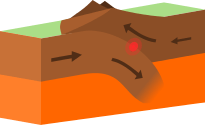
What type of plate boundary is this?
a)
Plate
b)
Divergent
c)
Convergent
d)
Transform
64.
What type of event will occur at this boundary?
a)
Earthquake
b)
Volcano Eruption
c)
Tornado
d)
Mountain Building
65.
A divergent boundary occurs when plates ....
a)
Pull apart
b)
Come together
c)
Slide past each other
d)
subducting