wayground logo

Free Printable Worksheets

NEW

Font size

S
M
L
XL
Worksheets

Midterm Review

Total questions: 66

Worksheet time: 46mins

Name
Class
Date
1.

WHICH GAS IS THE MOST PLENTIFUL IN THE ATMOSPHERE?

a)

NITROGEN

b)

OXYGEN

c)

WATER VAPOUR

d)

CARBON DIOXIDE

2.
The layer of atmosphere closest to the Earth is called the
a)
mesosphere
b)
stratosphere
c)
troposphere
d)
proctosphere
3.
Oxygen is the most common gas in the atmosphere.
a)
True
b)
False
c)
Both True and False
d)
Neither True nor False
4.

The stratosphere is located between

a)

thermosphere and mesosphere

b)

core and mantle

c)

troposphere and mesosphere

d)

exosphere and mesosphere

e)

your head and Uranus

5.
The ozone layer
a)
is green and purple
b)
absorbs dangerous solar radiation
c)
smells like sulphur
d)
is made of carbon dioxide
6.
The greenhouse effect causes the Earth's air to
a)
heat up
b)
cool down
c)
blow up
d)
turn brown
7.
The ozone layer occurs in the 
a)
troposphere
b)
thermosphere
c)
stratosphere
d)
exosphere
8.
Most of Earth's weather occurs in the 
a)
troposphere
b)
stratosphere
c)
mesophere
d)
thermosphere
9.

The highest layer of the atmosphere is

a)

troposhphere

b)

mesosphere

c)

stratosphere

d)

exosphere

10.

Which layer of the atmosphere do we live in?

a)

troposhphere

b)

mesosphere

c)

stratosphere

d)

exosphere

11.

This is an example of

a)

rain shadow effect

b)

lifting

c)

wind funnel

12.
Describe an arctic air mass.
a)
Dry
b)
Wet
c)
Cold
d)
Warm
13.
Describe a continental air mass.
a)
Dry
b)
Wet
c)
Cold
d)
Warm
14.
Describe a maritime air mass.
a)
Dry
b)
Wet
c)
Cold
d)
Warm
15.
Describe a tropical air mass.
a)
Dry
b)
Wet
c)
Cold
d)
Warm
16.
What types of air masses form over oceans?
a)
Maritime
b)
Continental
c)
Polar
d)
Tropical
17.
What types of air masses form over land?
a)
Maritime
b)
Continental
c)
Polar
d)
Tropical
18.
What types of air masses would be warmer?
a)
Maritime
b)
Continental
c)
Polar
d)
Tropical
19.
What's the humidity and temperature of a continental tropical air mass?
a)
Wet and cold
b)
Dry and warm
c)
Wet and warm
d)
Dry and cold
20.

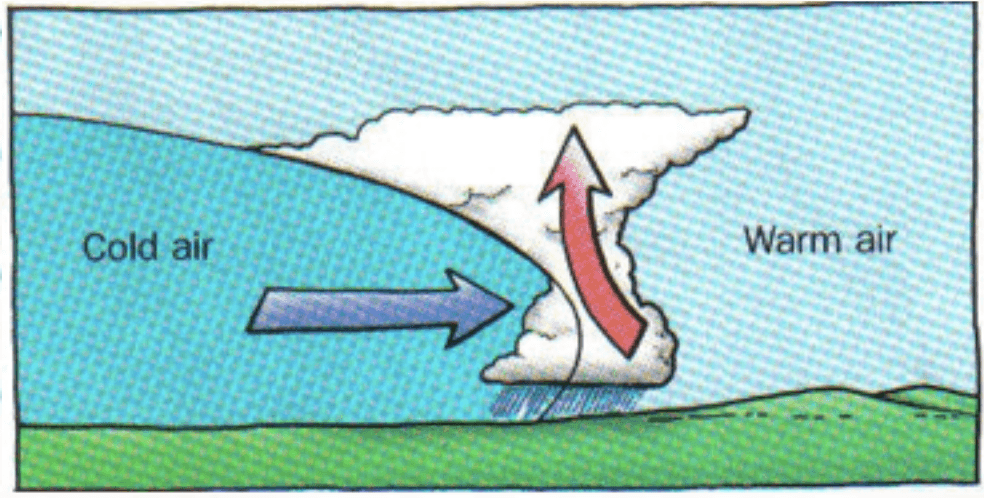
Name that front.

a)

Cold Front

b)

Warm Front

c)

Stationary Front

d)

Occluded Front

21.

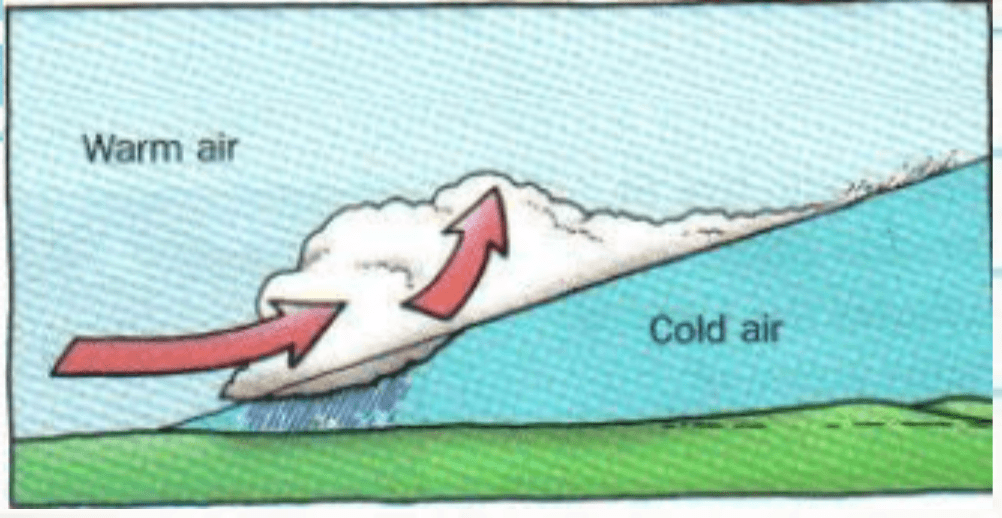
Name that front.

a)

Cold Front

b)

Warm Front

c)

Stationary Front

d)

Occluded Front

22.

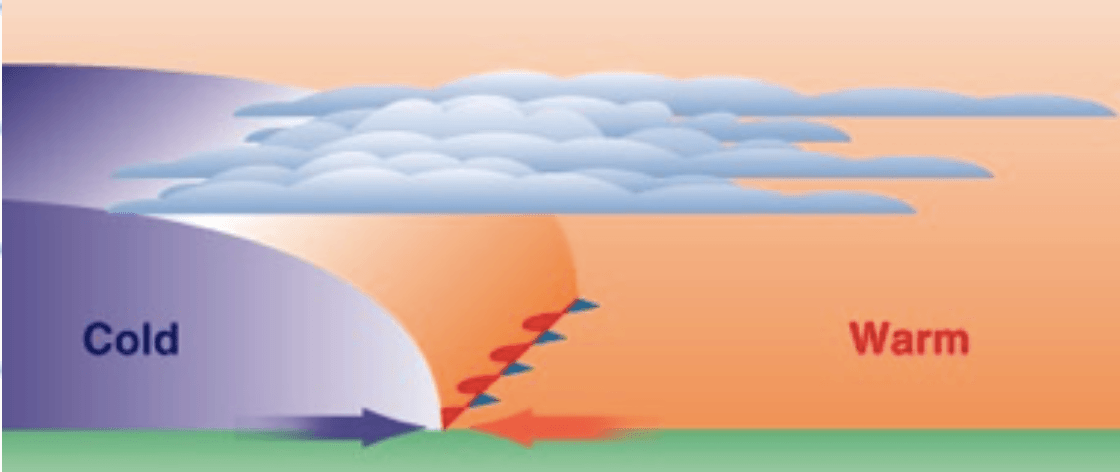
Name that front.

a)

Cold Front

b)

Warm Front

c)

Stationary Front

d)

Occluded Front

23.

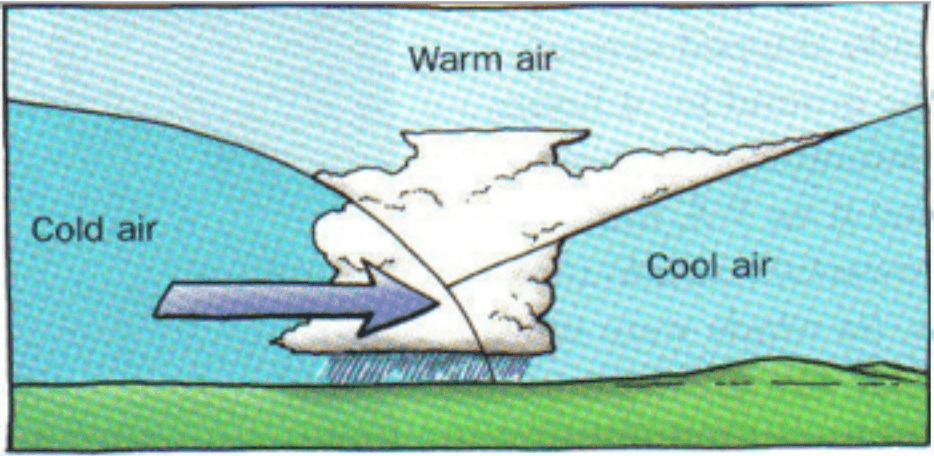
Name that front.

a)

Cold Front

b)

Warm Front

c)

Stationary Front

d)

Occluded Front

24.

Name that symbol.

a)

Cold Front

b)

Warm Front

c)

Stationary Front

d)

Occluded Front

25.

Brings some clouds and gentle rains.

a)

Cold Front

b)

Warm Front

c)

Stationary Front

d)

Occluded Front

26.

Cold dense air slides underneath warm air. The warm air is forced up, cools, and condenses.

a)

Cold Front

b)

Warm Front

c)

Stationary Front

d)

Occluded Front

27.

What is the wind direction

a)

Northeast

b)

Northwest

c)

Southeast

d)

Southwest

28.
What is the wind speed at this station
a)
3 knots
b)
15 knots
c)
25 knots
d)
30 knots
29.

What is climate?

a)

the condition of the atmosphere at any given time and place

b)

cloud cover and temperature

c)

precipitation and humidity at a given time and place

d)

weather conditions in an area over a long period of time

30.

Climate is affected by many factors including:

a)

latitude, elevation, and proximity to bodies of water

b)

tides and currents

c)

wind

d)

snow and sleet

31.

The rising and sinking of matter in a circular pattern due to differences in temperature:

a)

convection current

b)

ocean current

c)

convection oven

d)

climate zone

32.
A nebula is:
a)
A cloud of ice
b)
A cloud of dust and gas
c)
A cloud of just gas
d)
A cloud of just dust
33.
A nebula starts to collapse because of:
a)
A nearby star shining it's light
b)
A passing spaceship
c)
A passing comet
d)
Gravity
34.

A nebula collapses down into a disk known called:

a)

A compact disk

b)

An irregular cloud

c)

An protostellar disk

d)

An circular disk

35.

What forms in the very center of the accretion disk?

a)

A protostar

b)

A planet

c)

A protoplanet

d)

A planetesimal

36.
What is forming in the accretion disk away from the center?
a)
Light
b)
Protostars
c)
Planetesimals
d)
Hydrogen
37.

What happens during nuclear fusion in the sun?

a)

oxygen nuclei combine to form helium

b)

Helium nuclei combine to form oxygen

c)

helium nuclei combine to form hydrogen

d)

hydrogen nuclei combine to form helium

38.
The closer you live to an ocean the more likely your climate will be?
a)
maritime
b)
continental
c)
tropical
d)
polar
39.
The biggest factor in determining climate is?
a)
elevation
b)
an ocean
c)
latitude
d)
mountain
40.
A polar climate is?
a)
warm and cool
b)
consistently moderate
c)
consistently cool
d)
consistently warm
41.
The temperature of a tropical climate is?
a)
consistently warm
b)
consistently cool
c)
consistently moderate
d)
warm and cool
42.
Which of these is NOT a factor that determines the climate of a place?
a)
latitude
b)
wind patterns
c)
longitude
d)
elevation
43.
Climates are classified according to which two major factors?
a)
elevation & precipitation
b)
latitude & temperature
c)
elevation & latitude
d)
precipitation & temperature
44.
Any push or pull on an object.
a)
force
b)
velocity 
c)
inertia
d)
momentum
45.
The force of attraction between all matter.
a)
inertia
b)
friction
c)
net force
d)
gravity
46.
Gravity is increased with...
a)
greater mass & shorter distance
b)
greater mass & farther distance
c)
lower mass & shorter distance
d)
lower mass & farther distance
47.
Planets orbit the Sun in a shape called a(n)
a)
circle
b)
ellipse
c)
focus
d)
perihelion
48.
An ellipse is drawn around two points called
a)
aphelion
b)
perihelion
c)
foci
d)
axis
49.
When a planet orbits the Sun, one of the foci of the elliptical orbit is 
a)
the axis
b)
the perihelion
c)
the center
d)
the Sun
50.
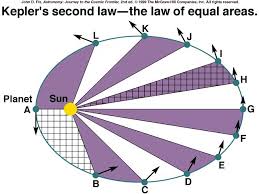
Where is the planet moving faster
a)
Position A to B
b)
Position B to C
c)
Position H to I
d)
Position I to J
51.
What has an eccentricity of zero
a)
a straight line
b)
a large ellipse
c)
a circle
d)
a small ellipse
52.
A planet moves __________ when it is farthest from the sun.
a)
faster
b)
slower
53.
The path a planet travels around the sun is called its 
a)
orbit
b)
ellipse
c)
barycenter
d)
precession
54.
Two factors effecting the magnitude of the force of gravity between 2 objects are...
a)
mass and distance 
b)
mass and matter
c)
distance and weight 
d)
weight and mass
55.

What are the two forces acting on a planet to keep it in orbit?

a)

Sun's gravity and inertia from SS formation

b)

earth's gravity and centriptial force

c)

The inertia from SS formation and acceleration

d)

none of these

56.
In simplest terms, what does Kepler's 3rd law state? 
a)
planets take a long time to orbit the sun
b)
there is no relationship between the distance of planet from the sun and the time it takes to orbit the sun
c)
there is a mathematical relationship between the distance of a planet from the sun and the time it takes to orbit the sun
d)
every planet has the same orbital period
57.
Any object with mass has gravity.
a)
True
b)
Sometimes
c)
False
d)
Never
58.

Kepler's Third law of planetary motion describes a relationship between the

a)

shape of orbit and location of Sun.

b)

orbital velocity and position in orbit

c)

distance from the Sun and length of year.

d)

path of epicycle and position.

59.

As distance between two objects increases, the pull of gravity _______________.

a)

Increases

b)

Decreases

c)

Stays the same

60.
The amount of matter in an object is 
a)
pressure
b)
weight
c)
mass
d)
force
61.
A person would weigh less on on the Moon than on the Earth because . . .
a)
Moon has more mass, and therefore more gravity
b)
Moon has less mass, and therefore more gravity
c)
Moon has more mass, and therefore less gravity
d)
Moon has less mass and therefore less gravity
62.
Two factors effecting the magnitude of the force of gravity between 2 objects are...
a)
mass and distance 
b)
mass and matter
c)
distance and weight 
d)
weight and mass
63.

What is Kepler's 1st law?

a)

The planets orbit in an ellipse

b)

The plants move faster when they are closer to the sun and slower when they are further from the sun

c)

The farther a planet is from the sun the slower the orbit

(P2 = a3)

64.
Centripetal acceleration always points
a)
in the direction of the object's motion
b)
in the opposite direction of the object's motion
c)
towards the center of the circle
d)
towards the outside of the circle
65.

What is Kepler's 1st law?

a)

The planets orbit in an ellipse

b)

The plants move faster when they are closer to the sun and slower when they are further from the sun

c)

The farther a planet is from the sun the slower the orbit

(P2 = a3)

66.

What shape is Earth's orbit?

a)

circle

b)

ellipse

c)

square

d)

spiral