
 Worksheets
Chem Lab Final Review
Total questions: 120
Worksheet time: 30hrs 46mins
Which of the following items are required for admission to the general chemistry teaching lab?
department approved safety glasses
long pants
shirt with sleeves that covers entire upper torso
flat soled shoes that cover the entire foot
hair longer than shoulder length tied back
It is OK to temporarily remove my safety glasses/goggles while in the lab to clean them.
True
False
I can wear any type of safety glasses or goggles in the lab.
True
False
Although eating and drinking are not permitted in the laboratory, chewing gum and candy are allowed.
True
False
In case of a chemical splash to the eyes, how long should you rinse your eyes in an eyewash station?
5 minutes
60 minutes
15 minutes
When is it OK to work with chipped or broken glassware in the laboratory?
If it is a small chip or crack
if the crack is just a star-crack
if the crack seems to be the only partway through the glasses
never
When should you clean up a chemical that you spill in the lab?
Whenever the TA catches you
immediately
at the end of the lab period
If I make a mistake in my lab notebook, I should
Tear out the page and throw it away
write the correct information on top of the mistake
scribble out the mistake
use white out to cover up the mistake
draw a single line through the mistake then enter the correct info
Which of the following personal items are permitted to be at your workstation int he laboratory? Select All
pen or pencil
drinking water bottle
lab manual (printout)
Flammable materials, like alcohol, should never be dispensed or used near...
an open flame
an open door
another student
a sink
If a laboratory fire erupts, immediately
throw water on the fire
open the windows
notify your instructor
run for the fire extinguisher
Approved eye protection devices (such as goggles) are worn in the lab
only if your dont have corrective glasses
at all times
to improve your vision
to avoid eye strain
if you wear contact lenses in the school lab
you dont have to wear protective goggles
advise your instructor that you wear contact lenses
keep the info to yourself
take them out before starting the lab and wear glasses under lab goggles
if you dont understand a direction or part of a lab procedure, you should
figure it out as you do the lab
as the TA before proceeding
skip it and move on to the next part
try several methods until something seems to work
After completing an experiment, all chemical wastes should be
left at your lab station for the next class
disposed of according to your TAs directions
taken home
dumped in the sink
If a lab experiment if not completed, you should
make up results
sneak into a different lab period to finish
copy the results from another student in the lab
discuss the issue with your instructor/TA
You are heating a substance in a test tube. Always point the open end of the tube
away from all people
toward yourself
toward another classmate
toward your lab partner
You are heating a piece of glass and now ant to pick it up. You should
pour cold water on it
use a rag or paper towels
use tongs
pick up the end that looks cooler
You have been injured in the lab. First you should
call your doctor after class
visit the infirmary after class
apply first aid on your own
notify your TA/instructor immediately
When gathering glassware and equipment for an experiment, you should
read all the directions carefully to know what equipment is necessary
all of the above
clean any glassware that appears dirty
examine all glassware for chips or cracks
Personal eyeglasses provide as much protection as
a face shield
safety glasses
splashproof chemical goggles
none of the above
Long hair in the laboratory must be
held away from the experiment with one hand
always neatly groomed
tied back or kept securely out of the way with a hair band
cut short
in a lab, the following should not be worn
all of the above
leggings
sandals
dangling jewlery
the following footwear is best in the laboratory
crocs
closed-toed shoes
sandals
open-toed shoes
horseplay or practical jokes in the lab are
not dangerous
always against the rules
okay
okay if you are working alone
if a piece of equipment if not working properly, stop, turn it off, and tell
your lab partner
the custodian
your best friend in the class
your TA/lab staff
if an acid is splashed on your skin, wash at once with
weak base
oil
plenty of water
soap
when you finish working with chemicals, biological specimens, and other lab susbtances, always
wipe your hands on your clothes
wipe your hands on a towel
treat your hands with skin lotion
wash your hands thoroughly with soap and water
when working in a lab it is important to orient yourself and identify locations of a fire blanket, fire extinguisher, the exits, eyewash stations, emergency showers, fire alarms, and waste containers
True
False
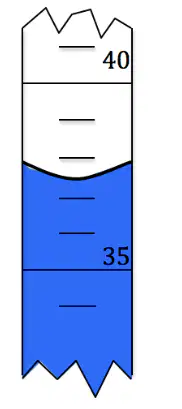
What is the volume indicated, to the correct number of sig figs
Melanie obtains a value of 3.449 g/mL for the density of her unknown solution. The actual density of the solution is 1.837 g/mL. What is the % error? Give 2 decimal places
A student obtains the following data:
Mass of empty, dry graduated cylinder: 24.149g
Volume add of NaCl solution: 8.11 mL
Mass of grad cylinder + NaCl soln: 44.58g
What is the density of the solution? 3 decimal places
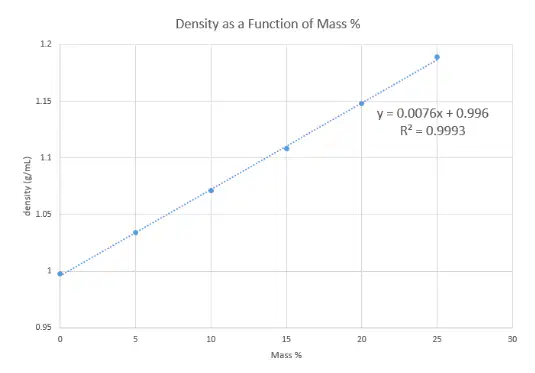
Jill creates a standard curve of mass vs volume for a series of solutions.
She is provided with a solution of unknown concentration (mass %). If the density of the unknown solution is 1.039 g/mL, what is the concentration of the solution, expressed as mass %? 3 decimal places
Jason measures three values of density for his unknown. The values he obtains are:
1.797 g/mL
1.609 g/mL
1.04 g/mL
What is the average of his three measurements? 3 decimal places
A student heats a sample of hydrate once, and the mass of the sample and the evaporating dish is 16.051 g. After a second heating cycle, the mass of the sample and the dish is 13.749 g. The student stops the heat/cool/weigh cycle after the second time.
If the original mass of the evaporating dish and the hydrate was 28.87 g, and the mass of the evaporating dish alone was 1.688 g, what is the mass of water removed from the sample by heating? 3 decimal places
George determines the mass of his evaporating dish to be 7.886 g. He adds a solid sample to the evaporating dish, and the mass of them combined is 13.67 g. What must be the mass of his solid sample? Express your response to three digits after the decimal.
An anhydrous (water removed) salt has a formula mass of 195.973 g/mol. If the hydrated version of the salt has 6 mol of water associated with it, what is the mass % of water in the hydrated salt? Report your answer to three digits after the decimal.
A student is told the theoretical mass % water in her sample is 67.655 %.
She obtains an experimental value of 48.85 % when she performs the lab activity.
What is her % error?
Report your answer to three digits after the decimal.
Sam records the mass of his evaporating dish as 5.501 g.
He records the mass of the evaporating dish and the sample of hydrate as 18.881 g.
After heating the sample in the evaporating dish to constant weight, the mass of them combined is 11.635 g.
How many moles of water were removed from the sample by the heating process?
Report your answer with three digits after the decimal.
You can always tell if an object is hot by looking at it
True
False
Long hair should be tied back when using a bunsen burner
True
False
Flame temperature can be adjusted by: (select all that apply)
adjusting the gas flow by turning the handle on the natural gas valve
adjusting the metal collar on the burner
lighting the burner with a match
Hot objects can be placed directly on the lab benchtop to cool
True
False
it is important to check glassware for scratches, nicks and cracks before heating
True
False
The temperature of an object can be checked prior to touching it by using an infrared thermometer
True
False
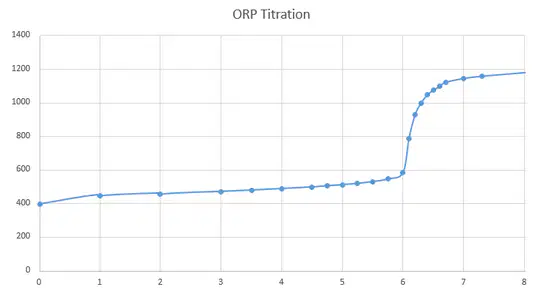
Examine the sample ORP output below. At what approximate added volume of titrant does the equivalence point occur? Enter your answer numerically.
A titration is performed as follows:
19.946 mL of Fe2+ solution of unknown concentration is charged into a 100 mL beaker
45 mL of deionized water is added
the solution is titrated with 0.892 M Ce4+ solution
the equivalence point is reached after 14.627 mL of Ce4+ solution is added
What is the concentration of the Fe2+ solution? Report your response to three digits after the decimal.
A solution of citric acid of unknown concentration, prepared in deionized water, is titrated with standardized sodium hydroxide solution, also in deionized water. A few drops of phenolphthalein is added to visualize the pH change. Phenolphthalein changes color from colorless to pink between pH of 7 - 9.
What is the titrant in this titration? sodium hydroxide
What is the analyte in this titration? citric acid
What is the equation of a line, in slope-intercept form, that connects the following two data points?
(5.0, 1200)
(6.0, -850)
Enter your answer by filling in the following blanks. Enter each of your answers as whole numbers without any rounding.
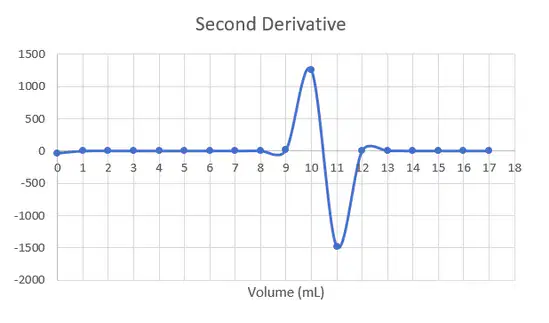
Examine the second derivative plot shown below. At what approximate added volume of titrant does the equivalence point occur? Enter your answer numerically in units of mL.
Magnesium is considered flammable
True
False
Magnesium reacts with water and acid solutions
True
False
The concentration of HCl solution is considered flammable
True
False
Water can be safety added to this concentration of HCl solution
True
False
This concentration of aqueous HCl is light blue in color
True
False
It is safe to wash with water if one's skin is exposed to magnesium chloride solution
True
False
Magnesium chloride solution is considered flammable
True
False
Hydrogen gas is considered a carcinogen
True
False
Hydrogen gas is considered an asphyxiant
True
False
Hydrogen gas is considered flammable
True
False
A student performs an experiment where gas is collected over water in an upside down graduated cylinder. If the atmospheric pressure is 750 mmHg and the level of water in the graduated cylinder is 18.5 cm higher than the level of the water exposed to the atmosphere, what is the total pressure of gases inside the graduated cylinder?
Enter your answer numerically in units of mmHg.
A student collects hydrogen gas over water in a graduated cylinder. If the student measures that the total pressure inside the graduated cylinder is 0.855 atm and the experiment was performed at 25oC, what is the pressure of hydrogen gas?
Enter your answer numerically in units of atm.
A student measures the pressure, volume, and temperature of a gas in the laboratory and records the following data:
P = 0.329 atm, V = 112 mL, T = 300 K
Based on this information, what would be the volume of the gas at STP?
Enter your answer to three significant figures in units of mL.
If 0.291 g of Mg are reacted with 10.0 mL of 3.00 M HCl, how many moles of H2 should be produced theoretically?
Enter your answer numerically in units of moles.
If 5.5 moles of gas are produced in an experiment and it is measured that they occupy 112 L at STP, what is the experimental molar volume of the gas?
Enter your answer numerically in units of L/mol to two digits after the decimal.
A coffee cup calorimeter is prepared, containing 100.000 g of water (specific heat capacity = 4.184 J/g K) at initial temperature 80.000 C. A salt weighing 5.576 g is quickly added. The salt has a molar mass of 239.577 g/mol. The final temperature of the solution is 11.207 C.
Assume no heat loss to the surroundings. Assume the specific heat capacity of the solution is equal to that of pure water, and that the mass of the solution is equal to the mass of the solid plus the mass of water in the calorimeter.
What is the molar heat of solution for the salt, in kJ/mol?
Report your answer to three digits after the decimal.
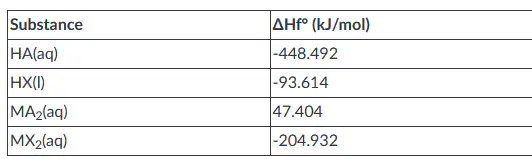
Standard heats of formation for reactants and products in the reaction below are provided.
2 HA(aq) + MX2(aq) → MA2(aq) + 2 HX(l)
What is the standard enthalpy of reaction, in kJ? Report your answer to three digits after the decimal.
A 312 g sample of a metal is heated to 361.375 °C and plunged into 200 g of water at a temperature of 48.347 °C. The final temperature of the water is 56.308 °C. Assuming water has a specific heat capacity of 4.184 J/g °C, what is the specific heat capacity of the metal sample, in J/g °C)? Assume no heat loss to the surroundings.
Report your response to 3 digits after the decimal.
Suppose you are investigating the reaction: M(s) + 2 HCl(aq) → MCl2(aq) + H2(g).
You weigh out a 0.234 gram piece of metal and combine it with 58.4 mL of 1.00 M HCl in a coffee-cup calorimeter. If the molar mass of the metal is 46.31 g/mol, and you measure that the reaction absorbed 121 J of heat, what is the enthalpy of this reaction in kJ per mole of limiting reactant?
Enter your answer numerically to three significant figures in units of kJ/mol.
You determine that the specific heat capacity of your unknown metal is 0.524 J/goC. What is the identity of the metal?
Both acids and bases can be corrosive.
True
False
Halogens are unreactive.
True
False
Mercury is readily absorbed through the skin.
True
False
Oxidizing agents and reducing agents should be stored close to one another for safety.
True
False
Peroxides can be stored indefinitely.
True
False
Pyrophoric substances can burn spontaneously in air.
True
False
Flammable liquids should be used with care near sources of ignition.
True
False
Cryogenics are stored at high temperatures
True
False
Electricity can be hazardous.
True
False
CuSO4 absorbs light strongly at a wavelength of 635 nm. Consider that you measure the initial intensity of light, Io, entering the solution at 635 nm, and the intensity of light passing through the solution, I, at 635 nm.
Sample 1: 0.400 M CuSO4
Sample 2: 0.200 M CuSO4
Which of the following statements is true?
The intensity of light passing through the solution, I, will be higher for Sample 1 compared to Sample 2.
The intensity of light passing through the solution, I, will be the same for Sample 1 compared to Sample 2.
The intensity of light passing through the solution, I, will be lower for Sample 1 compared to Sample 2.
The reported molar absorptivity of Red Dye #3 is 1.525 L mol-1 cm-1. If a solution of Red Dye #3 displays an absorbance of 1.09 in a cuvette that is 0.671 cm in length, what is the concentration of the dye in solution? Report your response to three digits after the decimal. _____ M
A stock solution of Blue #1 has a concentration of 4.365 M. 2 mL of this solution is diluted with 9 mL water. What is the concentration of the resulting solution? Provide your response to 3 significant figures.
A student's calibration curve for Blue #1 at 635 nm yields a straight line described by the equation y = 0.334 x + 0.025. If the measured absorbance for a solution of unknown concentration of Blue #1 is 0.474, what is the concentration of the Blue #1 solution? Provide your response to three digits after the decimal.
The concentration of dye in Solution A is 28.842 M. You have 13 mL of water at your disposal to make the dilutions.
The solution is diluted twice, to make Solutions B and C.
In the first dilution, 3 parts of Solution A is diluted with 12 parts water to make Solution B.
In the second dilution, 6 parts of Solution B is diluted with 4 parts water to make Solution C.
What is the concentration of dye in Solution C? Provide your response to three digits after the decimal.
What does the skull and crossbones represent when used as the pictogram on an SDS?
carcinogen
flammable
acute toxicity
corrosive
What does the exclamation mark represent when used as the pictogram on an SDS?
carcinogen
mutagen
flammable
irritant
Which pictogram(s) appear on the SDS for silver nitrate? Select all that apply.
carcinogen
flammable
irritant
skin corrosion/burns
oxidizer
What is the 'signal word' (if any) for silver nitrate?
danger
warning
alert
none
What happens when silver nitrate is heated to composition?
nothing
may emit toxic fumes
releases water
forms carbon dioxide
What should be used to extinguish a fire containing silver nitrate?
carbon dioxide
halons
water
tri class dry chemical
Is silver nitrate light sensitive?
yes
no
unknown
What color is silver nitrate?
white
yellow
colorless
silver
What effect (if any) does silver nitrate have on aquatic species?
toxic
none
unknown
beneficial
What is the melting point of 1-naphthol, according to the SDS?
542 C
1.224 C
233 C
96 C
Is 1-naphtol air and/or light sensitive?
air sensitive only
light sensitive only
neither light or air sensitive
both light and air sensitive
What do the pictograms for 1-naphthol indicate? Select all that apply.
skin corrosion/burns
oxidizer
irritant
acute toxicity
flammable
A student measures the absorbance of a sample of red dye #3 using a spectrophotometer. If the absorbance is measured as 0.624, what is the concentration of red dye #3 in the sample?
Enter your answer in units of micromolar to three significant figures.
A student makes three plots of their data and finds that a plot of [A] vs t is linear, a plot of ln[A] vs t is non-linear, and a plot of 1/[A] vs t is non-linear. What is the rate law of the reaction?
Rate = k
Rate = k[A]
Rate = k[A]2
Rate = k[A]3
Which one of the following sets of units is appropriate for a second-order rate constant?
s–1
mol L–1s–1
L mol–1s–1
mol2 L–2s–1
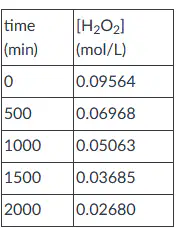
You will need to generate a set of graphs to answer this question.
Concentration vs time data for the following decomposition reaction was collected at 300 K. The data is shown in the table below.
What is the rate constant for the reaction at this temperature (in units of min-1)?
H2O2(aq) → H2O(l) + 1/2 O2(g)
What is the safety pictogram for household bleach (sodium hypochlorite solution, 5-12.5%)?
irritant
skin corrosion/burns
explosive
aquatic toxicity
Which is the best definition of asphyxiant?
poisonous
spontaneously catches on fire
ignites in air
can result in suffocation
Which is the best definition of lachrymator?
can result in skin rash
irritates the lungs
burns the skin
can irritate eyes and cause tearing
Which is the best definition of teratogen?
can cause birth defects
can cause cancer
can cause ruptures in skin on exposure
explosive
Which is the best definition of mutagen?
can cause radiation
can cause genetic mutation
can cause birth defects
can cause cancer
Which is the best definition of corrosive?
can cause damage to living tissue
can irritate eyes and cause tearing
can cause birth defects
can cause cancer
Which of the following best describes the reaction, if any, that occurs when aqueous solutions of sodium carbonate and sodium iodide are combined?
double replacement
redox
neutralization
no reaction
If an unknown solution is a poor conductor of electricity, which of the following must be true?
the solution is highly ionized
the solution is slightly ionized
the solution is highly reactive
the solution is slightly reactive
Which ion(s) is/are spectator ions in the reaction, if any, that results from combining aqueous solutions of CoCl2 and AgNO3? Select all that apply.
Co^2+
Cl-
Ag+
NO3-
An infrared wave has a wavelength of 6.5 × 10⁻⁴ cm. What is this distance in angstroms, Å?
Enter a value with two significant figures to complete the expression: ____ x 104 Å.
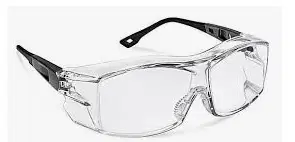
Which descriptor of eye protection best identifies the eye protection shown:
safety goggles
face shield
fluid resistant shield
safety glasses
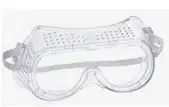
Which descriptor of eye protection best identifies the eye protection shown:
safety glasses
face shield
safety goggles
fluid resistant shield
Which form of eye protection is most appropriate for use in the general chemistry lab?
fluid resistant shield
laser eyewear
safety glasses/goggles
dust goggles
In a typical heating/cooling curve, what is the slope of the line when a change of state is occurring?
none of the above
negative slope
slope +1
positive slope
In a typical heating curve, what is the nature of the slope of the curve when the substrate, in one state of matter, is being heated to another state of matter, but no change of state is occurring?
slope < 0
slope = 0
slope > 0
A solid is heated to a liquid and then to a gas. How many changes of state typically occur in the process?
2
0
1
3
Melting a solid to form a liquid is exothermic.
True
False
Recall q=m.c.ΔT. How much heat, in J, is required to increase the temperature of an object with mass 3.753 g by 98.947 C if the specific heat of the substance is 5.03 J/g C? Provide your response to one digit after the decimal.
Which is greater in magnitude, the heat of fusion or the heat of vaporization of water?
heat of fusion
theyre the same
heat of vaporization
Just like we can calculate heat required to change the temperature by a given magnitude, given its mass and specific heat, we can also calculate the energy required to change the state of matter of a quantity (mass) of substance, given its heat of fusion (ΔHf) or heat of vaporization (ΔHvap). The calculation is similar for both processes, and resembles that used for specific heat.
To calculate the heat (q) required to melt a given mass (m) of a substance from a solid to a liquid state, you will require the heat of fusion for the substance, ΔHf. Quantity of heat is found by: q = m.ΔHf.
Notice temperature doesn't appear in the formula. Why not?
temperature change of the substance is incorporated in the heat of fusion
temperature change doesnt affect quantity of heat
temperature change is independent of mass
there is no temperature change during a change of state

