
 Worksheets
Midterm Exam CTEC 32 - Agri-Fishery
Total questions: 46
Worksheet time: 44mins
The process of adapting behavior of an animal to fit the needs of people.
Breeding
Domestication
Selection
Cross breeding
Which of the following statement is not TRUE about the human civilization and livestock history?
Taming and raising animals supplied a surer source of food and clothing.
Even before the human race learned to tame and raise animals, they are not dependent on hunting and wild plant for food and clothing.
With the domestication of animals came the beginnings of a more settled way of life.
A better food supply meant an increase in population.
A cattle bred which is known for its good heat resistance and good beef/meat at the same time.
Brahman cattle
Shorthorn cattle
Santa Gertrudis cattle
All of the above
Brahman cattle is a breed which is used to mate with another breed. The advantageous desirable traits of this breed needed for domestication is:
Good meat
Good resistance to heat
Good resistance to cold
Fast growing
This is the mating of animals of different breeds to corporate desirable traits to another and the main goal is to produce a breed with the combination of two desirable traits.
Domestication
Breeding
Selection
Cross breeding
It means to identify and use for breeding purposes those animals with traits which are considered to be desirable.
Domestication
Breeding
Selection
Cross breeding
The humped cattle found in tropical countries; more resistant to some diseases, parasites and heat than the other breed.
Sus vittatus
Bos taurus
Sus scrofa
Bos indicus
A domesticated cattle which came from either the Aurochs (common in Europe) or Celtic Shorthorn (British).
Sus vittatus
Bos taurus
Sus scrofa
Bos indicus
In 1943, who is the man traveled in new world and during his second voyage he brought various types of animals?
Hernando Desoto
Christopher Columbus
Cortez
Captain John Smith and Lord Delaware
The first civilization of people to tame swine about 4900 BC.
American
Spaniards
Mexican
Chinese
Based on historical records, when was the first-time swine was use as food?
New Stone Age
Modern Age
New world Age
None of them
A kind of horse used as the main draft (used in pulling loads) animal by colonists.
Saddle horses
Oxen
Horses
All of the above
A wild jungle fowl of India which was believed to be the ancestor of the most tamed chicken.
Gallus gallus
Turkey
Anas boschas
Goose
An animal function where materials which cannot be used directly by humans are converted into food by livestock's (e.g. pasture, hay, cornstalks).
Converting feed into food
Clothing
Power
Recreation
Conservation
An animal function which helps conserve soil and soil fertility through manure.
Converting feed into food
Conservation
Clothing
Power
Recreation
One way of preventing run-off where surface water from outside the feedlot prevents from getting onto the feedlot.
Diversion
Drainage
Debris basins
Detention ponds
A part of preventing a run-of where this part is able to dry/drain the feed bunks and waterers.
Diversion
Drainage
Debris basins
Detention ponds
A way of preventing or controlling odors of animal wastes and gases which is utilized to attempt to neutralize the odor so no odor remains.
Masking agents
Counteractants
Deodorants
Digestive deodorants
These are bacteria which create a digestive process that eliminates the odor.
Masking agents
Counteractants
Deodorants
Digestive deodorants
This covers up the odor of the wastes with the introduction of another odor.
Masking agents
Counteractants
Deodorants
Digestive deodorants
The following are rules in the disposal of dead animals except for:
Approved/licensed disposal plant, burying, disposal pits and burning.
When burning animals, use commercial incinerators to eliminate bad odors.
May bury the animals when disposal is not available provided that the pit follows the restrictions.
Dead animals should be hauled in uncovered, metal, leak proof vehicle.
The process of breaking down food by mechanical and enzymatic action in the alimentary canal into substances that can be used/absorbed by the body.
Absorption
Digestion
Disposal
Distribution
This process takes place after the absorption, in which the nutrient from the feed is delivered into the bloodstream.
Digestion
Absorption
Disposal
Distribution
This process takes place after digestion, in which the digested parts of the feed are assimilated into the bloodstream.
Digestion
Absorption
Disposal
Distribution
A kind livestock that have a stomach that is divided into four parts, and they are also known as the cud-chewing animals.
Ruminants
Non-ruminants
Both
None of them
The following are digestive juices in small intestines which help in the digestion process, except for:
Pancreatic
Intestinal juice
Bile
Chyme
The material product when partly digested feed leaves the stomach; it is an acid, semifluid, gray, and pulpy mass.
Pancreatic
Intestinal juice
Bile
Chyme
Part of the digestive system that the main function is to absorb water.
Large intestine
Small intestine
Cloaca
Rectum
Small fingerlike projections which increase the absorption area of the small intestine.
Caecum
Bile
Villi
Large intestine
It is defined as a chemical compound that aids in the support of life.
Protein
Nutrients
Vitamins & Minerals
Carbohydrate
The following are considered as fat-soluble vitamins:
A, C, E, K
A, D, E, K
A, B, C, D
A, B, C, K
Minerals are said to provide material for growth of bones, teeth and tissue. Minerals are categorized as trace and major minerals. Which among the following is not included as a major mineral?
Salt
Calcium
Phosphorus
Iron
Livestock are usually fed on roughages of what crude protein percentage?
18%
<18%
>18%
None of them
Livestock such as swine require concentrates of what crude protein percentage?
10%
<10%
>10%
None of them
Which of the following is not included as a ruminant animal?
Horse
Cattle
Goat
Sheep
Which of the following is not included as a non-ruminant animal?
Pigs
Horses
Poultry
Sheep
The following are true about dry matter and as-fed, except for:
The percentage of a nutrient on a dry matter basis will always be higher than it will be on an as fed basis.
Amount of feed of dry matter and as-fed are expressed in percentage.
The amount of feed on a dry matter basis will always be lower than the amount of feed on an as fed basis.
Dry matter nutrients and as-fed are expressed in percentage.
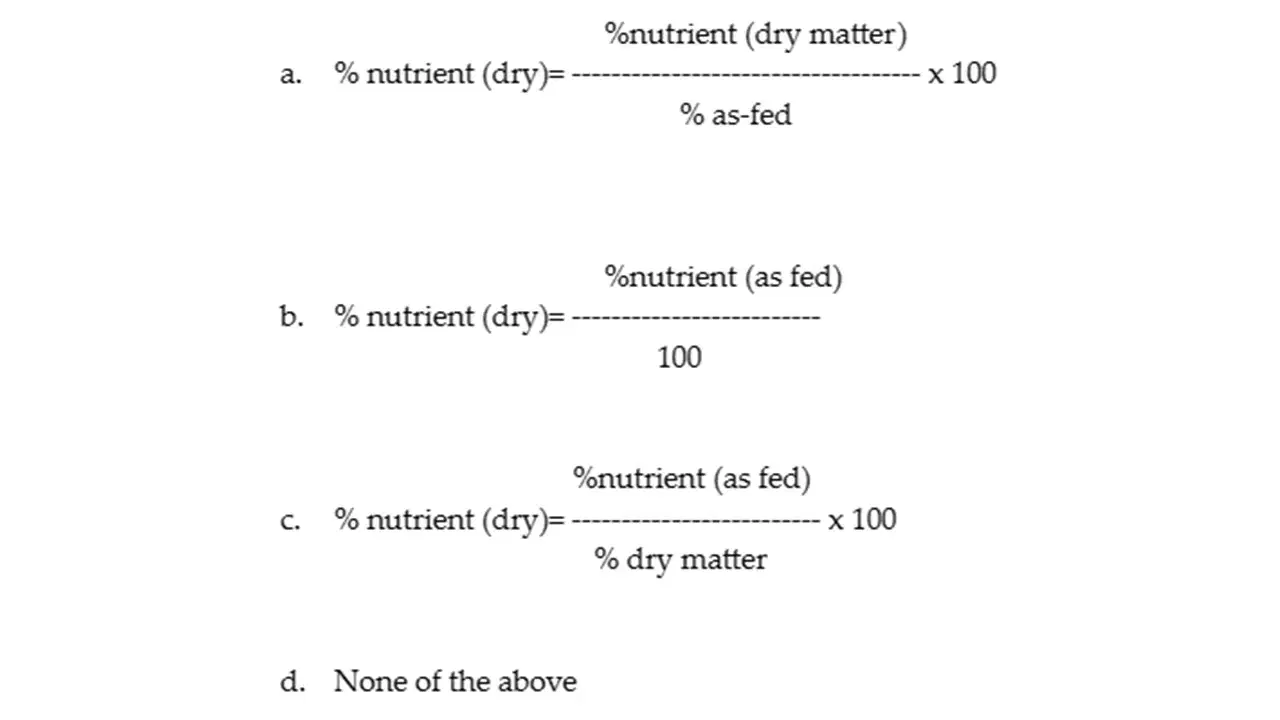
In computing the % of nutrient of dry matter, the formula should be
A
B
C
D
In converting feeds from one basis to another, the formula required in solving the dry matter is:
B = A ÷ C
A =B×C
C =A×B
B=A × C
In computing feeds using the Pearson square, the nutrient requirement and the available requirement are subtracted in what way?
Vertically
Horizontally
Diagonally
All of the above
415 kilograms of feed is needed to feed a 32-kg growing hog. A feeding standard requires a 15% crude protein ration. Corn and soybean oil meal are selected as feeds. A feed composition shows that corn has 13% and soybean oil has 38% crude protein, respectively on as-fed basis. How much corn and soybean oil meal are needed to be mixed together to complete the 415 kg requirement for the growing hog?
230 kg of Corn and 185 kg Soybean oil meal
33.2 kg of Corn and 381.8 kg Soybean oil meal
185 kg of Corn and 230 kg of Soybean oil meal
381.8 kg of Corn and 33.2 kg of Soybean oil meal
8 kg of Soybean oil meal and 92 kg of Corn
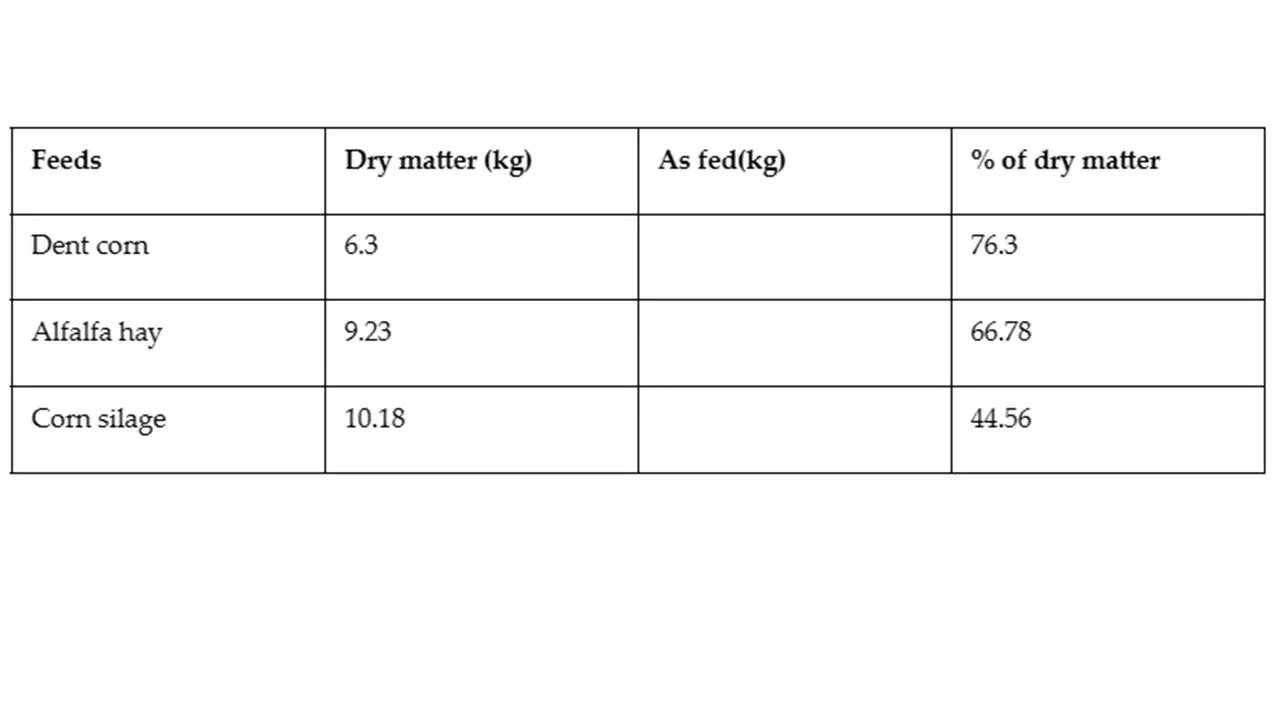
Compute for the amount of as-fed Dent corn?
6.82 kg
8.26 kg
9.82 kg
3.67 kg
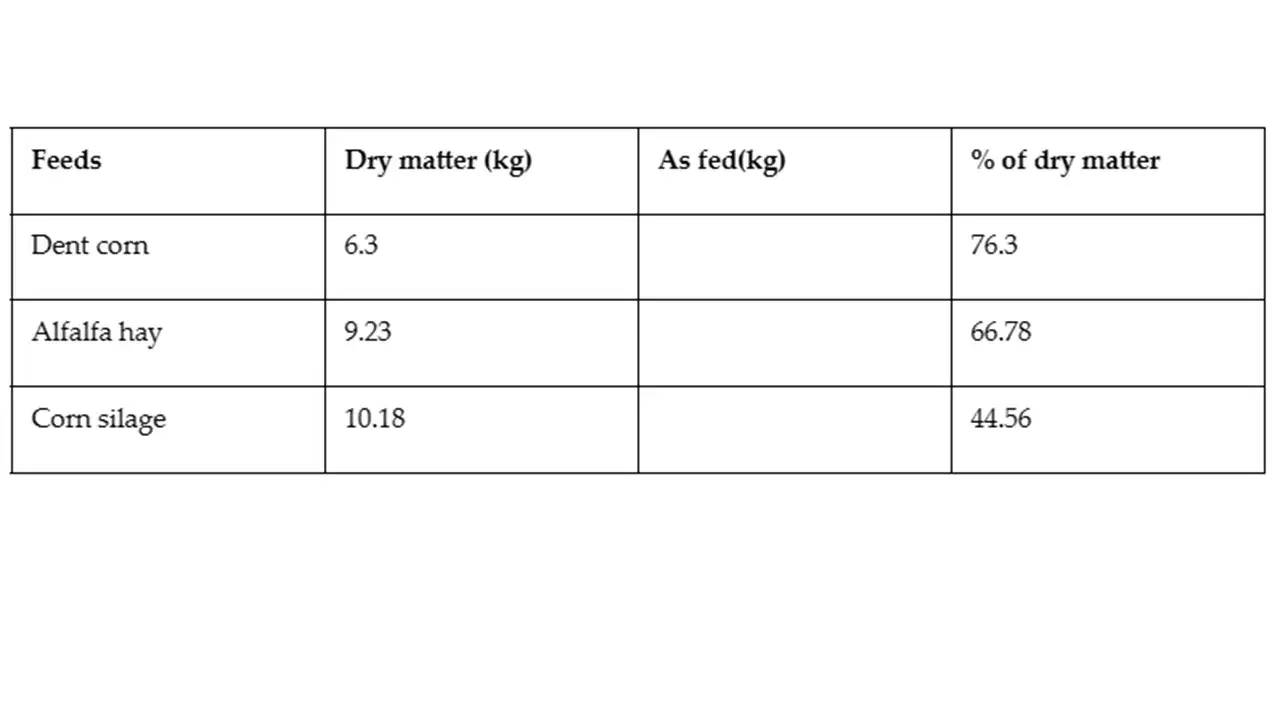
Compute for the amount of as-fed Alfafa hay?
8.26 kg
12.82 kg
10.26 kg
13.82 kg
Compute for the amount of as-fed Corn silage?
22.85 kg
18.84 kg
8.26 kg
13.82 kg
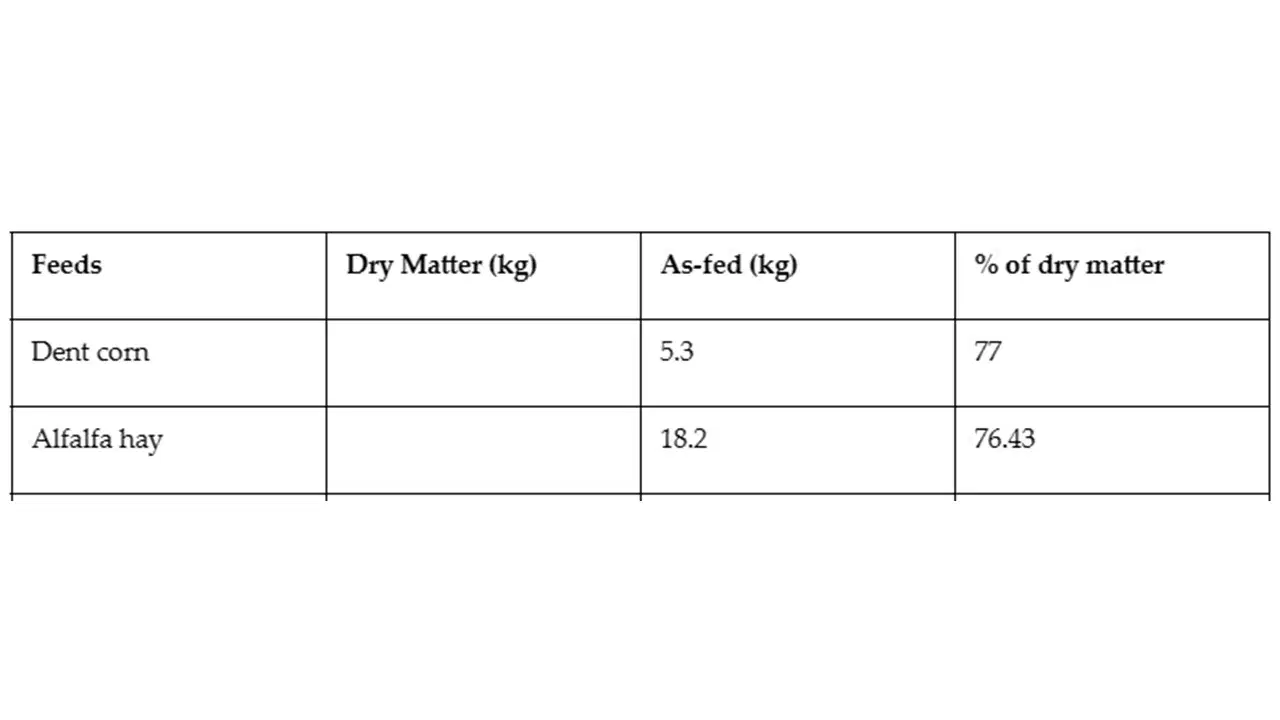
Compute for the amount of dry matter Dent corn?
4.08 kg
6.88 kg
408.1 kg
3.85 kg
Compute for the amount of dry matter Alfalfa hay?
58.23 kg
7.06 kg
13.91 kg
23.81 kg

