
 Worksheets
Biol111 DNA replication
Total questions: 53
Worksheet time: 53mins
Which of the following units are repeatedly joined together to form a strand of DNA?
Amino Acids
Nucleotides
Fatty Acids
Polysaccharides
Nucleotides polymerize by adding from
3’ to 5’
5’ to 5’
5’ to 3’
3’ to 3’
The process of DNA replication is called semi conservative because it results in
none of these
Two DNA molecules. One original molecule and one with two new strands
two exact copies with new strands
two DNA molecules, each with 1 original strand and one new.
If the structure of DNA was not anti parallel, then it would not have a double helix
True
False
Nitrogen bases are joined by which type of bond?
polar bonds
hydrogen bonds
phosphate bonds
deoxyribose bonds
Adenine bonds with _____
Cytosine
Thymine
Guanine
Uracil
Cytosine bonds with ____
Adenine
Thymine
Guanine
Uracil
What does DNA stand for?
Deoxyribonucleic acid
Denitrogenous acid
Deribonucleic acid
Diribonucleic acid

The picture below shows the steps of DNA replication beginning with step one and ending with step three.
Because you are reusing the old, or parent, DNA strand DNA replication is said to be
Semi- Conservative
Semi-discontinuous
Continuous
Fully-Conserveative

The picture below shows an enzyme unzipping DNA.
What is the name of this enzyme?
DNA Helicase
DNA Ligase
DNA polyermase
DNA topoisomerase
Match the nucleotide with its complementary nucleotide.
Cytosine-
Thymine
Guanine
Adenine
Cytosine
Which enzyme is responsible for adding the free nucleotides to the replicating DNA?
DNA Helicase
DNA Ligase
DNA polyermase 3
DNA polymerase 1
Which is the first step of DNA replication?
Topoisomerase unwinds original DNA strand
RNA Primase lays down RNA primer for new nucleotide bases.
DNA polymerase builds new strands by bring in new nucleotide bases.
Helicase separates the DNA strand
Which is the second step of DNA replication?
DNA Helicase unzips original DNA strand
RNA Primase lays down RNA primer for new nucleotide bases.
DNA polymerase builds new strands by bring in new nucleotide bases.
Ligase knits together fragments on lagging strand
Which is the third step of DNA replication?
DNA Helicase unwinds original DNA strand
Primase lays down RNA primer for new nucleotide bases.
DNA polymerase builds new strands by bring in new nucleotide bases.
Ligase knits together fragments on lagging strand
Which is the fourth step of DNA replication?
DNA Helicase unwinds original DNA strand
Primase lays down RNA primer for new nucleotide bases.
DNA polymerase builds new strands by bring in new nucleotide bases.
Ligase knits together fragments on lagging strand
What is the fifth step in dna replication?
Helicase unzips nucleotides
Topoisomerase unwinds DNA
Ligase glues nicks together
DNA polymerase 3 adds nucleotides

Which letter in the picture below depicts the leading strand in DNA replication?
A
C
B
Both A and B
Which letter in the picture below depicts the lagging strand in DNA replication?
A
C
B
Both A and B
If a person suffered from a disorder where their DNA fragments were unable to fill in the missing slots in between the fragments of the lagging strand, they would most likely have a disorder that affected which enzyme?
DNA Helicase
DNA Ligase
DNA polyermase
RNA Polymerase
Okazaki fragments appear on which strand of DNA during DNA replication?
lagging
leading
deoxyribose and nitrogenous base
Nitrogenous base and phosphate
deoxyribose sugar and phosphate
ATG TGA CAG

Nitrogenous base
What is the difference between a nitrogenous base and a nucleotide?
A nitrogenous base is a part of a nucleotide; a nucleotide includes a nitrogenous base, sugar, and phosphate group.
a nucleotide is a part of a nitrogenous base; a nitrogenous base includes a nucleotide, sugar, and phosphate group


Enzyme that fills in the gaps between nucleotides
Ligase
Polymerase
Helicase
Primase
Enzyme that breaks hydrogen bonds (unzips)
Ligase
Polymerase
Primase
Helicase
Site where replication begins
Polymerase action site
Replication fork
Replication Origin
In the front
The new DNA strand formed after DNA replication is an exact copy of its parent strand
True
False
Proteins that DNA winds itself around to create a Chromosome
Histones
Enzymes
Chromatin
DNA polymerase

Which bases are purines?
A
G
T
C
Which bases are pyramidines?
C
T
G
A
The percentage of A and T are equal, and C and G are equal
True
False
What is the purpose of SSBs?
Snipping DNA
Removes tension in strand
Prevents the strands from making secondary structures (Bonding back together)
Separates the bases
What does topoisomerase do?
It relives tension in the strand By unwinding
It separates hydrogen bonds
It glues the fragments together
It prevents secondary structures from forming
A template strand can be read either 3’ to 5’ or 5’ to 3’
False, a template strand can only be read 5' to 3'.
True, a template strand can be read in both directions simultaneously.
False, a template strand cannot be read at all.
False, a template strand can only be read 3' to 5'.

A segment of DNA is shown in the diagram. Which of these identifies the part of the DNA segment labeled X?
Nucleotide
Phosphate group
Hydrogen bond
Deoxyribose
What is a phosphodiester bond between?
What way does a replication bubble open?
<— and —>
—> only
<— only
—> and <—
What is an origin of replication?
What determines the leading strand vs the lagging strand?
What is the correct way to label the carbons on a sugar?
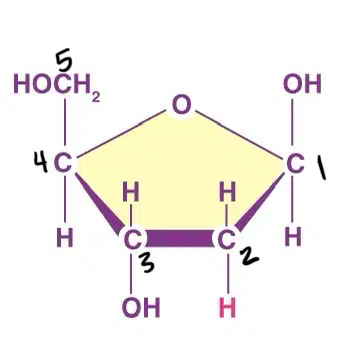
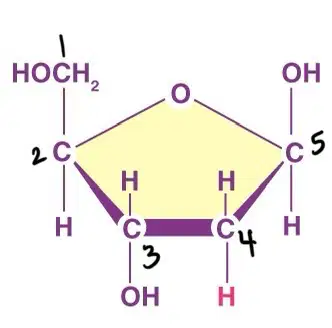
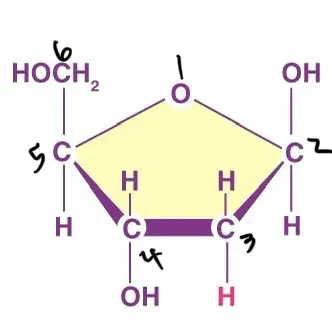
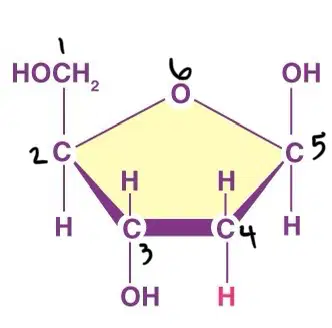
How many origins of replication can there be?
Multiple origins of replication in eukaryotes
No origins of replication in eukaryotes
One origin of replication in eukaryotes
What is the difference between DNA and RNA?
What is the difference between a replication fork and a replication bubble?
A replication fork is the point of separation of DNA strands during replication that occurs in one direction, while a replication bubble is a region where replication occurs in both directions, containing two forks.
A replication bubble is the point of separation of DNA strands during replication that occurs in one direction, while a replication fork is a region where replication occurs in both directions, containing two bubbles.
Where is a nucleotide added to another nucleotide?
At either the 3' end or the 5’ end
At the 3' end
At the 5' end
In between the phosphodiester bond
What is the correct order of enzymes used in DNA replication?
Topoisomerase, Helicase, Primase, DNA Polymerase, Ligase
DNA Polymerase, Helicase, Ligase, Primase, topoisomerase
Primase, Ligase, Helicase, topoisomerase, DNA Polymerase
Topoisomerase, DNA Ligase, Primase, Helicase, DNA Polymerase

