wayground logo

Free Printable Worksheets

NEW

Font size

S
M
L
XL
Worksheets

Post test review

Total questions: 55

Worksheet time: 29mins

Name
Class
Date
1.
When assessing the ankle on a pt, you perform an anterior drawer test and notice an empty feeling endpoint. There is movement beyond the anatomical limit and pain that occurs at the end of the range. What type of injury does the pt most likely have? 
a)
grade 2 muscle strain
b)
grade 3 ligament sprain
c)
grade 3 muscle strain 
d)
none of the above
2.
The vertebrae are ....
a)
Long Bones
b)
Short Bones
c)
Flat Bones
d)
Irregular Bones
3.
The tibia is a ....
a)
Long Bone
b)
Short Bone
c)
Flat Bone 
d)
Irregular Bone
4.
The scapula is a ....
a)
Long Bone
b)
Short Bone
c)
Flat Bone 
d)
Irregular Bone
5.
The cranial bones are ....
a)
Long Bones
b)
Short Bones
c)
Flat Bones
d)
Irregular Bones
6.
The ribs are ....
a)
Long Bones
b)
Short Bones
c)
Flat Bones
d)
Irregular Bones
7.
The humerus is a ....
a)
Long Bone
b)
Short Bone
c)
Flat Bone 
d)
Irregular Bone
8.
The femur is a ....
a)
Long Bone
b)
Short Bone
c)
Flat Bone 
d)
Irregular Bone
9.
The right shoulder is ______ to the sternum.
a)
medial
b)
superior
c)
inferior
d)
lateral
10.
The bone is _____ to the skin.
a)
inferior
b)
superficial
c)
deep
d)
posterior
11.
Away from midline
a)
Lateral
b)
Distal
c)
Superior
d)
Transverse
12.
Toward the back; opposite of Anterior
a)
Superior
b)
Posterior
c)
Inferior
d)
Lateral
13.
Away from the origin or trunk
a)
Deep
b)
Distal
c)
Proximal
d)
Posterior
14.
Closer to midline in relation to another part
a)
Deep
b)
Distal
c)
Medial
d)
Proximal
15.
The head is ______ to the chest.
a)
superior
b)
dorsal
c)
inferior
d)
ventral
16.
The tibia is ______ to the femur.
a)
distal
b)
proximal
c)
deep 
d)
superficial
17.
Your pelvis is ______ to your clavicle.
a)
inferior
b)
distal
c)
superior
d)
lateral
18.
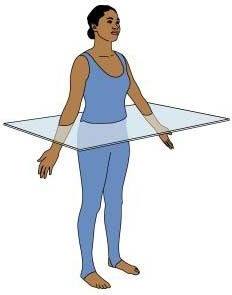
Plane that divides body into top and bottom portions (superior-head; inferior-feet)
a)
Medial Plane
b)
Sagittal
c)
Proximal 
d)
Transverse Plane
19.
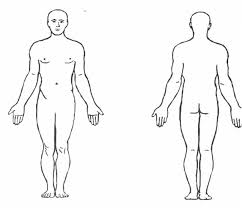
Body is standing straight, facing forward, upper limbs at side and palms facing forward. 
*right and left refer to "right" and "left" of the body in position.
a)
Sagittal
b)
Anatomical Position
c)
Anterior Position
d)
Anatomical Plane
20.
The rib cage is _____ to the heart.
a)
proximal
b)
medial
c)
superficial
d)
distal
21.
What is the plane that divided the body into left and right halves called? 
a)
frontal
b)
transverse 
c)
sagittal
d)
lower quadrant
22.
What would be a motion that is performed in the sagittal plane? 
a)
trunk twists
b)
running
c)
jumping jacks
d)
none of the above
23.
What is the plane that divides the body into front and back halves? 
a)
transverse
b)
frontal
c)
sagittal
d)
upper quadrant
24.
What is a motion in the frontal plane?
a)
jumping jacks
b)
running
c)
trunk twists
d)
none of the above
25.
What motion will occur in the transverse plane?
a)
running
b)
jumping jacks
c)
trunk twists
d)
arm/leg abduction
26.
What major muscle group is shown here?
a)
hamstrings
b)
quadriceps
c)
biceps
d)
gastrocnimeus
27.
What major muscle group is shown here?
a)
hamstrings
b)
quadriceps
c)
biceps
d)
gastrocnimeus
28.
Which letter refers to the lumbar section of the vertebral column?
a)
A
b)
B
c)
C
d)
D
29.
Which letter refers to the cervical section of the vertebral column?
a)
A
b)
B
c)
C
d)
D
30.
What part of the HOPS assessment is the most critical to know in order to make a accurate diagnosis?
a)
medical history
b)
conditions of the playing field
c)
the mechanism of the injury
d)
position the pt plays
31.
What does the H in HOPS assessment stand for?
a)
History
b)
Harmful
c)
Histology
d)
His/Her
32.
What does the O in HOPS stand for?
a)
Ocular
b)
observation
c)
Obscene
d)
Obvious
33.
What does the P in HOPS stand for? 
a)
Perfect 
b)
Position
c)
Palpation
d)
Pifiormis
34.
What does the S in HOPS stand for?
a)
Secret Tests
b)
Special Tests
c)
Special moves
d)
Spinal 
35.
What is considered a normal BP?
a)
135/80
b)
178/75
c)
121/81
d)
120/80
36.
What does the systolic/top number on the blood pressure represent?
a)
pressure in the arteries when the heart is contracting
b)
pressure in the ventricles when the heart is between contractions
c)
pressure around the heart
d)
none of the above
37.
What does the diastolic number on the blood pressure indicate?
a)
pressure in the arteries when the left ventricle is between contractions
b)
pressure in the arteries when the heart is contracting 
c)
pressure in the heart 
d)
none of the above
38.
What are two common apophyseal avulsion conditions found in sports?
a)
sever's and myositis ossificans
b)
sever's and osgood-schlatter's
c)
osgood-schlatter's and laarsen-johansen's
d)
none of the above
39.
What are two common tests for the ACL at the knee?
a)
Anterior Drawer and posterior drawer
b)
anterior drawer and lachman
c)
lachman and posterior drawer
d)
none of the above
40.
Which muscle of the quadriceps group will undergo atrophy after a surgery?
a)
vastus lateralis
b)
trapizeus
c)
deltiod 
d)
vastus medialis oblique
41.

Which terms describe directions that are opposite of one antoher?

a)

distal and superior

b)

anterior and superior

c)

medial and inferior

d)

proximal and distal

e)

lateral and posterior

42.

The term "lumbar" refers to what area of the spine?

a)

mid-back

b)

low back

c)

tailbone

d)

neck

43.

What are the 2 major muscle groups that cross both the hip and knee joints?

a)

biceps and quadriceps

b)

pectorals and hamstrings

c)

triceps and obliques

d)

quadriceps and hamstrings

e)

gluteals and lats

44.

Indicate which step of the HOPS routine is being addressed in this action: You perform a talar tilt test

a)

History

b)

Observation

c)

palpation

d)

special test

45.

Indicate which step of the HOPS routine is being addressed in this action: You ask the pt what happened

a)

History

b)

Observation

c)

palpation

d)

special test

46.

Indicate which step of the HOPS routine is being addressed in this action: You push on her anterior talofibular ligament

a)

History

b)

Observation

c)

palpation

d)

special test

47.

Indicate which step of the HOPS routine is being addressed in this action: You perform a tibia-fibula squeeze test

a)

History

b)

Observation

c)

palpation

d)

special test

48.

Indicate which step of the HOPS routine is being addressed in this action: You ask if she heard a "pop"

a)

History

b)

Observation

c)

palpation

d)

special test

49.

Indicate which step of the HOPS routine is being addressed in this action: You notice the amount of swelling present

a)

History

b)

Observation

c)

palpation

d)

special test

50.

Indicate which step of the HOPS routine is being addressed in this action: You touch her Achilles tendon

a)

History

b)

Observation

c)

palpation

d)

special test

51.

Indicate which step of the HOPS routine is being addressed in this action: You ask her to perform active dorsiflexion

a)

History

b)

Observation

c)

palpation

d)

special test

52.

Indicate which step of the HOPS routine is being addressed in this action: You perform an anterior drawer test

a)

History

b)

Observation

c)

palpation

d)

special test

53.

Indicate which step of the HOPS routine is being addressed in this action: You question specific time of injury

a)

History

b)

Observation

c)

palpation

d)

special test

54.

Indicate which step of the HOPS routine is being addressed in this action: You check for bruising or discoloration

a)

History

b)

Observation

c)

palpation

d)

special test

55.

Indicate which step of the HOPS routine is being addressed in this action: You touch her lateral malleolus

a)

History

b)

Observation

c)

palpation

d)

special test