wayground logo

Free Printable Worksheets

Font size

S
M
L
XL
Worksheets

Complex Invertebrates

Total questions: 60

Worksheet time: 31mins
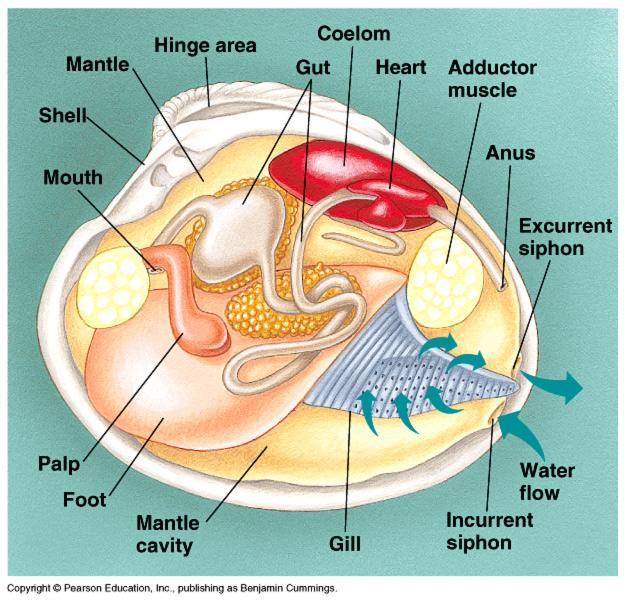
Name
Class
Date
1.
Which part of the Mollusk body is specialized for burrowing, feeding, and movement?
a)
trochophores
b)
visceral mass
c)
mantle
d)
foot
2.
Which part of the Mollusk body is the tissue covering the body and secretes the shell?
a)
Mantle
b)
Trochophore
c)
Foot
d)
Visceral Mass
3.
Which part of the Mollusk body contains organs?
a)
Foot
b)
Visceral Mass
c)
Trochophore
d)
Mantle
4.
Which class of Mollusks have the most advanced nervous system?
a)
Gastropods
b)
Bivalves
c)
Cephalopods
d)
arthropods
5.
Which of the following is the organ used by Mollusks for excretion?
a)
gills
b)
nephridia
c)
mantle
d)
visceral mass
6.
Which of the following is the correct description of the body cavity of Mollusks?
a)
They are  protostome acoelomates
b)
They are protostome coelomates
c)
They are deuterostome coelomates
d)
They are protostome pseudocoelomates
7.

Which class of Mollusks have many species that are sessile or sedentary?

a)

Gastropods

b)

Bivalves

c)

Cephalopods

d)

arthropods

8.
The mollusk larval stage of development is called the
a)
coelomate
b)
trochopore
c)
radula
d)
cephalopod
9.
Which part of the mollusk contains the heart, digestive and reproductive organs?
a)
radula
b)
head-foot
c)
visceral mass
d)
trochopore
10.
Organs that are in contact with blood supply and specialized for gas exchange
a)
trochopore
b)
radulas
c)
bivalves
d)
gills
11.
Mollusk's tongue-like strip covered with teeth that point backward is called the ____
a)
trochopore
b)
radula
c)
gills
d)
visceral mass
12.
Which of the following is the correct description of reproduction in Mollusks?
a)
Mostly asexual
b)
Budding
c)
Regeneration
d)
Mostly sexual
13.

Which phylum of worms has a bilateral symmetry, a one-way digestive system with a separate mouth and anus, respiration through the skin, a hydrostatic skeleton, and a segmented body?

a)
Annelida
b)
Platyhelminthes
c)
Nemotoda
d)
Nemertea
14.
Which structure is NOT associated with digestion?
a)
Gizzard
b)
pharynx
c)
nephridia
d)
crop
15.

Which of the following is a larger segment of the earthworm’s body is used to create a coocoon for eggs?

a)
Septa
b)
Setae
c)
Clitellium
d)
Ganglia
16.

Which type of skeleton is found in worms?

a)
Longitudinal
b)

Endoskeleton

c)
Exoskeleton
d)
Hydrostatic
17.

Which of the following is a structure related to excretion in worms?

a)

Ganglia

b)

Gizzard

c)

Nephridia

d)

Crop

18.

Which phylum has pseudocoelomate?

a)
Platyhelminthes
b)
Nematoda
c)
Annelida
d)

Mullusca

19.

Which phylum mostly parasitic and includes hookworms, pinworms, and heart worms?

a)
Platyhelminthes
b)
Nematoda
c)
Annelida
d)

Tardigrada

20.

Which of the following is the evolutionary advancement found is found annelids and arthropods (and chordates) but not mollusks and roundworms?

a)

Three germ layers

b)

Need to molt

c)

Cephalization

d)

Coelomates

e)

segmentation

21.

Which is NOT a member of the clade, Edysozoa?

a)
Roundworm
b)

Arthropods

c)
Segmented worms 
d)

Tardigrades

22.
As members of the clade ____, Arthropods, like roundworms, must molt to grow thanks to their protective outer covering.
a)
Deuterostomia
b)
Bilateria
c)
Lophotrochozoa
d)
Ecdysozoa
23.

Spiders, ticks, and scorpions are in the class, Arachnida, which is part of the subphylum ___, which is named after the mouthparts that resemble fangs or jaws.

b)

Crustacea

c)

Myriapoda

d)

Hexapoda

24.
Which group of arthropods have 3 body segments: head, thorax, and abdomen?
a)

Crustacea

c)

Myriapoda

d)
Insecta
25.
Lobster, shrimp, and crabs are examples of what group of Arthropods?
a)

Insects

c)
Crustaceans
d)

Trilobites

26.
All arthropods have segmented bodies, jointed appendages, and ________________. 
a)
tails
b)
lungs
c)
wings
d)
an exoskelton
27.
Which groups have 2 body segments: cephalothorax and abdomen?
a)
Chilopoda and Insecta
b)
Diplopoda and Chilopoda
c)
Arachnids and Crustaceans
d)
Crustaceans and Insecta
28.
The malpighian tubules are organs associated with which system?
a)
skeletal
b)
Digestive
c)
Reproductive
d)
Excretory
29.
Why do arthropods have to shed their exoskeletons?
a)
it wears out
b)
they don't shed
c)
it limits the size they can grow
d)
to go from water to land environments
30.
Respiratory organ in spiders that is modified for life on land 
a)
gills
b)
book lungs
c)
lungs
d)
pharynx
e)

tracheal tubes

31.
Which of the following is NOT a benefit of insects?
a)
biological control
b)
disease carriers
c)
pollinators
d)
source of food
32.
Which group contains the largest number of animal species?
a)
Arthropods
b)
fish
c)
vertebrates
d)
jellyfish
33.
The phylum Echinodermata includes all of the following except:
a)

seastars

b)
clams
c)
sand dollars
d)
basket stars
34.
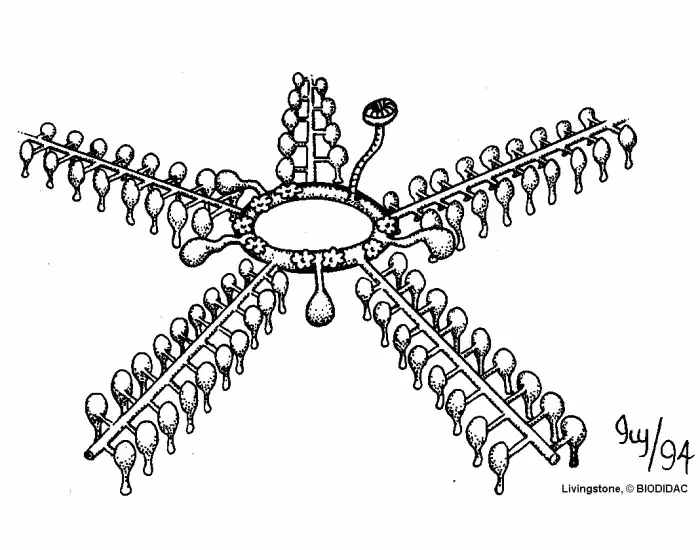
What allows water to enter the water vascular system?
a)
tube feet
b)
mouth
c)
ampulla
d)
madreporite
35.
Sea stars feed by ___.
a)
Injecting poison that digests the prey 
b)

Everting (turn inside-out) their stomach to digest prey

c)

Using a radula to their prey with jaws and teeth

d)

Squeezing their prey with their tube feet until it dies

36.
What type of symmetry do adult echinoderms exhibit?
a)
Asymmetry
b)
Pentaradial symmetry
c)
Bilateral symmetry
d)
Trilateral symmetry
37.
What does the term echinoderm mean?
a)
tube feet
b)
star shaped
c)
spiny skin
d)
stomach foot
38.
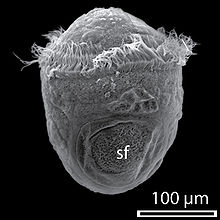
What are these?
a)
Mouth
b)
Anus
c)
Madreporite
d)
Tube foot
39.
The larva of echinoderms have _____ symmetry.
a)
Asymmetrical
b)
Bilateral
c)
Radial
d)
None
40.
Echinoderms have an internal skeleton and a system of fluid-filled tubes called a(n)...
a)
water vascular system
b)
nervous system
c)
notochord
d)
ampulla
41.
Tiny pincers that surround the spines that help keep foreign objects off the sea star are called ________
a)
tube feet
b)
pedicellariae
c)
madreporite
d)
ampulla 
42.
By what process will starfish regrow an arm torn off by a predator?
a)
Reconstructive meiosis
b)
Regeneration
c)
Tissue regenesis
d)
Mitotic restoration
43.
What type of skeleton do echinoderms have?
a)
Exoskeleton
b)
Hydrostatic skeleton
c)
Endoskeleton
d)
Mesenteric skeleton
44.

A(n) _______________is a flexible, rod-shaped structure that supports the body of a developing chordate.

a)

notochord

b)

vertebrate

c)

spinal cord

d)

brain

45.

Which of the following is not one of the characteristics of all chordates?

a)

notochord

b)

pharyngeal pouches

c)

bones

d)

post-anal tail

46.

In chordates, the __________ is a dorsal rod, with a sheath of connective tissue, functioning in support.

a)

Nerve cord

b)

Notacord

c)

vertebrate

d)

backbone

47.
In chordates, the __________ are a series of openings in the pharyngeal region, between the digestive tract and the outside of the body. 
a)
gill slits
b)
atriopores
c)
siphons
d)
book gills
48.

Unlike all other animal phyla, the nerve cord in chordates is

a)

found on the dorsal side of the animal

b)

found on the ventral side of the animal

c)

paired

d)

controlled by ganglia instead of a brain

49.

Echinoderms and Chordates are closely related. Which is NOT a character of both phyla?

a)

Deuterostomes

b)

Cephalization

c)

Bilateral symmetry (at some point of their lives)

d)

Endoskeletons

e)

Triploblastic

50.

Which is correctly paired for quadrupeds, bipeds, arthropods and worms?

a)

Ventral = belly side

b)

Dorsal = up

c)

Caudal = head side

d)

Lateral = towards the middle

51.

Which is FALSE?

a)

Exoskeletons aid in protection.

b)

Exoskeletons aid in reducing water loss on land.

c)

Exoskeletons aid movement (for muscle attachment.)

d)

Exoskeletons aid in energy production.

52.

Which is TRUE of segmentation?

a)

Increased mobility

b)

Decreases specialization

c)

Limits regeneration

d)

Aids in cephalization and brain development

e)

Allows for sexual reproduction

53.

Which is correctly paired with its support structure?

a)

Mollusk - exoskelleton

b)

Echinoderm - Endoskeleton

c)

Chordate - Exoskeleton

d)

Annelid - water vascular system

e)

Nematode - hydrostatic skeleton

54.

What function do fame cells, nephridia, green glands, malpigian tubes have in common?

a)

Excretion (removing metabolic waste and maintaining salt and water balance.)

b)

Nervous system (sensing the environment and controlling response

c)

Respiration (obtaining and delivering oxygen)

d)

Digestion (eating, digesting and absorbing nutrients)
55.

Tube feet aid in all of the following EXCEPT ____.

a)

movement

b)

reproduction

c)

feeding/hunting

d)

excretion and respiration

e)

sensing the environment

56.

Radula, pharynx, mandibles, maxillipeds, and chelicerae, all function in ___.

a)

respiration

b)

reproduction

c)

excretion

d)

movement

e)

feeding

57.

Which group of structures do NOT belong together? 

a)

joint, cheliped, appendage

b)

madreporite, stone canal, ring canal, ampule, tube foot

c)

tube foot, notochord, pharynx

d)

compound eye, antenna, tympanum

e)

intestine, cardiac stomach, pyloric stomach, mandible

58.

How do tardigrades reproduce?

a)

Parthenogenesis - females only

b)

Sexually - Give live birth (viviparous)

c)

Sexually - lay eggs (oviparous)

d)

Asexually - budding

59.

Tardigrades can survive in

a)

extreme hot and cold temperatures

b)

hydrothermal vents

c)

high levels of radiation

d)

vacuum of space

e)

all of the above!

60.

Tardigrades are most closely related to roundworms. Considering this, their derived characters include all of the following EXCEPT ____.

a)

triploblasty

b)

cuticle

c)

pseudocoeloms

d)

Deuterostome development