
 Worksheets
Particle Theory & States of matter
Total questions: 25
Worksheet time: 18mins
What is thermal expansion? Explain with an example
Write two differences between boiling point and melting point.
The decrease in the volume of a substance as its temperature decreases is called (a)
The changing of state from gas to solid is called....
Condensation
Deposition
Evaporation
Realisation
An example of a solid is: (Bonus points for creativity)

The process where a gas turns to a liquid is:
Condensation
Sublimation
Rectification
Absorption
Which of the following temperature values is likely going to make the particles of a water to move very slowly? All the numbers given are in degrees celicious.
10
13
16
19
An object _______ when it changes from a solid to a liquid.
Flies
Melts
Goes home
Floats

What is the specific latent heat of fusion?
The amount of energy needed to melt 1 kg of a substance.
The amount of energy needed to boil 1 kg of a substance.
The amount of energy needed to freeze 1 kg of a substance.
True or false. ‘Changes of state are physical changes’.
True
False

The change of state from a solid to a gas is called
freezing

Temperature at which matter changes from liquid to solid is called
What is an example of evaporation?
Putting jelly mix in the freezer
Ice cubes disappearing in a drink
Dew drops on plants
Clothes drying in the Sun


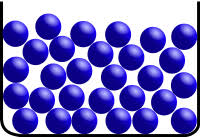
What state of matter is pictured?
Solid
Liquid
Gas
Plasma
There are two answers for this.
Particles in a _________ take the shape of the container.
solid
liquid
gas

If the atoms of an object are moving or vibrating fast, the temperature would be...
cold
hot
unknown

Is an increase in a material's volume when its temperature increases
thermal contraction
thermal expansion
specific heat
An increase in the volume of a material due to a temperature increase in the material.
Thermal contraction
Thermal expansion
Thermal heat

