
 Worksheets
Y9 Question Bank
Total questions: 123
Worksheet time: 3hrs 31mins


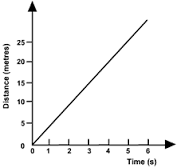
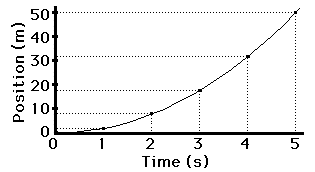
The 2 objects have the same average speed over the 7 seconds. Why?
Both objects traveled the same distance in the same amount of time.
The graph for Object B is steeper at the end of the time.
Object B has sections of zero speed while Object A is never stopped
The final position on the graph for Object A is much greater.

What is happening in section C?
going down a hill
speed is increasing
speed is decreasing

What is occurring at E?
It is traveling at a constant speed
there is no change in motion

At which position is the object accelerating the fastest?
c
k
neither because they are slowing down, which isn't acceleration

How Far did object A travel from 0-7 seconds?
1 meter
2 meters
3 meters
4 meters


limit of proportionality
A graph of extension against force for a material that follows Hooke's Law is:
A spring has a spring constant of 25N/m. What is its extension when loaded with 50N?
2cm
0.5m
2m
25m
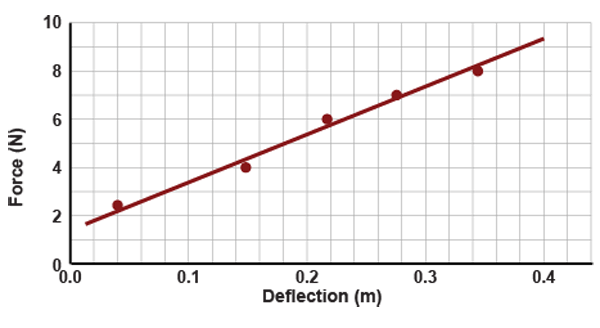
What quantity can you calculate from the graph and give the magnitude of that quantity.
a) Extension of a spring is directly proportional to the force applied.
Spring constant is measured in
N
N/m
m
The relationship between stretching force, F, with the extension, x, of a spring, is given by the equation: F = kx where k is the spring constant. What is the unit of k?
N/m
N/m2
kg/m
N

Which graph shows the correct relationship between the force, F, and the extension, x, of a spring that obeys Hooke's Law?
A
B
C
D

The diagram shows a load M supported by the arrangement of springs P, Q and R. All the springs are identical.
Which comparison is correct about the extension of P, Q and R?
P < Q < R
Q < R < P
R < Q < P
Q < P < R

Which newtonmeter has the stiffest spring?
Remember: a stiffer spring is harder to extend
A
B
C
D

The extension of the spring is the distance between which two points on the metre rule?
A and B
A and C
B and C
A and D

How does this graph show that the limit of proportionality was exceeded?
the best fit line goes through the origin
the best fit line starts to curve
the plotted points all lie on the line of best fit line
the extension is zero at zero force
At what value of force did the spring exceed the limit of proportionality?
4.0 N
5.5 N
6.0 N
6.2 N

What is the spring constant of this spring?
0.25 N/m
0.36 N/m
25 N/m
36 N/cm
What would the graph look like if a stiffer spring was used (and the limit of proportionality was not exceeded)?
The best fit line would be steeper
The best fit line would be less steep
The best fit line would curve
The best fit line would be longer

How could the accuracy of this investigation be improved?
Use a longer ruler to measure the length
Use a pointer from the spring to measure the length
Use a new spring between each reading
Use a stronger spring in the investigation
A spring has a spring constant of 20 N/m
When an apple is hung from the spring, the spring extends 6.5 cm
The spring does not go past the limit of proportionality.
Calculate the force exerted by the apple on the spring.
0.325 N
3.1 N
1.3 N
130 N
What is the spring constant of a spring that extends from 0.10m to 0.30 m long when a force of 4.0 N is applied?
0.8 N/m
1.2 N/m
13 N/m
20 N/m
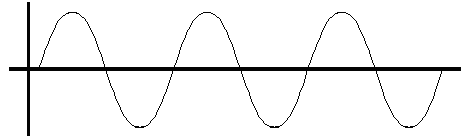
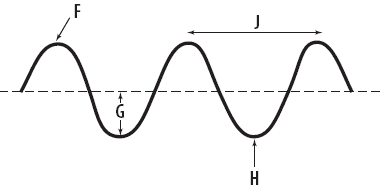
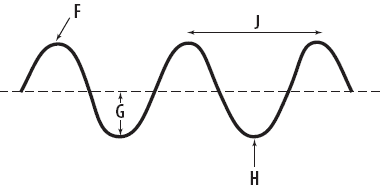
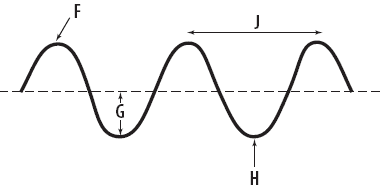
What type of wave is this? (a)
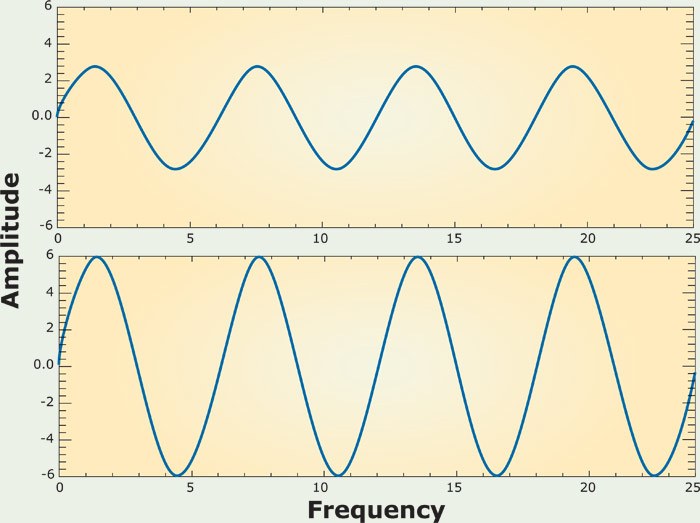
Which property of these waves differs? (a)

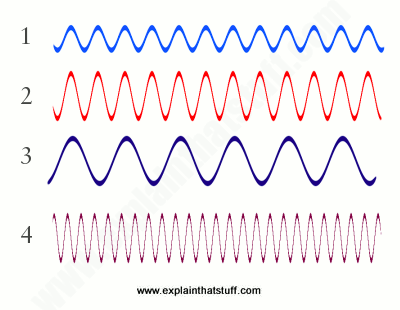

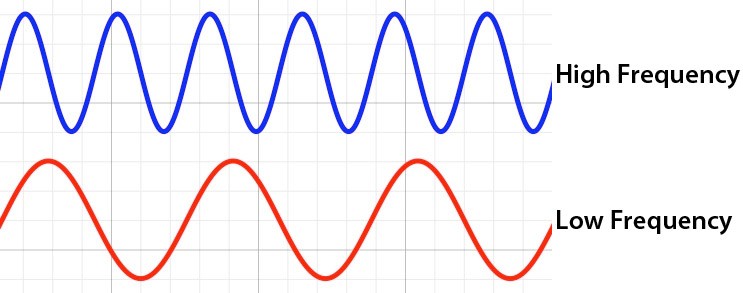
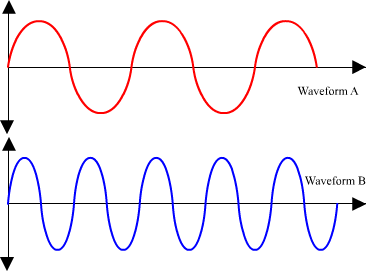
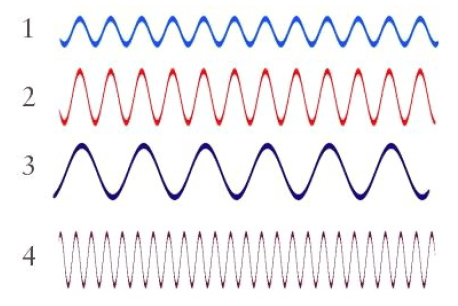
Which wave in the diagram has the greatest frequency?
1
2
3
4
The oscillations in a transverse wave are....
parallel to the direction of the wave
tangentially to the direction of the wave
at an 180 degree angle
perpendicular to the direction of the wave
The oscillations in a longitudinal wave are...
parallel to the direction of the wave
back and forth
tangentially to the direction of the wave
perpendicular to the direction of the wave
All waves
are physical environments in which waves can occur.
move perpendicular to the direction of the wave.
move parallel to the direction of the wave.
are disturbances made by energy within a medium or space.
The oscillations in a transverse wave move....
parallel to the direction of the wave
tangentially to the direction of the wave
at an 180 degree angle
perpendicular to the direction of the wave
The oscillations in a longitudinal wave move...
parallel to the direction of the wave
back and forth
tangentially to the direction of the wave
perpendicular to the direction of the wave

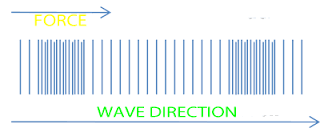
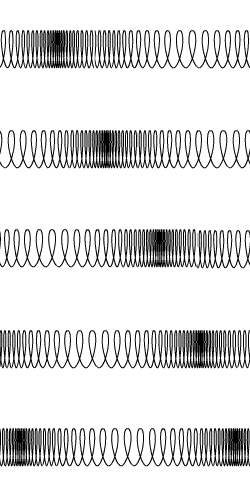
What type of wave is this?
compressional
transverse
longitudinal
surface

What type of wave is this?
rarefaction
compressional
longitudinal
transverse
Waves transfer
the medium in which they occur.
energy.
energy and matter.
disturbances.
What does a wave carry from place to place?
energy
matter
people
energy and matter
A disturbance that transmits energy through matter or empty space.
a. transverse wave
b. trough
c. wave
d. vibration
A wave that can travel through a vacuum is called an (a) wave
A wave that can only travel through a medium is called a (a) wave.
Sound waves are an example of a
transverse wave
longitudinal wave
electromagnetic wave
All electromagnetic waves are (a) waves
True or false? A sound wave can travel through a vacuum.
TRUE
FALSE
Which of these are electromagnetic waves?
sound
radio
infrared
seismic
True or false? Mechanical waves can travel through a vacuum.
TRUE
FALSE
In (a) waves the oscillations are perpendicular to the direction of energy transfer.
Which of these is the correct spelling?
parrallell
paralel
parallel
parralel
Which of these is spelled correctly?
oscillation
ossillation
oscilation
occillation
The electromagnetic spectrum is a continuous range of ______ for electromagnetic radiation.
light
frequencies
particles
magnestism
Electromagnetic waves that you can see
radio waves
visible light
x-rays
ultraviolet rays
Radio waves
Has the longest wavelengths and the lowest frequency
Microwaves
Used in cell phone communication and police radar systems
Infrared rays
It is used in thermal imaging
UV rays
Overexposure to this can result in sunburns and skin cancer
Gamma Rays
Has the highest energy of all electromagnetic radiation and is the most damaging to human tissue
Reorder the following according to the spectrum
red
orange
yellow
green
blue
Reorder the following from shortest wavelength to the longest wavelength.
gamma waves
x-rays
ultraviolet waves
visible light
infrared rays
Reorder the following from shortest wavelength to the longest wavelength.
radio waves
microwaves
infrared
x-rays
gamma waves
Which has more energy?
radio/tv waves
infrared

Which EM waves are have the highest energy & are the most dangerous?
radio
gamma rays
infrared
x-rays
how fast do electromagnetic waves travel through the vacuum of space?
they don't
250,000,000 m/s
the speed of light
100mph
as the wavelength of a wave increases its frequency also increases
true
false
How does light travels?
In a straight line
in a curved path
in a zig-zag path
Sound waves cannot travel through which of these?
paper
milk
outer space
hydrogen

Which Electromagnetic waves help doctors detect a broken bone inside your body?
UV light
Gamma ray
X ray

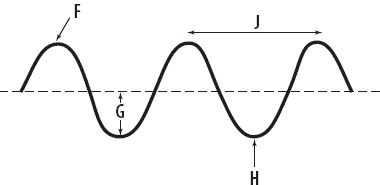
Match these parts of a light wave
Amplitude
height of the wave
wavelength
distance from crest to crest or trough to trough
crest
top
trough
bottom
frequency
how often waves occur
Order these colors from least energy to most energy
red
orange
green
blue
violet
Order these radiant energy forms from least energy to most energy
radio
microwave
infrared
visible
match these types of energy with how they can be used
Infrared
"seeing" the heat of a person or animal in the dark
Radio
music, communication
Microwaves
cooking
Ultraviolet (UV)
growing plants, tanning, cleaning
X-Rays
"seeing" inside the body (bones)
The number of cycles that are completed per second is called the ________ and is measured in _________.
frequency, Hertz
wavelength, meters
amplitude, meters
period, seconds

Which wave has the highest frequency?
1
2
3
4

Examine the picture. What is the period of the wave?
8 seconds
1/8 sec
1/8 Hz
8 Hz

Examine the picture: What is the frequency of one wave?
8 sec
0.125 Hz
8 Hz
0.125 sec

Examine the picture. What happens to the period of a wave as frequency increases?
Increases
Decreases
The frequency of a wave is 10 Hz. What is the period of the wave?
10 sec
0.1 sec
0.5 Hz
5 sec
The period of a wave is 4 seconds. What is the frequency?
0.25Hz
0.25 sec
4 Hz
2 Hz
The time needed for a wave to complete one full cycle is the ____ .
period
frequency
harmonic
amplitude
A boy notices that 45 complete waves travel past him in 90 seconds. What is the frequency of these water waves?
100 m
1 Hz
0.5 Hz
1m/s
What is the unit of measurement for kinetic energy? (a)
What is the equation for calculating kinetic energy?
21mv2
FΔx
vm
mgh
A bicycle and a person with a total mass of 80 kg are traveling at a velocity of 7 m/s. What is their kinetic energy?
156,800 J
1,960 J
0.82 J
7,840 J
What is the kinetic energy (in Joules) of a 4kg shotput thrown with a velocity of 13m/s?
Can energy be created or destroyed?
no
yes
As the velocity of an object decreases its kinetic energy will...
increase
decrease
stay the same
Suppose all of the objects are moving at 15 mph. Reorder the following objects from that with the least kinetic energy to that with the greatest
A honeybee
A ball
A dog
A car
A plane
For an object of constant mass, m, moving at a speed of v, the kinetic energy is:
21mv2
When the speed of the object is doubled, the kinetic energy of the object will (a)
Complete the equation for kinetic energy:
kinetic energy = 0.5 x (a) x (b) 2
Complete the equation for work done:
work done = (a) x distance
Complete the equation for gravitational potential energy:
Ep = mass x gravitational field strength x (a)
Complete the equation for wave speed:
wave speed = (a) x wavelength
Complete the equation for work done:
work done = force x (a)
Complete the equation for wave speed:
wave speed = frequency x (a)

