
Font size
 Worksheets
EM - Acute Abdoemn
Total questions: 34
Worksheet time: 18mins
What of the following is NOT a sign that requires surgery or surgery specialist consult even before or while doing work-up for acute abdomen?
Hypotension
Shock
Severe pain
Instability
What is NOT a s/s of acute abdomen?
Abd distension
Gradual onset
Severe pain
Rebound tenderness
Abd rigidity or guarding
What is NOT a s/s of acute abdomen?
Hematemesis
Pulsatile mass
Weakness, numbness, decreased perfusion of extremities
Ill-appearing, uncomfortable, in distress
Dull, vague symptomology
What is NOT a s/s of benign abdomen?
No guarding, rebound tenderness, distension or rigidity
Normal or mildly abdnormal lab/radiologic studies
Stable vitals
Hematemesis
Dull, vague symptomology
Vascular accident or rupture of a hollow viscus would correlate with what onset of pain?
Abrupt excruciating pain at onset
Abrupt severe pain at onset and worsens rapidly
Gradual mild pain at onset with slowly worsening pain
Urolithiasis, acute pancreatitis, mesenteric thrombosis, small-bowel strangulation, ruptured ectopic pregnancy, ruptured ovarian cyst would correlate with what onset of pain?
Abrupt excruciating pain at onset
Abrupt severe pain at onset and worsens rapidly
Gradual mild pain at onset with slowly worsening pain
Peritoneal inflammation or infection (appendicitis or diverticulitis) would correlate with what onset of pain?
Abrupt excruciating pain at onset
Abrupt severe pain at onset and worsens rapidly
Gradual mild pain at onset with slowly worsening pain
Vascular condition (MI, mesenteric ischemia, AAA), acute pancreatitis, perforation of hollow viscus, peritonitis, renal colic, and biliary colic would correlate with what characteristic of pain?
Severe
Dull
Intermittent (crampy)
Absent (Abdominal "fullness")
Vague, sometimes poorly localized and gradual onset suggest an inflammatory process or low-grade infection (appendicitis or diverticulitis) would correlate with what characteristic of pain?
Severe
Dull
Intermittent (crampy)
Absent (Abdominal "fullness")
Gastroenteritis, mechanical small bowel obstruction, ovarian torsion would correlate with what characteristic of pain?
Severe
Dull
Intermittent (crampy)
Absent (Abdominal "fullness")
Also known as "gas stoppage sign." Pain beginning at midline of abd, accompanied by urge downward, and persisting despite defecation would correlate with what characteristic of pain?
Severe
Dull
Intermittent (crampy)
Absent (Abdominal "fullness")
Shoulder pain to ipsilateral diaphragmatic irritation by air, blood, or infection in the peritoneal cavity as pattern of radiation or shift in location would correlate with what?
Cholecystitis
Appendicitis
Ureteral colic in urolithiasis
Flank pain to groin or genitalia as pattern of radiation or shift in location would correlate with what?
Cholecystitis
Appendicitis
Ureteral colic in urolithiasis
What symptoms with abd pain might suggest infection of the urinary or biliary system, such as pyelonephritis and cholangitis?
Fever with chills
Fever will chills, jaundice, hypotension
High fever and peritoneal signs in female
What symptoms with abd pain might suggest suppurative cholangitis surgical emergency?
Fever with chills
Fever will chills, jaundice, hypotension
High fever and peritoneal signs in female
What symptoms with abd pain might suggest acute salpingitis with pelvic peritonitis when accompanied by no apparent systemic illness?
Fever with chills
Fever will chills, jaundice, hypotension
High fever and peritoneal signs in female
What do high pitch and/or hyperactive bowel sounds suggest?
Pyelonephritis
Cholangitis
Bowel obstruction
Appendicitis
What of the following is NOT correctly matched?
CMP - electrolyte imbalance/kidney function - Fluid loss
Elevated lipase/amylase - Pancreatitis or biliary obstruction
Elevated lactic acid - severe infection, sepsis, organ damage, mesenteric ischemia
+ G/C culture - PID
UA - bacteria - urolithiasis
All of the following are radiologic studies for acute abdomen, but what is the most commonly used?
CTA C/A/P
Abd plain radiographs (+/- chest)
Abd/pelvic US
CT of abd/pelvis
What of the following abd x-ray finding is NOT correctly matched with the diagnosis?
Gas pattern/air-fluid levels ----> diverticulitis
Cecum and sigmoid ----> volvulus
Colonic dilations ----> obstructions or toxic megacolon
Air in abnormal location ----> perforated gastric/duodenal ulcer or colon
Calcifications/ opacities ----> gallstones, ureteral stones, foreign body
What imaging study is most useful for gallbladder, biliary ducts, pancreas, appendix, abd aorta, renal tract (hydronephrosis w/ urolithiasis in pregnant women), and reproductive tract?
CTA C/A/P
Abd plain radiographs (+/- chest)
Abd/pelvic US
CT of abd/pelvis
What type of CT a/p is best to assess for urolithiasis or in those with kidney failure?
w/o IV contrast
w/ IV contrast
What type of CT a/p is best to assess for infection, bleeding, masses, necrosis (appendicitis, diverticulitis, pancreatitis, spleen rupture, ischemic colitis, and retroperitoneal hemorrhage)?
w/o IV contrast
w/ IV contrast
What imaging study is most useful for evaluation of PE, thoracic/abd aneurysm or dissection, solid viscus injury, or massive lower GI bleed?
CTA C/A/P
Abd plain radiographs (+/- chest)
Abd/pelvic US
CT of abd/pelvis
What is NOT possible management for acute abdomen?
IV fluids & analgesics
Liquid diet
Anti-emetics +/- NG suctioning
ABX
Surgical consultation
All of the following are IV ABX choices for mild/mod acute abdominal disease, EXCEPT one that is for severe disease.
Moxifloxacin
Ampicillin-sulbactam
Piperacillin-Tazobactam
Ertapenem
Metro + Cipro
All of the following are IV ABX choices for severe acute abdominal disease, EXCEPT one that is for mild/mod disease.
Imipenem
Ampicillin-sulbactam
Piperacillin-Tazobactam
Meropenem
Ampicillin + Metro
A 42 yo WF with no significatn PMH comes to the ER with c/o abdominal pain for 3 days. She also c/o low fever and pain that is worse after eating. On exam, her temp is 100 F, she is mildly tachycardic, appears uncomfortable, and is tender with guarding in the RUQ. She has a positive Murphy's sign. Does this describe a likely acute or benign abdominal process?
Acute
Benign
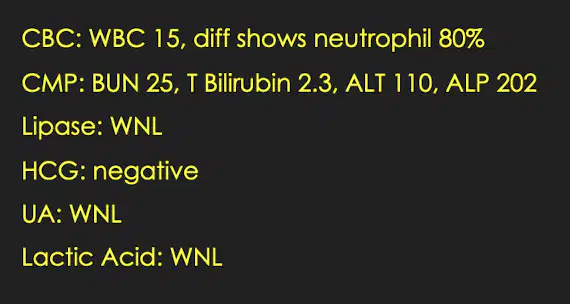
A 42 yo WF with no significatn PMH comes to the ER with c/o abdominal pain for 3 days. She also c/o low fever and pain that is worse after eating. On exam, her temp is 100 F, she is mildly tachycardic, appears uncomfortable, and is tender with guarding in the RUQ. She has a positive Murphy's sign. Labs were done. US gallbladder with stones and wall thickening. What is NOT part of the treatment?
IV fluids, NPO
Pain & nausea meds
Follow up with GI
Amp-sulbactam iV
Consult surgery
A 34 yo WM with no significant PMH presents to the ER with a CC of abd pain for 3 months. He states the pain comes and goes. He states "it hurts all over" when it does. On exam, vitals are stable, he is in no acute distress, laughing with his friend that is also in the room. He has mild TTP in the epigastric region but no guarding or rebound tenderness. Rectal exam is negative for occult or gross blood. Does this describe a likely acute or benign abdominal process?
Acute
Benign

A 34 yo WM with no significant PMH presents to the ER with a CC of abd pain for 3 months. He states the pain comes and goes. He states "it hurts all over" when it does. On exam, vitals are stable, he is in no acute distress, laughing with his friend that is also in the room. He has mild TTP in the epigastric region but no guarding or rebound tenderness. Rectal exam is negative for occult or gross blood. Labs were done. What is NOT part of the workup and tx?
Discharge w/ strict return precautions
CT a/p
Follow up with GI
Consider starting a PPI
A 29 yo female presents to the ER complaining of sudden onset of severe, intermittent pain originating in the right flank and radiating to the right groin. She also complains of N/V. She exhibits tenderness in the right flank with no rebound tenderness. UA reveals microscopic hematuria. What is the imaging and most likely diagnosis? (choose 3)
Dissection
CT w/o contrast
US if pregnant
Nepro/urolithiasis
CTA C/A/P
A 14 yo male presents to the ED with abd pain which began diffusely and settled in the RLQ. Examination reveals tenderness, rigidity, and rebound tenderness. What is the imaging would provide the highest accuracy and most likely diagnosis? (choose 2)
Dissection
CT of abdomen
US if pregnant
Appendicitis
CTA C/A/P
A 54 yo WM presents to the ER via EMS with sudden onset of excruciating pain in the epigastric region approx 30 min ago. Pt describes the pain as a "tearing" that goes through to his back. On exam, BP 212/110, HR 110, pale, diaphoretic, and in severe distress. EKG with no STEMI. What is the imaging would provide the highest accuracy and most likely diagnosis? (choose 2)
Dissection
CT of abdomen
US if pregnant
Appendicitis
CTA C/A/P

