wayground logo

Free Printable Worksheets

NEW

Font size

S
M
L
XL
Worksheets

Ecology Review

Total questions: 19

Worksheet time: 11mins

Name
Class
Date
1.

Barnacles are animals that cannot move. In order to get food, they attach to whales and catch any floating plankton in the water. The whale is neither helped nor harmed in the interaction. What type of symbiosis is this?

a)

Mutualism

b)

Commensalism

c)

Parasitism

d)

Neutralism

2.

In the wild, some alligators gets their teeth cleaned by birds. The birds gets their food from the alligators' teeth.

What type of symbiosis is this?

a)

Mutualism

b)

Commensalism

c)

Parasitism

d)

Neutralism

3.

In an ecosystem, there are populations of moose, rabbits, grass, and pine trees. Suddenly, a fire blazes through the area, which kills all of the populations. As the months go on, new species of grass begin to take root. This attracts animals, and eventually the ecosystem is restored.


What type of ecological succession happened?

a)

Primary succession

b)

Secondary succession

c)

Tertiary succession

d)

None of the above

4.

In this photo, what is an abiotic factor?

a)

Deer

b)

Grass

c)

rain

5.
Members of a species in a defined area
a)
Ecosystem
b)
community
c)
biodiversity
d)
population
6.
Organisms that relies on other organisms for food; consumer
a)
herbivore
b)
decomposer
c)
heterotroph
d)
species
7.
What may happen if the snowshoe hare was removed from the food web pictured?
a)
The insects in the habitat would increase.
b)
The shrew population would decrease due to being only hawk food source.
c)
The willow tree population would decrease.
d)
Foxes would dies due to no food source. 
8.
In the energy pyramid here, how much of the energy in the producers gets passed to the herbivores?
a)
10%
b)
20%
c)
80%
d)
90%
9.
In the food web shown, the snail would be considered...
a)
primary consumer
b)
secondary consumer
c)
tertiary consumer
d)
producer
10.

Volcano erupting would be an example of what type of succession?

a)

Primary

b)

Secondary

c)

Tertiary

11.

What are plants that convert energy from the sun called?

a)

decomposer

b)

primary consumer

c)

secondary consumer

d)

producer

12.
Which is an example of a parasitic relationship?
a)
a bee pollinates a flower
b)
a tapeworm takes nutrients from a dog
c)
an orchid lives in a tree but does not harm the tree
13.
A collection of organisms that make up a community as well as all of the nonliving aspects of the environment.
a)
Population
b)
Community
c)
Habitat
d)
Ecosystem
14.

What is a niche?

a)

The habitat that an organism lives in

b)

An organism’s “role” in an ecosystem

c)

A type of consumer

d)

The relationship between a producer and consumer

15.
a relationship between two in which one species, the predator, feeds on the other species, the prey
a)
chemosynthesis
b)
predation
c)
cellular respiration 
d)
commensalism
16.
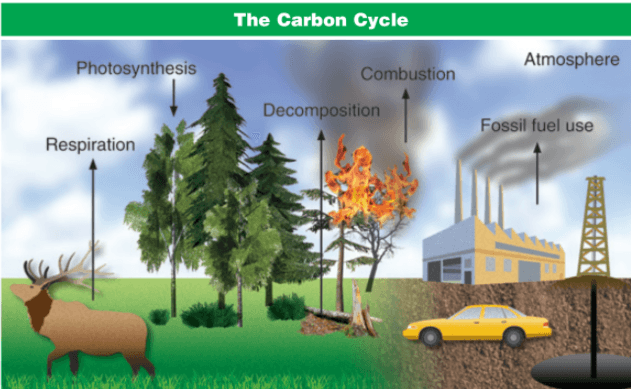
Which of the following removes carbon from the atmosphere?
a)
Combustion
b)
Respiration
c)
Photosynthesis
d)
Death
17.
The average temperature of the surface of Earth has increased approximately 1°C in the past century. Which reason best explains this increase in temperature?
a)
lower levels of ozone in the atmosphere
b)
lower levels of nitrogen in the atmosphere
c)
higher levels of carbon dioxide and other greenhouse gases in the atmosphere
d)
higher levels of oxygen in the atmosphere
18.
Burning fossil fuel has which effect in the carbon cycle?
a)
It removes carbon dioxide from the atmosphere.
b)
It puts carbon dioxide under the ground.
c)
It adds carbon dioxide to the atmosphere.
d)
It has no effect in the carbon cycle.
19.

Which statement is an example of how carbon moves through a food chain as part of the cycle?

a)

Producers release carbon dioxide, and consumers take it it.

b)

Producers take in carbon dioxide, and consumers release it.

c)

Producers take in carbon from the soil, and they release it when they decompose.

d)

Producers release carbon into the soil, and consumers take it in from the soil.