
 Worksheets
6th Grade Remediation Part 1
Total questions: 30
Worksheet time: 16mins
What shape are the orbits of the planets?
Elliptical
Circle
Rectangle
Square
Select all the true statements about our planets.
The outer planets are larger, and the inner planets are smaller.
The inner planets are composed of gases, whereas the outer planets are composed of metals.
The outer planets are colder than the inner planets because they are further away from the sun.
The inner planets have few if any moons, however, the outer planets sometimes have many moons.
Which planet has the highest gravity in our solar system?
Mars
Saturn
Jupiter
Earth

A meteoroid is approaching Earth's surface. Which meteoroid is currently most affected by the Earth's gravitational pull?
1
2
3
4
Which statement is true about the planets?
Each planet is an equal distance from one another.
All of the planets revolve around the Sun at the same speed.
The four outer planets are larger in size than the four inner planets.
Small planets are gaseous and the large planets are rocky.
Which of these did NOT help increase our knowledge of the solar system?
Manned space craft, like the space station and space shuttles
Robotic space craft, like probes and artificial satellites)
Powerful Earth-based and space telescopes
Models of Earth and science textbooks
Smaller planets that have not cleared the neighborhood around their orbit as they revolve are called ____.
Dwarf planets
Tiny planets
Rocky planets
Comets
What is a streak of light that is produced by a meteoroid burning up in the Earth’s atmosphere?
Meteor
Comet
Meteorite
Asteroid

The item labeled 3 is the planet ___.
Jupiter
Mars
Earth
Venus
Which of the following is a correct statement about the planets in the solar system?
Venus is located at a closer distance to the Sun than Mars.
Earth is a rocky planet larger in size than the gas planet Saturn.
Uranus is located at a distance further from the sun than Neptune.
Mercury, Neptune, and Mars are all small in size and rocky in composition.
Which statements describe the properties of the Earth?
The Earth is covered with oceans and has frozen ice caps in its polar regions.
The Earth is protected from harmful solar radiation by its atmosphere and magnetic field.
Carbon dioxide and oxygen make up most of the Earth's atmosphere.
Scientific evidence indicates the Earth is about 3.5 billion years old.

This moon is appearing larger in the sky than it did the night before. What moon phase is shown?
Waxing crescent
Waning crescent
Waxing gibbous
Waning gibbous

Look at the image and select all true statements.
The moon rotates around the Earth, while the Earth revolves around the Sun.
The Earth rotates on its axis and revolves around the Sun.
The Sun revolves around the Earth, while the moon rotates around the Earth.
The moon revolves around the Earth, while the Earth rotates.

What phase of the moon is labeled 8?
Waning crescent
Waxing gibbous
Waning gibbous
Waxing crescent

What causes the Earth to have seasons?
The tilt of the Earth's axis and the revolution of the Earth around the Sun
The distance of the Earth from the Sun
The tilt of the Earth's axis
The revolution of the Earth around the Sun

Number 4 is of which phase of the moon?
Waxing gibbous
Waning crescent
Waxing crescent
Waning gibbous

What can be the reason for the moon's shape changing during different phases?
The moon spins on its axis.
The moon varies the amount of light it produces.
The moon revolves around Earth.
The moon grows and shrinks in shape.

What occurs when the Moon blocks a view of the Sun and shadows a portion of the Earth?
Total eclipse
Tidal eclipse
Solar eclipse
Lunar eclipse

What season is the Southern Hemisphere experiencing during phase number 3? (Careful! Southern!)
Autumn
Summer
Spring
Winter
The rise and fall of the ocean, called the tides, are caused by the gravitational pull of the ___.
sun only
sun and the planets
moon and the sun
moon only

How is the intake of solar radiation affected by the increase of carbon dioxide in the Earth's atmosphere?
A reduced amount of energy is passed through the Earth's atmosphere.
A reduced amount of energy is absorbed by the Earth's atmosphere.
Additional energy is trapped by greenhouse gases.
Additional energy is reflected back into space.

Convection in the atmosphere not only heats the air, but moves it as well. Why is the air in arrow B moving downward?
As the cooler air rises, it pushes the warmer air back to the surface to be cooled.
It has been warmed by the sun and is transferring heat to the surface.
As the air was warmed, it became more dense and is falling to the surface.
It has been cooled in the upper atmosphere and is sinking back to the surface.
Convection is the circulation of heat through a material caused by heating and cooling. How does radiation play a part in supplying the thermal energy transfer from the sun to the Earth's convection driven weather systems?
The sun's radiation heats the air in the upper atmosphere, which starts to circulate.
The sun's radiation heats the ozone layer, which supplies heat to the jet stream.
The sun's radiation heats the CO2 in the atmosphere, which supplies heat to the clouds.
The sun's radiation heats the landforms, which then heats the air above them.
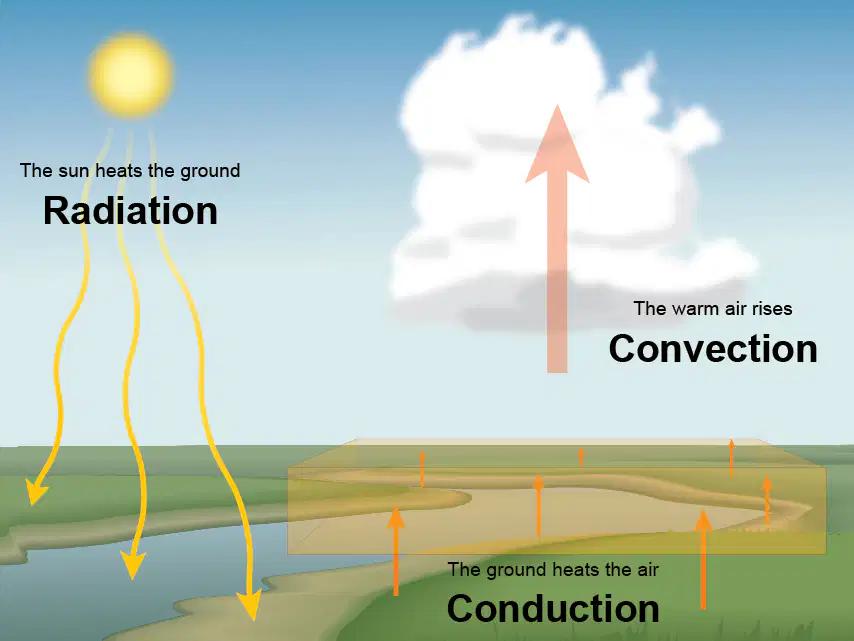
Which of the following heat transfers is the reason why the air right above Earth's warm surface heats up?
Conduction
Convection
Radiation
Reduction

The sun heats Earth's surface. Earth loses some of that absorbed heat into space by ___.
radiation
conduction
convection
reflection
Which is the best explanation for a convection current in the atmosphere?
Hot air expands and rises, causing it to become cooler and denser. Then it falls again in a continuous process.
Hot air expands and rises to the top of the atmosphere, while the cool air stays below it.
Cold air expands and rises, causing it to become warmer and contracting. Then it falls again in a continuous cycle.
Cold light air rises in the atmosphere, while the warmer air stays near the ground.
What sources are used to store, move, and deliver energy easily in usable forms?
Primary energy sources
Secondary energy sources
Tertiary energy sources
Quaternary energy sources
Which type of energy is the driving force of all primary energy sources?
Mechanical
Radiant
Thermal
Electrical
How is the sun related to the formation of fossil fuels?
Fossil fuels contain stored solar energy from the prehistoric plant and animal organisms that decomposed and formed the fuels.
Fossil fuels are the direct result of combining solar energy with nuclear energy.
Fossil fuels form when the sun heats the ocean to a certain temperature.
Fossil fuels contain solar energy from ancient desert sands that lied along the equator, and stored large amounts of sunlight.
Biomass is a good primary energy source that is found in wood or corn ethanol. How do these plants and organisms get their energy?
They absorb radiant energy as sunlight and convert it into chemical energy by photosynthesis
They absorb chemical energy as sunlight and convert it into mechanical energy.
They absorb chemical energy and convert it into radiant energy by photosynthesis
They absorb radiant energy as sunlight and convert it into electrical energy.

