wayground logo

Free Printable Worksheets

NEW

Font size

S
M
L
XL
Worksheets

PSSA Practice Week 2

Total questions: 16

Worksheet time: 23mins

Name
Class
Date
1.
The picture shows a small, shelled animal. Which tool should be used to measure the MASS of the shelled animal? 
a)
ruler
b)
stopwatch 
c)
triple beam balance
d)
graduated cylinder
2.
A student puts water into a graduated cylinder and carefully adds 2 small rocks - in the image shown. What is the volume of the rocks?
a)
2 mL
b)
3 mL 
c)
5 mL 
d)
12 mL 
3.
At which location is the gravitational potential energy of the water the greatest?
a)
Location W 
b)
Location X 
c)
Location Y 
d)
Location Z 
4.
Which two types of organisms in this aquatic food web have a producer–consumer relationship?
a)
Microscopic algae and white suckers
b)
Small invertebrates and amphipods
c)
Phytoplankton and mummichogs
d)
Amphipods and channel catfish
5.
What lunar phase occurred on June 4, 1776?
a)
Waning gibbous
b)
Waxing gibbous
c)
Waning crescent
d)
Waxing crescent
6.

James sets up an experiment to see how the mass of a ball affects the distance it rolls off a ramp.  Identify the independent variable.

a)
distance traveled by the ball
b)
height of the ramp
c)
mass of the ball
d)
weight of the ball
7.

Butter bean seeds were placed in petri dishes lined with moist paper towel for 5 days at different temperatures & germination was measured.  Which of the following is the dependent variable?

a)
Number of seeds
b)
Time it took to germinate
c)

Moisture of soil.

d)
Type of seed
8.
Over the next 15 minutes, which changes would most likely occur?
a)
The temperature in Cup A will decrease and the temperature in Cup B will increase.
b)
The temperature in Cup A will decrease and the temperature in Cup B will decrease.
c)
The temperature in Cup A will increase and the temperature in Cup B will increase.
d)
The temperature in Cup A will increase and the temperature in Cup B will decrease.
9.
The diagram shows a food chain that represents populations in an aquatic ecosystem. Based on the food chain, which statement best describes the relationship between the pike and the perch?
a)
The pike is a producer, and the perch is its consumer.
b)
The pike is a predator, and the perch is its prey.
c)
The perch is a predator, and the pike is its prey.
d)
The perch is a producer, and the pike is its consumer.
10.
The eyes of the owl and the rabbit shown in the diagram give each animal a different advantage.  The specialized eye types of these animals are examples of
a)
disruptions of the natural balance
b)
the interdependence of living things
c)
adaptations for survival under certain conditions
d)
involuntary responses to stimuli
11.
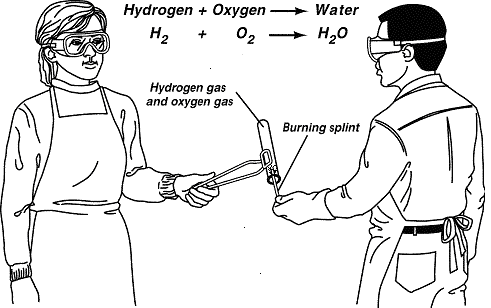
Identify the reactant(s) and product(s) of the reaction.
a)
All three are reactants and none are products.
b)
Hydrogen and water are the reactants, and oxygen is the product.
c)
Water and oxygen are the reactants, and hydrogen is the product.
d)
Hydrogen and oxygen are the reactants, and water is the product.
12.
Why should an experiment be repeated?
a)
to form a hypothesis
b)
to reduce the chance of error
c)
to change controls
d)
to identify the problem
13.
How many independent variables should be tested at a time in a scientific investigation?
a)
none
b)
one
c)
two
d)
three
14.
Which is the dependent variable in Amelia's experiment?
a)
the number of bean plants in each group 
b)
the amount of water given daily to each plant 
c)
the height of each bean plant 
d)
the amount of fertilizer given to each group of bean plants
15.
Which question can best be investigated by a scientist?
a)
Should I buy a red shirt or a green shirt?
b)
Does chocolate milk or plain milk taste better?
c)
Does a plant need sunlight to grow?
d)
Which feels softer, cat fur or dog fur?
16.

What is the difference between a scientific theory and a scientific law?

a)

A theory is a well-tested range of representations and a law is a concrete physical representation.

b)

A theory is a well-tested range of observations of why something works and a law is a well-tested concrete explanation how things work

c)

A theory is a well-tested range of observations of how something works and a law is a well-tested concrete explanation of why things work

d)

A theory is a hypothesis that is yet to be proven false and a law is a hypothesis that will always be true.