
 Worksheets
IPC Charge and Circuits Test
Total questions: 25
Worksheet time: 29mins

Which of the following can move from one atom to another?
protons
neutrons
electrons
the nucleus
An object with a negative charge will be most strongly attracted to which of the following?
an object with a weak positive charge
an object with a strong positive charge
an object with a weak negative charge
an object with a strong negative charge

Attract
Repel
Do Nothing
Orbit
Attract
Repel
Do Nothing
Orbit

The picture shows an electric circuit. This is a series circuit because:
The electrical current is divided between the three light bulbs.
It has 3 light bulbs.
The same current flows through all threelight bulbs.
It uses a single battery
This type of circuit only has one path for current to flow.
parallel
combination
split
series
Which best describes a parallel circuit?
Electricity flows along one pathway.
The flow of electricity comes from more than one source.
Electricity flows along more than one pathway
The flow of electricity comes from one source.

This is the symbol of which electrical device?
A light bulb
An resistor
An electrical cell
A switch

This is the symbol for a(n) ..................?
single cell
bulb
battery
AC current source
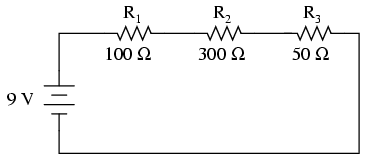
What happens if there is a break at any point in a series circuit?
no current flows
current flows through an alternative path
resistance goes to infinity
current reverses direction
Which of the following is a series circuit?


How many Volts would we need to produce a current of 8 Amps through a 6 Ohm resistor?
1.33 volts
24 volts
0.75
48 volts
A light circuit is operating at 75 Volts. What is the circuit's current if the resistance is 5 Ohms?
375 Amps
50 Amps
15 Amps
0.07 Amps
What resistance is needed to cause a 20A current flow with a 100V battery?
0.2Ώ
2000Ώ
200Ώ
5Ώ
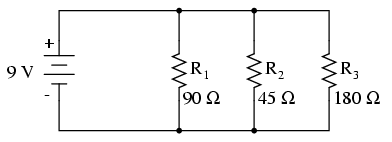

Solve for all values of the given circuit.
Solve for all values of the given circuit.

Solve for all values of the circuit shown in the picture.

Solve for all values of the circuit shown.

