
 Worksheets
Chem Semester 2 Final Exam Review #2
Total questions: 85
Worksheet time: 2hrs 28mins
The electrons in a polar covalent molecule are shared...
Evenly
Unevenly
Electrons are not shared
None of the Above
The polarity of a bond is determined by...
The sum of the electronegativities of the two atoms
The difference in the electronegativities of the two atoms
The charges of the atoms
None of the Above
Partial charges are present in which type of bond?
Ionic
Nonpolar Covalent
Polar Covalent
Both Polar Covalent and Ionic
Type of intermolecular force present in I2, Br2, and Cl2.
dipole dipole
H-bond
London dispersion
metallic
Which substance would have the weakest intermolecular forces of attraction?
CH4
NaCl
H2O
MgF2

Intermolecular forces for: NH3
London dispersion Forces
Dipole dipole
Hydrogen bonding
Viscosity is
the resistance to flow
the resistance to spread out
the ability to make sheets of metal
the ability to make wire
A weak IMF will result in a
high melting point
high viscosity
high surface tension
low surface tension
Surface tension is the property of water in which...
water molecules at the surface tend to stick together.
water spills easily.
water tends to be see-through.
Molecules with strong attraction between themselves require __________ to separate than weakly attracted molecules.
More energy
Less energy
No energy
Nuclear energy
the spontaneous rising of a liquid in a narrow tube
Surface Tension
Capillary Action
Viscosity
None of the above
All of the above
A hydrogen bond is a covalent bond. True or False
True
False, because it is ionic
False because it has an intramolecular force
False because it has an intermolecular force
2 L
3 L
4 L
6 L
What is the molarity of a 0.5L sample of a solution that contains 60.0 g of sodium hydroxide (NaOH)
0.8 M
1.5M
3.0M
6.0M
The part of the solution that is present in the greater amount and does the dissolving
Solute
Solvent
Solution
Solubility
Able to be dissolved
dissolvability
Insoluble
Soluble
Unsaturated
Unable to be dissolved
dissolvability
Insoluble
Soluble
Unsaturated
A measure of the maximum amount of solute that will dissolve in a certain amount of solvent at a certain temperature and pressure
Solution
Solute
Solvent
Solubility
When a solution can hold more solute because it currently contains less than the maximum amount for the solvent available.
Concentration
Saturated
Supersaturated
Unsaturated
When a solution cannot hold anymore solute in a solvent at a given temperature and pressure
Concentration
Saturated
Supersaturated
Unsaturated


How does a solution become supersaturated?
Vigorous stirring to dissolve more solute than usual.
Heat the solution to increase the solute then let it cool.
Add more solvent to lower the concentration.
Keep pouring solute in the solvent until it goes in.


What happens along the AC line?
Melting/Freezing
Vaporizing/Condensing
Vaporizing/melting
freezing/condensing
What happens along the BC line?
Melting/Freezing
Vaporizing/Condensing
Vaporizing/melting
freezing/condensing

What is being measured on the y axis?
Pressure
Temperature
Energy
Mass
What is being measured on the x axis?
Pressure
Temperature
Energy
Mass
The temperature and pressure conditions at which the solid, liquid, and gas phases of a substance exist at the same time is called the
Critical point
Triple point
Melting point
Boiling point

What is the vaporization point of this substance at 1 atm?
40°C
60°C
100°C
110°C
Which end of the water molecule would surround a Cl- ion in a solution
the Oxygen end
the Hydrogen end
neither end
they don't surround the ion
When water molecules completely surround ions or covalent molecules, they form what around them to keep them apart?
hydration shells
a polar bond
an invisible force field
a hydrogen bond
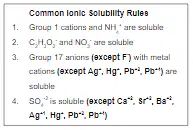
Determine if the compound is soluble or insoluble:
NaOH
Soluble
Insoluble
Determine if the compound is soluble or insoluble:
Hg2SO4
Soluble
Insoluble
In the following equation, determine which compound is insoluble:
CdSO4 + K2S → K2SO4 + CdS
CdSO4 (s)
K2S (s)
K2SO4 (s)
CdS (s)
Synthesis
Decomposition
Single Replacement
Combustion
Synthesis
Decomposition
Single Replacement
Combustion
Synthesis
Decomposition
Single Replacement
Combustion
N2+O2--> _NO
__Li + __Cl2 -> __LiCl
H2O + CO2 → HCO + HO
Predict the products, before balancing.
Co2(SO4)3 + NaOH -->
CoOH + NaSO4
CoNa + OH(SO4)3
Co2OH + Na(SO4)3
Co(OH)3 + Na2SO4
no reaction
What are the products for this combustion reaction:
C2H4 + 2 O2 -->
C2O2 + H4
CO2 + HOH
CO + H
CO2 + H2O
Predict the products for the this Double Replacement reaction:
AgNO3 + KCl →
AgCl + KNO3
AgK + ClNO3
KAg + NO3Cl
AgCl + 3 KNO
Predict the type of the following reaction.
3KOH + H3PO4 -->
Synthesis
Decomposition
Single Replacement
Double Replacement
Predict the products of the following reaction. No need to balance.
F2 + KBr →
FBr + K
KF + Br
KF2 + Br2
KF + Br2
If an element is diatomic it should have a subscript of___
1, always
2, only when it is an element
it shouldn't have a subscript, it should have a coefficent
2, when bonded in a compound
What is the charge of Iron in this compound. (Hint: think swap drop method):
Fe3(PO4)2
3+
2+
1+
6+
The symbol for a substance dissolved in solution is ______
(s)
(l)
(aq)
(g)
Fill in the blank. (Copper has a charge of 2+)
Cu+ AgNO3 → Ag + _____
Cu(NO3)2
CuNO3
CuAg
Cu
Predict the products for the this Single Replacement reaction:
K + HCl →
KCl + H2
KHCl
KH + Cl2
HCl + K2
Complete the balanced equation for this Double Replacement reaction.
3 NaOH + Fe(NO3)3 →
NaFe + OH(NO3)3
NaNO3 + Fe(OH)3
3 NaNO3 + Fe(OH)3
3 NaFe + 3 (OH)NO3
Predict the products for the this Single Replacement reaction: (Copper has a charge of 1+)
Mg + CuCl →
MgCl2 + Cu
Mg + Cu
MgCu + Cl2
MgCl + Cu2
The two sides of a chemical equation are called?
Reactants (left) and Products (right)
Ingredients (left) and Product (right)
Cations and Anions
Products (left) and Reactants (right)
Mass cannot be gained or lost in a chemical reaction.
Mass can only be lost in a chemical reaction.
Mass can only be gained in a chemical reaction.
Mass can be gained and lost in a chemical reaction.
Br2 (l) + KI (aq) →
Au (s) + HCl (l) →
Oxidation is the _________ of electrons.
loss
gain
sharing
transfer
Reduction is the ___________ of electrons.
loss
gain
sharing
transfer
In the reaction Zn + 2HCl --> ZnCl2 + H2
which element, if any, is oxidized?
Zinc
Hydrogen
Chlorine
None
In the neutralization reaction:
HCl + NaOH → NaCl + H2O
the NaOH is an example of a/an
Oxidation
Acid
Reduction
Base
In the neutralization reaction:
HCl + NaOH → NaCl + H2O
the HCl is an example of a/an
Oxidation
Acid
Reduction
Base
Use the solubility chart to determine if this is a chemical reaction and if so, what formed a precipitate?
Li2S + 2AgNO3 → 2LiNO3 + Ag2S
Yes, and LiNO3 formed a precipitate.
Yes, and Ag2S formed a precipitate.
No, it is not a chemical reaction because no precipitate formed.
Which of the following is a balanced equation for representing the decomposition of Aluminum Oxide?
2 Al2O3 → 3 O2 + 4Al
Al2O3 → O2 + 2Al
Al2O3 → 3 O+ 2Al
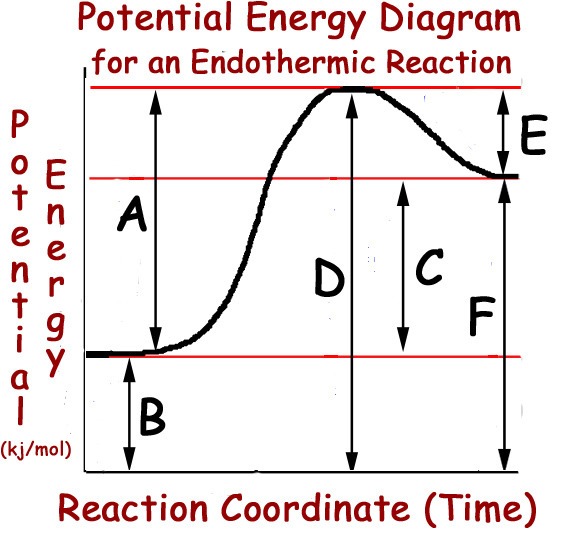
What letter represents the energy of the reactants?
A
B
C
F
What letter represents the energy of the products?
B
C
E
F

