
 Worksheets
COMPLETION EXAM IN CALCULUS BASED PHYSICS
Total questions: 50
Worksheet time: 39mins
A boat of mass 810 kg displaces 180 m3 of water when it is lowered into seawater. Calculate the upthrust acting on the hull of the boat and determine whether it will sink or float. Take density of seawater as 1030 kg/m3.
1,818,774 N
1,585,675N
Sink
Float
A boat of mass 210 kg displaces 80 m3 of water when it is lowered into seawater. Calculate the upthrust acting on the hull of the boat and determine whether it will sink or float. Take density of seawater as 1030 kg/m3.
982,544 N
808,344 N
Sink
Float
A cube of brass with dimensions of 500 x 500 x 500 mm and mass of 1,100 kg is lowered into a tank. Determine the upthrust and whether the cube will sink or float if the tank is filled with Crude Oil (Texas).
1.82 kN
1.07 kN
Sink
Float
A cube of brass with dimensions of 500 x 500 x 500 mm and mass of 1,100 kg is lowered into a tank. Determine the upthrust and whether the cube will sink or float if the tank is filled with pure water.
1086.8 N
1226.6 N
Sink
Float

A cube with sides of 80 mm is hung on a weighing scale and weighs 74 N. The cube is lowered into a bucket of pure water until it is fully immersed. What value of weight will the weighing scale show now?
64.72 N
72.33 N
68.98 N
73.20 N

A spherical buoy of diameter 0.5 m and mass 60 kg is attached to the seabed by a mooring rope and floats fully submerged. Calculate the tension in the mooring rope. Take density of seawater as 1020 kg/m3. (Use 2 d.p. throughout calculations)
38.2 N
46.4 N
54.5 N
61.8 N
A dam stand 50 m high across a valley. The pressure at the base of the dam wall is?
490500Pa
490.5Pa
50000Pa
500000Pa
A tank contains petrol with relative density 0.7 to a depth of 3m. The pressure at the base of the tank is?
20601Pa
20.6Pa
2100Pa
21000Pa
A liquid has a density of 800 m3kg and is in a container with a height of 0.5m. What is the pressure at the bottom of the container if the gravitational field strength is 9.8N/kg?
3920 Pa
39200 Pa
7840 Pa
78400 Pa
A gas has a density of 1.2 m3kg and is in a container with a height of 2.5m. What is the pressure at the bottom of the container if the gravitational field strength is 9.8N/kg?
29.4 Pa
294 Pa
2940 Pa
29400 Pa
A liquid has a pressure of 8000 Pa and is in a container with a height of 2m. What is the density of the liquid if the gravitational field strength is 9.8N/kg?
A. 408.2 m3kg
B. 816.3 m3kg
C. 1224.5 m3 kg
D. 1632.7 m3 kg
A gas has a density of 1.2 kg/m3 and a pressure of 5000 Pa. What is the height of the gas if the gravitational field strength is 9.8 N/kg?
450m
425m
42.5m
58800 m
A liquid flow through a system of two connected tubes at a rate of 4 liters per minute. It gets out from the end of the second tube at a speed of 7 meters per second. Find the cross-sectional area of the second tube.
OPTION A 9.52×10⁻⁶ m2
OPTION B 9.52×10⁻³ m2
OPTION C 5.71×10⁻⁴ m2
OPTION D 5.71×10⁻⁵ m2
Some liquid flows inside a pipe with a cross-sectional area of 0.02 m2. The liquid flows at 13 kg/s and has a density of 1 200 kg/m3.Calculate the flow speed through the pipe in meters per second.
0.54 m/s
0.26 m/s
3.85 m/s
1.85 m/s

A thin plate of mass 2.5 g is pushed by a constant force 𝐹=0.50mN, moving at a constant 1.32 cm/s over the surface of a viscous liquid that is 2.5 mm deep, as shown in the diagram. The speeds of the layers of the liquid between the plate and the lowest layer of the liquid are shown in the diagram. The liquid in contact with the top and bottom plates move at the same speed as the plates move. What is the dynamic viscosity of the liquid?
5.5×10⁻⁴ Pa⋅s OPTION A
9.4×10⁻⁴ Pa⋅s OPTION B
8.5×10⁻⁴ Pa⋅s OPTION C
3.0×10⁻⁴ Pa⋅s OPTION D
What is turbulence?
a. Irregular motion of the air resulting in throwing an airplane out of control or to cause structural damage
b. Regular motion of the air resulting in throwing an airplane out of control or to cause structural damage
c. Unplanned drop in the pressure of an aircraft
d. Planned drop in the pressure of an aircraft
Using the particle model of matter, viscosity is described as
answer choices
a. the larger the molecules, the higher the viscosity
b. the greater the distance between the particles, the greater the viscosity
c. the greater the friction between particles, the greater the viscosity
d. the faster the particles are moving, the greater the viscosity
What is Viscosity?
A fluids colour.
A fluids temperature.
A fluids resistance to flow.
The unit of Viscosity in SI system is Ns/m2
True
False
Which type of fluid flow is smooth, and predictable?
Turbulent
Viscous
Laminar
Inertial
What are the reasons causing pressure drop in hydraulic systems?
1. long length of pipe
2. friction
3. type of fluid
4. losses in valves and bends
1 and 4
only 1
2 and 3
all the above
Specific Gravity compares the density of a substance to ......
density
gravity
water
oil
Find the specific gravity of copper. The density of copper is 8.9 g/cm3.
8.9 g/cm3
8.9
4.3 g/cm3
4.3

Two workers use 100 N of force to move a sofa 2 meters in 2 seconds. How much power is required?
100 watts
400 watts
104 watts
50 watts
A worker climbs a ladder and does 8 J of work on a 2 N object. What is the distance they lift the object?
18 m
4 m
10 m
6 m
If you do 200 J of work in 10 seconds, your power output is...
2000 W
200 W
20 W
2 W
How much power is required to raise a 30 kg crate a vertical distance of 6 m in a time of 4 seconds?
120 W
52.5 W
450 W
385 W
525 W

Which type of energy is heat energy?
Potential
Kinetic
Thermal
Sound

Which type of energy is in food and fuel?
Potential
Thermal
Nuclear
Chemical

Which type of energy is due to the movement of electrons in a circuit?
Potential
Electrical
Thermal
Sound
A student with a mass of 62.0 kg walks up a flight of stairs with a height of 3.40 meters. If it takes him 7.00 seconds to get to the top, how much power did he generate?
295 W
2070 W
86.8 W
295.12 W
What is the relationship between work and energy?
not related
directly proportional
inversely proportional
When is work done on an object?
when the force is zero
when the displacement is zero
when the displacement is not zero
when force and displacement are perpendicular
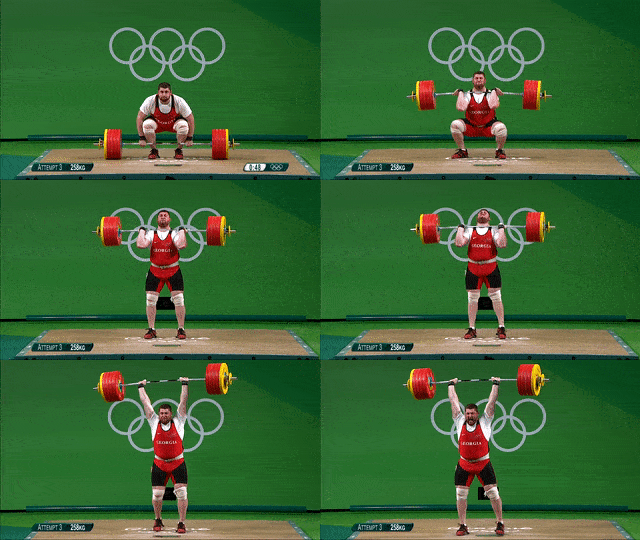
This weight lifter required 1029.7 newtons of force to bring the weights to a height of approximately 2.31 m in 9 seconds. How much power did he have?
264 Watts
1029 Watts
2,377 Watts
4,009 Watts

If a 725.7 N racer took 798 s to climb the 320 m, how power did she have?
291 Watts
281 Watts
317 Watts
313 Watts
A rollercoaster cart has a mass of 4,500 kg and is about to drop from it's greatest height of 255. If the potential energy at this height is 3,427,628.4 Joules, what is the predicted highest velocity of the rollercoaster?
39 m/s
1,523 m/s
45 m/s
33 m/s

What is the Total Energy at the bottom?
50 J
25 J
0 J
100 J
The Law of Conservation of Energy states:
Energy can created or destroyed but not transformed
Energy cannot be created or destroyed, it can only transformed
Energy can't be created, destroyed or transformed
Energy cannot be created or destroyed.

What force causes a roller coaster cart to slow down the most?
friction
weight
gravity
air resistance

