
 Worksheets
Science Cumulative Assessment
Total questions: 138
Worksheet time: 4hrs 25mins
Christopher wanted to learn more about Ganymede, one of Jupiter’s moons. Which of the following sources of information would be Christopher’s best choice?
his friends
the local newspaper
a neighborhood survey
a university’s astronomy web page
Taylor made some observations and has a question he would like to answer. What should Taylor do next?
form an opinion
analyze evidence
plan and conduct an investigation
draw conclusions and communicate results
Joseph wonders what kinds of birds live in his neighborhood. What skill will Joseph use to investigate the variety of birds in his neighborhood?
infer
observe
order
communicate
Scientists conduct investigations. What is the main reason for scientific investigations?
to practice doing experiments
to learn about recent discoveries
to demonstrate scientific procedures
to answer questions about the natural world
Sometimes scientists repeat the research of other scientists. Which of the following is the most likely reason scientists do this?
to form new theories
to improve the research
to win prizes for their work
to verify that the work is accurate
Imagine that a scientist suggests that the size of an insect population depends on the temperature. What observations must this scientist use in order to provide evidence to support his or her claim?
The scientist must observe the insect population only in winter.
The scientist must observe the insect population in the laboratory.
The scientist must observe the insect population in different areas
The scientist must observe the insect population throughout the year.
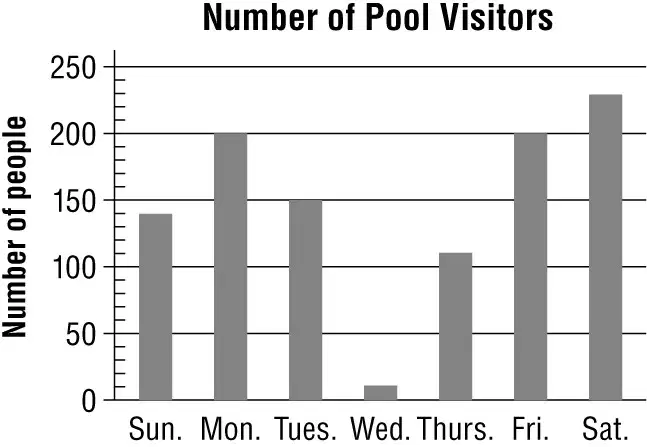
Tristan counts the number of people who visit the pool each day for 1 week. He displays his findings on a bar graph. Between which two days did the number of visitors change the most?
Tuesday and Wednesday
Wednesday and Thursday
Thursday and Friday
Friday and Saturday
In science, we often gather information with our senses by watching, listening, smelling, and touching. For example, you may record how the color of a flower changes. What is this process called?
stating hypotheses
forming conclusions
making observations
performing experiments
Some scientific tools are used for making observations, and others are used for making measurements. Which of these tools would be most useful for observing the behavior of ants?
hand lens
metric ruler
electronic balance
graduated cylinder
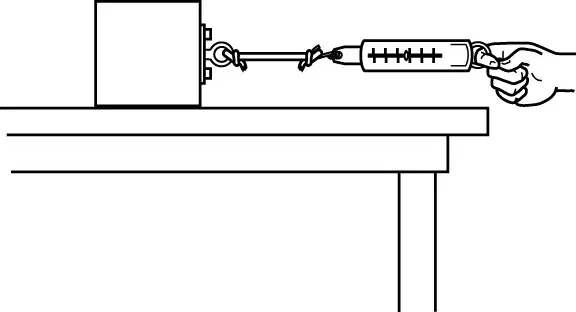
Patrick used a spring scale like this in an experiment he was conducting.
What did Patrick measure with the spring scale?
force
mass
volume
weight
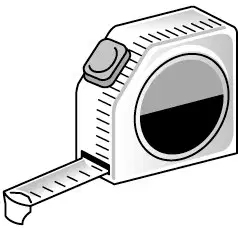
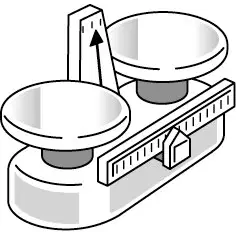
You can use many different tools to make measurements. Which of these tools can be used to measure the mass of an object?


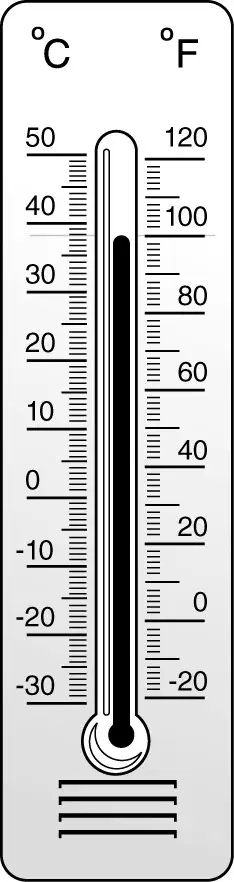
Naples, on the Gulf Coast of Florida, is known for its year-round sunshine, warm temperatures, and white sandy beaches. The thermometer on the right shows the temperature on a very hot day in Naples. Which temperature reading is correct?
100 ºC
48 ºC
40 ºC
38 ºC
Kyle is wondering what he is getting for his birthday. He decides to shake the box that contains his present. Kyle did not realize it, but he was acting like a scientist. What was the first step Kyle took in this situation that a scientist also takes?
asking a question
collecting evidence
drawing a conclusion
developing an explanation
Which of the following is always an important part of an experiment?
making a working model
observing things in nature
making drawings of things observed
identifying and controlling variables
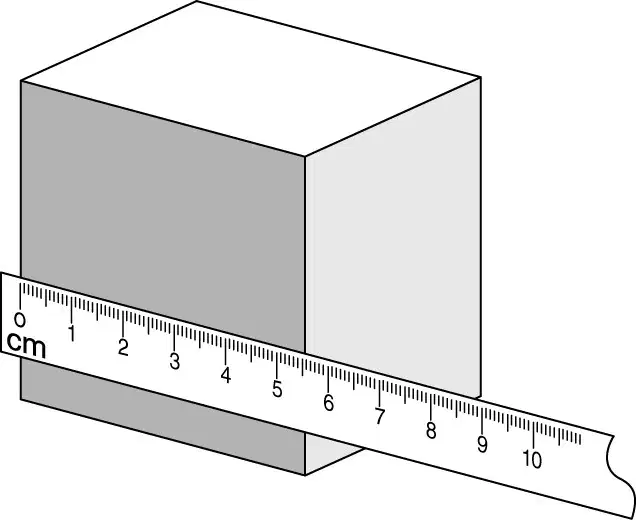
Angela measured the length of a block. How long is the block?
5 cm
5 in.
5.5 cm
6.5 in.
Which of these is the metric unit for measuring mass?
kilogram
liter
millimeter
pound
Which of the following is not a scientific investigation?
performing a controlled experiment
using a model to test a hypothesis
observing how five caterpillars change into butterflies
writing a letter about why it’s important to protect plants and animals
Which of the following would be best done using repeated observation rather than an experiment?
Determine the average number of times during a week in May that a group of bees visits flowers.
Determine whether a diet that includes honey every day will reduce allergies.
Determine which type of flower gives out the strongest scent.
Determine whether a bee hive is stronger than a wasp nest
Sanjay inferred that a train was approaching rapidly based on the way the noise from the train sounded. Which other skill is Sanjay using?
classifying
communicating results
planning an investigation
using time/space relationships
Scientists usually write reports about their investigations. What reasoning explains why they do this?
to classify results
to ask questions
to perform experimental trials
to communicate their work to other scientists
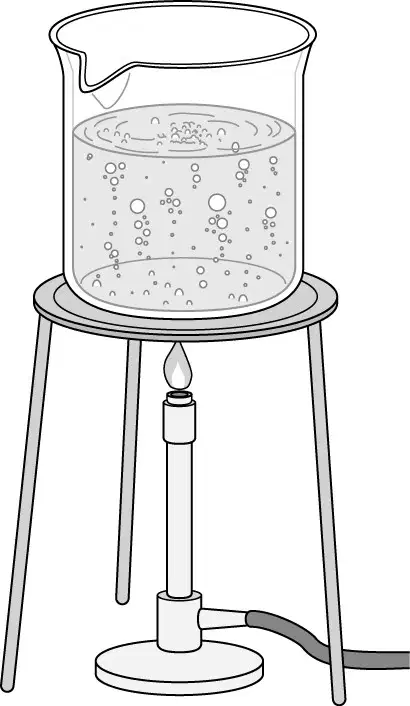
Study the following picture. Which statement demonstrates the most scientific observation?
The water is changing.
The flame is causing a change.
Bubbles are forming and rising.
Steam forms when water gets hot.

The following picture shows two students. What are they doing?
asking a question
planning an investigation
recording an observation
communicating results
Engineers design, model, and test many of the devices that we use every day. Which phrase below best describes the engineering process?
designing new industrial tools
gathering information to prove scientific theories
using math and science to solve practical problems
using raw materials to build structures and machines
Cell phones, washing machines, and door knobs are examples of which human accomplishment?
scientific observation
university scholarship
mathematics
technology
What does an engineering team need in order to test a new design?
problem
data
patent
prototype
What are the standards that help engineers determine how well a design is doing its job?
data
criteria
models
prototypes
A person is using crutches to help himself move around after a leg injury. Which claim explains why crutches are an example of biotechnology?
Engineers made them using the design process.
They are a product used to benefit living things.
They are manufactured using Earth-friendly materials.
The wood they are made from comes from living things.
Which of the following is a procedure you could use to predict design flaws in a fabric used to make sails for ships?
analyzing the ship’s deck for strength
testing to see how much cargo a sailboat can carry
marketing the sails and recording customer complaints
stressing the fabric with wind and weather over a period of time

Engineers want to develop a more efficient dishwasher by decreasing the running time and the amount of water used per cycle. They design and test four different dishwasher prototypes. The bar graph below shows the results of their tests. Based on the evidence in the bar graph, which model best meets the engineers’ design criteria?
Model A
Model B
Model C
Model D
While further testing their design, the engineers discover that dishwasher Model B doesn’t clean the dishes thoroughly. Which of the following is the best next step for the engineers?
Apply for a patent for the Model B dishwasher.
Start all over with a brand-new design for a dishwasher.
Evaluate what is wrong with Model B and work to redesign it.
Choose one of the other dishwashers to manufacture instead of Model B.
A group of engineers have developed four different models of a car. They have recorded data about each model’s miles driven per gallon. What would be the best way for the engineers to communicate the results of their testing?
detailed drawings of each of the cars
a bar graph comparing miles per gallon
a measurement of the size of the gas tank in each car
a data table showing the number of miles each car traveled during testing
Scientists or engineers often build a prototype of a design that they can test. Observing how the prototype performs shows the engineers how their design works. Which is another tool scientists use that is similar to a prototype?
a balance
a bar or circle graph
a model of the design
an experiment using the design
Which of the following activities often comes after the others in the creative design process?
redesigning
developing charts
testing a prototype
brainstorming ideas
Technology brings benefits but also risks. Which of the following is the best example of a physical risk associated with cell phones?
They distract people while driving.
They link people to hurtful Web sites.
They cause students to get poor grades.
They are thrown away and end up in landfills.

The picture below shows a person using a walker to get around.
It is not a prosthetic because a walker is not a biotechnology.
It is a prosthetic because a walker assists a damaged body part.
It is not a prosthetic because the people who use it have their legs
It is a prosthetic because walkers have been designed and tested by bioengineers.
A group of engineers is working on a design to improve the technology of an artificial heart. Which of these criteria should the engineers include in their design?
It should efficiently pump blood to the lungs and body.
It should be made from common and affordable materials.
It should match the color and texture of a real human heart.
It should be able to be controlled and adjusted by the patient.

A movie theater installed a ramp like this one for people in wheelchairs to use. The ramp helps them, but it is not a prosthesis. Why?
It is technology engineered to meet a need.
It does not replace a body part.
It is also used by people who do not need wheelchairs.
It is not the quickest way to get a wheelchair into a theater.
Leah and Deborah are asked to design a backpack with the purpose of making it less bulky. Which claim explains how the purpose of a design and the design criteria are related?
The purpose is only important until the criteria are set.
Setting criteria shows whether the purpose was set correctly
The purpose must be adjusted before the prototype can be tested.
The criteria are set to determine whether the design achieves the purpose.
Jason and Luis have designed and tested a tool to help them construct a backyard birdhouse. Now, they are writing a summary of their conclusions. What will these conclusions communicate?
whether the data reflected the purpose
whether the prototype met the criteria
whether the design matched the model
whether the design process created the data
Which is true about the engineering design process?
It ends when the engineer builds a model.
It is used to solve all human problems.
It begins with identifying a problem.
Most engineers do not use it to solve problems.
Telescopes are useful tools for observing objects in our solar system. When might you use a telescope?
to see more detail about a small area of the sky
to predict the position of a star
to determine the thickness of a planet’s core
to collect a sample from a space object
Planets are classified as either inner planets or outer planets based on their distance from the sun. What is found between the inner planets and the outer planets?
asteroids
comets
moons
stars
The masses of objects in the solar system can be reported by comparing them to the mass of Earth. Which of these planets in the solar system most likely has a mass more than 300 times greater than the mass of Earth?
Jupiter
Mercury
Mars
Venus
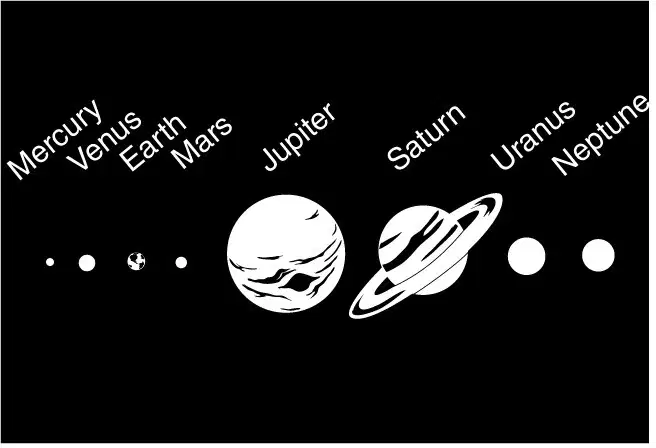
The figure below shows the eight planets in our solar system. Which of the following planets has a large solid core?
Jupiter
Mercury
Neptune
Saturn
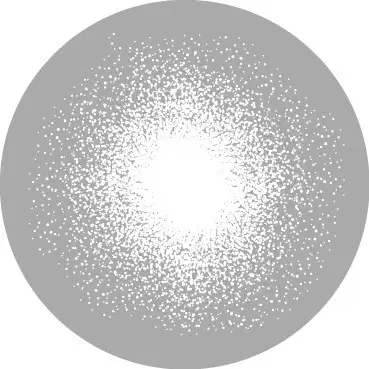
Li-Chen is creating a notebook with diagrams for each of the different kinds of galaxies. What label should Li-Chen use for the galaxy shown above?
elliptical galaxy
irregular galaxy
barred spiral galaxy
normal spiral galaxy
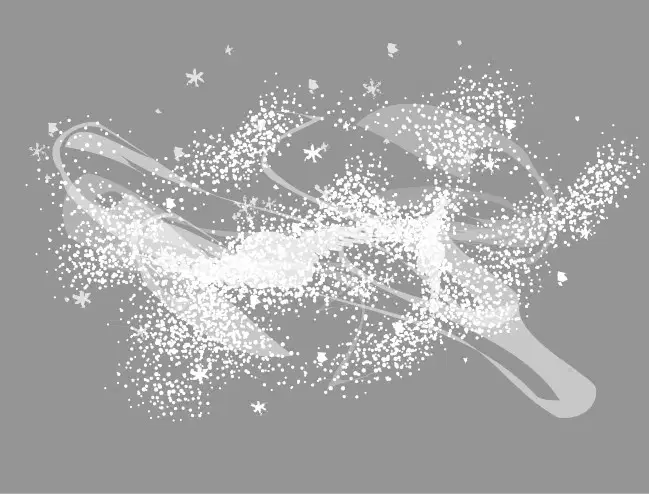
Some galaxies have symmetrical shapes. Other galaxies are not symmetrical. What term do astronomers use to describe a galaxy such as the one shown in the illustration?
barred spiral galaxy
elliptical galaxy
irregular galaxy
spiral galaxy
Elliptical galaxies are brightest toward the center. Which reasoning best explains this observation?
The stars are evenly distributed through the galaxy.
The center is crowded with stars, and the number of stars decreases farther out.
Most of the stars are near the outside of the elliptical galaxy with dust clouds in the center.
The stars are spread throughout the galaxy in bands that look like the arms of spiral galaxies.
Each of the images below shows two stars of the same color. Which claim is supported by the evidence in the picture?


All visible stars in the night sky are many times larger than Earth. What claim explains why they look like tiny points of light?
They are moving very fast.
The atmosphere blocks most of their light.
The stars visible at night are located very far from Earth.
Most of the light from stars is absorbed by galaxies, so it does not reach Earth.
When compared to other stars, the sun is not very unusual. However, the sun is very important to humans. What makes the sun more important than the other stars?
Unlike other stars, the sun is very large.
When compared to other stars, the sun is the hottest.
Unlike other stars, the sun is the right color for living things.
When compared to other stars, the sun is very close to Earth.
There are two types of spiral galaxies. What is a difference between a barred spiral galaxy and a normal spiral galaxy?
the number of spiral arms
the shape of the galaxy’s center
the number of stars in the galaxy
the colors of the stars in the galaxy
Which of these characteristics distinguishes the outer planets from the inner planets?
The outer planets have many moons.
The outer planets orbit in a different direction.
The outer planets have higher densities.
The outer planets have smaller diameters.
While looking at the sky one night, Bevan saw a streak of light. Bevan’s father told him that the light was produced by a small chunk of rock passing through Earth’s atmosphere. Which of these terms best describes what Bevan saw?
asteroid
comet
meteor
meteorite
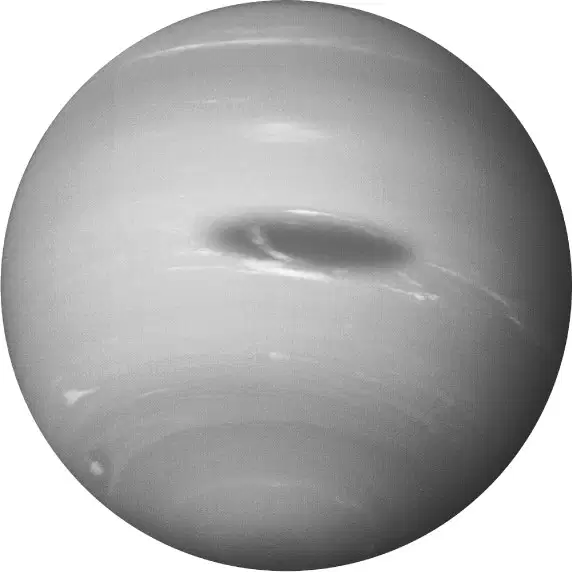
The picture below shows a feature known as the Great Dark Spot. Which of these planets is shown in the picture?
Jupiter
Neptune
Saturn
Uranus
Earth and Saturn are both planets orbiting the sun. Which of these other features do the two planets have in common?
They have a thin atmosphere.
They rotate about an axis.
Their orbits are the same length.
They have about the same mass.
A meteoroid is a chunk of rock traveling through the solar system. How is a meteorite related to a meteoroid?
A meteorite is a meteoroid that enters Earth’s atmosphere.
A meteorite is a meteoroid that has broken into smaller pieces.
A meteorite is a meteoroid that is larger in size than an asteroid.
A meteorite is a meteoroid that reaches the surface of Earth.
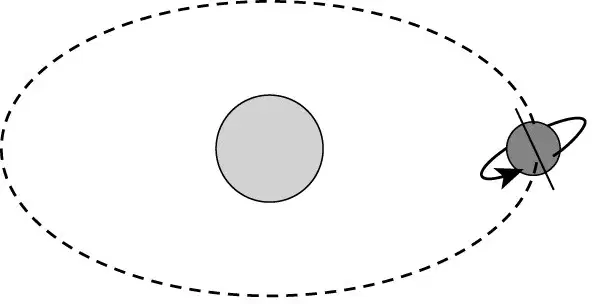
The diagram below shows a planet and the sun. What does the arrow on the diagram show?
how the planet rotates on its axis
the gaseous nature of the planet
why the planet has seasons
how the planet revolves around the sun
A student’s model of the solar system is shown below. Which of these objects would most likely be found between Mars and Jupiter?
stars
comets
asteroids
dwarf planets
During a visit to an observatory, Silvano observed the moon, Venus, the sun, and the star Sirius. Which of these objects is outside of the solar system?
Sirius
Venus
sun
moon
Saturn, Uranus, and Neptune are known as Jovian planets because they are similar to Jupiter. Which of these characteristics do these three planets have in common with Jupiter?
a large solid core
well-defined rings
a thick gaseous atmosphere
a density greater than Earth’s density
Antonio observes the weather one afternoon. He claims that thunderstorms are likely. Which observation provides evidence that supports this claim?
There is a light wind.
The temperature is 23 ºC (75 ºF)
The winds are blowing from the east.
The clouds are mainly cumulonimbus.

A student made the object below. What weather condition is the object designed to measure?
rainfall
humidity
wind speed
air pressure
Which pair of processes helps recharge aquifers?
rain falling on oceans and on land
glaciers breaking off and melting
snow and rain falling on land
melting glaciers and sea level rise
Which claim explains how weather differs from climate?
Weather is the state of the atmosphere at a given time and place, and climate is weather conditions in an area over a longer period of time.
Weather is atmospheric conditions in an area over a long period of time, and climate is the state of the atmosphere at a given time and place.
Weather describes cloud cover and temperature at a given time and place, and climate describes precipitation and humidity at a given time and place.
Weather describes precipitation and humidity at a given time and place, and climate describes cloud cover and temperature at a given time and place.
Which of these tools does a meteorologist use to describe the weather?


Clouds are categorized by their shape and their elevation. Which list shows cloud type in order from lowest to highest in the sky?
cirrus, altocumulus, stratus
cirrus, stratus, altocumulus
stratus, altocumulus, cirrus
stratus, cirrus, altocumulus

The illustration below shows what a piece of hail can look like on the inside. Which claim explains why some balls of hail have layers?
Water that freezes high in the atmosphere always forms layers.
Raindrops freeze from the inside out, forming one layer of ice at a time.
Cracks form layers in the ball of hail when the hail hits the ground.
Each time a ball of hail goes up and down within a thundercloud, a layer of ice is added.

The following diagram shows a location where two air masses meet. What kind of weather is most likely at this location?
a lightning storm
steady rain or snow
a thunderstorm
a wind storm
The following diagrams show the formations of air masses over different areas. Which air mass contains warm, moist air?


Which symbol indicates a warm front?


Evan watches the weather report on the news. The announcer states that an air mass formed over a tropical ocean is moving into the area where Evan lives. Which type of weather can Evan expect?
cold and dry
warm and wet
warm and dry
cold and wet
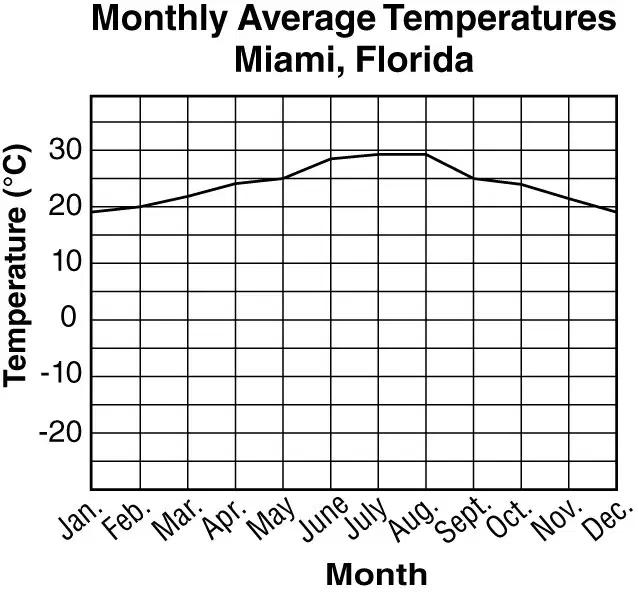
The graph shows the average temperatures in Miami, Florida. In what climate zone is Miami located?
polar
subpolar
temperate
tropical
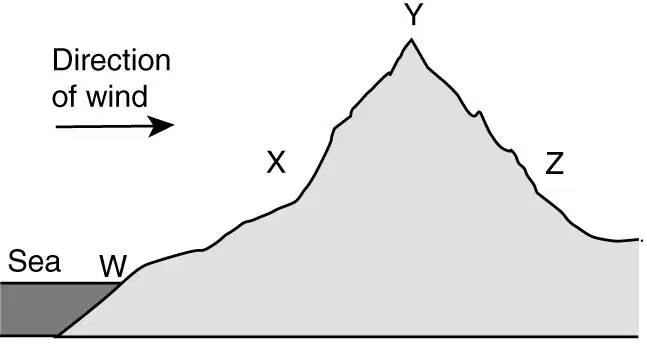
The arrows in this diagram show the direction of prevailing winds. At which point in the diagram are you likely to find a hot, dry desert climate?
Point W
Point X
Point Y
Point Z
Over long periods of time, the climate of an area can change. Which of these can cause a change in climate?
Earth’s position along its orbit
a long-term increase in temperature
tides caused by the moon
heating and cooling of a body of water
For science class, Liam, Carlos, and Xue are studying how precipitation levels vary in different parts of their city. What is the best procedure for collecting the data?
Choose four sites around the city. Record the precipitation at all four sites each time that it rains at the school. Record the results for 1 month.
Place three rain gauges in various places across the city. Each student measures the amount of rain in one gauge at the same time each day for 1 month. Record the results.
Choose three sites for rain gauges. Measure the first site. Then travel to the second site to measure it. Finally, travel to the third site and measure it. Record the results.
Choose three sites. Place a rain gauge at each site. Measure the first site twice a day for 1 month. The next month, measure the second site twice a day. Finally, measure the third site twice a day for a month. Record the results
The people of a city rely on runoff flowing into a lake to meet their water needs. They are concerned that there is less water in the lake this year than in the previous year. How can they collect data to test if their concern about the lake’s water level is valid?
measure the lake’s water density
compare the lake’s current water level to its previous year level
measure the air temperature to find out how fast the water is evaporating
compare this and last year’s average water usage
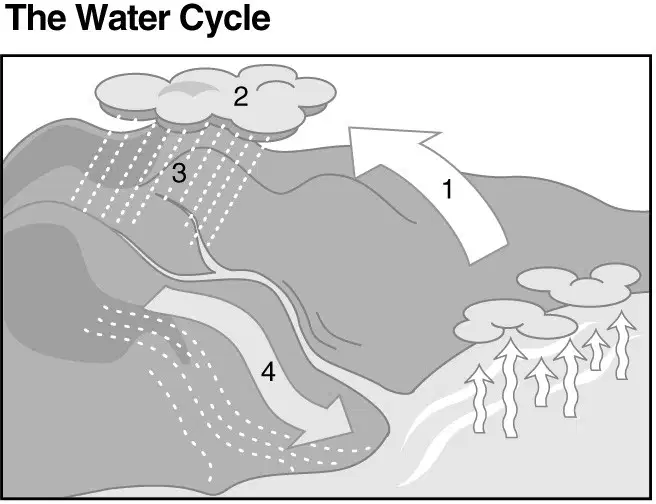
The diagram below shows the water cycle. At which point does runoff happen?
1
2
3
4
Water is constantly returning to the atmosphere from Earth’s surface. Where on Earth does most evaporation take place?
soil
oceans
mountain ice
lakes and rivers
The figures below illustrate a glass of water left on a windowsill. Which claim is supported by evidence in the picture?
Water has evaporated from the glass.
Water has changed from a gas to a liquid.
The liquid water has turned into a solid.
Condensation has caused the amount of water in the glass to increase.

Jacob put yeast into a bowl of water and added a little sugar. He put the bowl in a warm place. After a while, Jacob observed foam spilling out of the bowl. What kind of change is occurring?
physical change
chemical change
scientific change
geological change
Mai filled two balloons with the same amounts of water, sugar, and yeast. She put one on a table in the classroom. She put the other on a sunny windowsill. Which reasoning explains why Mai observed that the balloon in the window grew larger in size?
The windowsill area is cooler.
The windowsill area is warmer.
The classroom table area is warmer.
The classroom table area is the same temperature as the windowsill.
Which of the following represents a chemical change?


Which of these conditions has the greatest effect on how quickly a substance changes from one state to another?
color
light
shape
temperature
Why does milk have to be kept in a refrigerator?
Milk tastes better when it is cold.
The reactions that cause milk to spoil are slower at lower temperatures.
Physical changes that cause milk to spoil are slower at lower temperatures.
No chemical or physical changes can occur at cool temperatures.
Sergio tested a control solution at room temperature (25 °C), and measured how fast salt dissolved in it. Next, he cooled solution A to 10 °C and heated solution B to 40 °C. How quickly did the salt dissolve in solutions A and B compared to the control?
faster for solutions A and B
faster for solution A and slower for solution B
slower for solution A and faster for solution B
slower for solutions A and B
Felix is helping his father cook dinner. After Felix adds salt to the boiling water, what will he have in the pot?
a mixture called a solution
a solution called a mixture
a mixture called a combination
a solution called a combination
Gavin took a picnic to a sandy beach. He brought a garden salad and lemonade. Which of these best describes sand, a garden salad, and lemonade?
atoms
mixtures
solutes
solutions
Tania’s mom boils water in a pot on the stove to make soup. Which of these ingredients will dissolve in the water?
garlic
oil
pepper
salt
The following pictures show the particles of a substance in different states. All of the pictures show the same substance. Which is most likely a solid?


Each of the states of matter has specific characteristics. Which statement correctly describes one of these characteristics?
Solids flow from one place to another.
Gases can expand and be compressed.
Liquids have definite volume and shape.
The particles in solids have weak forces of attraction.
Lina needs to make a list of the physical properties of matter. Which of these should Lina include in her list?
balance
graduated cylinder
temperature
thermometer
Each state of matter has certain physical properties. Which is a physical property of a gas?
It has definite shape.
It can be compressed.
It has definite texture.
Its particles vibrate in place.
Which of the following drawings of atoms shows a different element from the other three?


Different elements have different kinds of atoms. How can you tell an atom of one element from an atom of another?
the number of electrons
the number of neutrons
the number of nuclei
the number of protons
Minerals break in different ways. Some break into thin sheets while others break into squares. What property of minerals is this?
cleavage
hardness
luster
streak
Which of these observations describes a minerals luster?
brittle
shiny
brown
hard
Which rock is formed by lava that has cooled quickly?
sedimentary
metamorphic
igneous
sandstone
Which rock is formed by layers of material that settled on the bottom of an ocean?
sedimentary
igneous
metamorphic
obsidian
Paolo wanted to identify a mineral. He rubbed a corner of the mineral across a white tile and recorded the color of the mark. What property was Paolo measuring?
cleavage
color
streak
luster
Minerals and rocks are not exactly the same. How are minerals and rocks related to each other?
Minerals are groups of related rocks.
Minerals have crystals, but rocks do not.
Rocks are made up of one or more minerals.
Rocks contain different chemical compounds than minerals.
Minerals are identified and sorted by different characteristics. Luster is one way to sort minerals into different types. What is a mineral’s luster?
the way that light reflects from its surface
the mineral’s elements and their arrangement
the color that it makes when rubbed on a tile
the way that it breaks when you strike it with a wedge
Sheila is classifying the rocks in her collection. She knows that limestone often contains fossils. In which category of rock should she classify these rocks?
igneous
granite
metamorphic
sedimentary
Both igneous rock and sedimentary rock can turn into metamorphic rock. What two conditions are necessary for this to happen?
heat and erosion
heat and pressure
weathering and erosion
weathering and pressure

Minerals have various physical properties. The illustration below shows a tool that is used to test a physical property of minerals.
What physical property of a mineral is tested using this tool?
cleavage
color
luster
streak
An ant’s antennae sense temperature and pressure. Which human structure serves the same function?
taste bud
rods and cones
skin
olfactory bulb
During recess, Renee scraped her knee, so the nurse put a bandage on it. Which of the functions below that are normally provided by skin is now being provided by the bandage?
preventing dehydration
keeping bacteria out of the body
regulating body temperature
sensing when it is being touched
The human body receives sensory information from its surroundings. The body knows when food is warm or cold and whether an object is smooth or fuzzy. The body sends signals to other parts of the body, which then respond to the information. Which organ processes the sensory information the body receives?
brain
skin
heart
stomach
The digestive system contains several organs working together to achieve a common function. Food passes through some of these organs. Other organs, called accessory organs, never contain food, but are still important to the process of digestion. Which organs are accessory organs to digestion?
liver and pancreas
kidneys and bladder
esophagus and stomach
small intestine and large intestine
Which organ of the digestive system mashes food and mixes it with acid?
liver
stomach
small intestine
large intestine
Which organ of the digestive system absorbs nutrients from digested food?
large intestine
small intestine
pancreas
liver

The security camera shown in the figure records what goes on in the store. Information from the camera is sent to a computer in the office. There, the information is translated into an image.
Which part of the human body serves the same purpose as the wires leading from the camera to the computer?
brain
eyes
nose
nerves

The organ shown below, identified with an arrow, plays an important role in digestion by producing a substance that helps break down certain foods.
What substance does this organ produce to help digestion?
oil
acid
salt water
bile

The organ shown above, identified with an arrow, is a digestive organ.
What happens when food reaches this organ?
Acidic juices mix with the food.
Food is stored, but no digestion occurs.
The food is moved into the large intestine.
The food is completely digested and absorbed into the bloodstream.

Digestion takes place in the digestive tract, which is shown in the following figure.
n what order does food move through the organs of the digestive tract?
A, B, C, D
A, B, D, C
A, C, B, D
A, D, B, C

The following picture shows the human circulatory system.
What is the function of the organ marked as X?
to add oxygen to the blood
to remove carbon dioxide from the blood
to filter blood
to pump blood

Madison's life science class was investigating the characteristics of animals. The drawings below show three animals Madison was studying.
Which physical structures do all three of these animals use for support and movement?
claws and teeth
scales and tails
bones and muscles
lungs and legs
Jacob put yeast into a bowl of water and added a little sugar. He put the bowl in a warm place. After a while, Jacob observed foam spilling out of the bowl. What kind of change is occurring?
physical change
chemical change
scientific change
geological change
Mai filled two balloons with the same amounts of water, sugar, and yeast. She put one on a table in the classroom. She put the other on a sunny windowsill. Which reasoning explains why Mai observed that the balloon in the window grew larger in size?
The windowsill area is cooler.
The windowsill area is warmer.
The classroom table area is warmer.
The classroom table area is the same temperature as the windowsill.
Which of the following represents a chemical change?
Which of these conditions has the greatest effect on how quickly a substance changes from one state to another?
color
light
shape
temperature
Why does milk have to be kept in a refrigerator?
Milk tastes better when it is cold.
The reactions that cause milk to spoil are slower at lower temperatures.
Physical changes that cause milk to spoil are slower at lower temperatures.
No chemical or physical changes can occur at cool temperatures.
Felix is helping his father cook dinner. After Felix adds salt to the boiling water, what will he have in the pot?
a mixture called a solution
a solution called a mixture
a mixture called a combination
a solution called a combination
Gavin took a picnic to a sandy beach. He brought a garden salad and lemonade. Which of these best describes sand, a garden salad, and lemonade?
atoms
mixtures
solutes
solutions
The following pictures show the particles of a substance in different states. All of the pictures show the same substance. Which is most likely a solid?

