
Font size
 Worksheets
Ch13 Forces of Change (Whole Chapter)
Total questions: 50
Worksheet time: 25mins
A change in a gene
replication
translation
mutation
transcription
Genetic drift is driven by chance, not natural selection
true
false
A forest fire ignites and kills many members of a population of rattlesnakes. This is an example of:
gene flow
genetic drift
mutation
Genetic diversity is increased through:
genetic drift
gene flow

This image is an example of:
genetic drift
gene flow
The more genetic variation a population has,
the more likely it is for some individuals to
evolve
migrate
survive
mutate
Mutations are important because they bring about
death of the organism in which they develop
genetic variation needed for a population to evolve
benefits for the individual, not for the population
changes in genotype, but not phenotype
Mutation
Change in DNA sequence
Gene Flow
Increases genetic variation
Genetic Drift
Usually decreases genetic variation
Bottle Neck
Population gets smaller (Natural Disaster)
Founders Effect
Starting a new population
A trait or change in lifestyle that helps a plant or animal survive in its environment
adaptation
evolution
homologous
vestigial
Genetic drift is change in the allele frequency of a population due to...
natural selection
nonrandom mating
random chance
artificial selection
This mechanism of evolution occurs when populations immigrate or emmigrate
genetic drift
gene flow
extinction
natural selection
Male peacocks have beautiful blue and green plumage. However, this coloration makes them easier for tigers to hunt and kill. Why might they have these colors?
Sexual preference by female peacocks
Peacocks mated with parrots a long time ago
Genetic drift randomly killed off all brown peacocks
There is no reason - it's a horrible mutation with no advantage
Which of the following is an example of the bottleneck effect?
Bald Eagles are hunted until near extinction, population recovers
Red fox pups are more likely to survive in a snowy environment if they are born white
Small group of iguanas floats to an island, starts a new population
Farmer chooses seeds from largest apples to plant next year. This results in larger apples from year to year
Natural selection operates on the _______ of an individual organism.
environment
genotype
survival
phenotype
The concept of genetic bottlenecks includes which of the following?
sharing of genetic material between two populations
increased ability to resist new diseases
extensive gene flow
a loss of genetic diversity in descendent populations
Organisms with the best suited adaptations for their environment are more likely to survive and reproduce than organisms that are not very well adapted
natural selection
artificial selection
creationism
Select the right word for this definition:
"in biology, changes that happen over time in the gene pool of a population."
evolution
extinction
mutation
If a new trait DOES help an organism survive, what may happen to it?
It dies and its DNA is not passed on
It survives and its DNA is passed on
It changes its traits to adapt and survive
Hunters killed elephants with tusks resulting in more tuskless elephants. The hunters were the ___ pressure changing the population
Selective
Unusual
Usual
exceptional

What type of selection is pictured here?
Directional
Disruptive
Stabilizing

What type of selection is pictured here?
Directional
Disruptive
Stabilizing
Type of Selective Pressure: A particular bird species lays an average of 4 eggs per nesting season. If more than four eggs are produced, the parents may not be able to feed the hatchlings. If less than 4 eggs are produced, there is an increased risk that predators will take all the young that have been produced.
Directional
Disruptive
Stabilizing
Type of Selective Pressure: A lizard population lives in a very rocky area consisting of black rocks and white rocks. Black lizards can hide from predators by living on black rocks, and white lizards can hide from predators by living on white rocks. The intermediate grey colored lizard is found in fewer numbers because of its inability to hide from predators in this environment.
Directional
Disruptive
Stabilizing
Type of Selective Pressure: During the ice ages, the black bears of Europe increased in size.
Directional
Disruptive
Stabilizing
Type of Selective Pressure: In a population of field mice, coat color ranges from light tan to dark brown. Medium brown mice are found in greater abundance due to their ability to blend in with their surroundings.
Directional
Disruptive
Stabilizing
Charles Darwin formulated his idea for natural selection after visiting which unique island chain?
England
Hawaii
The Galapagos
Indonesia
Which characteristic of the finches in the Galapagos did Darwin find particularly interesting?
Finches on different islands were very similar except the size of their beaks, which varied quite a bit
Some finches in the Galapagos couldn't fly
The finches were absent from some of the islands
The finches showed evidence of nonrandom mating
The study of embryo development
Endocrinology
Embryology
Genomics
Entemology
A measure of an organism's ability to survive and reproduce
Fitness
Homology
Selection
Proteomics
Darwin proposed the idea of ...
Nonrandom mating
Sexual selection
Natural Selection
Genetic Drift
Evidence for evolution comes from
Fossil Record
Comparative Anatomy
Comparative Genetics
All of the above
The man who also came up with the idea of natural selection, but wasn't given credit since Darwin had more evidence.
Gregor Mendel
Alfred Russel Wallace
Albert Einstein
James Watson
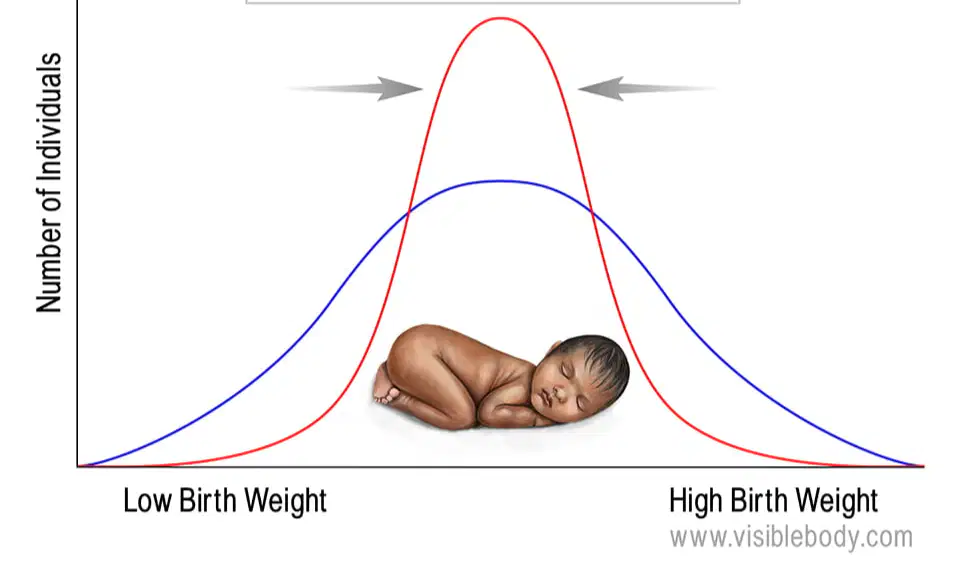
This is an example of...
Disruptive selection
Stabilizing Selection
Directional Selection
When a species exhibits differences in traits between males and females
Natural Selection
Artificial Selection
Sexual Selection
Sexual Dimorphism
The allele for sickle cell anemia has an unusually higher fitness on the continent of ________
North America
Africa
Asia
Europe
Studying the similarities and differences in gene sequences between two species
Comparative Genomics
Comparative Embryology
Comparative Anatomy
Proteomics
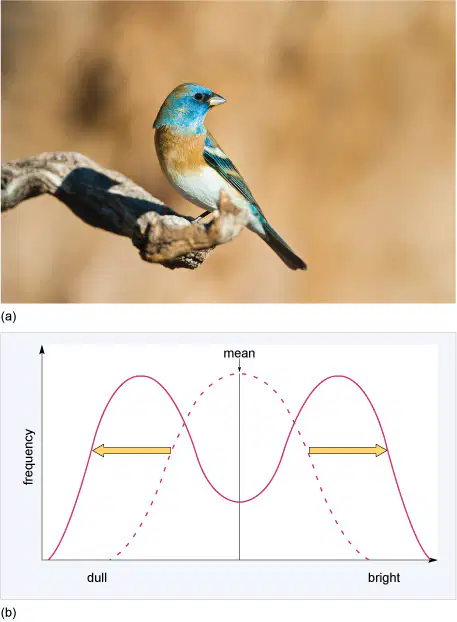
Which type of selection is this?
Directional selection
Natural selection
Disruptive selection
Stabilizing selection
Which type of selection may lead to speciation?
Directional selection
Disruptive selection
Stabilizing selection
The process by which one species may gradually become two
Specialization
Diversification
Population growth
Speciation
Allele frequencies in populations don't change unless and evolutionary force is acting on them.
Natural Selection
Hardy Weinberg Principle
Gene Flow
Independent Assortment
Two structures that appear to have the same function but did not arise from common ancestry.
Analogous traits
Homologous traits
Derived traits
Vestigial Traits
Natural Selection directly acts on...
Phenotypes
Genotypes
T/F: Since Darwin first proposed the idea of natural selection and common ancestry, we have discovered more and more evidence that supports his idea from new sources such as comparative genetics, the fossil record, and comparative proteomics.
True
False
The study of protein structure
Proteomics
Genetics
Proteinology
Genetic Drift
The allele for sickle-cell anemia has a higher fitness in Africa because it provides some resistance to ...
Genetic Drift
AIDS
Malaria
Hemophilia
Anatomical structures that have little or no use but are present due to ancestry.
Vestigial traits
Homologous traits
Analogous traits
Derived Traits
The "A" allele = 40%
The "a" allele = 60%
These are examples of...
Genes
Allele Frequencies
Proteomic numbers
Hardy Weinberg Principles

