wayground logo

Free Printable Worksheets

NEW

Font size

S
M
L
XL
Worksheets

Classification Review

Total questions: 38

Worksheet time: 32mins

Name
Class
Date
1.

Which four kingdoms are eukaryotic?

a)

Archaebacteria, Protist, Plant, Animal

b)

Eubacteria, Fungi, Archaebacteria, Plant

c)

Eubacteria, Fungi, Plant, Animal

d)

Protist, Fungi, Plant, Animal

2.

Which kingdom contains organisms that are able to live in extreme environments?

a)

Eubacteria

b)

Plant

c)

Animal

d)

Archaebacteria

3.

Which kingdom contains organisms with cell walls made of cellulose who are autotrophs and non-motile?

a)

Plant

b)

Protist

c)

Eubacteria

d)

Animal

4.

Which kingdom contains organisms whose cells never have a cell wall and are heterotrophs?

a)

Plant

b)

Animal

c)

Archaebacteria

d)

Fungi

5.

Which kingdom contains organisms that are multicellular autotrophs?

a)

Fungi

b)

Animal

c)

Plant

d)

Archaebacteria

6.

Which kingdom contains organisms that are unicellular, prokaryotic, and could live on a door knob?

a)

Eubacteria

b)

Archaebacteria

c)

Protist

d)

Fungi

7.

Which kingdom would a pond living, unicellular, and eukaryotic organism belong to?

a)

Protist

b)

Archaebacteria

c)

Animal

d)

Plant

8.

Which kingdom does the organism that lives in a hot spring belong to?

a)

Plant

b)

Animal

c)

Protist

d)

Archaebacteria

9.

This tiny organism spends its day reproducing rapidly (about once every 20 minutes), often inside the bodies of other organisms. Its genetic material is not contained inside a nucleus.

a)

Protist

b)

Eubacteria

c)

Plant

d)

Archaebacteria

10.

This rather soft, low-lying organism spends its day taking nutrients from a rotten log through its hyphae. It continues to undergo cell division and grow larger.

a)

Protist

b)

Fungi

c)

Plant

d)

Eubacteria

11.

This organism spends its day taking in carbon dioxide and releasing oxygen through its stomata. It never eats but can grow many meters tall.

a)

Fungi

b)

Protist

c)

Plant

d)

Archaebacteria

12.

This organism spends its day roaming through the forest in search of food. Its hunting techniques require use of its keen sense of smell and hearing.

a)

Fungi

b)

Eubacteria

c)

Protist

d)

Animal

13.

I am a prokaryote. I am unicellular. You can find me everywhere like in your digestive tract.

a)

Protist

b)

Fungi

c)

Eubacteria

d)

Archaebacteria

14.

I am eukaryotic and mostly multicellular. Occasionally, I can be unicellular but I cannot make my own food so I absorb nutrients from dead and decaying materials.

a)

Fungi

b)

Eubacteria

c)

Archaebacteria

d)

Plant

15.
Which kingdoms are prokaryotic?
a)
Archaebacteria and Animalia
b)
Eubacteria and Archaebacteria
c)
Fungi and Protista
d)
Plantae and Eubacteria
16.
 You would find mushrooms and molds in which kingdom?
a)
Plantae
b)
Protists
c)
Fungi
d)
Animalia
17.
In which kingdom do I belong if I am unicellular, autotrophic, and eukaryotic?
a)
Archaebacteria
b)
Protista
c)
Animalia
d)
Plantae
18.
What is the difference between Archaebacteria and Eubacteria?
a)
Eubacteria are eukaryotic.
b)
Archaebacteria are multicellular.
c)
Archaebacteria can live in extreme environments.
d)
Archaebacteria are found everywhere.
19.
All of the following have a nucleus except...
a)
bacteria
b)
animals
c)
plants
d)
protists
20.
Which kingdom contains multicellular, heterotrophic organisms whose cells have NO cell walls?
a)
Protista
b)
Fungi
c)
Plantae
d)
Animalia
21.
When DNA is contained in a nucleus, the cell is...
a)
eukaryotic
b)
prokaryotic
c)
unicellular
d)
multicellular
22.
Animals must eat other organisms for food, so they are classified as...
a)
heterotrophs
b)
autotrophs
c)
eukaryotic
d)
prokaryotic
23.

What are the six kingdoms of life?

a)

Animals, Plants, Vertebrates, Invertebrates, Viruses, Fungi

b)

Bacteria, Amoeba, Algae, Archaea, Protists, Nuclei

c)

Archaea, Bacteria, Protists, Animals, Plants, Fungi

d)

Archaea, Bacteria, Animals, Plants, Proteins, Fungi

24.

What are the names of the three domains of life?

a)

Bacteria, Archaea, Eukarya

b)

Bacteria, Archaea, Animalia

c)

Archaea, Plantista, Animalia

d)

Life, Animals, Plants

25.

Which four kingdoms are eukaryotic?

a)

Archaebacteria, Protist, Plant, Animal

b)

Eubacteria, Fungi, Archaebacteria, Plant

c)

Eubacteria, Fungi, Plant, Animal

d)

Protist, Fungi, Plant, Animal

26.
I have a nuclear membrane, can do photosynthesis and am multicellular. What kingdom do I belong to?
a)
Animalia
b)
Archaebacteria
c)
Plantae
d)
Protista
27.
I sometimes get confused by others to be a plant. I'm heterotrophic and digest decaying material. What kingdom to I belong to?
a)
Archaebacteria
b)
Animalia
c)
Fungi
d)
Protista
28.
How many kingdoms are there?
a)
2
b)
3
c)
6
d)
8
29.
Which kingdom do humans belong to?
a)
Plantae
b)
Fungi
c)
Animalia
d)
Protista
30.
What step do we always start with when using dichotomous keys?
a)
1
b)
2
c)
3
d)
4
31.
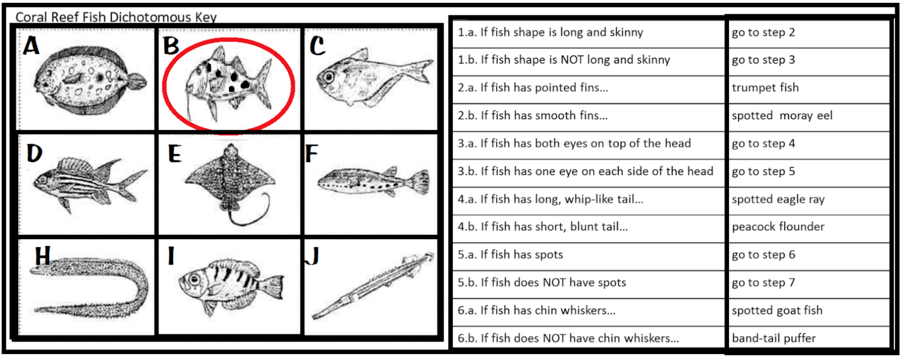
Using this dichotomous key, identify the name of the circled Fish, J.
a)
peacock flounder
b)
band-tail puffer
c)
trumpet fish
d)
spotted goat fish
32.
Using this dichotomous key, identity the name of the circled fish.
a)
band-tail puffer
b)
spotted goat fish
c)
peacock flounder
d)
trumpet fish
33.
What is the purpose of a dichotomous key?
a)
to find a common ancestor
b)
to show the evolution of organisms
c)
to see what organisms eat
d)
to identify organisms
34.
The scientific name for an organism is made from the:
a)
class and family name
b)
genus and species name
c)
domain and kingdom name
d)
kingdom and phylum name
35.
A dichotomous key for trees is provided. Hikers found a tree that has large brown cones and single sharp needles. What species of tree have the hikers found?
a)
Juniper
b)
Pine
c)
Spruce
d)
Fir
36.
Which of the following is the correct way to write the scientific name of a house cat? (imagine that these options are all in italics)
a)
Felis Domesticus
b)
felis domesticus
c)
Felis domesticus
d)
felis Domesticus
37.
The 8 levels of classification, most broad to most specific.
a)
Domain, Genus, Family, Order, Class, Phylum, Kingdom, Species
b)
Domain, Species, Kingdom, Genus, Phylum, Family, Class, Order
c)
Domain, Kingdom, Phylum, Class, Order, Family, Genus, Species
d)
Order, Kingdom, Species, Domain, Phylum, Family, Class, Genus
38.
What is the scientific name of housefly?
a)
Musca domestica
b)
Insect domestica
c)
Animalia domestica
d)
Diptera domestica