wayground logo

Free Printable Worksheets

Font size

S
M
L
XL
Worksheets

Evolution

Total questions: 47

Worksheet time: 44mins
Name
Class
Date
1.
Where the better adapted organisms survive to pass traits along to offspring.
a)
Evolution
b)
Natural Selection
c)
Extinction
d)
Artifical Selection
2.
Why are advantageous traits more likely to be passed onto offspring?
a)
Because they are more likely to survive and reproduce.
b)
Because they come from dominant alleles.
c)
Because they come from recessive alleles.
d)
Because the trait is an acquired phenotype.
3.
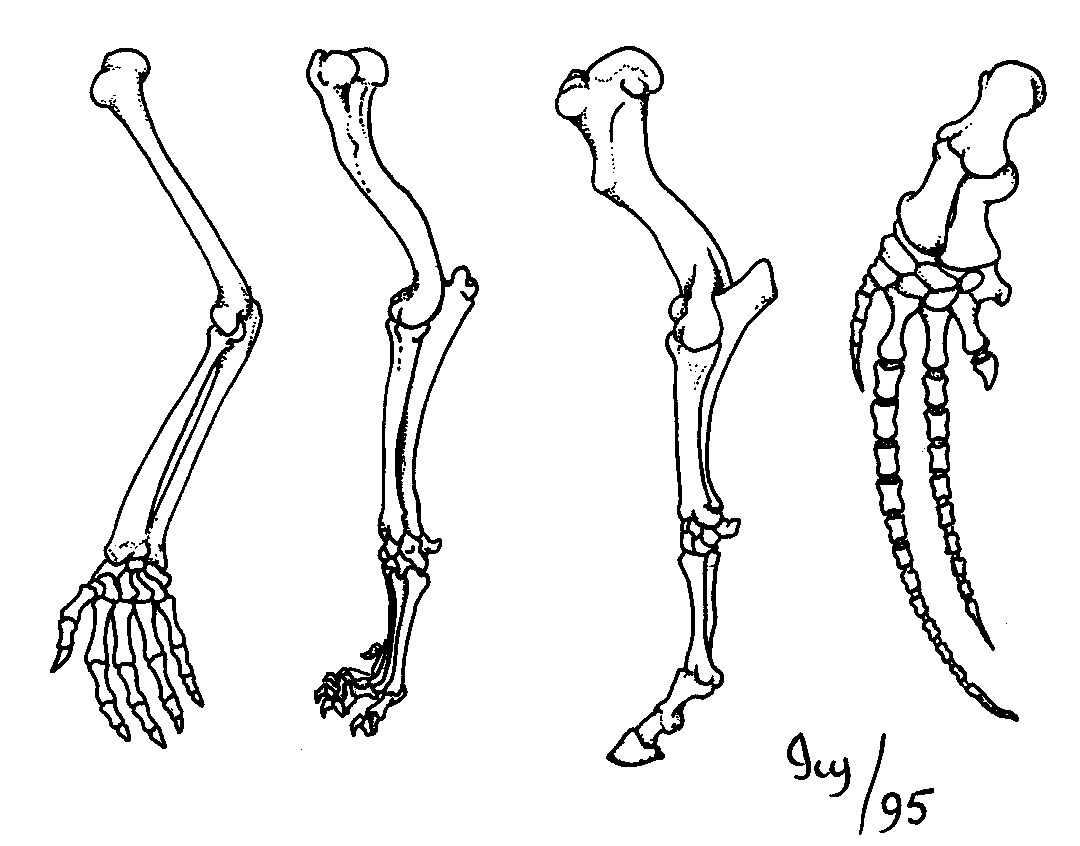
Structures with the same parts have different functions; suggests that organisms share a common ancestry
a)
vestigial structures
b)
homologous structures
c)
adaptive radiation
d)
fossil
4.
Study of embryos of various organisms to show a common ancestor because of similarities in development
a)
natural selection
b)
embryology
c)
speciation
d)
evolution
5.
The diagram shows fossils in different rock layers. Which of these statements about the age of these fossils is most likely correct?
a)
Fossil A and C are the same age
b)
Fossil B is older than fossil C
c)
Fossils A is older than fossil B
d)
Fossil D is older than fossil C
6.
What does Darwin's theory of evolution suggest?
a)
species change over time
b)
extinct species are not related to living species
c)
different species can interbreed
d)
animals that look alike are most closely related
7.

Whales are aquatic mammals that contain a pelvis (hip) bone. Even though it does not aid in its movement, the function must have been used by a common ancestor of the whale. Thus, the pelvis is referred to as a(n)

a)

vestigial structure

b)

analogous structure

c)

homologous structure

8.
The ability of an organism to survive and reproduce in its specific environment 
a)
diversity.
b)
evolution
c)
adaptation
d)
 fitness
9.
Genetic differences between organisms of the same species
a)
Variation
b)
Adaptation
c)
Behavior
d)
Environment
10.
Why do embryologist study embryos?
a)
to see if they are related
b)
to understand adaptations
c)
to determine the age
d)
to learn what parents are vestigial
11.
When an organism completely dies out, it is called.....
a)
Adaption
b)
Extinction
c)
Fossilization
d)
Mutation
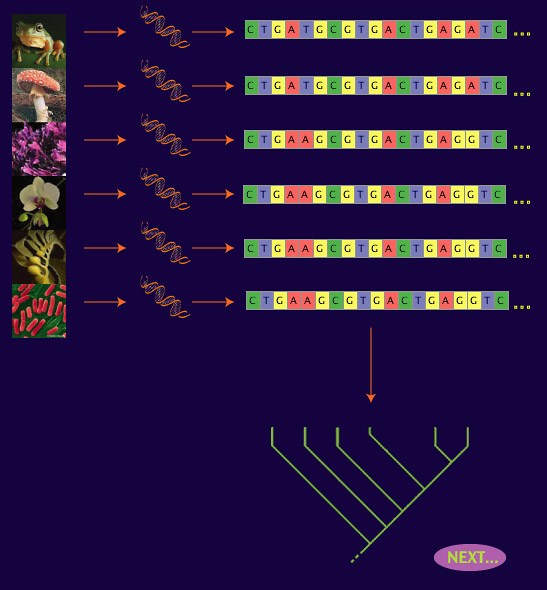
12.
Two organisms that are closely related would have
a)
very similar DNA sequence
b)
exactly the same DNA sequences
c)
no proteins in common
d)
completely different DNA sequence
13.
Comparing human hemoglobin of chimpanzees, horses, kangaroos, and chickens, reveal that humans have the fewest amino acid differences with 
a)
Kangaroos
b)
Horses
c)
chickens
d)
chimpanzees
14.
Mutations are important because they bring about
a)
death of the organism in which they develop
b)
genetic variation needed for a population to evolve
c)
benefits for the individual, not for the population
d)
Hardey-Weinberg equilibrium within a population
15.

What do we call a change in the genome over time?

a)

Evolution

b)

Adaptation

c)

Extinction

d)

Environmental influences

16.
Since the 1800s humans have stopped burning coal, and the trees have returned to their original color. Which moth will be more successful in this environment?
a)
Dark moth
b)
Light moth
c)
Both will be equally successful
d)
Neither will be successful
17.

Structures are similar in function but not in structure

a)

Vestigial

b)

Homologous

c)

Analogous Structures

d)

Embryonic

18.
The struggle for existence against other members of an organisms species is
a)
Competition
b)
Natural Selection
c)
gene flow
d)
genetic drift
19.

Shows how different groups of organisms have changed over time.

a)

fossil record

b)

homologous structures

c)

embryology

20.

The more offspring an organism has the greater the odds that a few of them will survive, reproduce and pass on those traits

a)

overproduction

b)

variation

c)

selection

d)

adaptation

21.
The study of the similarity and differences in body structures between species.
a)
comparative anatomy
b)
embryology
c)
molecular biology
d)
archaeology
22.
Charles Darwin’s observation that finches of different species on the Galápagos Islands have many similar physical characteristics supports the hypothesis that these finches 
 
a)
have the ability to interbreed.
b)
acquired traits through use and disuse.
c)
all eat the same type of food.
d)
descended from a common ancestor.
23.
Only populations can evolve.
Individuals can not evolve.
a)
True
b)
False
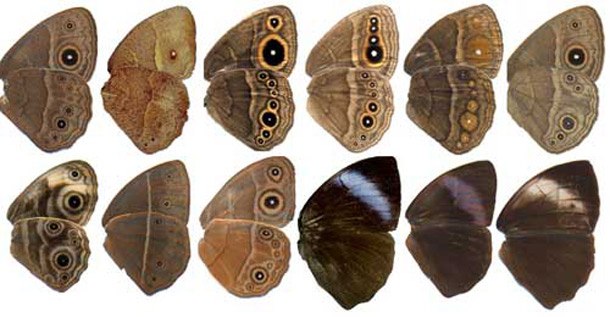
24.
These moths are all the same species. The differences between their wings is an example of ________________
a)
Natural Selection
b)
Variation
c)
Homeostasis
d)
Extinction
25.
a)

A

b)

B

c)

C

d)

D

26.
a)

F

b)

G

c)

H

d)

J

27.
a)

A

b)

B

c)

C

d)

D

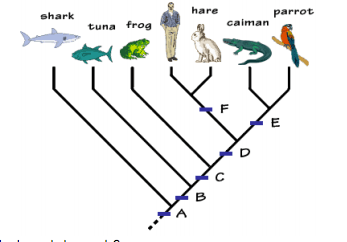
28.

On the cladogram, which organism is the closest relative of the parrot?

a)

Frog

b)

Hare

c)

Caiman

d)

Parrot

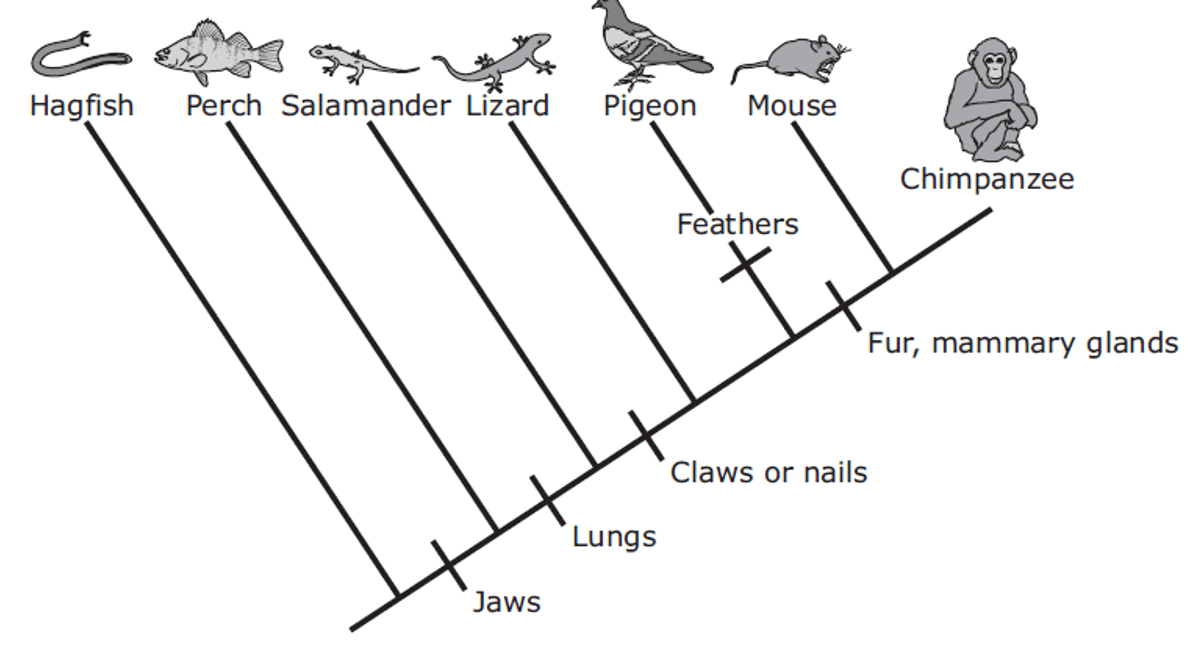
29.

All the animals to the right of the salamander would have the common characteristic of...

a)

Fur

b)

Claws or nails

c)

Lungs

d)

Jaws

30.

what is an adaptation?

a)

a change in behavior or physical aspect of an organism in order to be better suited to survive in a particular environment.

b)

a change that an organism quickly develps to survive

c)

a unique characteristic that makes an organsism more dominant

d)

a shift in an organisms behavior

31.

Which would be an adaptation useful in a cold biome?

a)

Being of a smaller size

b)

Being active during the cooler times of day

c)

Blubber/fat

d)

Having dark fur

32.

What would be the most useful adaptation for a rabbit in the snow...

a)

camoflauge

b)

having long ears

c)

having strong legs

d)

strong teeth

33.

The picture shows flowers with an unusual shape. Which beak shape would best allow a bird to reach the nectar inside the flower?

a)

Long and thin

b)

Short and thick

c)

Short and thin

d)

Long and thick

34.

A principle that states geologic change occurs suddenly.

a)

Catastrophe

b)

Castrophism

c)

Uniformitarianism

d)

Uniform

35.
________________ states that the Earth has gone through slow continuous changes. ex. erosion, continental drift, 
a)
Uniformitarianism
b)
Catastrophism
c)
Gradualism
d)
Law of Superposition
36.

What is Spontaneous Generation?

a)

idea that organisms could come from non-living matter

b)

the law that all living things come from nonliving things

c)

living things come from living things

d)

Non living things create all non living things

37.

Who was the first scientist to try to disprove the idea of spontaneous generation?

a)

Redi

b)

Needham

c)

Spallanzani

d)

Pasteur

38.

Only the jars that were open to air had maggots in it

a)

TRUE

b)

FALSE

39.

What experiment is this?

a)

Koch Experiment

b)

Louis Pasteur Experiment

c)

Spontaneous Growth Experiment

d)

Microbial Growth Experiment

40.

This closed flask will show ______ growth.

a)

no

b)

some

c)

a lot of

41.
_______ believed that organisms develop traits needed for survival and that traits that were unused would become weaker and gradually disappear. 
a)
Darwin
b)
Lamarck
c)
Mendel
d)
Watson
42.
True or False:
Two organisms with similar amino acid sequences must have a more resent common ancestor than two organisms with dissimilar amino acid sequences. 
a)
True
b)
False
43.

Which two levels of classification are used to name organisms?

a)

family and order

b)

kingdom and domain

c)

genus and species

d)

class and order

44.

What is monster # 1 ?

a)

Alienus quadlegicus

b)

Alienus haircus

c)

Alienus Tritoothicus

d)

Alienus Blobicus

45.
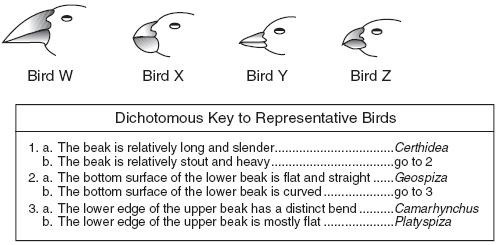
What is the name of bird W?
a)
Certhidea
b)
Geospiza
c)
Camarhynchus
d)
Platyspiza
46.
Tool used by a taxonomist to identify an unknown organism is a:
a)
dichotomous key
b)
binomial nmenclature
c)
scientific name
d)
binomial key
47.
When using a dichotomous key to identify organisms, what do we look at?
a)
physical features
b)
weather patterns
c)
environment
d)
diet