
 Worksheets
US History Comprehensive Review #2
Total questions: 75
Worksheet time: 35mins
The Kansas-Nebraska Act concerned which issue?
the expansions of slavery into new territories
the sale of federal lands to slave owners
the right of Northerners to own slaves
the return of slaves who had escaped from the South
This time period in US History consisted of the Civil War and the struggle to end slavery.
1845-1890
1765-1776
1865-1877
1861-1865
Which of these was a direct consequence of the Civil War?
the extension of voting rights to African American men.
the use of popular sovereignty to decide the issue of slavery
the addition of new states to the Union
the disintegration of the Whig Party
The Guilded Age started in and ended in .
1901, 1914
1865, 1877
1878, 1900
1890, 1915
The 14th Amendment was proposed by Congress in response to which of the following?
the emergence of white resistance to the civil rights movement
the passage of the Black Codes in the South
the rise of violence against emancipated slaves
the attempts of Democrats to limit the voting rights of African Americans
Which of the following was a pull factor that drew African Americans north during the Great Migration?
the sale of inexpensive land by the federal government
the construction of low-cost government housing in growing cities
the absence of segregation and racial discrimination outside the South
the availability of good jobs in the North and the West

This political cartoon is a criticism of which practice in the 19th century?
industrialism
laissez-faire capitalism
monopolization
vertical integration
The Gentleman’s Agreement between President Theodore Roosevelt and Japan resulted in a decrease of which of these?
Japanese immigration to the US
Japanese troops stationed in Manchuria
tariffs between Japan and the US
U.S. and Japanese fleets in the Pacific Ocean
This time period in US History consisted of economic growth and prosperity, rise of the automobile, and the beginning of the Harlem Renaissance.
1901-1914
1946-1960
1920-1929
1961-1973
This time period in US History lasted from 1890-1915 and included the Spanish American War, the annexation of Puerto Rico, and Cuban independence from Spain.
Imperialism
The Gilded Age
WWI
Western Expansion

Why does the cartoon depict Roosevelt carrying his "big stick" through the Caribbean?
Roosevelt felt that the United States had a moral responsibility to protect citizens from civil unrest in Caribbean nations.
Roosevelt wanted to seize control of resources available in the Caribbean to promote U.S. business interests.
Roosevelt believed that a strong military presence in the Caribbean was needed to protect the United States from attack by Latin American nations.
Roosevelt believed that an aggressive foreign policy was needed to prevent Caribbean nations from incurring major debts with European nations.
Which of the following describes a reason for U.S. involvement in WWI?
U.S. leaders feared that Germany might gain too much control and negatively affect American security and trade.
U.S .leaders argued that the stage of war might shift from European soil to territory in the United States.
U.S citizens worried that the Central Powers might be swayed to adopt a non-democratic form of government.
U.S. citizens were persuaded by German propaganda that placed Britain and France's cruelty on display.
This time period consisted of social activism and political reform across the United States, and lasted from 1901-1914.
Imperialism
The Gilded Age
The Roaring Twenties
The Progressive Era
The excerpt below comes from a speech given by President Woodrow Wilson in 1917: “The world must be made safe for democracy. Its peace must be planted upon the tested foundations of political liberty. We have no selfish ends to serve. We desire no conquest, no dominion. We seek no indemnities for ourselves, no material compensation for the sacrifices we shall freely make. We are but one of the champions of the rights of mankind. We shall be satisfied when those rights have been made as secure as the faith and the freedom of nations can make them.”
What was the purpose of this speech?
to justify the acquisition of overseas territory
to persuade the Senate to ratify the Treaty of Versailles
to convince Congress to declare war on Germany
to reassure the public of his commitment to U.S. neutrality.
Which entrepreneur had a significant impact on the cosmetics industry?
Harriet Beecher Stowe
Madame C.J. Walker
Emily Dickinson
Sojourner Truth
Which of the following was the main reason that the federal government created a method for Native Americans to become U.S. citizens?
to reduce the amount of money spent supporting Native Americans
to encourage Native Americans to assimilate into mainstream society
to undermine the legal basis of the treaties made with Native American tribes
to guarantee that Native Americans enjoyed constitutionally protected civil rights
This time period in U.S History consisted of the struggle to end racism in the United States.
Civil Rights Era
Civil War Era
Progressive Era
Reconstruction Era
What was the main purpose of the Interstate Commerce Act of 1887?
to ensure the spread of manufacturing across the frontier
to remove import taxes for goods shipped from one state to another
to prevent railroads from charging farmers and merchants high shipping rates
to protect American agriculture and industry from foreign competition
Which of the following was a goal of the Dawes Act of 1877?
Push Native Americans to adopt an agricultural lifestyle
Lure Native Americans to migrate to the frontier
Entice Native Americans to move to urban areas
Give Native Americans jobs in the federal bureaucracy
This made the production of steel more efficient and affordable.
Combustion Engine
Horizontal Integration
Vertical Integration
Bessemer Process
The invention of the by Henry Ford allowed manufacturing production to be more efficient allowing for different factories to produce more profits.
Car
Assembly Line
Bessemer Process
Combustible Engine
Which statement describes the role played by the U.S. journalists during the Spanish-American war?
Journalists exaggerated events to build support for the war, giving the president and Congress little chance to resolve the conflict diplomatically.
Journalists ignored the signs of impending war until it was too late to inform the public of the government’s intentions to declare war on Spain.
Journalists focused on bad news rather than good news in order to criticize the decisions made by the president and military leaders
Journalists provided frequent reports of the fighting, allowing the public to follow a foreign war closely for the first time.

What was the main purpose of this poster?
to encourage young men to enlist in the army
to demonstrate the reason for entering the war
to generate financial support for the war effort
to create public distrust of Germans
The timeline below shows changes in U.S. tariff policy between 1920 and 1930:
May 1921— Emergency Tariff increases import taxes on agricultural products
September 1922— Fordney-McCumber Tariff raises tariffs on farm and manufactured goods
June 1930— Smoot-Hawley Tariff increases tariff levels to record high level.
What conclusion can be drawn from this timeline?
The American economy was almost entirely self-sufficient throughout the 1920s.
During the 1920s, the United States shifted from an export-based economy to an import-based economy.
Crop prices and corporate profits increased steadily during the 1920s as a result of government policy
During the 1920s, Congress supported domestic producers with a protective trade policy.
Passage of which of these represented a shift from the foreign policy that dominated American politics between the two world wars?
the Wagner Act
the Espionage Act
the Lend-Lease Act
the Taft-Hartley Act
A general vote on a question brought to electors
Referendum
Recall
Initiative
Bill
National Association for the Advancement of Colored People
Angel Island
AFL
NAACP
NWO
Added to Monroe Doctrine - US could interfere in Latin American Affairs
Big Stick Diplomacy
Roosevelt Corollary
Fourteen Points
Dollar Diplomacy
Officially stated separate but equal was legal
Plessy vs. Ferguson
Brown vs. Board of Education
Jim Crow
Harpers Ferry
Non-English speaking, often Jewish, culturally diverse
Eastern and Southern European Immigrants
Asian and Irish Railroad Workers
Western Europeans
Angel Island
Exclusive control or possession of the supply of a commodity, trade or service
Communism
Populist Party
Progressive Party
Monopolies and Trusts
New York/East Coast immigrant processing center
Ellis Island
Angel Island
Teddy Roosevelts foreign policy to use US military as "motivation" in dealing with other countries
Dollar Diplomacy
Big Stick Diplomacy
Roosevelt Corollary
MOnroe Doctrine
The right to organize a law or legislation on a ballot
Referendum
Recall
Direct Election of Senators
Initiative
The practice of using children in factories and other workplaces as cheap labor
Slavery
Child Labor
Trafficking
Who is the progressive president; Big Stick diplomacy; national parks; Square Deal
Theodore Roosevelt
James Monroe
Franklin Roosevelt
Harry Truman
17th Amendment, gave voters direct control over who represents them
Direct Election of Senators
Recall
Referendum
Initiative
Presidents who sought to improve US society and economy: Teddy Roosevelt, Taft, and Wilson
Welfare Presidents
New Age Presidents
Populist Presidents
Progressive Presidents
The right to remove elected officials from office during their term
Initiative
Referendum
Recall
Allowed for ranchers to keep cattle in one place
Barbed Wire Fencing
Electrical Fencing
Cattle Dogs
Shepherds
What was the large animal relied upon by Indians, depopulated by White Settlers
(a)
A progressive initiative to improve working conditions
8-hour work day
Decrease in wages
Longer hours
Improved communication system developed by Samuel Morse
(a)
Improved communication system developed by Alexander Graham Bell
(a)
the practice of a powerful country taking over a less powerful country for resources
(a)
Important contributors to construction of Transcontinental Railroad
Slaves
Asian and Irish Workers
Eastern and Southern European Immigrants
American Steel Tycoon, Robber Baron
Carnegie
Rockefeller
Vanderbilt
Developed the Lightbulb allowed cities and things to be built because of electricity for streets
Thomas Edison
Alexander Graham-Bell
Samuel Morse
Journalists who uncovered scandals and unacceptable conditions in American workplace
Muckrakers
Yellow Journalist
Scalawags
Carpet Baggers
American Oil Tycoon, Robber Baron
Rockefeller
Carnegie
Vanderbilt
California/West Coast immigrant processing center
Ellis Island
Angel Island
Union designed to unite workers
American Federation of Labor
United Farm Workers
NAACP
Passive project in Central America connecting Atlantic to Pacific; Completed by the US under Teddy Roosevelt
Suez canal
Panama Canal
Atlantic Channel
Pacific Canal
A massive railway system connecting cities across the entire US
Interstate Highway
Route 66
Amtrak
Transcontinental RailRoad
Conflict between US and Spain over Cuba, Philippines
Spanish-American War
Cuban Missile Crisis
Vietnam
Korean War
Political Machines promised to protect immigrants' jobs in return for
military service
physical security
votes
cash payments
Which trend has reflected the increasing diversity in United States society in recent years?
new efforts by public schools to teach religious education
an increase in immigration from Latin America
failure of Congress to approve appointments of women and minority groups to federal courts
growing demands for unskilled labor
Which statement about immigration during the 1800s is most valid?
organized labor supported unlimited immigration
most immigrants to the United States were illegal aliens
few immigrants came from western Europe
industrial growth led to a demand for cheap immigrant labor
The intent of United States immigration laws of the 1920s was to
encourage cultural diversity
restore an open-door policy toward immigration
restrict immigration through the use of quotas
increase economic opportunities for recent immigrants
During the late 1800s and early 1900s, where did most of the immigrants to the United States settle?
urban centers of the Northeast
plantations of the New South
farming regions of the Great Plains
mining areas of the Far East
Why did the United States follow a policy of unrestricted immigration from Europe during most of the 1800s?
the US wanted to help European nations by taking their surplus population
immigrants were the only capital resources for business and industry
most American desired a more diversified culture
the American economy needed many unskilled workers
In the late 1800s, the patterns of United States immigration changed in that
most immigrants were political refugees
increasing numbers came from eastern and southern Europe
most immigrants chose to settle in the farming regions of the West
far fewer immigrants arrived than in previous years
Which of the following individuals would have been most likely to become a Nativist?
a Protestant worker
an Italian immigrant
a Catholic priest
an English speaking Irish immigrant
Which statement about immigration to the United States is most accurate?
the number of immigrants has remained constant in each decade during most of American history
the ethnic mix of immigrants to the United States has remained mostly unchanged
nearly all immigrants have easily assimilated into American culture
the desire for economic advancement has been a major reason for immigration to the US
Which of the following individuals would have been most likely to visit Ellis Island during the first few years of the 20th century?
an Italian immigrant
a farmer moving to New York
a Chinese immigrant
an emancipated slave
Which of the following laws was passed in large part due to Nativism?
Chinese Exclusion Act
Sherman Anti-Trust Act
Civil Rights Act of 1964
Voting Rights Act of 1965
Iron ore, running water, lumber, and oil are all examples of which of the following?
natural resources that helped the US become an industrialized nation
natural resources used to produce steel
natural resources used to produce electricity
natural resources which the US lacked during the age of industrialization
"It was a sight to behold. Whole families sharing small rooms with other families. The smell was horrible, and the Lord knows what critters were living in the walls. I guess it's good they work 16 hour days; ain't no room for much except sleeping."
The above quote is probably talking about
African American sharecroppers
immigrants living in a tenement
robber barons living in an urban area
members of the Populist movement
Ethnic ghettos, political machines, tenements, slums, and cultural diversity were all consequences of which of the following?
democracy
abolition
emancipation
industrialization
When the Civil War began, Abraham Lincoln’s main goal was to…
free the slaves
punish the South
bring and end to the war
restore the Union
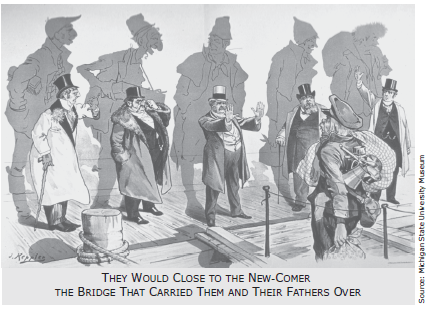
Philanthropists

Which factor prompted the passage of this legislation?
Denial of labor union membership for unskilled workers
Increased nativism and anti-immigrant attitudes
Wage increases for workers in manufacturing positions
Increased U.S. involvement in foreign wars and conflicts

Based on this cartoon and your knowledge of U.S. history, which concern led to the rise of nativism in the United States during this time period?
A fear that immigrants planned to destroy a famous American monument
A fear that immigrants were seeking to harm American society
A fear that immigrants would make weapons to damage American factories
A fear that immigrants were angry about American participation in World War I

- Europeans seek industrial jobs in the United States.
- World War I begins.
- Nativism resurges in the United States.
What was one way the US government responded to this combination of events?
Made labor unions illegal.
Passed immigration restrictions.
Implemented a military draft.
Established a federal income tax.

Nativists wanted to...
group immigrants into their sections of the city
assimilate immigrants into American society
limit immigration
convert immigrants into migrants

