
 Worksheets
APS Semester Test Study Guide
Total questions: 129
Worksheet time: 1hrs 5mins
Name
Class
Date
1.
The best definition of energy is
a)
the ability to move
b)
the speed an object travels
c)
the ability to cause a change
d)
the vibrations of atoms
2.
Atoms that have a positive charge will be attracted to atoms with a ___ charge.
a)
positive
b)
negative
c)
neutral
3.
Acceleration occurs when an object’s ________________ changes in a certain time frame.
a)
distance
b)
velocity
c)
position
d)
speed
4.
When an object speeds up, it has ____________________ acceleration.
a)
undetermined
b)
negative
c)
positive
5.
The equation for speed is:
a)
distance x time
b)
distance/velocity
c)
time/distance
d)
distance/time
6.
The formula for calculating acceleration is ____________________
a)
time / final velocity - initial velocity
b)
initial velocity - final velocity / time
c)
final velocity - initial velocity / time
d)
time / initial velocity - final velocity
7.
An object traveling at a constant speed can still technically be accelerating if its ______________ is changing.
a)
position
b)
direction
c)
mood
d)
none of the above
8.
When an object slows down, it has ____________________ acceleration.
a)
undetermined
b)
negative
c)
positive
9.
Acceleration can be calculated by dividing the change in velocity by the ______________ in which the change occurred.
a)
time
b)
length
c)
speed
d)
momentum
10.
A ball thrown at 30m/s N is an example of
a)
speed
b)
velocity
c)
acceleration
d)
all of the abaove
11.
Slowing down to keep from running a red light at an intersection is an example of
a)
speed
b)
velocity
c)
acceleration
d)
none of the above
12.
Motion is
a)
an increase in an object's speed
b)
a decrease in an object's speed
c)
a change in position relative to a reference point
d)
the stopping of an object relative to a reference point
13.
What is the speed of an object that covers 400 km in 5 hr?
a)
40 km/hr
b)
80 km/hr
c)
2000 km/hr
d)
800 km/hr
14.
An object traveling at a constant 20m/s in a circular path is changing it's
a)
speed
b)
momentum
c)
velocity
d)
mass
15.
A student practicing for a track meet ran 300m in 45 s. What was her average speed?
a)
135 m/s
b)
135 m
c)
6.67 m/s
d)
6.67 m
16.
The next day, the student in the previous question ran 300m in 35s. By how much did her speed increase?
a)
8.57 m/s
b)
8.57 m
c)
6.67 m/s
d)
1.90 m/s
17.
A car traveled 1763 km from New York to Florida in 21 hours. What was its average velocity?
a)
83.95 km/hr
b)
65.67 km.hr
c)
37,023 km/hr
d)
12.2 km/hr
18.
A line on a Speed-Time graph with a steep slope would indicate what?
a)
Constant speed
b)
Moving slowly
c)
Moving quickly
d)
No motion
19.
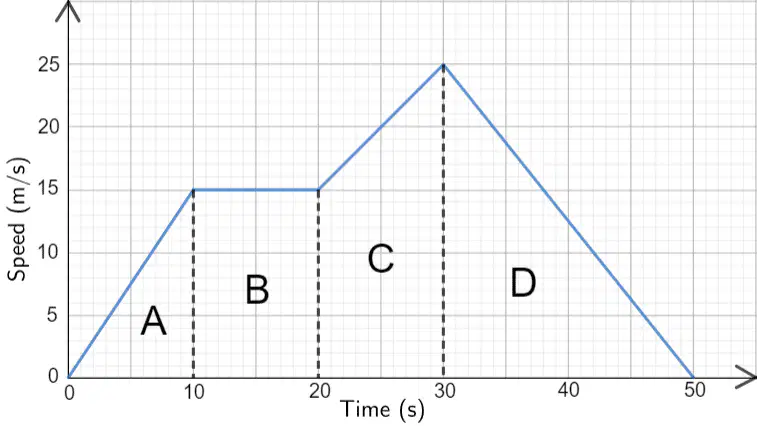
In the graph below, what is happening in part B?
a)
no motion
b)
constant speed
c)
positive acceleration
d)
negative acceleration
20.

In the graph below, what is happening in part C?
a)
no motion
b)
constant speed
c)
positive acceleration
d)
negative acceleration
21.
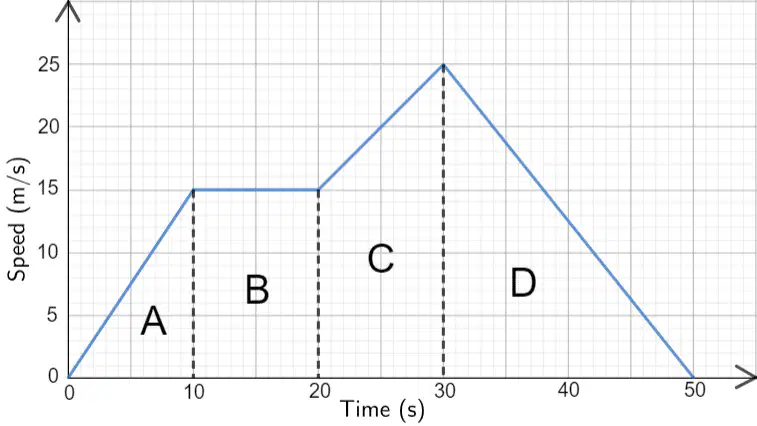
In the graph below, what is happening in part A?
a)
no motion
b)
constant speed
c)
positive acceleration
d)
negative acceleration
22.
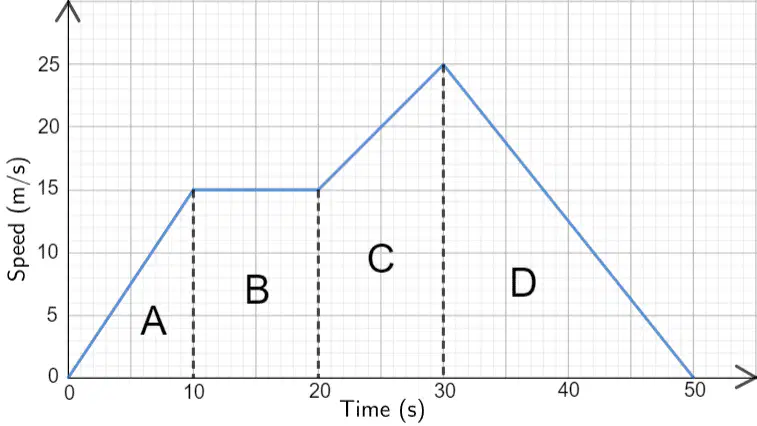
In the graph below, what is happening in part D?
a)
no motion
b)
constant speed
c)
positive acceleration
d)
negative acceleration
23.
When does a car accelerate?
a)
While traveling at a constant speed
b)
While speeding up or slowing down
c)
When changing direction
d)
Both B and C are correct
24.

Looking at the graph below, at what point in time is the person traveling at a constant speed?
a)
0-10 hours
b)
10-12 hours
c)
12-16 hours
d)
Both A and C are correct
25.
The units for acceleration are:
a)
km/hr
b)
m/s
c)
m/s²
d)
km/s²
26.
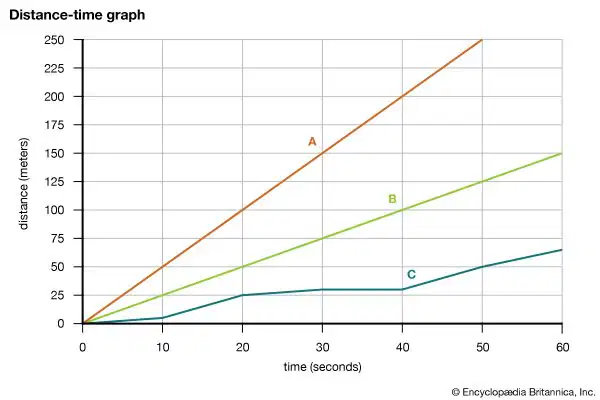
Analyze the following graph. Is Person A, Person B, or Person C moving the fastest?
a)
Person A
b)
Person B
c)
Person C
27.
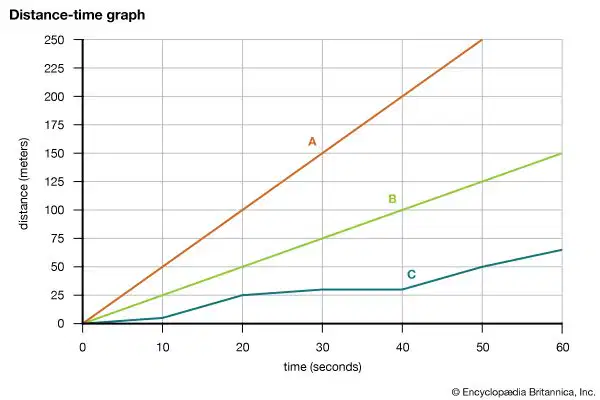
What is the average speed of Person B?
a)
.4 m/s
b)
2.5 m/s
c)
.4 m/s²
d)
2.5 m/s²
28.
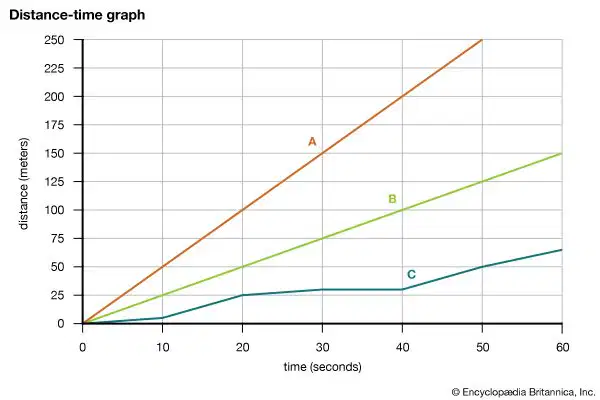
Which statement about the graph below is true?
a)
Person C is moving the fastest.
b)
All three people are accelerating.
c)
The average speed of Person A is 50 m/s.
d)
Person A and Person B are both traveling at a constant speed.
29.
Which of the following is determined by distance divided by time with direction?
a)
speed
b)
velocity
c)
acceleration
d)
momentum
30.
On a Speed-Time Graph, what does a horizontal line (above 0) represent?
a)
constant speed
b)
constant acceleration
c)
zero acceleration
d)
none of theabove
31.
On a Distance-Time Graph, what does a curved line moving up and away from the reference point represent?
a)
constant speed
b)
constant acceleration
c)
zero acceleration
d)
zero speed
32.
A car slows from 50.0 m/s to 20.0 m/s in 6.00s. What is the acceleration?
a)
5 m/s2
b)
-5 m/s2
c)
11.67 m/s2
d)
-11.67 m/s
33.
If a speeding train hits the brakes and accelerates at a rate of –1.09 m/s², how long will it take for the train to go from 54.8 m/s to 12.0 m/s?
a)
39.3s
b)
-39.3s
c)
61.3s
d)
61.3 m/s
34.
How far did a capybara travel in 8 minutes going 12 m/s?
a)
96m
b)
96m/s
c)
720m
d)
5760m
35.
What is a wave?
a)
a movement of matter
b)
a disturbance that carries energy
c)
the process of electrons being transferred
d)
large fluctuations in force
36.

What property of a wave is represented by letter A?
a)
Wavelength
b)
Amplitude
c)
Speed
d)
Frequency
37.

What property of a wave is represented by letter B?
a)
Wavelength
b)
Amplitude
c)
Speed
d)
Frequency
38.

What part of a wave is represented by letter D?
a)
Crest
b)
Compression
c)
Rarefaction
d)
Trough
39.

What part of a wave is represented by letter E?
a)
Crest
b)
Compression
c)
Rarefaction
d)
Trough
40.
Which of the following can act as media for a wave?
a)
Solids only
b)
Liquids only
c)
gases only
d)
Solids, liquids and gases
41.
When the frequency of a wave decreases,
a)
the wavelength increases.
b)
the wavelength decreases.
c)
the wavelength increases and then decreases.
d)
the wavelength remains the same.
42.
True or False? Electromagnetic waves can travel through empty space and do not require a medium through which to travel.
a)
True
b)
False
43.
True or False? Sound waves are able to travel through gases the fastest.
a)
True
b)
False
44.
True or False? A transverse wave moves the matter at a right angle to the direction in which the wave travels.
a)
True
b)
False
45.
Light waves travel at what speed?
a)
300,000,000 km/s
b)
3,000,000 km/s
c)
300,000 km/s
d)
340 m/s
46.
If the speed of visible light is 300,000,000 m/s, and gamma rays are higher frequency and a shorter wavelength, how does their speed compare?
a)
Gamma rays have a faster wave speed.
b)
Visible light has a faster wave speed.
c)
They are the same speed.
d)
They cannot be compared because one is electromagnetic and one is mechanical.
47.
Which of the following lists electromagnetic waves in order from longest to shortest wavelength?
a)
Gamma, X-ray, Ultraviolet, Infrared, Microwave, Visible, Radio
b)
Gamma, X-ray, Ultraviolet, Visible, Infrared, Microwave, Radio
c)
Transverse, Radio, Microwave, Infrared, Visible, Ultraviolet, Longitudinal
d)
Radio, Microwave, Infrared, Visible, Ultraviolet, X-ray, Gamma
48.
Which of the following is NOT true of electromagnetic waves?
a)
They can travel through space.
b)
They all travel at the same speed.
c)
They travel slower than mechanical waves.
d)
They are transverse waves.
49.
Which has a higher frequency on the visible light spectrum: red or green?
a)
Red
b)
Green
c)
They have the same fequency
50.
Which wave type has the highest frequency?
a)
microwaves
b)
gamma rays
c)
sound waves
d)
X-rays
51.
The B in ROY G BIV stands for
a)
Blue
b)
Black
c)
Blue-Green
d)
Blue-Violet
52.
What is required for mechanical waves to travel?
a)
Energy
b)
A medium
c)
Matter
d)
All of the above are correct.
53.
The wave properties that share an inverse relationship are
a)
Frequency and pitch
b)
Amplitude and volume
c)
Frequency and wavelength
d)
Amplitude and wavelength
54.
The ___________ is a measure of how much energy a wave has.
a)
amplitude
b)
frequency
c)
pitch
d)
all of the above are correct.
55.
Which EM wave type is sunscreen used to protect us from?
a)
Gamma
b)
Ultraviolet
c)
Infrared
d)
Visible
56.
Which animal can see infrared light?
a)
Pit vipers
b)
Cats
c)
Dogs
d)
Foxes
57.
In longitudinal waves, which part of the wave is analogous to the crest of a transverse wave?
a)
Trough
b)
Compression
c)
Rarefaction
d)
Wavelength
58.
Which wave type is used to treat cancer?
a)
X-ray
b)
Infrared
c)
Gamma
d)
Transverse
59.
Which statement describes how sound waves travel through different media?
a)
The medium has no influence on sound wave travel.
b)
Sound waves travel faster through air than anything else.
c)
Sound waves travel faster through liquids and solids than air.
d)
Sound waves cannot travel through liquids or solids.
60.
What type of waves do remote controls use?
a)
Infrared
b)
Gamma
c)
X-rays
d)
Microwaves
61.
When does reflection occur?
a)
When light strikes an object and is absorbed
b)
only when an object is placed in front of a mirror
c)
when waves are bent in the process of moving from one medium to another
d)
when a wave strikes an object and bounces off
62.
How are wavelength and frequency related?
a)
the greater the wavelength, the greater the frequency
b)
the greater the frequency, the smaller the wavelength
c)
wavelength and frequency are equal
d)
there is no relationship between wavelength and frequency
63.
Which of these forces works only by combining electric and magnetic forces?
a)
magnetic
b)
electric
c)
electromagnetism
64.
This force occurs when ions create attractive and repulsive forces.
a)
magnetic
b)
electric
c)
electromagnetism
65.
This force occurs when there is an attractive and repulsive force between two poles.
a)
magnetic
b)
electric
c)
electromagnetism
66.
In a magnet the opposite poles will ___________.
a)
repel
b)
attract
c)
both
67.
The magnetic field of a magnet is ____________ further away from the magnet.
a)
stronger
b)
weaker
c)
larger
d)
smaller
68.
Electric charges that do not move through a current are known as
a)
magnetic
b)
electric
c)
electromagnetism
d)
static electricity
69.
When electrons flow through wires from a - terminal to a + terminal a/an _____________ is created.
a)
magnet
b)
static charge
c)
current
d)
electromagnet
70.
The area around an electric charge that experiences the force exerted by the electric charge.
a)
electric field
b)
electric force
c)
electric poles
d)
electric charge
71.
A compass needle points North because
a)
the mass of the compass affects it
b)
the location of the magnetic south pole attracts the needle to it
c)
the Earth's magnetic South pole is located at the geographic North pole
d)
the Earth's magnetic North pole is located at the geographic South pole
72.
What makes an electromagnet stronger?
a)
greater number of loops
b)
smaller number of loops
c)
decreasing the current
d)
decreasing the voltage
73.
Electric current is measured in ________________.
a)
amperes
b)
volts
c)
Newtons
d)
watts
74.
When your hair stands on end, each strand repelling the other, you are experiencing ______________________ ________________________.
a)
magnetic force
b)
repelling forces
c)
static electricity
d)
direct current
75.
What do you end up with if you cut a magnet in half?
a)
two unmagnetized pieces
b)
a north pole piece and a south pole piece
c)
two pieces, each with a north and south pole
d)
two north pole pieces
76.
To get 2 magnets to attract each other, how should they be positioned?
a)
with the same poles near each other (north close to north or south close to south)
b)
with the opposite poles near each other (north close to south)
c)
the position of the magnets doesn't matter
77.
What makes magnetic objects different from non-magnetic objects?
a)
electrons spin in different, random directions
b)
electrons spin in the same direction
c)
magnetic force flows from the north to the sides
d)
magnetic force flows from the south to the sides
78.
Like North and South poles on magnets, electrons and protons
a)
attract
b)
repel
c)
repulse
d)
are neutral
79.
The buildup of charges on an object is called ____.
a)
static electricity
b)
static charge
c)
positive charge
d)
negative charge
80.
What causes charges to move in a circuit?
a)
voltage
b)
energy
c)
electricity
d)
magnetism
81.
An electric current will always follow ____.
a)
the path of least resistance
b)
the path to the north pole
c)
the path to the south pole
d)
the path with insulators
82.
A complete, unbroken path through which electric charges can flow is a (an) ____.
a)
electrical circuit
b)
electrical resistance
c)
magnetic field line
d)
magnetic pole
83.
Materials that allow the charges of an electric current to move freely through them are called ____.
a)
insulators
b)
conductors
c)
resistors
d)
magnets
84.
The region around a magnet where the magnetic force is exerted is known as its ____.
a)
magnetic pole
b)
magnetic field
c)
lodestone
d)
magnetic domain
85.
A temporary magnet ____.
a)
keeps its magnetism for a long time
b)
cannot be destroyed
c)
easily loses its magnetism
d)
has two north poles
86.
The closer together a magnet’s magnetic field lines are, ____.
a)
the weaker the magnetic field
b)
the stronger the magnetic field
c)
the closer they are to the magnet's center
d)
the closer they are to disappearing
87.
Which type of energy is associated with electric currents?
a)
mechanical energy
b)
electrical energy
c)
magnetic energy
d)
geothermal energy
e)
Option 2
88.
An electric current produces a (an) ____.
a)
magnetic field
b)
solenoid
c)
insulator
d)
magnet
89.
A device that increases or decreases voltage is called a (an) ____.
a)
alternator
b)
generator
c)
transformer
d)
turbine
90.
One part of a freely swinging magnet always points ____.
a)
east
b)
to Earth's geographic north pole
c)
toward Earth's core
d)
toward Earth's magnetic pole in the Northern hemisphere
91.
An example of an insulator is ____.
a)
rubber
b)
copper
c)
silver
d)
iron
92.
The SI unit(s) for energy is ____.
a)
Joules or kilojoules
b)
grams or kilograms
c)
watts or kilowatts
d)
newtons
93.
The amount of inertia an object has depends on its _____.
a)
force
b)
mass
c)
friction
d)
age
94.
Which of these is measured in newtons (N)?
a)
acceleration
b)
mass
c)
momentum
d)
friction
95.
_____ is the force that opposes the sliding motion of two surfaces that are touching each other.
a)
friction
b)
inertia
c)
gravity
d)
spring
96.
A group of students are playing tug-of-war. The students on both sides pull with equal force. This is an example of:
a)
unbalanced forces
b)
balanced forces
c)
acceleration
d)
displacement
97.
The sum of all the forces acting on an object is called the _____ force.
a)
net
b)
gravitational
c)
final
d)
inertial
98.

If the same force is applied to each of these balls, which one will have the SMALLEST acceleration?
a)
a
b)
b
c)
c
d)
d
99.
Which of the following is NOT an example of unbalanced forces acting on an object?
a)
An acorn falling from a tree, accelerating
b)
A car moving straight at 80 km/h
c)
A car changing speed from 50 km/h to 80 km/h
d)
A truck slowing down as it approaches a stop sign
100.
A person in a head-on car collision, who is not wearing a seatbelt, continues to move forward at the original speed of the car because of ____________.
a)
friction
b)
inertia
c)
gravity
d)
weight
101.
A feather will fall through the air more slowly than a brick because of _____ acting on it.
a)
gravity
b)
air resistance
c)
terminal velocity
d)
momentum
102.
The firefighter feels the hose pushing backwards on his hands. What is the most likely cause of this?
a)
The escaping water exerts an equal and opposite force on the hose
b)
Since the hose is at rest, it tends to stay at rest
c)
The force on the water equals the mass of the water times its acceleration
d)
The hose is very elastic
103.
The force that pulls all objects towards the Earth is
a)
friction
b)
gravity
c)
magnetic
d)
electrical
104.
A force that is transferred from a person or object to another object is
a)
applied
b)
spring
c)
friction
d)
gravity
105.
The force of attraction between positive and negative charges
a)
normal
b)
applied
c)
electrical
d)
tension
106.
The force that pushes objects up due to the fluid pressure of a liquid is
a)
air resistance
b)
normal
c)
buoyancy
d)
spring
107.
The force in strings, cables, ropes or wires when they are being pulled is
a)
applied
b)
normal
c)
gravity
d)
tension
108.
The force that is created when two surfaces rub against one another
a)
normal
b)
tension
c)
friction
d)
applied
109.
The force that pushes objects up when they are on a solid surface
a)
normal
b)
tension
c)
friction
d)
applied
110.
How much force is required to accelerate a 1000.0 kg car at a rate of 3 m/s²?
a)
3000N
b)
333.33N
c)
30N
d)
3000m/s
111.
If a 70.0 kg swimmer pushes off a pool wall with a force of 250 N, what is his acceleration?
a)
17,500N
b)
3.57 m/s2
c)
.28 m/s2
d)
none of the above
112.
A weightlifter raises a 200.0 kg barbell with an acceleration of 3.00 m/s². How much force does the weightlifter use to raise the barbell?
a)
66.67N
b)
66.67m/s2
c)
600N
d)
600m/s2
113.
A dancer lifts his partner above his head with an acceleration of 2.50 m/s². The dancer exerts a force of 200.0 N. What is the mass of his partner?
a)
100 kg
b)
50kg
c)
80kg
d)
500kg
114.
You can calculate kinetic energy (KE) by using the equation ____.
a)
KE = mgh
b)
KE = 1/2 m v2
c)
KE = 1/2 (9.8)h
d)
KE = dst
115.
You can calculate gravitational potential energy (GPE) by using the equation ____.
a)
GPE = 1/2mh
b)
GPE = 1/2gh
c)
GPE = mgh
d)
GPE = 1/2 m v2
116.
The KE of an object increases as its ____ increases.
a)
velocity
b)
temperature
c)
gravitational constant
d)
height
117.
How could you increase the GPE of a ball without raising it higher?
a)
change the shape of the ball
b)
change the volume of the ball
c)
change the mass of the ball
d)
insult the ball by calling it a triangle
118.
Elastic and gravitational examples of what category of energy?
a)
kinetic energy
b)
immediate energy
c)
temporary energy
d)
potential energy
119.
The type of energy found in fuels and food is
a)
chemical potential energy
b)
elastic potential energy
c)
radiant energy
d)
kinetic energy
120.
According to the law of conservation of energy, the total amount of energy in the universe ____.
a)
increases over time
b)
decreases over time
c)
changes constantly
d)
remains constant
121.
On the way down, the KE of a coconut falling from a tree
a)
increases
b)
does not exist
c)
decreases
d)
stays the same
122.
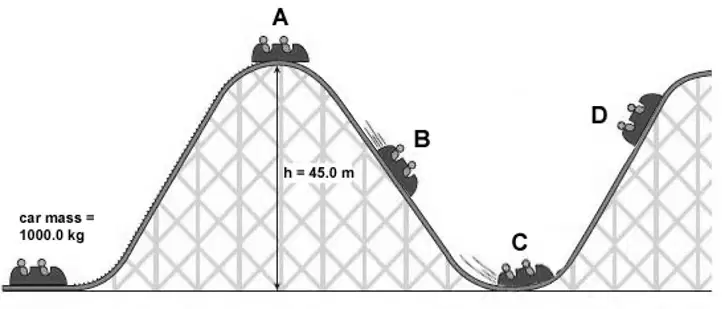
Where is the KE of the roller coaster the greatest?
a)
A
b)
B
c)
C
d)
D
123.
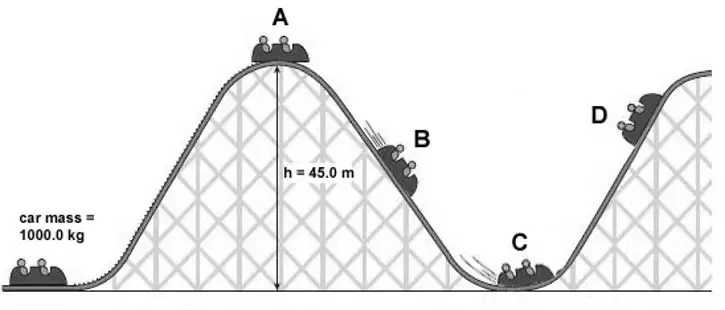
Where is the GPE of the roller coaster the greatest?
a)
A
b)
B
c)
C
d)
D
124.
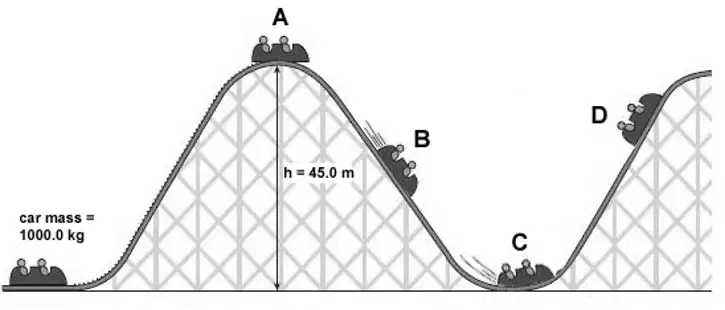
Where is the KE and GPE of the roller coaster roughly equal?
a)
A
b)
B
c)
C
d)
D
125.
How much work is required to stand and hold a 7kg bowling ball for 30 seconds?
a)
210 J
b)
30 J
c)
4.3 J
d)
0 J
126.
The unit of Joules is shorthand for
a)
kg x m2/s2
b)
kg x m2
c)
N x m
d)
N x m2
127.
Which of the following is NOT a form of energy?
a)
Sound
b)
Mechanical
c)
Thermal
d)
Distance
128.
If the velocity of an object doubles, what will happen to its Kinetic Energy?
a)
It will decrease by 1/2
b)
It will stay the same
c)
It will double
d)
It will quadruple
129.
A rope is able to sustain 1,250 kg of mass. If a piano is suspended 20 m above the ground and has 396,000 J of Potential energy, will the rope snap?
a)
Yes
b)
No
100 %

