wayground logo

Free Printable Worksheets

NEW

Font size

S
M
L
XL
Worksheets

PSQ: More Waves and Sound

Total questions: 28

Worksheet time: 31mins

Name
Class
Date
1.
After the train passed, the pitch of the train whistle became lower. This change in sound would be represented by what change in the diagram above? 
a)
The distance represented by C would increase. 
b)
The distance represented by C would decrease. 
c)
The distance represented by D would increase. 
d)
The distance represented by D would decrease. 
2.
Which of the following would you hear as a low pitched sound? 
a)
sound wave with a frequency of 50 Hz
b)
sound wave with frequency of 10,000 Hz
c)
sound wave with an intensity of 10 dB
d)
sound wave with an intensity of 100 dB
3.

Sound travels FASTEST through which of these materials?

a)

A type of gas, like helium

b)

Empty space

c)

A metal such as iron

d)

Water

4.
Sound Waves Move faster in what temperature 
a)
Heat 
b)
Cold
c)
Doesn't Matter
d)
Both
5.
Which of the following does sound depend on?
a)
type of medium
b)
distance to the medium
c)
height of the medium
d)
vibration of the medium
6.

Loud sound means....

a)

the frequency is higher

b)

the amplitude is higher

c)

the amplitude is lower

d)

the frequency is lower

7.

Pay attention to the picture.

Which wave has lower pitch?

a)

Blue wave

b)

Red wave

8.
The pitch of a stringed instrument can be affected by 
a)
an object called a hammer
b)
the size of a player's fingers
c)
the length of its strings
d)
how hard it is struck or plucked
9.
Why does cupping your hands around your mouth when you shout make the sound travel further?
a)
The sound spreads out.
b)
Your voice gets louder.
c)
You are screaming.
d)
The sound energy is directed in one direction.
10.
What causes an echo?
a)
sound waves bouncing off large, hard surfaces
b)
sound waves bouncing off carpet
c)
sound waves bouncing off tables and chairs
d)
you repeating yourself
11.
How can you make a sound louder?
a)
move away from the sound
b)
use more energy to create the sound
c)
use less energy to make the sound
d)
use a smaller number of objects to create the sound
12.
Sound is a form of? 
a)
energy
b)
pitch
c)
volume
d)

work

13.
You are exploring how to make sound louder by tapping a pencil against a desk. To make a louder sound with the pencil, you could
a)
tap the pencil against the desk with more force
b)
wave the pencil
c)
tap the pencil against the desk more gently
d)
tap the pencil in your hand
14.
When two waves combine to form a new wave with a larger amplitude, it is called 
a)
Diffraction
b)
Destructive Interference
c)
Resonance
d)
Constructive Interference
15.

A wave has frequency of 5 Hz and a speed of 25 m/s. What is the wavelength of the wave?

a)

25 m

b)

125 m

c)

5 m

d)

25 m/s

16.
What phenomenon does this image demonstrate?
a)
Constructive interference
b)
Destructive interference
c)
Increasing frequency
d)
Increasing period
17.

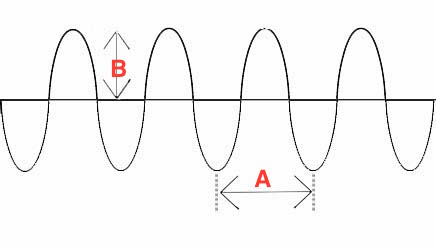
Which statement is correct about the wave shown in the diagram?

a)

It is a transverse wave because the particles are moving perpendicular to the motion of the wave.

b)

It is a transverse wave because the particles are moving parallel to the motion of the wave.
c)

It is a longitudinal wave because the particles are moving perpendicular to the motion of the wave.

d)

It is a longitudinal wave because the particles are moving parallel to the motion of the wave.
18.
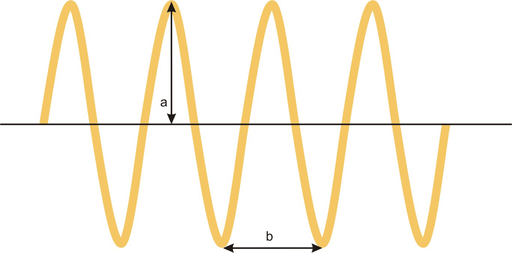
What property of the wave is represented by the letter "B"?
a)
amplitude
b)
crest
c)
trough
d)
wavelength
19.
What do waves carry from place to place?
a)
Energy, but not matter or particles
b)
Energy and matter or particles
c)
Matter or particles but not energy
d)
Neither energy nor matter or particles
20.
How many waves are in this wave chain?
a)
6
b)
3
c)
4
d)
5
21.

What does this image represent?

a)

interference

b)

diffraction

c)

refraction

d)

resonance

22.

What is the angle of reflection?

a)

30

b)

60

c)

90

d)

180

23.

The following image demonstrates...

a)

Reflection

b)

Interference

c)

Diffraction

d)

Refraction

24.
When the sound source moves, the frequency changes
ex. police car siren sounding lower pitch after the car passes
a)
pitch
b)
frequency
c)
Doppler Effect
d)
medium
25.

Which is the most accurate definition of the Doppler Effect?

a)

It's the way in which sound gets louder and louder as the object gets closer to the observer.

b)

It's the apparent change in the amplitude of a wave caused by relative motion between the source of the wave and the observer.

c)

It's the apparent change in the frequency of a wave caused by relative motion between the source of the wave and the observer.

d)

It's the apparent change in the speed of a wave caused by relative motion between the source of the wave and the observer.

26.

Four students are asked: Why are you able to observe the Doppler Effect with sound waves on Earth but not light waves?

Which student has the most accurate answer?

a)

Dave: Because light waves move so quickly, the Doppler Effect doesn't apply to them.

b)

Steve: The Doppler Effect only works on a limited range of frequencies.

c)

Jess: The Doppler Effect works on light waves, but it's moving too fast for us to observe the differences in frequencies.

d)

Jenn: The Doppler Effect is only detectable when the source or observer are moving toward or away from each other at a velocity that is a measurable fraction of the wave being emitted.

27.

What is created when an object travels faster than the speed of sound?

a)

Sonic boom

b)

Flash of light

c)

Babies

d)

The Doppler Effect

28.

Assuming the speed of sound is 340 m/s, what is the most likely speed of the jet shown below?

a)

200 m/s

b)

500 m/s

c)

100 m/s

d)

340 m/s