wayground logo

Free Printable Worksheets

NEW

Font size

S
M
L
XL
Worksheets

Waves

Total questions: 55

Worksheet time: 2hrs 13mins

Name
Class
Date
1.

A wave with a large wavelength will have a ______ frequency and _____ energy

a)

high, low

b)

high, high

c)

low, high

d)

low, low

2.
The distance from one point to the next corresponding point on a wave is called the ________________.
a)
waveform
b)
peak
c)
amplitude
d)
wavelength
3.

The number of waves that pass a fixed point in a given amount of time is...

a)

frequency

b)

wave speed

c)

amplitude

d)

wavelength

4.
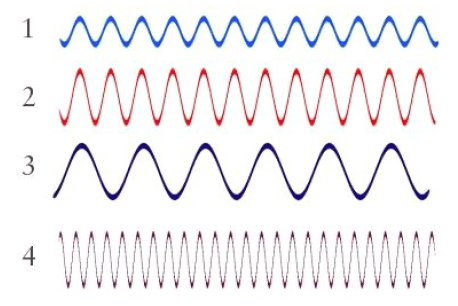
Which wave in the diagram has the greatest wavelength?
a)
1
b)
2
c)
3
d)
4
5.

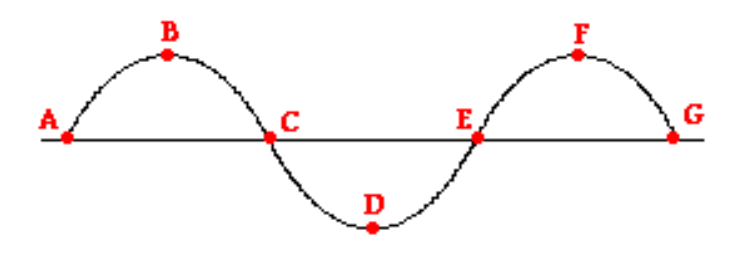
Which letter(s) represent the wavelength?

a)

A & B

b)

B & D

c)

B & F

d)

C & E

6.

Which transverse wave has the highest frequency?

a)

1

b)

2

c)

3

d)

4

7.
The matter (solid, liquid, or gas) through which waves can travel
a)
Medium
b)
Object
c)
Transverse Wave
d)
Wavelength
8.

Which diagram shows the wavelength of a wave?

a)
b)
c)
9.

What does a wave carry from place to place?

a)

energy

b)

matter

c)

people

10.

The highest point on a transverse wave is the

a)

compression

b)

crest

c)

rest position

d)

trough

11.

The lowest point on a transverse wave is the

a)

compression

b)

crest

c)

rest position

d)

trough

12.

A wave that can travel through matter and empty space is a:

a)

electromagnetic wave

b)

longitudinal wavy

c)

transverse wave

d)

mechanical

13.

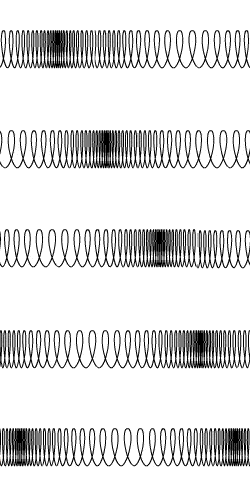
What type of wave is this?

a)

Longitudinal

b)

Transverse

c)

Electromagnetic

d)

x ray

14.

You can't hear sounds in outer space because there is no

a)

medium

b)

light

c)

energy

d)

heat

15.
What property of the wave is represented by the letter "B"?
a)
amplitude
b)
crest
c)
trough
d)
wavelength
16.
The number of wavelengths that pass a point each per second is:
a)
frequency
b)
period
c)
longitudinal 
d)
transverse wave 
17.
The type of waves that require medium to pass:
a)
Mechanical Waves
b)
Electromagnetic Waves
18.
When the frequency of a wave increases, what happens to the wavelength?
a)
The wavelength is not directly affected by the frequency of a wave.
b)
The wavelength increases.
c)
The wavelength decreases.
d)
More specific information is needed to form a conclusion about the wavelength.
19.
which material does sound travel the fastest?
a)
solid 
b)
liquid 
c)
gases
20.

how does a gamma ray and a radio wave differ in terms of wavelength and energy?

a)

Gamma wavelength is shorter and has a lot more energy.

b)

Radio wavelengths are short and have a lot of energy.

c)

Gamma wavelenths are shorter and have low energy

d)

Radio waves are long and have less energy.

21.

A rarefaction is generated when particles move ______.

a)

together

b)

closer

c)

under

d)

apart

22.

A back-and-forth motion causing particles to move close together generates a _______.

a)

rarefaction

b)

surface wave

c)

transverse wave

d)

compression

23.

Sound is made when a source of energy forces the matter to _________.

a)

shake

b)

vibrate

c)

move

d)

stay still

24.

Sound waves cannot travel through which of these ____.

a)

paper

b)

milk

c)

outer space

d)

hydrogen

25.

The amount of energy a sound wave carries per sound through a unit of area is its ____.

a)

pitch

b)

amplitude/intensity

c)

loudness

d)

frequency

26.

The ____ of a wave increases with increased energy.

a)

wavelength

b)

amplitude

27.

Frequency of waves is measure in _____.

a)

Hertz

b)

Decibels

c)

Watts

d)

Meters/second

28.

Which is an example of the doppler effect?

a)

The apparent change in pitch of a police siren as it passes you.

b)

The delay in sound between the lightning and thunder.

c)

The change in pressure in your ears when driving up a mountain.

d)

When you can no longer hear a sound as the pitch increases.

29.
When the car moves AWAY from you, its horn seems...
a)
Low pitched
b)
High pitched
c)
Normal
30.
When an ambulance move TOWARD you it sounds ________ pitched. 
a)
high
b)
low
c)
medium
31.
What can you tell about this object's motion?
a)
Moving to the North (up).
b)
Moving to the South (down). 
c)
Moving to the West (left). 
d)
Moving to the East (right). 
32.
What can you tell about the motion of this object?
a)
Moving left.
b)
Moving right quickly.
c)
Standing still. 
d)
Moving up slowly. 
33.

What is the Doppler effect?

a)

The observed change in frequency of sound or light because of the relative motion of a wave source and the observer.

b)

The observed change in amplitude of sound or light because of the relative motion of a wave source and the observer.

c)

The observed change in wave speed of sound or light because of the relative motion of a wave source and the observer.

d)

The observed change in equilibrium position of sound or light because of the relative motion of a wave source and the observer.

34.

Light can change color due to the Doppler Effect.

a)

True

b)

False

35.

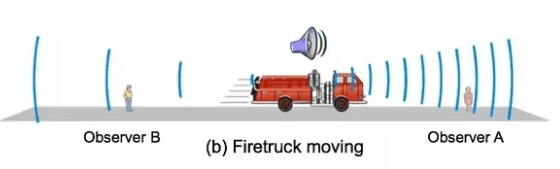
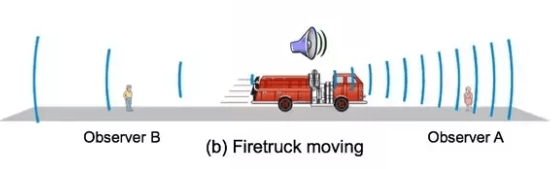
Look at the picture. Who is experiencing a higher pitched sound?

a)

Observer A

b)

Observer B

c)

There's no difference

36.

Look at the picture. Who is experiencing a lower pitched sound?

a)

Observer A

b)

Observer B

c)

There is no difference

37.

You are driving in a car and honk the horn at a person standing in the street. As you approach the person, what happens to the pitch of the horn according to you in the car?

a)

It increases

b)

It decreases

c)

It stays the same because you are in the car moving with the sound.

38.
A wave with a large wavelength will have a ______ frequency and _____ energy
a)
high, low
b)
high, high
c)
low, high
d)
low, low
39.
Which has the LONGEST wavelength and, therefore, the lowest frequency/energy
a)
Gamma Rays
b)
Radio Waves
c)
Visible Light
d)
Infrared rays
40.
Which has the SHORTEST wavelength and, therefore, the highest frequency/most energy
a)
Radio waves
b)
Ultraviolet Rays
c)
Gamma Rays
d)
X-rays
41.
Which section of the spectrum is the ONLY one we can see?
a)
X-rays
b)
Visible Light
c)
Gamma Rays
d)
Ultraviolet Rays
42.
As the frequency of an electromagnetic wave increases, the amount of energy in that wave...
a)
increases.
b)
decreases.
c)
stays the same.
43.
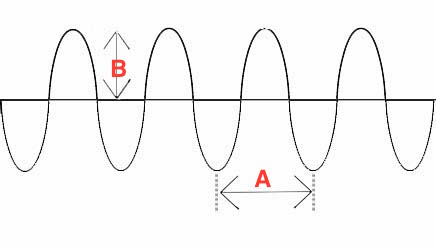
The height of the wave is known as the _____________.
a)
amplitude
b)
crest
c)
trough
d)
wavelength
44.
The blue section of the wave is measuring _________________.
a)
wavelength
b)
crest
c)
trough
d)
amplitude 
45.

Which electromagnetic waves are used in ovens?

a)
Infrared rays
b)
ultraviolet rays
c)
microwaves
46.
Which type of waves are used in broadcasting?
a)
radio waves
b)
infrared rays
c)
x-rays
47.
How much of the electromagnetic spectrum is made up of visible light?
a)
only a small portion
b)
a very l;arge portion
c)
about half
48.
Which electromagnetic waves allow us to diagnose & treat cancer?
a)
Gamma rays
b)
X-rays
c)
Ultraviolet rays
49.
Which of the following has frequencies higher than ultraviolet rays?
a)
visible light
b)
infrared rays
c)
x-rays
50.
Which of the following has wavelengths longer than microwaves?
a)
Infrared waves
b)
Radio waves
c)
Visible light
51.
Which electromagnetic waves help doctors detect broken bones inside your body?
a)
gamma rays
b)
x-rays
c)
ultraviolet rays
52.
Which electromagnetic waves are used in devices such as heat lamps & TV remote controls?
a)
ultraviolet rays
b)
microwaves
c)
infrared rays
53.

Order Of the Electromagnetic System?

a)

Radio Waves,Microwaves,Infrared,Visible Light,X-rays,Ultra Violet,Gamma.

b)

Radio Waves,Microwaves,Infrared,Visible Light,Ultra Violet,X-rays,Gamma.

54.

What is the Electromagnetic Spectrum?

a)

A Group of Energy Waves That are Visible to the human Eye.

b)

The name Given to a Group of Waves that mostly are Invisible and can travel through empty Or outer Space.

55.

You can Not detect Infrared waves with special Goggles.

a)

True

b)

False