
 Worksheets
PS Semester 2 Review
Total questions: 184
Worksheet time: 4hrs 43mins
Jennifer’s height is 1.6307 m tall. She made the following measurements of her height:
a. 1.6 m
b. 1.64136 m
c. 2.064 m
d. 1.63 m
Which of the above measurements is the most accurate measurement?
A
B
C
D
Jennifer’s height is 1.6307 m tall. She made the following measurements of her height:
a. 1.6 m
b. 1.64136 m
c. 2.064 m
d. 1.63 m
Which of the above measurements is the least accurate measurement?
A
B
C
D
Jennifer’s height is 1.6307 m tall. She made the following measurements of her height:
a. 1.6 m
b. 1.64136 m
c. 2.064 m
d. 1.63 m
Which of the above measurements is the most precise measurement?
A
B
C
D
Jennifer’s height is 1.6307 m tall. She made the following measurements of her height:
a. 1.6 m
b. 1.64136 m
c. 2.064 m
d. 1.63 m
Which of the above measurements is the least precise measurement?
A
B
C
D
The Physics Avenger’s mass is 86.202 kg. He made the following measurements of his mass:
a. 23.02 kg
b. 86.2 kg
c. 46.11202 kg
d. 86.447 kg
Which of the above measurements is the least precise measurement?
A
B
C
D
The Physics Avenger’s mass is 86.202 kg. He made the following measurements of his mass:
a. 23.02 kg
b. 86.2 kg
c. 46.11202 kg
d. 86.447 kg
Which of the above measurements is the most precise measurement?
A
B
C
D
The Physics Avenger’s mass is 86.202 kg. He made the following measurements of his mass:
a. 23.02 kg
b. 86.2 kg
c. 46.11202 kg
d. 86.447 kg
Which of the above measurements is the most accurate measurement?
A
B
C
D
The Physics Avenger’s mass is 86.202 kg. He made the following measurements of his mass:
a. 23.02 kg
b. 86.2 kg
c. 46.11202 kg
d. 86.447 kg
Which of the above measurements is the least accurate measurement?
A
B
C
D

Quantitative observations use numbers, qualitative uses the words.
Quantitative observations use the words, qualitative uses numbers.
Quantitative observations use colors, qualitative uses the world.

A bug repellent was sprayed on one arm. On the other arm, the bug repellent was not sprayed. After 2 hours, the number of bug bites are recorded. What is the independent variable?
The type of bug repellent
If an arm was sprayed with bug repellent or not
The number of bug bites

A bug repellent was sprayed on one arm. On the other arm, the bug repellent was not sprayed. After 2 hours, the number of bug bites are recorded. What is the dependent variable?
The type of bug repellent
If an arm was sprayed with bug repellent or not
The number of bug bites
Does the flavor of ice cream effect how fast the ice cream melts? The flavor of ice cream is the....
independent variable
dependent variable
An apple’s freshness will last longer if they are refrigerated. If you did an experiment to test this, the freshness would be the...
independent variable
dependent variable
A study was done to find if different tire treads affect the braking distance of a car.

One chicken is injected with a growth hormone while another chicken is not injected with a growth hormone. After one year, both chickens are weighed. What is the independent variable?
If a chicken was injected with a growth hormone or not
The weight of the chicken
The type of chicken

One chicken is injected with a growth hormone while another chicken is not injected with a growth hormone. After one year, both chickens are weighed. What is the dependent variable?
If the chicken was injected with a growth hormone or not
The weight of the chicken
The type of chicken

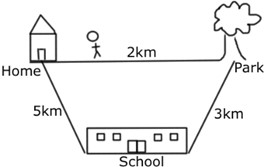
Jerry walked from home to school, then from the school to the park. What is his total displacement?
2 km
5 km
8 km
10 km
Jerry walked from home to school, then from the school to the park. What is his total distance?
2 km
5 km
8 km
10 km

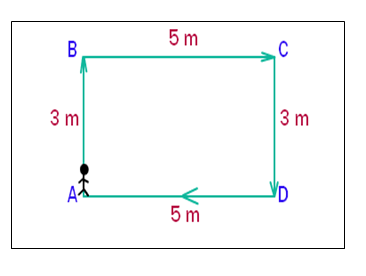
From the figure, what is the displacement?
20 meters
25 meters
15 meters
25 meters NE
Scott travels north 5 miles and then goes west 3 miles before coming straight back south 2 miles. What is his distance?
10 miles
7 miles
8 miles
6 miles
Billy runs 400 meters to Andy's house, turns around, and runs 400 meters back home. What is Billy's distance?
0 meters
400 meters
800 meters
1600 meters
Billy runs 400 meters to Andy's house, turns around, and runs 400 meters back home. What is Billy's displacement?
0 meters
400 meters
800 meters
1600 meters
The change in an objects position from the final position to initial position.
displacement
distance
motion
reference point

Two people walk across a parking lot. Their paths are shown in the image. Who traveled with a larger displacement?
Person A
Person B
They both had the same displacement.
When the total path length that an object has traveled is measured this is called...
displacement
position
distance
reference point
Two cars are travelling at 10 m/s, in different directions. Select the sentences that are true.
Their speeds are the same.
Their speeds are different.
Their velocities are the same.
Their velocities are different.
Sophia was trying to explaining to Tyler how to find the speed. What equation should she use to calculate speed?
speed = time/distance
speed = distance X time
speed = voleicty X time
speed = distance/time

Gabriel sprinted down the hallway for a science project. He ran a total of 40 meters in 20 seconds. What was his average speed?
2 meters per second
20 meters per second
40 meters per second
10 meters for second




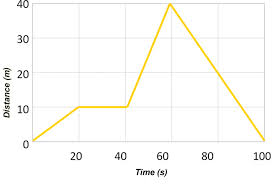
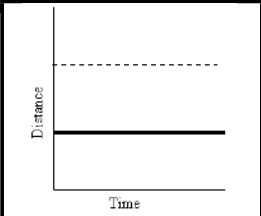


Segment O-A The bus is _________________.
at rest
returning (to original position)
moving forward
Segment A-B The bus is _________________.
at rest
returning (to original position)
moving forward
Segment B-C The bus is _________________.
at rest
returning (to original position)
moving forward
Segment C-D The bus is _________________.
at rest
returning (to original position)
moving forward
Segment D-E The bus is _________________.
at rest
returning (to original position)
moving forward
Segment E-F The bus is _________________.
at rest (stopped)
returning (to original position)
moving forward
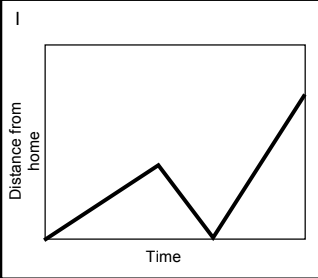
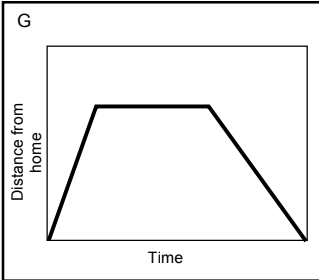
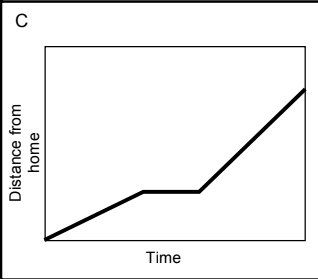
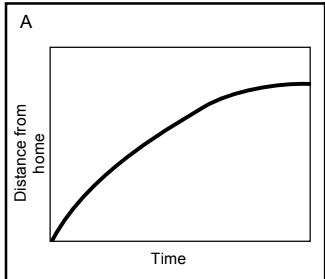
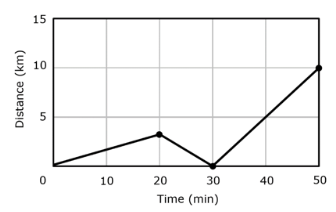
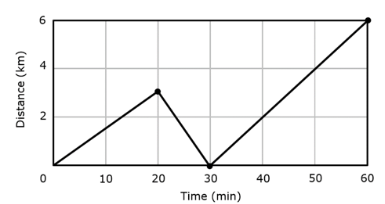
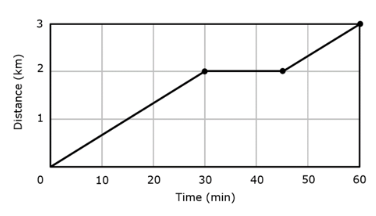
A student walks 2.0 km in a time of 30 minutes. The student then stop for 15 minutes to eat a snack then travels 1.0 km in 15 minutes.
Which graph shows the journey described?
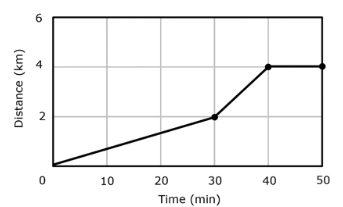

Anne cycles from Bristol to Salisbury.
The diagram shows the distance-time graph of her journey.
What is Anne's speed for the first two hours of her journey?
40 mph
30 mph
20 mph
10 mph

Where is the object stopped?
A
B
C
D
Where is the object moving back to the origin?
A
B
C
D
Where is the object moving away from the origin at the quickest speed?
A
B
C
D
What is the speed of the object during segment B?
0.5 m/s
1.3 m/s
2 m/s
2.5 m/s


Which graph shows the object moving at a constant speed away from the origin?
A
B
C
D
Which graph shows the object moving from fast to slow?
A
B
C
D
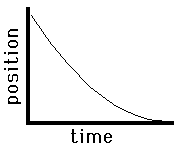

Describe the motion
Stationary
Constant speed
Acceleration
Deceleration
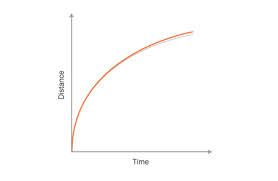
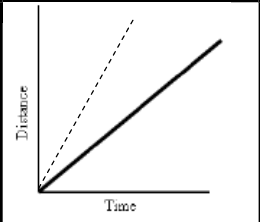
In which of the following graphs below are both runners moving at the same speed?


This is the distance-time graph of a person on a walk.
During segment AB, the person was...
walking at a constant speed
speeding up
slowing down
stopped
This is the distance-time graph of a person on a walk.
During segment AB, the person was...
walking in the positive direction
walking in the negative direction
stopped so they have no direction
This is the distance-time graph of a person on a walk.
During segment BC, the person was...
walking at a constant speed
speeding up
slowing down
stopped
This is the distance-time graph of a person on a walk.
During segment BC, the person was...
walking in the positive direction
walking in the negative direction
stopped so they have no direction
This is the distance-time graph of a person on a walk.
During segment CD, the person was...
walking at a constant speed
speeding up
slowing down
stopped
This is the distance-time graph of a person on a walk.
During segment CD, the person was...
walking in the positive direction
walking in the negative direction
stopped so they have no direction
This is the distance-time graph of a person on a walk.
During segment DE, the person was...
walking at a constant speed
speeding up
slowing down
stopped
This is the distance-time graph of a person on a walk.
During segment DE, the person was...
walking in the positive direction
walking in the negative direction
stopped so they have no direction
This is the distance-time graph of a person on a walk.
During segment EF, the person was...
walking at a constant speed
speeding up
slowing down
stopped
This is the distance-time graph of a person on a walk.
During segment EF, the person was...
walking in the positive direction
walking in the negative direction
stopped so they have no direction
This is the distance-time graph of a person on a walk.
During segment FG, the person was...
walking at a constant speed
speeding up
slowing down
stopped
This is the distance-time graph of a person on a walk.
During segment FG, the person was...
walking in the positive direction
walking in the negative direction
stopped so they have no direction
In each of the following cases, determine where the car has no acceleration?
A car speeds up after a stoplight turns green.
A car slows down as it approaches a red light
A car with the cruise control set at 80 km/h going down a straight highway
A car turning a curve at a constant speed
The SI unit for acceleration is
mph
ft/sec
m/s2
m/s
When are you undergoing an acceleration in a car? (Choose all that are correct)
speed up
slow down
make turns
constant speed
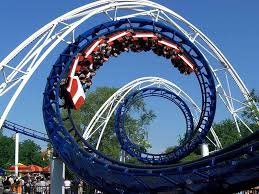
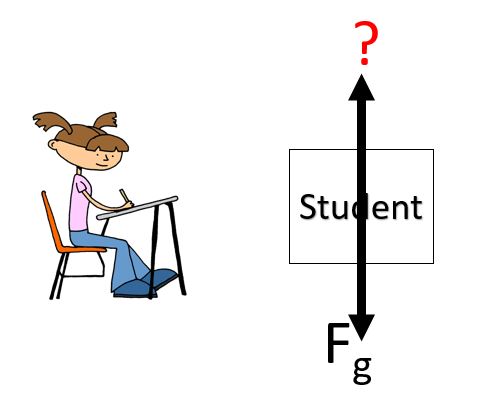

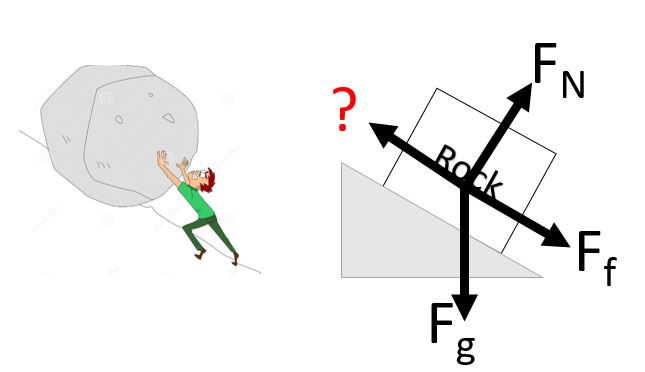

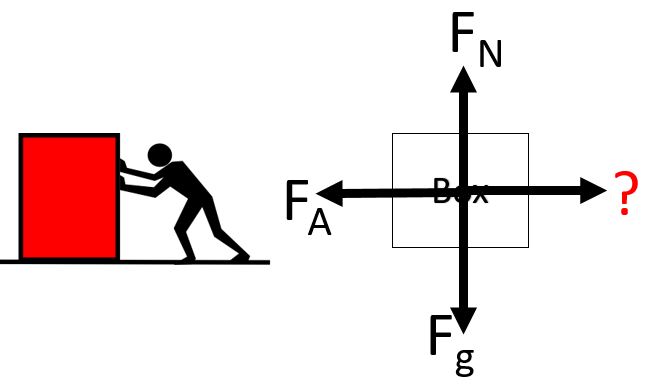
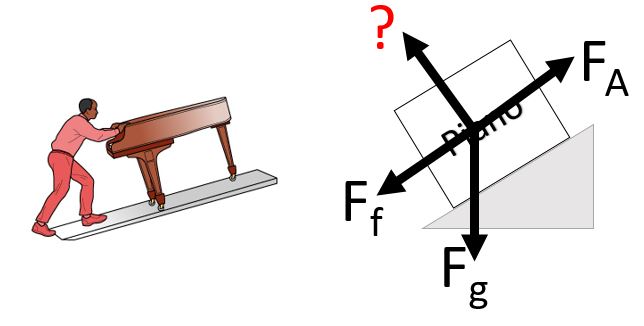
Whenever an object is moving across a surface, there is always this force opposing the motion:
inertia
momentum
friction
applied force
The force that keeps objects on top of surfaces instead of letting them sink into the surface is known as:
normal
abnormal
static
inertia
The force exerted by ropes and chains is called
tension
normal
elastic
mechanical


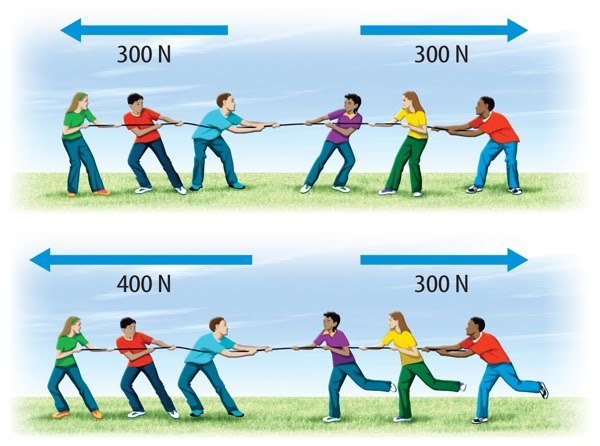
In which situation are the force balanced?
top
bottom
both
Neither is balanced
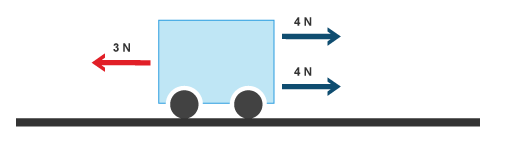
What is the total force on the object pictured? (consider right to be positive)
-3 N
5 N
4 N
8 N
11 N
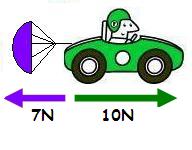
What is the total force? (consider right to be positive)
17 N
3 N
-3 N
-17 N

Calculate the total force shown in the diagram? (consider up to be positive)
-25 N
-9 N

What is the total force? (consider right to be positive)
-65 N
65 N
-35 N
35 N

Find the total force on this object:
(assume right and up are positive)
- round your answer to the nearest whole number
- only type in the number (not the units)
(a)

Find the total force on this object:
(assume right and up are positive)
- round your answer to the nearest whole number
- only type in the number (not the units)
(a)
The tendency of an object to resist a change in its motion is called
inertia
friction
tension
gravity
Without an unbalanced force, a moving object will not only keep moving, but its ______________________________ will also remain the same.
force and motion
speed and time
speed and direction
inertia and distance
How can you use Newton’s first law to start a skateboard to roll?
The skateboard won’t move unless you push off from the pavement with one foot. The force you apply when you push off is stronger than the force of friction that opposes the skateboard’s motion. As a result, the force on the skateboard is unbalanced, and the skateboard moves forward.
The skateboard won’t move unless you push off from the pavement with one foot. The force you apply when you push off is weaker than the force of friction that opposes the skateboard’s motion. As a result, the force on the skateboard is balanced, and the skateboard moves forward.
How can you use Newton’s first law to stop your skateboard?
Once the skateboard starts moving, it would keep moving at the same speed and in the same direction if not for another unbalanced force. That force is gravity between the skateboard and the pavement. The force of gravity is unbalanced because you are no longer pushing with your foot to keep the skateboard moving. That’s why the skateboard stops.
Once the skateboard starts moving, it would keep moving at the same speed and in the same direction if not for another unbalanced force. That force is friction between the skateboard and the pavement. The force of friction is unbalanced because you are no longer pushing with your foot to keep the skateboard moving. That’s why the skateboard stops.
When an object is at rest and the forces on it are ___________, this object will remain at rest.
balanced
unbalanced
When an object is at rest and the forces on it are ___________, this object will begin to accelerate.
balanced
unbalanced
When an object is moving and the forces on it are ___________, this object will keep moving at a constant velocity.
balanced
unbalanced
When an object is moving and the forces on it are ___________, this object will begin to accelerate.
balanced
unbalanced

This object is...
moving at a constant velocity
accelerating to the left
accelerating to the right
not enough information to tell

This object is...
moving at a constant velocity
accelerating to the left
accelerating to the right
not enough information to tell

This object is moving at a constant velocity.
Find the amount of the unknown force.
15 N
30 N
more than 30 N
less than 30 N

This object is accelerating to the right.
Find the amount of the unknown force.
12 N
20 N
more than 20 N
less than 20 N
8 N
A 1500 kg car is traveling at 35 m/s. How much inertia does this car have?
35 m/s
35 kg
1500 kg
4364 kg
According to Newton’s second law of motion, if the total force remains the same but mass increases, then acceleration will
increase
decreases
remain constant
An object is propelled along a straight-line path by a force. If the total force were doubled, its acceleration would
Halve
Double
Remain constant
The force of friction on a sliding object is 10 newtons. The applied force needed to maintain a constant velocity is
Less than 10N
More than 10N
10N
A 10kg block with an initial velocity of 10m/s slides 10m across a horizontal surface with an acceleration of 5m/s2 and comes to rest. The stopping force acting on the block is about
5N
10N
25N
50N
.
A hockey puck is set in motion across a frozen pond. If ice friction and air resistance are neglected, the forced required to keep the puck sliding at constant velocity is
Equal to the weight of the puck
The weight of the puck divided by the mass of the puck
The mass of the puck multiplied by 9.8 m/s
Zero newtons
Mike's car, which weighs 1,000 kg, is out of gas. Mike is trying to push the car to a gas station, and he makes the car go 0.05 m/s2 .Using Newton's Second Law, you can compute how much force Mike is applying to the car (F= M x A)
50N
100N
5N
F= mass * acceleration
A 20 kg bike accelerates at 10 m/s2. what is the total force acting upon it?
25 Newtons
20 Newtons
200 Newtons
10 Newtons
An object of mass 10 kg is accelerated upward at 2 m/s2. What total force is required?
20 N
2 N
5 N
0 N
When total force is 20 N, mass is 5 kg, what is acceleration? F = ma
Football A has a greater mass than football B. Which football will have greater acceleration when both are thrown with the same force in the same direction?
Football A
Football B
They will have the same acceleration
Mass has no effect on acceleration
Jenny applies a 60 N force to a 20 Kg cart, what is the acceleration of the cart if friction can be neglected?
1200 m/s2
0.33 m/s2
20 m/s2
3 m/s2

A cheetah can run briefly with a speed of 31.0 m/s. Suppose a cheetah with a mass of 47.0 kg runs at this speed. What is the cheetah’s kinetic energy?
1457 Joules
22,584 Joules
15 Joules
45,167Joules
The unit in which kinetic energy is measured is
Newton
Kilogram
Joules
Metres per second
What is the kinetic energy of a 4kg shotput thrown with a velocity of 13m/s
676 J
52 J
17J
338 J
What is the kinetic energy of a ball with a mass of 5kg rolling at 10m/s
50 J
500 J
250 J
25 J
What is the kinetic energy of a 1.5 kg object moving at a velocity of 100 m/s
112.5 J
7,500,000 J
75 J
7,500 J
What is the kinetic energy of a 25 kg object moving at a velocity of 2.5 m/s
78.125 J
31250 J
781.25 J
78,125 J
Energy stored because of gravity is called:
Gravitational Potential Energy
Kinetic Energy
Mechanical Advantage
Chemical Energy
Gravitational potential energy depends on the strength of gravity, ________ and ________ of the object.
height and mass
friction and movement
mass and movement
height and friction

You throw a ball into the air as shown in the diagram. At what point does the ball have the most gravitational potential energy?
W
X
Y
Z

At which position does the child on the swing have the most gravitational potential energy?
W
X
Y
Z

At which point on the roller coaster is the gravitational potential energy the greatest?
W
X
Y
Z
Which is the correct unit for expressing gravitational potential energy?
Joule
Newton
m/s2
meter
Which of the following is the correct equation for calculating an object's gravitational potential energy?
PE = mgh
PE = mg / h
PE = mg + h
PE = gh
What is the value of the Earth's acceleration due to gravity (g)?
9.8 m/s2
100 m/s2
25 m/s2
3.14 m/s2
Determine the gain in gravitational potential energy when a 4.00 kg block is raised 18.00 m.
g is 9.81m/s2.
ROUND TO THE WHOLE NUMBER.
NO UNITS
(a)
An owl has a mass of 4.00 kg. It dives to catch a mouse from a height of 20m How much GPE does the owl lose?
g is 9.81m/s2.
ROUND TO THE WHOLE NUMBER.
NO UNITS
(a)
One of the tallest radio towers is in Fargo, North Dakota. The tower is 629 m tall. If a bird lands on top of the tower with a mas of 0.3kg. What is the birds GPE?
g is 9.81m/s2.
ROUND TO THE WHOLE NUMBER.
NO UNITS
(a)

