
Font size
 Worksheets
Integrated Chem/Physics Semester 2 Review
Total questions: 125
Worksheet time: 1hrs 7mins
A physical property that measures mass per unit volume
density
flammability
physical property
element
reactivity
characteristic/trait that can be seen through direct observation of a substance.
mixture
physical property
physical change
chemical property
chemical change
an example of a physical change
flammability
fireworks exploding
rust
melting
the ability to burn
physical change
conductivity
elasticity
flammability
reactivity
Anything that has mass and volume.
solid
liquid
gas
matter
mixture
an example of a chemical change
breaking glass
boiling water
stretching copper into wire
rusting
a homogenous mixture
solid
solution
matter
compound
transforms one type of matter into another type of matter
physical change
physical property
chemical change
chemical property
a mixture that has the same composition throughout the entire substance
heterogenous mixture
homogenous mixture
pure substance
matter
observed when a substance changes into a new substance
physical property
chemical property
physical change
chemical change
a change to a substance that does NOT change the identity of the substance
physical change
physical property
chemical change
chemical property
something that will always have the same composition
matter
compound
pure substance
mixture
solution
a substance made from two or more different elements
matter
mixture
compound
pure substance
solution
a substance that cannot be broken down into other substances
matter
mixture
element
solid
solution
a mixture that has a different composition throughout the substance
heterogenous mixture
compound
homogeneous mixture
element
H2O is an example of a(n):
Element
Compound
Homogeneous Mixture
Heterogeneous Mixture
Calcium (Ca) is an example of a(n):
Element
Compound
Homogenous Mixture
Heterogeneous Mixture
Tap water (water, salt & minerals) is an example of a(n):
Element
Compound
Homogeneous Mixture
Heterogeneous Mixture
Methane (CH4) is an example of a(n):
Element
Compound
Homogeneous Mixture
Heterogeneous Mixture
Chicken noodle soup is an example of a(n):
Element
Compound
Homogeneous Mixture
Heterogeneous Mixture
Which of the following is a physical property?
Heat of combustion
Boiling point
Flammability
Reactivity
Which of the following is NOT a sign that a chemical change has occurred?
Change in color
Change in shape
Formation of a gas
Change in odor
Which of the following is an example of a chemical change?
Ripping paper in half
Boiling an egg
Cracking an egg
Dissolving sugar in water
Which of the following is a physical change?
Burning a match
Vinegar reacting with baking soda
Melting butter
Cooking an egg
Which of the following is a physical property?
Combustion
Electronegativity
Color
PH Level
Hammering wood together to build a house is an example of a:
chemical change.
physical change.
Bleaching your hair is an example of a:
physical change.
chemical change.

Green bananas turning yellow on their own as they ripen. This is a:
chemical change.
physical change.
What particle in the atom has a positive charge?
proton
neutron
electron
quark
What is the particle in the atom that has no charge?
neutron
proton
electron
alpha particle
The particle in the atom that has a negative charge is called?
electron
proton
neutron
megatron
The area outside the nucleus where a particle moves around is called?
electron cloud
nucleus
electron space
orbital space
The number of electrons in the outer energy level is referred to as?
valence electrons
outer electrons
electron cloud
orbital shells
Why do sodium and potassium have similar properties?
They both have a full valence energy level.
They each have only one valence electron.
They both have few protons.
They are both non-metals.
In an electron dot diagram, what do the dots around the symbol represent?
electrons
valence electrons
protons
protons and neutrons
Which statement correctly describes the location and charge of the neutrons in an atom?
The neutrons are inside the nucleus and have a positive charge.
The neutrons are outside the nucleus and have a neutral charge.
The neutrons are outside the nucleus and have a negative charge.
The neutrons are inside the nucleus and have a neutral charge.

How many protons, electrons and neutrons are present in an atom of carbon, C, with the mass of 12?
12 protons, 12 electrons, 12 neutrons
6 protons, 12 electrons, 6 neutrons
12 protons, 6 electrons, 12 neutrons
6 protons, 6 electrons, 6 neutrons
What are any of the various self-contained units of matter or energy that are fundamental parts of all matter. These particles include electrons, protons, and neutrons.
subatomic particles
elements
nucleus
electron cloud
elements that are shiny, malleable, ductile, and good conductors of heat and electricity
metals
nonmetals
metalloids
semiconductors
Which of the following metals is not solid at room temperature?
mercury
iron
potassium
zinc
metals that can be hammered and rolled into sheets
malleable
ductile
metallic luster
ions
metals that can be drawn into wires
malleable
ductile
metallic luster
ions
Which family is found to the left of the stair step line?
metals
nonmetals
metalloids
semiconductors
In ionic bonding, metals become the ___________ ion
postive
negative
In ionic bonding, nonmetals become the ______ ion
postive
negative
when a metal ion and a nonmetal ion bond to form a compound
ionic bond
covalent bond
metallic bonding
metallic luster
Group 1 on the periodic table
Alkali Metals
Alkaline Earth Metals
Transition Elements
Halogens
Which group is the most reactive?
Transition Elements
Alkali Metals
Alkaline Earth Metals
Noble Gases
Element in which the nucleus breaks down and gives off particles and energy
Radioactive Element
Synthetic Element
Transuranium Element
Transition Element
Group 2 on the periodic table:
Alkali Metal
Alkaline Earth Metal
Halogens
Noble Gases
Elements in groups 3 through 12 on the periodic table
alkali metals
alkiline earth metals
transition metals
noble gases
elements that usually are gases or brittle solids at room temperature
metals
nonmetals
metalloids
semiconductors
Which family is found to the right of the stair step line?
metals
nonmetals
metalloids
Which element to the left of the stair step line is actually a nonmetal?
hydrogen
helium
potassium
oxygen
What type of bond is formed when atoms share electrons?
ionic bond
covalent bond
metallic bond
consists of two atoms of the same element in a covalent bond
diatomic molecule
ionic bond
covalent bond
metallic bond
Group 18 on the periodic table
Noble Gases
Halogens
transition metals
alkali metals
The shiny property of metals
malleable
ductile
metallic luster
metallic bond
A bond between two nonmetal atoms is a __________ bond.
ionic
nuclear
metallic
covalent

Which of the following is NOT a covalent bond?
K2S
H2O
I2
CO2
Ionic bonds form between ---
nonmetals.
metals and nonmetals.

Which of the following is NOT an ionic bond?
NH3
KCl
K3N
NaCl
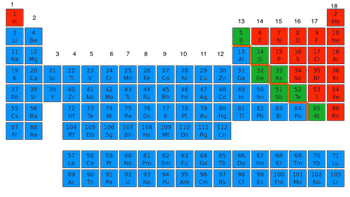
Potassium and Sulfur create...
KS
KS2
K2S
K2S2
How do potassium and nitrogen bond together?
Al3+ O2-
Write the formula for barium + nitrogen
Ba2N3
Ba3N2
BaN
BaN3
Which of the following is an ionic compound:
CH4
I2
LiBr2
CO
Mg and O will bond to make...
Mg2O3
MgO2
MgO
Mg2O
Ca and N create...
Al(OH)3 --> Al2O3 + H2O
CUO + CO2 --> CuCO3
Ca + MgCl2 --> CaCl2 + Mg
_Bi + _O2 > _Bi2O3
Why must chemical equations be balanced?
So that the equation doesn't explode
The reaction won't happen until it is balanced
Based on the Law of Conservation of Matter, matter cannot be created or destroyed.
Based on the Law of Conservation of Energy, energy cannot be created or destroyed.e

2HI --> H2 + I2
__HNO2 + __O2 --> __HNO3
2Ca + O2 > 2CaO
What is the 2 located behind oxygen (O) called?
Ca + MgCl2 --> CaCl2 + Mg
C2H2 + O2 --> CO2 + H2O
When nuclei decay, massive amounts of __________ is released.
energy
electrons
protons
neutrons
The Chernobyl plant provided power for the city of
London
Pripyat
Moscow
Washington DC
What year did the Chernobyl Disaster occur in?
1991
2019
1986
44 BCE
What did the meltdown at Chernobyl release into the air?
Radioactive dust
Bees!
The Hounds
The Kracken
Where was the Chernobyl power plant located?
In the United States
In the Soviet Union (Ukraine)
In England
In France

What was the dangerous zone surrounding Chernobyl called?
Zone of Exclusion
Zone of Danger
Safe Zone
Zone of Radiation
How many workers were killed by blasts of radioactive fire?
One million
134
One hundred billion dollars
6
A substance doing the dissolving, usually the part of a solution present in the larger amount
solvent
solute
solution
solubility
a substance being dissolved, usually the part of the solution in the lesser amount
solvent
solute
solubility
concentration
the ability of a substance to dissolve in a solvent
solution
concentration
solute
solubility
a substance that vigorously reacts with most metals to produce hydrogen; it readily conducts electricity; it turns litmus red and has a pH of less than 7; it typically is corrosive or sour-tasting
acid
base
neutral
solution
a substance that does not react with most metals or readily conduct electricity; it turns litmus blue and has a pH of greater than 7; it typically feels slippery and is bitter-tasting
acid
base
neutral
solution
a substance that has a pH of 7; water is an example
acid
base
neutral
concentration
a measure of how acidic or basic a solution is; the low it is the more acidic, the higher the more basic
concentration
pH
conductivity
solubility curve
indicator that turns red in the presence of an acid and blue in the presence of a base
solvent
solute
litmus
temperature
a solution in which more solute can be added and dissolved. It is below the maximum amount of solute.
saturated
unsaturated
neutral
super saturated
a solution that contains more of the dissolved solute than could be dissolved by the solvent under normal circumstances; increasing temperature or pressure can increase the maximum possible solute dissolved in a solvent
saturated
unsaturated
super saturated
concentration
when a substance is becoming part of a liquid to form a solution
agitation
dissolving
solubility
concentration
What does it mean to have a concentrated solution
Low base
Low acid
The amount of acid or base dissolve in a solution.
it consist of buffers
________ is the chemical reaction between an acid and a base which results in the formation of salt and water.
Dissociation
Neutralization
Saturated
Unsaturated
Bananas have a pH of 5.2, what is it?
Acid
Base
Neutral
None of the above
_________ a solution that holds all solute it can hold.
Unsaturated Solution
Solution
Solvent
Saturated Solution
Ammonia has a pH of 11.5, what is it?
Acid
Base
Neutral
None of the above
Lemons and pickles taste sour, this property indicates that they are __________.
Acids
Bases
Neutral
None of the above
What does the value of 7 on the pH scale indicate?
Acid
Base
Neutral
None of the above
Soap is an example of a(n)_______.
Acid
Base
Salt
Ion

