
 Worksheets
Biology: Benchmark 4
Total questions: 63
Worksheet time: 49mins
Darwin noticed that many organisms seemed well suited to what?
being preserved as fossils.
providing humans with food.
surviving the environments in which they lived.
Swimming from South America to the Galapagos Islands.
The species of finches that Charles Darwin found on different islands varied in certain structural adaptations. One of the most significant adaptations that Darwin noted was
birds' different shaped beaks.
similarities of the birds' embryos.
length of the birds' necks.
Number of eggs in each bird's nest
Based on the adaptations Charles Darwin observed in finches and tortoises in the Galapagos, he wondered:
if species living on different islands had once been members of the same species.
if finches and tortoises had originated from the same ancestral species.
if all birds on the different islands were finches.
why all tortoises on the different islands were identical.
Biologists in Darwin's time had already begun to understand that living things change over time. How did Darwin contribute to these ideas?
He found many fossils that showed that these changes could not possibly happen on islands.
He figured out and explained how these changes happened and supported his ideas with evidence.
He made guesses about how these changes happened, and wrote experiments that could be used to test these guesses.
He was the first person to truly believe that these changes happened, and he worked very hard to convince others.
Charles Darwin's observation that finches of different species on the Galapagos Islands have many similar physical characteristics supports the hypothesis that these finches
have the ability to interbreed.
acquired traits through use and disuse.
all eat the same type of food.
descended from a common ancestor.
Which of the following ideas is supported by Darwin's observation of local variation among tortoises in the Galapagos Islands?
artificial selection
adaptation
acquired characteristics
tendency towards perfection
Darwin first began to formulate his concept of evolution by natural selection after
experimenting with animals.
observing patterns among the geographical location of certain species.
reading the writings of Wallace.
agreeing with Lamarck about the driving force behind evolution.
James Hutton's and Charles Lyell's work suggest that
Earth is several million years old.
Earth is several thousand years old.
all fossils were formed in the last 1000 years.
all rocks on Earth contain fossils.
One scientist who attempted to explain how rock formations, such as rock layers, form and change over time was
Thomas Malthus
James Hutton
Charles Darwin
Jean-Baptiste Lamarck
James Hutton's and Charles Lyell's work was important to Darwin because these scientists
explained volcanoes and earthquakes.
explained all geological events on Earth.
suggested that Earth was old enough for evolution to have occurred.
refuted the work of Lamarck, which was based on misunderstandings.
Jean-Baptiste Lamarck proposed that organisms
have an innate tendency toward complexity and perfection.
have an innate tendency to become simpler as time passes.
inherit all of the adaptations they display.
belong to species that never change.
Darwin realized that the economist Malthus's theory of population control
applied only to humans.
could be generalized to any population of organisms.
could be generalized only when populations lived in crowded conditions.
explained why the number of deaths exceeded that of births.
The economist Thomas Malthus suggested that
in the human population, people die faster than babies are born.
without certain checks on population size, there would soon be insufficient food for the growing human population.
in the 1700's, England needed more housing.
the majority of a species' offspring.
A random and permanent change to a gene
Protein
Gene
Natural Selection
Mutation
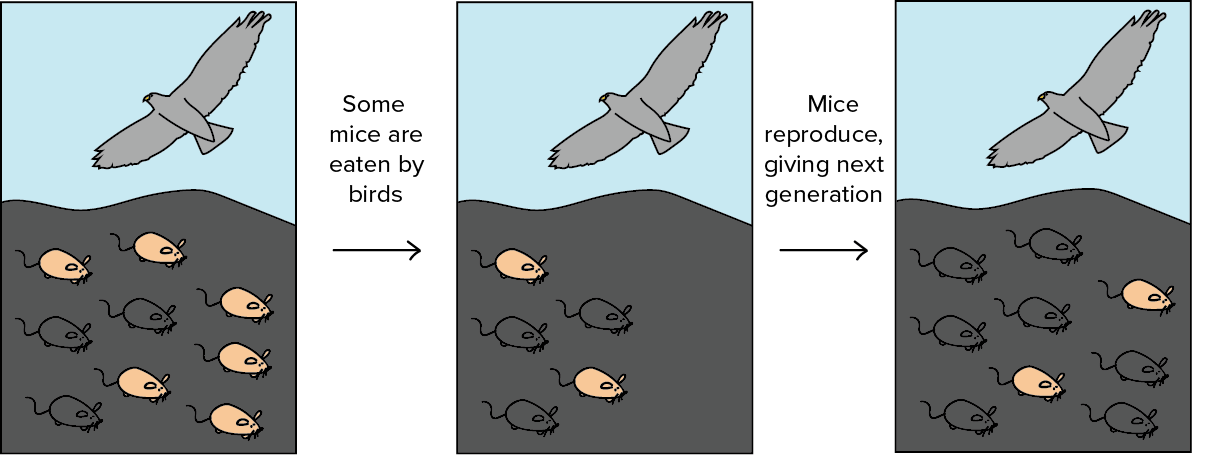
Peppered moths were able to adapt to their environment because
They decided to change colors in order to survive
The population had varying traits
Pollution covered the trees
The trees camouflaged all moths

Which term refers to the process by which individuals that are better suited to the environment survive and reproduce, therefore passing down their genes to their offspring?
Evolution
Variation
Adaptation
Natural Selection
What are these examples of; different shapes of beaks, different lengths of necks, different colors of fur?
environmental factors
resources
genetic variations
overproduction
What is natural selection?
Survival of the fittest
Differences between individuals
Organisms are descended from ancestral species.
Artificial selection
Adaptations can be:
camouflage
ability to survive cold weather
hunting skills
all of the above
When unrelated species evolve similar characteristics because they live in similar
environments
Divergent Evolution
Speciation
Convergent Evolution
Punctuated equilibrium
A number of different species arise from one common ancestor
- New environments caused differences to evolve in populations
Convergent Evolution
Divergent Evolution
Coevolution
Gradualism
What is the order of classification? (largest to smallest)
(a)

The figure shows how natural selection of a single-trait gene affects lizard survival.
Which of the following most likely causes the changes in allele distribution?
The allele for light gray coloration disappears from the population. This may be because light gray lizards are more visible to predators and therefore they might be less likely to survive and reproduce.
The allele for black coloration decreases fitness and becomes less common. This may be because black coloration keeps the lizards cool during hot summer temperatures.
Medium gray coloration in lizards appears to be a neutral mutant allele that allows the lizards to hide better from predators. This leads to increases in phenotype and allele frequency of gray coloration.
Because black and medium gray lizards are less visible to predators, these alleles are neutral to natural selection and therefore will not disappear from the population of lizards.

stabilizing
directional
disruptive
the answer is not here


What type of natural selection is this?
Disruptive Selection
Directional Selection
Stabilizing Selection
Natural Selection
Genetic drift is more likely to happen in...
aquatic populations
small populations
terrestrial populations
older populations
Genetic drift is change in the allele frequency of a population due to...
random chance
natural selection
non-random mating (sexual selection)
artificial selection

Which of the following is an example of the founder effect?
Humans choose two dogs they like the characteristics of and breed them together.
Affected individuals with blue skin can trace their ancestry back to one of the first settlers in the region.
The environment of a fox population changes and over time foxes who are white survive and pass on their genes to their offspring.
Cheetah populations reach their lowest levels with reduced diversity and as they rebound are so genetically similar they appear to be inbred.

Which of the following is an example of the bottleneck effect?
Cheetah populations reach their lowest levels with reduced diversity and as they rebound are so genetically similar they appear to be inbred.
Affected individuals with blue skin can trace their ancestry back to one of the first settlers in the region.
The environment of a fox population changes and over time foxes who are white survive and pass on their genes to their offspring.
Humans choose two dogs they like the characteristics of and breed them together.
behavioral isolation
temporal isolation
gametic isolation
geographic isolation
Which of the following lines of evidence shows that whales are descended from a land-dwelling, four-legged ancestor?
Whales have bone structures in their forelimbs and pelvis that are similar to those of terrestrial mammals
Whale embyros have similar structure to embryos of land-dwelling mammals, birds, and reptiles.
An analysis of DNA shows that whales' closest living relatives are hippopotamuses.
A, B, and C

Speciation that caused by breeding occurring at different time of the day is called
behavioral isolation
temporal isolation
ecological isolation
habitat isolation
Complete the diagram below to show all the taxonomic levels


What is the purpose of a cladogram?
To map the ancestral relationships and shared traits of different organisms.
To trace the inherited traits of a single species over time.
To check the likelihood of an offspring having a particular trait.
To monitor mutations that arise among different populations.

What do both the squirrel and lion have in common that the other animals do not?
They are both vertebrates
They both have lungs
They are both mammals
They both lose their canine teeth.
Which of the following pictures is an example of a cladogram?


What function do the aortic arches have?
transfer oxygen
pump blood throughout the body
send and receive sensory information
What do the crayfish use as flippers for swimming?
walking legs
long atenna
small antenna
swimmerets
Where are swimmerets located?
abdomen
cephalothorax
antenna
chilapeds

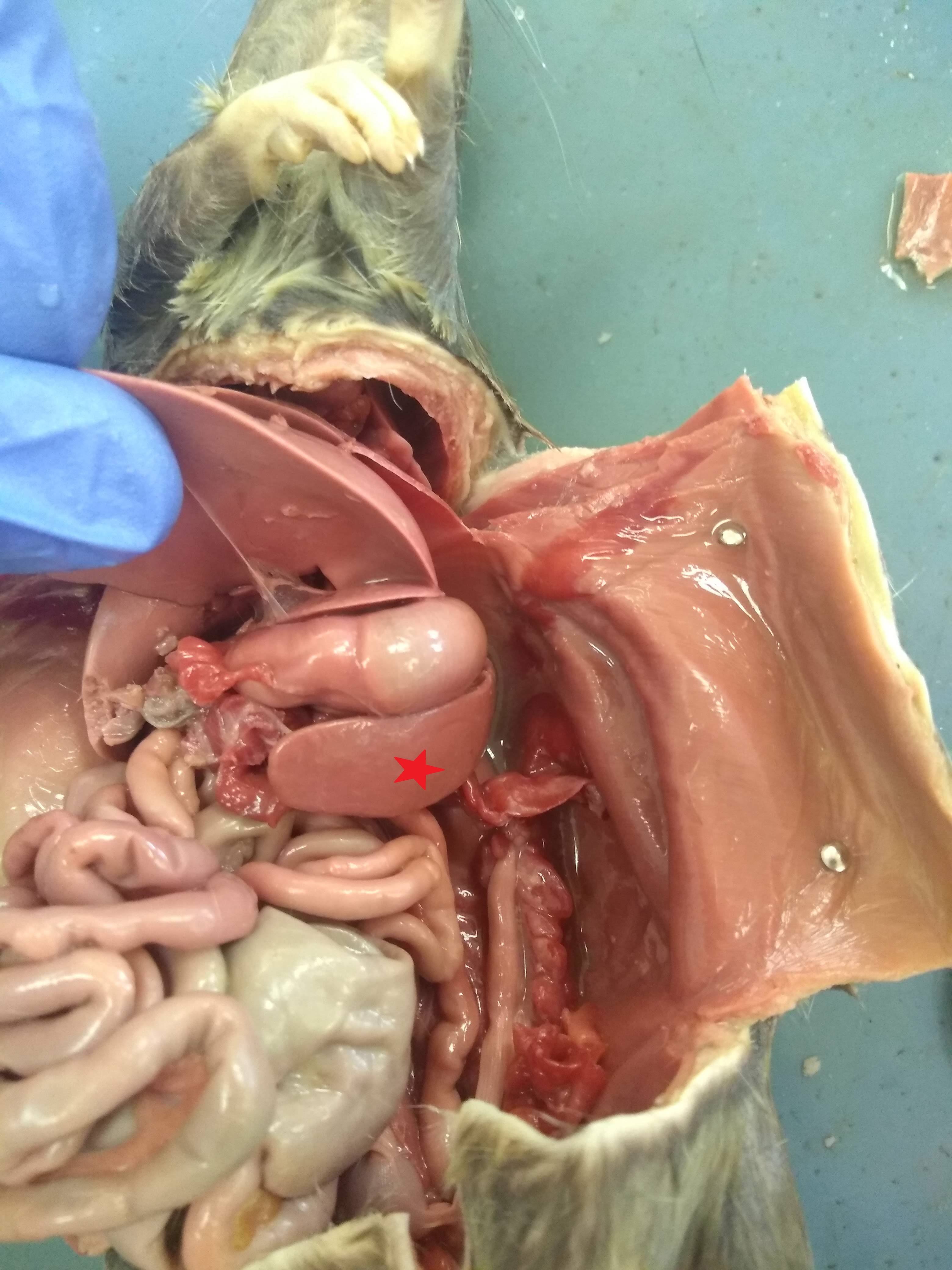
Identify the organ/structure that is marked with a red star.
Spleen
Stomach
Kidney
Teste
Diaphragm
Long supporting rod that runs through the body just below the nerve cord is the...
pharyngeal pouches
vertebrae
notochord
dorsal hollow nerve cord
Which of the following is a characteristic of all chordates but is not found in invertebrates?
a notochord
four legs
a circulatory system
a skeleton
If an animal has a head and a tail, it has _____ symmetry.
It does not have symmetry.
bilateral
radial
super duper cool
The concentration of nerve cells and sense organs in the head is called
exoskeleton
cephalization
animal
notochord
_____ and _____ are organelles that arose from endosymbiosis
nucleus and cell membrane
mitochondria and chloroplasts
cell wall and chloroplasts
mitochondria and nucleus
Which of the following is evidence to support the endosymbiotic theory?
Mitochondria and chloroplasts have their own DNA, which is similar to prokaryotic DNA.
Fossil evidence shows that the first forms of life were prokaryotic cells.
All eukaryotic cells have a double-layered membrane composed of phosplipids and proteins.
Prokaryotes have the same number and types of enzymes as eukaryotes.
Which scientist is credited with proposing the theory of natural selection?
Jean-Baptiste Lamarck
Charles Darwin
James Hutton
Gregor Mendel
What is the main mechanism that drives evolution in populations?
Migration
Mutation
Natural selection
Genetic drift
Which term describes the inherited traits that increase an organism's chance of survival and reproduction?
Variation
Adaptation
Speciation
Mutation

