
 Worksheets
7th Grade WH Final
Total questions: 75
Worksheet time: 38mins
Name
Class
Date
1.
1. Hindu _____ ruled small but often rich kingdoms.
a)
Brahmans
b)
Kings
c)
Rajas
d)
Generals
2.
2. During the neolithic revolution people went from being _____ to ______.
a)
hunter-gatherers / nomadic
b)
foragers / hunter-gathers
c)
nomadic / foragers
d)
foragers / farmers
3.
3. Monsoons are strong, often violent ______ that change direction with the season
a)
winds
b)
tornadoes
c)
snowstorms
d)
rainstorms
4.
4. The _____ Desert lies on the border between India and Pakistan.
a)
Gobi
b)
Sahara
c)
Thar
d)
Savannah
5.
5. India’s winters are ________.
a)
Cold and Snowy
b)
hot and dry
c)
Just like the United States
d)
rainy
6.
6. The summer monsoons bring ______ to India
a)
drought
b)
typhoons
c)
hot and dry temperature
d)
heavy rains
7.
7. Chandragupta Maura led a rebellion that drove out the ______ invaders.
a)
Aryan
b)
Greek
c)
Roman
d)
Punjab
8.
8. Chandragupta employed ______ who provided him with reports on events in the provinces.
a)
mayors
b)
governors
c)
spies
d)
reporters
9.
9. Ashoka built _______ shrines and temples throughout Asia.
a)
Buddhist
b)
Hindu
c)
Christian
d)
Moslem
10.
10. The engineers found _____ that seemed very old, but were formed exactly alike.
a)
Bricks
b)
A Wall
c)
Crushed Rocks
d)
Clay
11.
11. The Indian subcontinent is part of a tectonic plate that has been moving for more than ____ years.
a)
200 million
b)
50 million
c)
200,000
d)
29,028
12.
12. A person will suffer ____ when they are unable to breathe.
a)
sickness
b)
death
c)
loss of oxygen
d)
brain damage
13.
13. Confucius lived in a transition time where feudal lords were in a constant state of ______
a)
empire building
b)
poverty
c)
warfare
d)
alliances
14.
14. Confucius was not allowed to attend the funeral of ________
a)
his father
b)
his wife
c)
the king
d)
his nephew
15.
15. Shih Huang-ti and the Legalists banned all_________.
a)
weapons
b)
festivals
c)
religion
d)
books on history
16.
16. the Legalists believed that all human activity should be directed toward ______
a)
increasing the amount of money
b)
increasing the power of the ruler
c)
building the great wall
d)
training for military victory
17.
17. Confucius taught that people are basically ________
a)
evil
b)
tiered
c)
classed
d)
good
18.
18. Confucius' teaching managed to survuve the Burning of the Books because his philosophy was often handed down_______.
a)
legally
b)
by emperor
c)
orally
d)
by family
19.
19. China had not been a __________ nation for hundreds of years when the Legalists came to power.
a)
unified
b)
strong
c)
rich
d)
economic
20.
20. Genghis Khan, means "__________."
a)
King of. Kings
b)
Universal Ruler
c)
Dictator
d)
Short Man
21.
21. Genghis Kahn’s grandson, _____Khan, conquered China
a)
Kenkis
b)
Genhi
c)
Ch'in
d)
Kublai
22.
22. The ______ learned of silk in the second century before the Common Era.
a)
Chinese
b)
Germans
c)
Japanese
d)
Romans
23.
23. We know today that silk is made from a sticky substance produced by _________.
a)
slaves
b)
labor
c)
sugar cane
d)
silkworms
24.
24. _______ traveled the entire length of the Silk Road.
a)
Very few people
b)
Merchants
c)
Soldiers
d)
Everyone
25.
25. In 1269, ________ traveled from his home in Italy to China on the Silk Road. Hide answers
a)
Mr. Gobell
b)
Juan Peron
c)
Christopher Columbus
d)
Marco Polo
26.
26. The Silk Road was a network of _________ that connected Europe with China.
a)
railroads
b)
trade routes
c)
Roman roads
d)
tunnels
27.
27. The Polo brothers met ________, who was the king of all Mongols in his palace in faraway China.
a)
Alexander the Great
b)
Genghis Khan
c)
Attila the Hun
d)
Kublai Khan
28.
28. People described Marco Polo's book as Il Milione for they claimed that it had a million _______
a)
questions
b)
lies
c)
answers
d)
readers
29.
29. In 476CE, warriors attacked the city of _____ ending 800 years of glory for the “Eternal City.” Hide answers
a)
Jerusalem
b)
Constantinople
c)
Alexandria
d)
Rome
30.
30. The era between the fall of Rome and the Renaissance is a thousand-year period we call the ____
a)
Pax Romana
b)
Doom Days
c)
Middle Ages
d)
Rebirth
31.
31. The beginning of the Middle Ages in Western Europe is often called the "________."
a)
Barbarian Age
b)
Dark Age
c)
Black Death
d)
Golden Era
32.
32. Middle Ages, builders demonstrated their faith through the construction of massive ________.
a)
aqueducts
b)
cathedrals
c)
roads
d)
walls
33.
33. Many modern legal rights stem from a document called the __________ written in 1215
a)
Bill of rights
b)
Constitution
c)
Pledge of Allegiance
d)
Magna Carta
34.
34. books produced during the Middle Ages were called _______, a term that means “written by hand,”
a)
manuscripts
b)
epic poems
c)
novels
d)
historical fiction
35.
35. The Roman government often ________ Christians.
a)
enslaved
b)
paid
c)
persecuted
d)
deported
36.
36. Emperor Nero blamed Christians for starting the Great _____ of Rome in 64CE.
a)
War
b)
Famine
c)
Plague
d)
Fire
37.
37. Christians started celebrating Jesus' birth in December when Romans celebrated the ____ birth.
a)
Universe's
b)
Moon's
c)
Sun's
d)
Emporer's
38.
38. after ____ death, Emperor Theodosius declared Christianity the official religion of the Empire.
a)
Kublai Khan's
b)
Caesar's
c)
Jesus'
d)
Constantine's
39.
39. Christianity spread to France after Frankish king ______ became a Christian in 496.
a)
Clovis I
b)
Louis IV
c)
Constantine
d)
Genghis Khan
40.
40. St. Benedict established strict rules for __, including when monks should eat, pray, and work.
a)
Slaves
b)
Villagers
c)
Churches
d)
Monatseries
41.
41. Huns were ______ warriors who terrorized Europe for a generation in the fifth century.
a)
civilized
b)
nomadic
c)
African
d)
sedentary
42.
42. The Romans saw the Huns as _____; they spoke a language of grunts and had a taste for raw meat.
a)
gods
b)
more advanced
c)
animals
d)
half-animals
43.
43. Scholars believe China constructed the Great Wall to keep out the ______ ancestors of the Huns.
a)
mongol
b)
roman
c)
russian
d)
Asian
44.
44. The Huns were _______, which means they tended to animals.
a)
differentiated
b)
sedentary
c)
farmers
d)
pastoralists
45.
45. Attila often ______ those who opposed him, driving their bodies onto sharp sticks
a)
crucified
b)
boiled
c)
impaled
d)
lanced
46.
46. Attila's army suddenly retreated from Italy after a meeting with _______,
a)
clovis I
b)
Constantine
c)
Kublai Khan
d)
Pople Leo I
47.
47. Long haired kings of the Franks began uniting under the rule of __________.
a)
Charles Martel
b)
Clovis
c)
Atilla the Hun
d)
Marovich
48.
48. Frankish Merovingian believed their authority came from their ______________.
a)
uncut hair
b)
relationship with God
c)
a strong army
d)
popularity with the people
49.
49. Boer means _________ in Dutch, the language spoken in Holland.
a)
slave
b)
leader
c)
white
d)
farmer
50.
50. _________ assumed control of South Africa in 1795, after the Napoleonic Wars in Europe.
a)
Spain
b)
Germany
c)
France
d)
Great Britain
51.
51. People from Great Britain settled in South Africa after gold and ______ were discovered.
a)
oil
b)
silver
c)
silk
d)
diamonds
52.
52. Many devout Christians traveled to Africa on _________ to teach their religion
a)
missions
b)
journeys
c)
camels
d)
assignment
53.
53. Maafa is a Kiswahili term for "_________"
a)
diaspora
b)
slave
c)
exodus
d)
disaster
54.
54. Imperialism is the practice of building ________ to support trade.
a)
empires
b)
cities
c)
roads
d)
alliances
55.
55. The barbarous “_______” began shortly after Europeans began exploring the west coast of Africa.
a)
silk road
b)
camel caravan
c)
triangle trade
d)
Atlantic crossing
56.
56. The ____________ is the largest desert in the world
a)
Sahara
b)
Gobi
c)
Kalahari
d)
Arabian
57.
57. A ___________ is someone who can imagine something that hasn’t yet happened.
a)
tyrant
b)
astrologer
c)
triumph
d)
visionary
58.
58. Aksum (also spelled Axum) is today a rural and easily overlooked town in northern ________.
a)
Ghana
b)
Nigeria
c)
Ethiopia
d)
South Africa
59.
59. Aksum was a center of trade and where ________ was first introduced to sub-Saharan Africa.
a)
Islam
b)
Buddhism
c)
Christianity
d)
Hinduism
60.
60. _______ established the Ethiopian Orthodox Church in the fourth century.
a)
Saint Patrick
b)
Pope Leo III
c)
Roman Catholic missionaries
d)
King Ezana
61.
61. _______,was a great city that flourished on the Niger River for more than four hundred years.
a)
Mali
b)
Ghana
c)
Timbuktu
d)
Ethiopia
62.
62. Timbuktu was on the _________ route that linked sub-Saharan Africa to North Africa and Arabia.
a)
triangular trade route
b)
silk road
c)
salt route
d)
camel caravan
63.
63. Timbuktu was located near several _______ mines in the Sahara Desert.
a)
salt
b)
gold
c)
iron
d)
coal
64.
64. Mansa Musa built a great ____, or Islamic temple, in Timbuktu attracting scholars from far away
a)
kaaba
b)
mosque
c)
church
d)
library
65.
65. At one time, historians estimate that more than __________ people lived in Timbuktu.
a)
50,000
b)
100,000
c)
200,000
d)
1,000,000
66.
66. A Muslim is a person who practices ________.
a)
Jihad
b)
Christianity
c)
Islam
d)
Hinduism
67.
67. When Mansa Musa got to Cairo, he gave away so much _____ the economy was affected for 20 years
a)
gold
b)
silver
c)
salt
d)
money
68.
68. After Mali the neighboring kingdom of ________ developed into the last black empire.
a)
Ghana
b)
Ethiopia
c)
Songhai
d)
Islam
69.
69. The archaeologists referred to the ancient culture as Nok, the name of a modern _______ village
a)
European
b)
Ethiopian
c)
Mali
d)
Nigerian
70.
70. Nok artifacts included sculptures of ____________.
a)
kings
b)
animals and people
c)
chariots
d)
bridges
71.
71. Terra cotta is __________ that has been baked in an oven.
a)
clay
b)
metal
c)
charcoal
d)
silk
72.
72. When two rivers come together it is called a __________.
a)
merge
b)
stand still
c)
confluence
d)
gridlock
73.
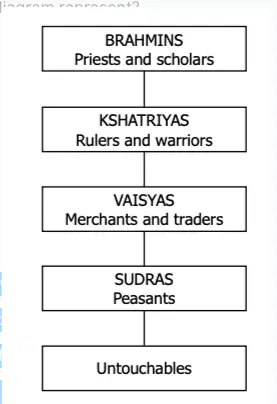
73. What does this diagram represent?
a)
Class system of China
b)
Political system of Greece
c)
Feudal system of Japan
d)
Caste system of India
74.
74. During the nineteenth century, several European powers pursued a policy of imperialism in Africa and Asia.What was one important effect of European imperialism in Africa?
a)
African natural resources were exploited by colonial powers.
b)
Working conditions for the majority of people of Africa improved.
c)
The African economy became dependent on the export of manufactured goods.
d)
Europeans recognized the superiority of African culture.
75.
Which war was mainly between England and France over who was the rightful king?
a)
The Crusades
b)
The Seven Year War
c)
The Hundred Years' War
d)
The French Revolution
100 %

