
 Worksheets
Semester 2 Biology Final
Total questions: 117
Worksheet time: 59mins
Which phrase best describes an exothermic chemical reaction?
does not absorb any energy
forms products with higher bond energy than reactants
releases more energy than it absorbs
Identify the products in this reaction: 6H2O + 6CO2 🡪 C6H12O6 + 6O2
A. 6H2O and 6CO2
B. 6CO2 and C6H12O6
C. C6H12O6 and 6O2
Chemical reactions that absorb more energy than they release are called
A. exothermic
B. catalyzed
C. endothermic
The activation energy needed for a chemical reaction is decreased by a
A. catalyst
B. reactant
C. product
If the activation energy of a biochemical reaction is lowered, then
A. the reaction will happen faster
B. the reaction will happen more slowly
C. this will not affect the rate of the reaction
Which macromolecule is an enzyme?
A. Carbohydrate
B. Lipid
C. Protein
The molecule that an enzyme binds to is known as its
A. substrate
B. monomer
C. polymer
The energy required to get a reaction started is known as the:
A. Exothermic Ability
B. Activation Energy
C. Reactant
An enzyme that has lost its shape and can no longer function properly is said to be:
Denatured
B. Activated
In the enzyme activity lab, students had tennis balls taped into their hands to represent a competitive inhibitor. What is the impact of a competitive inhibitor on a reaction?
Speeds it up
slows it down
no impact
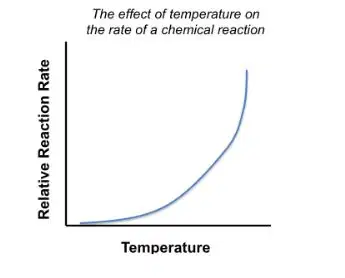
In the graph to the left, an increase in temperature results in
A. a decrease in the required activation energy.
B. an increase in reaction rate.
Which macromolecule found in the food you eat will your cells break down first to get ATP?
A. Carbohydrates
B. Lipids
C. Proteins
Which phrase best describes the function of the ATP molecule?
stores energy
creates energy
Energy is released from an ATP molecule for cellular processes when it
A. converts a phosphate group to ADP
B. attaches an extra phosphate group.
C. loses a phosphate group.
Where does your body get the energy for reattaching a third phosphate to ADP, creating ATP?
A. usually from carbs
B. from nucleic acids
C. from breaking ATP
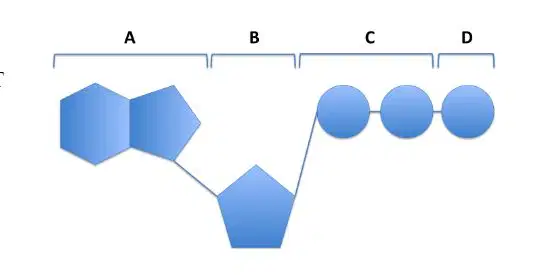
All of the following parts make up an ADP molecule EXCEPT
A. structure B
B. structure C
C. structure D
Which structures pictured would make up an ATP molecule?
only
A. A and B
B. A, B and C
C. A, B, C, and D
Between which two letters will the bond break to release energy?
A. A and B
B. B and C
C. C, and D
The sugar that is found in ATP is:
A. Splenda
B. sucrose
C. Ribose
Photosynthesis takes in energy from the sun to create glucose. This reaction that absorbs energy is considered to be:
Activated
Endothermic
Cellular Respiration breaks the bonds in food to release energy which is stored in ATP. This reaction, which releases energy is considered to be:
A. Activated
B. Endothermic
C. Exothermic
The nitrogen base found in ATP and ADP is:
A. Thymine
B. Cytosine
C. Adenine
The energy you can use in the food that you eat is stored in its:
A. Chemical Bonds
B. Heat
C. DNA
Organisms that use energy from the sun to make their own food are called.
A. carnivores
B. consumers
C. omnivores
D. producers.
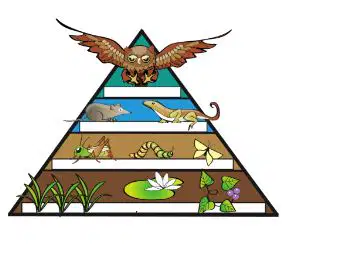
The figure to the left shows a trophic pyramid for an ecosystem. What happens to the amount of energy in the pyramid as it moves up through the different levels?
A. Energy increases by 10% each level
B. Energy decreases by 90% each level
In food chains, the flow of energy is ALWAYS _________.
A. one-way
B. reversible
C. two-way

The following organisms make up a food chain:
algae 🡪 fish 🡪 bear. If you were to place the bear into the trophic pyramid to the left, the bear would go on level _____ and have ________ amount of energy available to it.
A. A; the least
B. C; the least
C. A; the greatest
D. B; an intermediate
All energy on earth comes from the:
A. Core of the Earth
B. Wind
C. Sun
ALL organisms that get their energy from living or once-living organisms are known as:
A. carnivores
B. consumers
C. producers
Which of the following would be considered an autotroph?
A. Bear
B. corn plant
A buzzard lives off dead and decaying matter. Which of the following best describes a buzzard?
A. Carnivore
B. Omnivore
C. Detrivore
A coyote is an opportunist that will eat anything it can find: mice, bugs, fruit, berries, etc. Which of the following best describes a coyote?
A. Carnivore
B. Omnivore
C. Herbivore
D. Detrivore
Which of the following would be considered a primary consumer?
A. Bear
B. Shark
C. Grass Hopper
D. Oak tree
The purpose of photosynthesis is to
A. make ATP for humans
B. build proteins in plants
C. store solar energy as sugar.
In which organelle does photosynthesis occur?
A. Mitochondria
B. Chloroplast
After photosynthesis is finished inside of a plant, six molecules of oxygen have been produced, as well as a single molecule of C6H12O6, otherwise known as
A. carbon dioxide.
B. water
C. glucose.
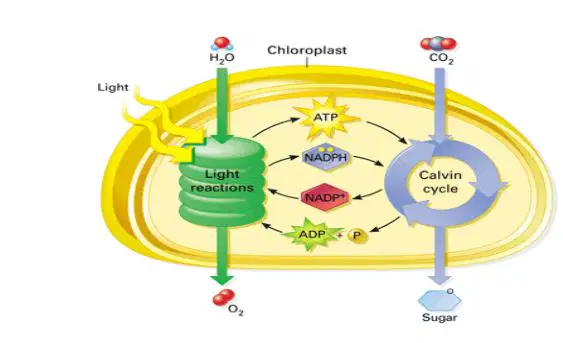
Photosynthesis occurs in two stages: light-dependent reactions and light-independent reactions. During the light-dependent reactions,
A. water molecules are split by sunlight.
B. a molecule of sugar
C. glucose is made
During photosynthesis, different gases move in and out of plant cells. Which phrase best represents the net flow of gases involved in photosynthesis?
A. Carbon dioxide moves in; oxygen moves out
B. Oxygen moves in; carbon dioxide moves out
Why is the presence of chlorophyll in plants important?
A. It assembles the sugar.
B. It creates ATP to power the process.
C. It captures water to be used in the process .
D. It absorbs the solar energy needed to create the sugar.
Which process can produce the most energy for a cell?
A. Lactic acid fermentation
B. Aerobic respiration
C. Anaerobic respiration
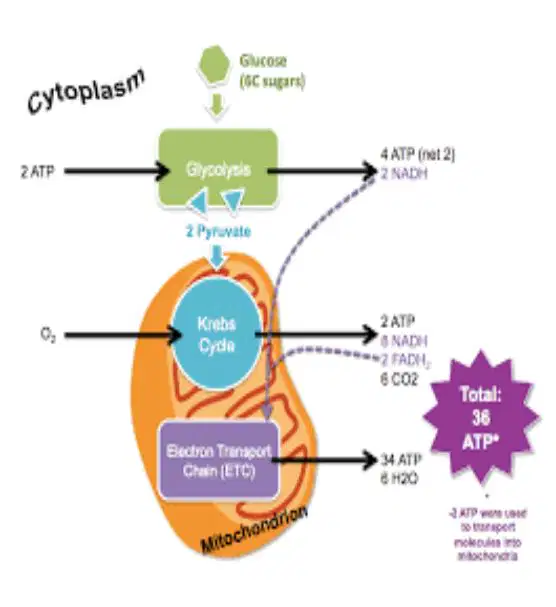
At the beginning of cellular respiration ____________________________ occurs, where glucose is broken down into pyruvate and ATP. This step does not require any oxygen.
A. Glycolysis
B. Krebs/Citric acid cycle
C. Electron Transport Chain
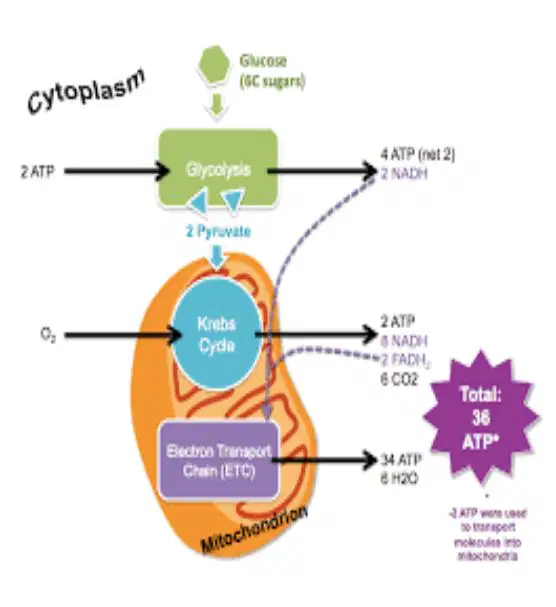
Which process takes place in the inner membrane of mitochondria?
A. Krebs Cycle
B. Electron Transport Chain
C. Citric acid Cycle
Energy from food must be transformed into the bonds of _________ before it can be used by cells.
A. ATP
B. NADP
In humans, where does DNA replication take place?
A. Cytoplasm
B. Nucleus

A scientist is doing an experiment to identify different molecules. Some components of these molecules are listed in this table. Which of the four molecules is DNA, based on the table to the right?
A. Molecule 1
B. Molecule 2
C. Molecule 3
D. Molecule 4
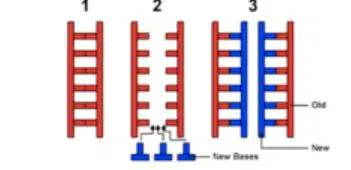
The picture below shows the steps of DNA replication beginning with step one and ending with step three. Because you are reusing the old, or parent, DNA strand DNA replication is said to be
Fully Conservation
Semi-Conservative
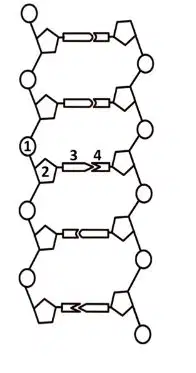
Use the diagram to the right AND your knowledge of biology to answer this question. Structures 3 and 4 are held together by
A. weak peptide bonds
B. strong hydrogen bonds.
C. weak hydrogen bonds.
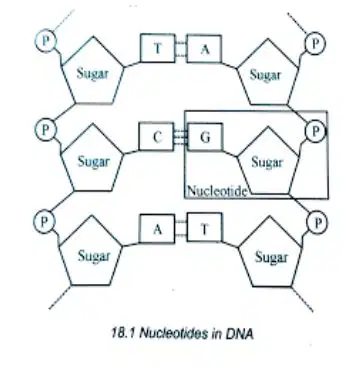
In nucleotides, the letters A, G, C, and T represent
A. phosphate groups.
B. deoxyribose sugars.
C. nitrogen bases.
Which of the following nucleic acids contains thymine?
DNA only
transfer RNA only
Messenger RNA only
all of the above
DNA is a polymer made of many monomers known as:
Peptides
Amino acids
Nucleotides
Phosphates
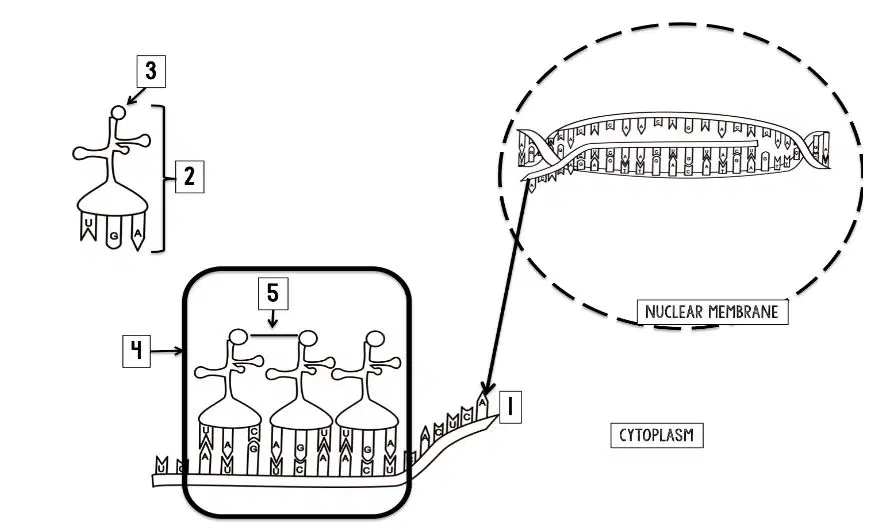
The mRNA which is copying the code directly from DNA is represented by which number .
A. 1
B. 2
What is the molecule produced by the process shown above?
A. Glucose
B. A protein
Structure number 2 represents a .
A. tRNA
B. mRNA
The bond between amino acids which is represented by number 5 is a ____ bond.
A. covalent
B. peptide
Amino Acids link together to form:
A. Carbohydrates
B. DNA
C. Protein
If a portion of a messenger RNA molecule contains the base sequence A-A-U, then the corresponding anti-codon on the tRNA base sequence is .
A. G-G-T
B. T-T-A
C. U-U-A
The sequence of ________________ in a DNA molecule determines the protein that will be produced.
A. lipids
B. nucleotides
How many amino acids are coded for by the strand of mRNA shown here? Assume the reading frame begins with the first nucleotide.
A U G U A C
A. 1
B. 2
Which statement below BEST summarizes the role of DNA in cells?
A. It guides cell division.
B. It protects cells from infection.
C. It provides the instructions for making proteins.
A Chromosome...
Is a subunit that makes up nucleic acids
Is a subunit that makes up protein
Is a portion of a chromosome that codes for a single protein
Is a portion of DNA that is condensed and rod-like.
A gene...
Is a subunit that makes up nucleic acids
Is a subunit that makes up protein
Is a portion of a chromosome that codes for a single protein
Is a portion of DNA that is condensed and rod-like.
A nucleotide...
Is a subunit that makes up nucleic acids
Is a subunit that makes up protein
Is a portion of a chromosome that codes for a single protein
Is a portion of DNA that is condensed and rod-like.
A codon...
Is a subunit that makes up nucleic acids
Is a subunit that makes up protein
Is a set of 3 nucleotides that code for a specific amino acid
Is a portion of DNA that is condensed and rod-like.
An amino acid...
Is a subunit that makes up nucleic acids
Is a subunit that makes up protein
Is a portion of a chromosome that codes for a single protein
Is a portion of DNA that is condensed and rod-like.
The form of a gene that is always expressed if present is the form.
A. recessive
B. dominant
Two heterozygous purple-flowering pea plants are crossed. (Pp x Pp ) If purple is dominant over white, what are the expected phenotypic results? Use a punnett square to prove your answer.
A. 100% purple.
B. 75% purple; 25% white.
C. 50% purple, 50% white.
If an organism inherits one dominant allele and one recessive allele for eye color, their genotype would be:
A. haploid
B. homozygous
C. heterozygous
Two parents have the genotype Gg for a genetic disorder caused by a recessive allele. What is the chance that any of their children will inherit the disorder?
A. 25%
B. 50%
C. 75%
In pigs, the allele for a wavy, rough coat (R) is dominant to the allele for a soft, fine coat (r). A rough coat boar and a soft coat sow mate. They produce several litters, 50% are rough coat and 50% are smooth coat. What must be the genotypes of the parents to create this phenotypic ratio?
A. RR × rr
B. Rr × rr
C. RR × Rr
D. Rr × Rr
Imagine two heterozygous parents. Each has a dominant allele (B) for brown eyes and a recessive allele (b) for blue eyes (Bb x Bb). What would the genotypic ratio of the offspring be?
A. 100% Bb
B. 50% BB, 50% Bb
C. 25% BB, 50% Bb, 25% bb
D. 50% Bb, 50% bb
An example of a homozygous recessive is
Aa
aa
An example of homozygous dominant is:
Aa
AA
A cross between two individuals concentrating on only one definable trait. Ex: AA
Monohybrid cross
Dihybrid cross
A cross between organisms involving 2 pairs of contrasting traits; Aa and Tt
Monohybrid Cross
Dihybrid cross
The trait that always appears, even in a heterozygous combination
Dominant
Recessive
A condition in which neither of two alleles of a gene is totally dominant over the other.
Multiple Alleles
Codominance
Three or more forms of a gene that code for a single trait.
Multiple alleles
Codominance
Red hair and freckles are commonly inherited together. Which of the following patterns of inheritance explains this?
A. Linked genes
B. Multiple alleles
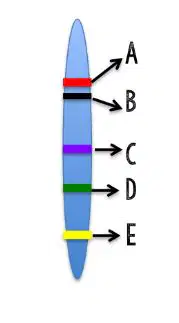
Which pair of genes in the diagram to the right would be most likely to be inherited together?
A. A and B
B. A and C
In a newly discovered species of flower, it was discovered that the color of the flowers is determined by two different genes. This results in a flower with a color that is a blend of the two parent flowers. Which of the following inheritance patterns is this?
A. Multiple alleles
B. Incomplete dominance
For an XX female to express a recessive sex-linked trait, she must have .
A. a Y chromosome
B. one recessive allele
C. two recessive alleles
Human height occurs in a continuous range because it is affected by the interaction of many genes, making it a(n)
A. autosomal trait
B. polygenic trait.
83. When getting an X-ray taken at the doctor’s office, you notice the technician cover you with a heavy vest. This vest, you are told, contains lead, a metal that can block X-rays, which are a form of radiation. The technician covers your torso, and folds the vest over double across your reproductive organs (testes/ovaries). This is done because radiation can damage the DNA of these organs, causing a mutation you may pass to children. Substances like radiation and other certain chemicals are known as mutagens because
A. they cause cancer
B. they cause mutations in the sequence of DNA.
C. they generate muteness.
A change in a gene or a chromosome
Mutation
Mutagen
Somatic Cells
Body cells are also known as:
Gametic Cells
Somatic Cells
Autosomal Cells
When a single nucleotide is replaced with a different nucleotide CTGGAC to CTGGGC it is called:
Gene Mutation
Point Mutation
When a section of a chromosome breaks off and becomes attached to another chromosome.
Point Mutation
Chromosome Mutation
How would you categorize a genetic disorder that is equally likely in males and females and is caused by the presence of two affected alleles?
A. Autosomal dominant disorder
B. Sex-linked disorder
Mutations can be caused by all of the following except .
A. viruses
B. global warming
C. chemicals
Sex cells are also called…
Somatic Cells
Gametic Cells
Autosomal Cells
A person that doesn't show the disease but can pass the disease causing allele to offspring.
Pedigree
Carrier
Dominator
A chart used to trace the phenotypes and genotypes in a family to determine whether people carry diseases or traits
Pedigree
Carrier
Dominator
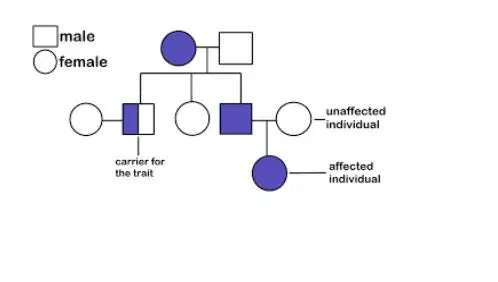
In the diagram, what does a square represent?
Male
Female
Affected individual
In the diagram, what does a circle represent?
Male
Female
Affected individual
In the diagram, what does a completely filled in square represent?
Male
Female
Affected individual
In the diagram, what does a completely empty circle represent?
Unaffected Individual
Horizontal Line
A vertical Line
In the diagram, what does a horizontal line represent?
Unaffected Individual
Marriage
Offspring
In the diagram, what does a vertical line represent?
Unaffected Individual
Marriage
Offspring
A population of bacteria is treated with hand sanitizer. Because of genetic variation in the population, what is a possible outcome?
A. The population will grow quickly
B. Some may be resistant and survive.
One of the biggest ways that a species evolves is because some organisms with some traits survive and reproduce better than others. This process is known as
A. natural selection
B. convergent evolution.
C. coevolution.
D. sexual selection.
An adaptation is
A. any trait an organism possesses
B. how an organism evolves during its own lifetime.
C. a gene an organism has.
D. a trait that helps an organism survive in its environment.
Genetic diversity is ultimately/mainly the result of
A. meiosis
B. viruses
C. mutations.
D. reproduction.
Individuals that are well adapted to their environment will survive and produce
A. fewer mutations
B. more offspring
C. stronger gene
D. better traits
Which of the following is not an example of a biological process in a biogeochemical cycle?
A. Transpiration
B. Erosion
Carbon dioxide is returned to the atmosphere primarily by
A. combustion by humans.
B. photosynthesis by producers.
Carbon cycles through the biosphere in all of the following processes EXCEPT .
A. photosynthesis
B. transpiration
C. burning of fossil fuels
D. decomposition of plants and animals
Nitrogen fixation is carried out mainly by .
Humans
Bacteria
In the carbon cycle, decomposers return carbon to the soil. Which of the following is NOT something that decomposers can break down?
A. Waste products like urine or feces
B. The bodies of dead plants and animals.
C. Carbon dioxide found in the air
Humans increase carbon dioxide (CO2) in the atmosphere, and contribute to the carbon cycle by
A. combustion from driving cars.
B. planting trees to improve photosynthesis.
C. conserving energy with alternative energies.
When deforestation (cutting down trees) occurs in an area, what immediate effect does this have on the water cycle?
A. More water is returned to the atmosphere by transpiration.
B. There is less runoff water, but more transpiration.
C. More photosynthesis occurs, and CO2 begins decreasing.
D. Less is returned to the air by transpiration.
Water can be returned to the atmosphere through the leaves of plants by.
A. evaporation
B. condensation.
C. precipitation
D. transpiration.
For the carbon cycle and the nitrogen cycle to function properly, which organisms must always be present?
A. Decomposers
B. Herbivores
What pattern of growth is shown by humans on Earth, whose population is growing out of control?
A. Exponential
B. Logistic
C. Carrying capacity
D. Population crash
A renewable resource is one that
is used faster than it is replenished.
is replenished as fast as it is used.
is used like fossil fuels.
can be recycled.
The development of nuclear power has provided electricity for less money, but with a tradeoff. What may be considered a negative impact of nuclear power?
A. Large amounts of energy are produced very cheaply.
B. It takes a lot of energy to run a nuclear power plant.
C. Nuclear power plants provide new jobs for a community.
D. The radioactive waste is unsafe and hard to store safely.
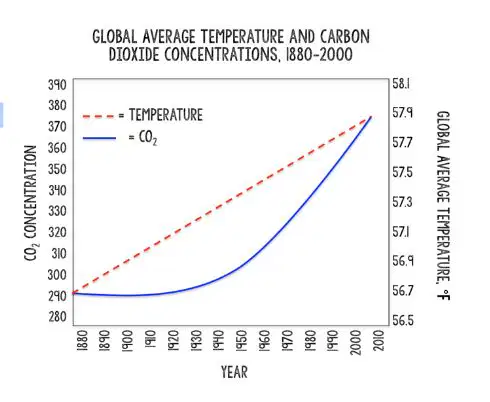
Examine the diagram to the right and the trend seen by the two lines. Global temperature has been closely linked with the buildup of CO2 in the atmosphere. Which of the following statements is most likely true based on the graph?
Since 1880, carbon dioxide has caused a temperature increase of 10° Fahrenheit.
Since 1880, adding carbon dioxide has caused the global temperature to decline.
Since 1880, carbon dioxide has caused the temperature to increase by about 1.2 degrees.
Since 1880, carbon dioxide has no effect on the global temperature.
What human activity would have the most significant effect on the temperature of the earth?
A. deforestation
B. water pollution
C. solar panels
D. burning fossil fuels

