
 Worksheets
Skeletal System Test
Total questions: 122
Worksheet time: 1hrs 10mins


Which of the following a facial bone?
Occipital
Parietal
Mandible
Temporal
Which of the following a cranial bone?
Mandible
Maxilla
Nasal
Temporal

These are air filled cavities that surround the nose that warm and moisten inspired air and amplify the tone of the voice.
conchae
palate
sinuses
pharynx

suture highlighted in red
coronal
squamosal
lamboidal
metopic

suture highlighted in red
frontal
sagittal
coronal
squamosal

suture highlighted in red
coronal
lamboidal
sagittal
metopic

suture highlighted in red
lamboidal
frontal
sagittal
squamosal

occipital bone
foramen magnum
coronal suture
fontanelle

Mandible
Frontal
Temporal
Maxilla

Occipital
Frontal
Temporal
Parietal

Maxilla
Zygomatic
Nasal
Mandible

Mandible
Zygomatic
Frontal
Maxilla

Sphenoid
Temporal
Parietal
Zygomatic

Temporal
Zygomatic
Parietal
Mandible

Parietal
Temporal
Frontal
Zygomatic

Parietal
Temporal
Occipital
Sphenoid

Parietal
Frontal
Sphenoid
Mandible

The function of the paranasal sinuses.........
decrease the relative weight of the skull
increase the resonance of the voice
humidify inhaled air
heat inhaled air
What is the function of the fontanelles
To make the head bigger
To make the the head smaller to pass through the birth canal
To connect the facial bones
To protect the brain

Thoracic
Sacrum,
Coccygeal
The increase in vertebrae size from the neck to the lower back is due to:
supporting more weight in the lower back than in the neck
supporting less weight in the lower back than in the neck
evolution
vertebrae don't increase in size


Gesturing "no" with the head depends on the structure(s) of which vertebrae?
thoracic vertebra
lumbar vertebra
atlas and axis
cranium
Ribs 1-7 are called __________ ribs. Ribs 8-10 are called ________ ribs. Ribs 11 and 12 are called ________ ribs.
floating, true, false
true, false, floating
true, floating, false
false, floating, true
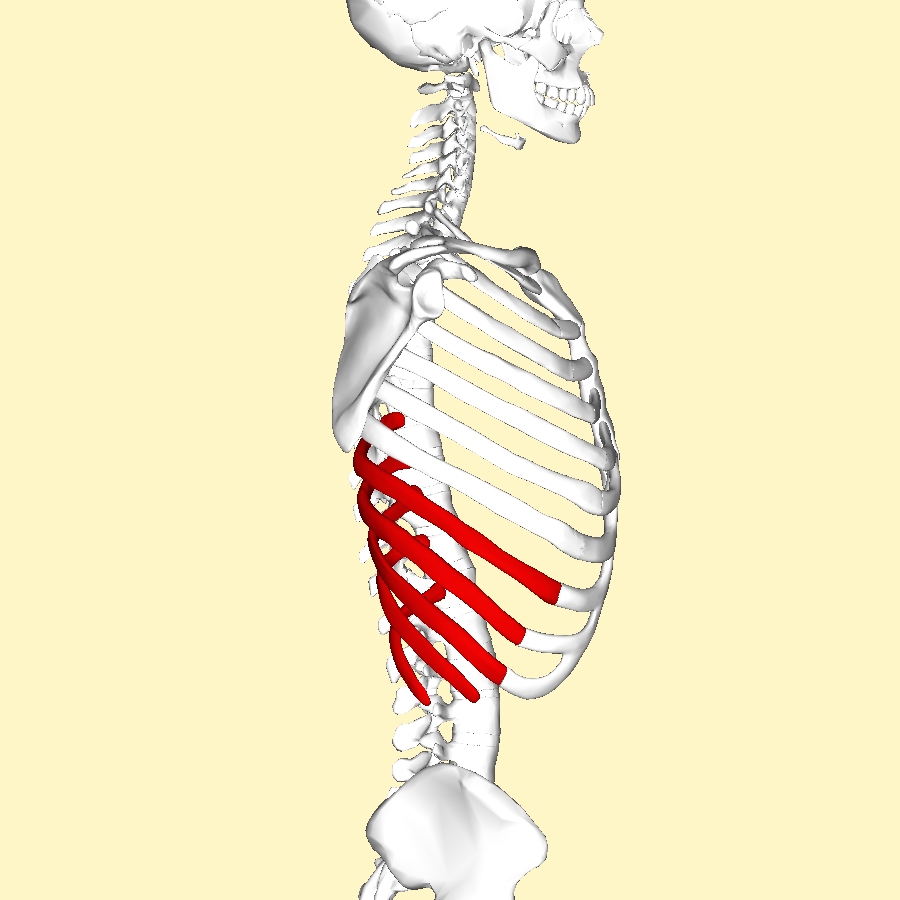
Ribs 8-10 that are connected, via cartilage, to rib pair 7, and are thus indirectly connected to the sternum, are known as
true ribs
false ribs
floating ribs
suprasternal ribs

Identify the structure indicated in the image.
manubrium
body of sternum
xiphoid process
rib cage

identify the skeletal bone in the picture that is highlighted green and blue; also known as the breastbone
clavilce
Sternum
Rib Cage
verterbrae
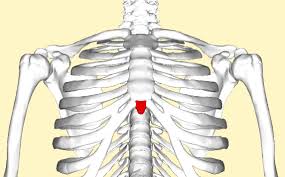
Identify the structure indicated in the image.
manubrium
body of sternum
xiphoid process
rib cage
sternum

DISTAL END
STERNAL END
ACROMIAL END
PROXIMAL END
The clavicle attaches to the ___ medially.
tibia
scapula
sternum
carpal
The clavicle attaches to the ___ laterally.
tibia
scapula
sternum
carpal
Which of the following is most commonly fractured in a fall?
Clavicle
Humerus
Cranium
Scapula

Number 5 represents the insertion point of the major shoulder muscle. This landmark is called
the bicipital groove
the deltoid tuberosity
the glenohumeral tuberosity
none of the previous
The forearm bone closest to the thumb is the __________.
Ulna
Radius
The bone that spans from the shoulder to the elbow is known as the ___________________.
Humerus
Ulna
Femur
Tibia


The section of this picture highlighted in green is called the _______________?
Tibia
Patella
Ilium
Fibula

Identify #16? It is the deep socket of the hip bone. It receives the head of the femur to form the ball and socket joint.
acetabulum
obturator foramen
iliac crest
greater sciatic notch
ischial spine
Females have a subpubic angle that is wider (larger, more obtuse) than males, measuring around 80 degrees or more
true
false
Which statement is true for the male pelvis?
The male pelvis is taller but narrower than the female pelvis.
The male pelvis is lighter than the female pelvis.
The male pelvis has a subpubic angle closer to 90 degrees.
The male pelvis has smaller acetabula.

What bone of the pelvic girdle is colored purple (#1)?
ilium
ischium
pubis
sacrum
coccyx
What bone of the pelvic girdle is colored beige (#2)?
ilium
ischium
pubis
sacrum
coccyx
What bone of the pelvic girdle is colored pink (#3)?
ilium
ischium
pubis
sacrum
coccyx
What bone of the pelvic girdle is colored blue (#4)?
ilium
ischium
pubis
sacrum
coccyx
What bone of the pelvic girdle is colored blue (#5)?
ilium
ischium
pubis
sacrum
coccyx



The head of the femur articulates with the coxal bones at the _____________________________________.
Obturator Foramen
Acetabulum
Greater Trochanter
Lesser Trochanter
Common name for Pollex
Thumb
Great toe
Heel
Ankle
When seated, the weight of the body is borne by the
obturator foramina
iliac crests
ischial tuberosities.
posterior inferior iliac spines.

Identify the structure marked with the X: This cartilaginous joint joins the two pubic bones together.
pubic symphysis
obturator foramen
iliac crest
acetabulum
Common name for Hallux
Thumb
Head
Big Toe
Groin
Which statement is true for the female pelvis?
The female pelvis is narrower than the male pelvis.
The female pelvis is taller than the male pelvis.
The female pelvis has smaller acetabula, which are also farther apart.
Which pelvis is generally heavier?
The female pelvis is heavier.
The male pelvis is heavier.
The following is NOT one of the 3 Joint Classifications..
Cartilaginous
Cartilage
Fibrous
Synovial
The joints that allow the most movement are called
Fixed
Fibrous
Cartilaginous
Synovial


What type of joint is displayed in the picture?
Pivot joint
Ellipsoid joint
Hinge joint

What joint is displayed in picture
Hinge Joint
Saddle joint
Ball and socket joint
Which type of joint gives you the largest range of motion?
Pivot joint
Ball-and-socket joint
Hinge joint
Gliding joint
The main purpose of synovial fluid is:
Keeping bones moist
Lubrication
Strengthening tendons and cartilage
Protecting the spinal cord
When kicking a football the knee
Flexes
Extends
Abducts
Adducts
Hinge joints allow What type of movement?
Flexion & Extension
Abduction & Adduction
Rotation & Extension
Flexion & Rotation

Which is one of the functional ways a joint is classified
Fibrous—tend to be immovable
Amphiarthroses—slightly movable joints
Synovial –tend to be freely movable

Which is one of the structural ways a joint is classified?
Cartilaginous—both immovable and slightly
movable
Synarthroses—immovable joints
Diarthroses—freely movable joints

In terms of function, which is considered an immovable?
a synarthrosis
an amphiarthrosis
a diathrosis
all joints are movable
immovable joint
amphiarthrosis
diarthrosis
synarthrosis
synostosis
Which of the following is true of sutures.
They are only found in the skull.
They are not unique to individuals.
They are amphiarthroses throughout life.
They can never become ostoses.
The pubic symphysis is a _________ joint.
amphiarthrosis
symphysis
both amphiarthrosis and symphysis
neither amphiarthrosis nor symphysis

When kicking a football the knee
Flexes
Extends
Abducts
Adducts


Identify the joint action being performed.
Pronation
Supination
Inversion
Eversion
To pinch with a thumb and finger involves a movement called
opposition.
circumduction.
rotation.
eversion.
Cartilage
Joins bone to bone
Is found in the cavity of bones
Is found at the ends of bones
Joins muscle to bone
Ligaments
Join bone to bone
Joint muscle to bone
Are found on the ends of bones
Acts as a shock absorber between the joints
Nodding your head "yes" is an example of
circumduction.
flexion and extension.
pronation and supination.
lateral and medial rotation.
Tendons
Join bone to bone
Join muscle to bone
Are found at the ends of bones
Are found in the cavity of bones

