
 Worksheets
5/25/23 Study Guide Final Math 3
Total questions: 80
Worksheet time: 20hrs 0mins
Find the slope of the line that passes through:
(6,7) and (4,2)
(a)
What slope is parallel to:
m = 3/4
(a)
The following represents slopes of two lines. Which answer choice describes the two lines? m = 7 and m = -7
(Parallel, Perpendicular, Neither)
(a)
Line 1: (15, 20), (17, 18)
Line 2: (-22, -18), (-20, -16)
(Parallel, Perpendicular, Neither)
The two lines are (a) .
y = 5/7x +2 y = 5/7x - 30 These lines are...
Parallel, Perpendicular, Neither
(a)

What is the equation for the yellow line? (assume both lines are parallel)
(a)

What is the equation of the blue line which passes through the point (0,6)?
(assume these line are perpendicular)
(a)

Find the measure of the indicated angle.
(a)

Solve for x.
(a)

Find the ?
(a)

Find x.
(a)

Find the measure of each angle indicated.
(a)

Find the measure of each angle indicated.
(a)
A turn is also called a (a) .
(Translation, Reflection, Rotation)
Point (-5,2) is reflected over the y axis. Where is the new point located?
(a)


Perform the indicated operation.
Write answer in descending order.
( 9x2 - 7x + 8 ) - ( 12x2 - 8x - 11 )
-3x2 - 15x + 19
21x2 - 15x - 3
-3x2 - 15x - 3
-3x2 + x + 19
f(x)=3x2 - 8x + 2

Factor and cancel out in order to simplify.
9(x+10)
x+10
9
x+9
Factor the following polynomial:
3x2+14x−5
(3x + 5)(x - 1)
(3x - 1)(x + 5)
(3x + 1)(4x - 5)
(x - 15)(x + 14)
Factor the following polynomial:
x2+4x−21
(x + 4)(x - 21)
(x - 7)(x + 3)
(x - 4)(x + 21)
(x - 3)(x + 7)
x2 - 25
Solve system by using Cramer's Rule. Answers are written in the following form (x,y)
4x+6y=3
8x−3y=1
(41,31)
(−31,41)
(31,41)
(41,−31)
x−3y=3
(1,6)
(6,−1)
(6,1)
(−1,6)

Find the determinant of the above matrix.
-23
23
-7
7

What is Dy/D?
−29−29
−29−116
−2929
−4

When setting up Cramer's Rule, what is the 2x2 determinant for the numerator for the x in the system?
∣−4 −2∣
∣−5 −4∣
∣−4 −16∣
∣−5 −26∣
∣−16 −2∣
∣−26 −4∣
∣−4 −4∣
∣−2 −5∣
When setting up Cramer's Rule, what is the 2x2 determinant for the numerator for the y in the system?
∣−4 −2∣
∣−5 −4∣
∣−4 −16∣
∣−5 −26∣
∣−16 −2∣
∣−26 −4∣
∣−4 −4∣
∣−2 −5∣

Use Cramer's Rule to solve the system.
(1/6, -1/2)
No unique solution
(5, -1/7)
(-7/4, -1/7)

What size is this matrix?
2x2
2x3
3x2
1x6

What is the formula for the determinant of a 2x2 matrix?
ad-bc
ab-cd
ad+bc
(a+d)(b+c)
Solve using Cramer's Rule...
2x+y=0
3x+2y=−2
What is the x-coordinate of the solution?
(a)
Solve using Cramer's Rule...
2x+y=0
3x+2y=−2
What is the y-coordinate of the solution?
(a)
Solving using Cramer's Rule...
5x−6y=−45
9x+8y=13
What number is in Row 1 Column 2 in the numerator of the y-coordinate?
(a)
Solving using Cramer's Rule...
5x−6y=−45
9x+8y=13
What number is in Row 2 Column 1 in the numerator of the x-coordinate?
(a)
Solving using Cramer's Rule...
5x−6y=−45
9x+8y=13
What number is in Row 2 Column 2 in the numerator of the x-coordinate?
(a)
Solving using Cramer's Rule...
5x−6y=−45
9x+8y=13
What is the y-coordinate of the SOLUTION?
(a)
Solve using Cramer's Rule...
2x+y−3z=−5
5x+2y−2z=8
3x−3y+5z=17
What number is in Row 2 Column 3 in the numerator of the x-coordinate?
(a)
Solve using Cramer's Rule...
2x+y−3z=−5
5x+2y−2z=8
3x−3y+5z=17
What number is in Row 3 Column 2 in the numerator of the y-coordinate?
(a)
Solve using Cramer's Rule...
2x+y−3z=−5
5x+2y−2z=8
3x−3y+5z=17
What number is in Row 1 Column 3 in the numerator of the z-coordinate?
(a)
Solve using Cramer's Rule...
2x+y−3z=−5
5x+2y−2z=8
3x−3y+5z=17
What is the y-coordinate of the SOLUTION?
(a)

What is the solution for x given the graph to the systems of equations
(a)

What is the solution to the systems of equations shown in the graph?
1 Solution x=-1/2
1 Solution y=-1/2
Many Solutions
No Solution

What is the solution for y based on the system:
(a)

Find the answer using substitution: Please list your answer as a coordinate (x,y)
(a)

Find the answer to the systems using substitution: List the solution as a coordinate (x,y):
(a)

Solve the given systems of equations using elimination: Write you answer as a coordinate (x,y).
(a)

Find the answer to the systems using elimination: List the answer as a coordinate (x,y):
(a)

Solve the systems with any method you choose: Check all that apply:
x= -5/2
y=-5/2
No Solutions
Infinitely Many Solutions
x=0
Solve the systems with any method you choose: Check all that apply:
x= -5/2
y=-5/2
No Solutions
Infinitely Many Solutions
x=0

a
b
c

21
29
20

Cos(A)=
815
178
158
817

Determine the sin(θ) given the diagram:
56
65

Q4: Given triangle XYZ, find tan(∠Y) if XY=50, YZ=40, and XZ=30
4030
5040
3050
3040

35/21
21/28
35/28
28/21

16/34
16/30
30/34
34/16

32/40
32/24
24/40
24/32
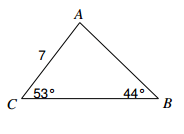


Find b
12
10
23
14
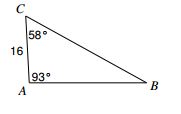
Use the Law of Sines to solve for a
33
24
12
29

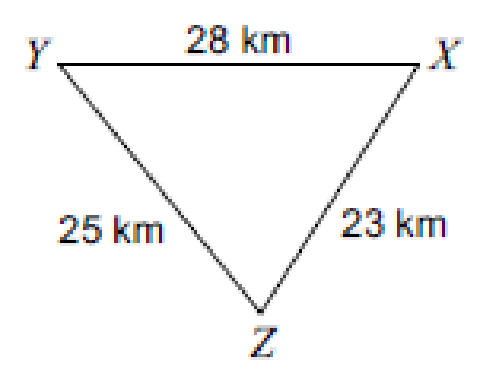
Find angle Z
20.15°
71.23°
51.06°
57.71°
What are the possible criteria for the Law of Cosines? #5
SSA, SSS
SSA, ASA
SSS, SAS
AAS, ASA
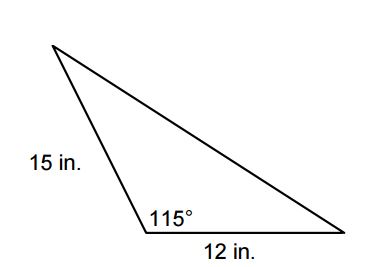
Find the missing side. #10
15.9 in.
22.8 in.
19.2 in.
521.1 in.
Which would you use to find a missing angle? #13
cos A = 2bab2−a2−c2
cos A = −2bca2−b2−c2
cos A = 4baa2−b2−a2
sin A = 2bca2−b2−c2

What is the correct set up to find angle H?
#11
cos H = 4(11)(15)112−132−152
cos H = 2(13)(15)112+132+152
cos H = −2(13)(15)112−132−152
H2 = 112+132+152−2(13)(15)cos11
m∠H= #6
44.1°
44.6°
45.2
45.6°
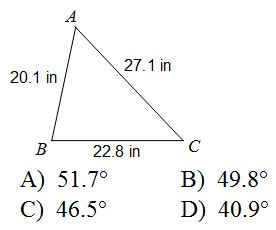
Use the angle formula from the Law of Cosines to find m<C. #16
A
B
C
D

