
 Worksheets
Biology Final Exam Review
Total questions: 45
Worksheet time: 52mins
NUCLEOTIDES ARE THE BUILDING BLOCKS OF...
CARBOHYDRATES
LIPIDS
NUCLEIC ACIDS
PROTEINS
AMINO ACIDS ARE THE BUILDING BLOCKS OF...
CARBHYDRATES
LIPIDS
NUCLEIC ACIDS
PROTEINS
FATTY ACIDS AND GLYCEROL ARE THE BUILDING BLOCKS OF..
CARBOHYDRATES
LIPIDS
NUCLEIC ACIDS
PROTEINS
WHAT ELEMENTS DO ALL BIOMOLECULES (LIPIDS, PROTEINS, NUCLEIC ACIDS, CARBS) HAVE IN COMMON?
CARBON, HYDROGEN, FLOURINE
CARBON, HYDROGEN, CHLORINE
CARBON, HYDROGEN, IODINE
CARBON, HYDROGEN, OXYGEN

This cell is a -
PROKARYOTIC
PLANT
ANIMAL
PROTIST


What do viruses have in common with living cells? They both...
store genetic information
have chloroplasts
use glucose for cellular respiration
have endoplasmic reticulum

Which viral life cycle kills its host cell by lysing (exploding)?
lytic
mitosis
lysogenic
S phase


Scientists can determine relatedness among organisms by comparing partial amino acid sequences. The table shows four partial amino acid sequences from four organisms.
Which organism is the LEAST related to the other three organisms?
Organism 1
Organism 2
Organism 3
Organism 4
Adaptations that result from natural selection are expected to increase the fitness of an organism. In terms of natural selection, which of the following best describes fitness?
Being able to escape from predators
Being among the strongest organisms in a population
Being able to survive, find a mate, and produce offspring
Being able to survive long enough to reach the adult stage
Which of these is a function of the cell membrane in all cells?
Producing cellular nutrients
Maintaining homeostasis
Neutralizing chemicals
Preserving cellular wastes
Which of the following is correct about the events of the cell cycle?
Little happens during the G1 and G2 phases of the cell cycle.
DNA replicates during the S phase of interphase.
Mitosis is usually the longest phase of the cell cycle when the cell is growing.
Interphase consists of G1, S, G2 phase and mitosis

A segment of DNA is shown in the diagram. Which of these identifies the part of the DNA segment labeled X?
Nucleotide
Phosphate group
Hydrogen bond
Deoxyribose
A segment of a DNA strand is shown.
3' AGGTCAGGT 5'
Which of these is the correct complementary DNA strand for the segment shown?
5' AGGTCAGGT 3'
5' ACCUGAGGU 3'
5' TGGACTGGA 3'
5' TCCAGTCCA 3'
When crossed with the genotype AaBb, which genotype would result in a 50% chance of producing offspring with the alleles AA?
AaBb
AABb
Aabb
aaBB
Delray has dimples and his wife does not. Delray has a homozygous dominant genotype for dimples, and his wife has a homozygous recessive genotype for no dimples.
If Delray and his wife decide to have children, then which Punnett square correctly shows the probability of them having a child with dimples?


What allele combination should go in the missing box of the Punnett square?
AA
Aa
aa
none of these
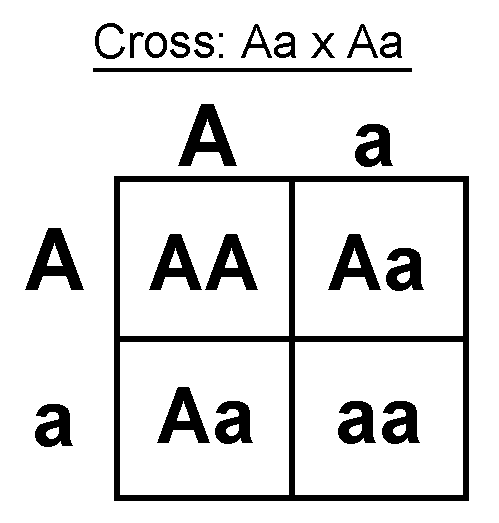
A = Brown hair and a = blond hair
What are the phenotype percentages of the offspring?
50% Brown hair and 50% Blond hair
25% Brown hair and 75% Blond hair
75% Brown hair and 25% Blond hair
0% Brown hair and 100% Blond hair
The gray squirrel, Eastern fox squirrel and red squirrel are all different species of squirrels. Why is having a scientific name for each species of an organism important?
To prevent existing named organisms from having their names changed as they become extinct
To keep the classification system from being altered as new organisms are discovered
To allow organisms to be placed in many classification levels at the same time
To standardize the naming and organization of organisms to avoid confusion

The standardized name differentiates mountain lions from pumas
The standardized name is less descriptive of the animal that has been observed
Communication with other scientists about mountain lions will be reduced
All scientists will be using the same name for mountain lions

Stemmiulida is more closely related to Merocheta than Penicillata is to Merocheta
Spirostreptida is more closely related to Glomerida than Sphaerotheriida is to Glomerida
Polizoniida is more closely related to Glomeridesmida than Sphaerotheriida is to Glomeridesmida.
Merocheta is more closely related to Glomeridesmida than Glomerida is to Glomeridesmida

Needle-like straight leaves that are mostly over 25cm long and found in clusters of three; no thorns on cones
Flattened and scale-like leaves that are mostly over 25cm long; soft and leathery cones
Needle-like straight leaves with a length of 25cm that are mostly found in clusters of 5; thorny cone
Leaves with a length of 25cm that are found in clusters of more than 5; no thorns on cones


Fur
Claws or nails
Lungs
Jaws

Organisms 1 and 2
Organisms 3 and 4
Organisms 1 and 4
Organisms 2 and 3

Anthropoda
Annelida
Mollusca
Platyhelminthes


Heterotrophic
Mobile
Prokaryotic
Multicellular


Which figure shows the process of replication?

