
 Worksheets
Greece Review
Total questions: 76
Worksheet time: 51mins
Mainland Greece is a _______, or body of land with water on three sides.
city-state
polis
peninsula
agora
What is democracy?
ruled by majority
ruled by a few
ruled by one
ruled by no one
The Greeks were:
polytheistic (believed in many gods)
monotheistic (believed in one god)
Greece's geography led to the development of city-states.
TRUE
FALSE
Stories of the Ancient Greeks' gods & goddesses were called...
parables
myths
epics
lullabies
The greatest philosopher of Ancient Greece was?
Socrates
Aristotle
Plato
All of the above
What contributions did the Ancient Greeks have on our modern society?
Art & Architecture
Science & Mathematics
Literature & Drama
All of the above
An old story told to explain events or to justify beliefs and actions
epic poem
myth
hero
polis
A powerful city-state
epic poem
agora
hero
polis
A long poetic story
epic poem
myth
hero
polis
A character who faces a challenge that demands courage, strength, and intelligence.
acropolis
myth
hero
agora
Highest point in a city or upper city
acropolis
myth
polis
agora
The city's market place and social center
acropolis
helots
polis
agora
A government ruled by a single person, such as a king
monarchy
aristocracy
tyrants
oligarchy
A government ruled by a small group of elite, landowning families
monarchy
aristocracy
tyrants
oligarchy
A powerful man who takes advantage of a situation and seizes power
monarchy
aristocracy
tyrants
oligarchy
A government ruled by a few powerful citizens
monarchy
aristocracy
democracy
oligarchy
A government in which citizens have a direct role in governing
democracy
aristocracy
tyrants
oligarchy
State owned slaves captured from conquered lands
acropolis
helots
polis
agora

Where's the ..........?
zoo
Parthenon
CUD
hospital

What is the name of this building?
The Colosseum
The Parthenon
The Acropolis
The Citidell
Where is this building located?
Rome, Italy
Florence, Italy
Troy, Greece
Athens, Greece
The building also functioned as the city . . .
court
armory
treasury
dining hall
According to Socrates, what is the ultimate goal of philosophy?
Improving the soul
Expanding the mind
Developing strong morals
Asking questions
What was the outcome of Socrates' trial?
He was sentenced to death
He was banished from Athens
He had to pay a fine
He was imprisoned
How does Socrates think we should learn about goodness?
From experience
By reading
From a wise person
In school

The Greeks were a _________ civilization that lived in southeastern Europe.
Powerful
Weak

The country was split into differents region by _______.
Mountains
Rivers

The ____________ linked major cities together.
Mediterranean Sea
Black Sea
Atlantic Ocean
Indian Ocean

The _________ of Greece impacted Greek culture. It also allowed Greeks to develop the most _________ society of their day.
geography, advanced
politics, weak
map, important

Greece is a peninsula, which is _______.
land that is surrounded by water on three sides
an island surrounded by water on all sides

Greece is surrounded by the ____________.
Mediterranean Sea
Aegean Sea

_________ is one of the biggest islands to the south of Greece.
Crete
Peloponnesus
_________ cover most of Greece.
Mountains
Rivers

Greece was divided into ___________ because of its geography and size.
city-states
states
cities
The climate in Greece was ______ for most of the year.
Hot
Cold
Mild
Why wasn't Greece united under one government? Hint: #4
It was too big to be united.
The seas were dangerous.
They didn't want to be united.

Greek city-state where democracy was first created
Sparta
Athens
Thebes
Corinth

Greek city-state that became a military society
Sparta
Athens
Thebes
Corinth

Membership in a state or community which gives a person civil and political rights and obligations
alliance
ephor
citizenship
tyranny

A type of government where the power is shared with a small group of people
democracy
oligarchy
aristocracy
tyranny

A type of government that uses force to rule
democracy
oligarchy
aristocracy
tyranny

A type of government that gives people the power to rule themselves
democracy
oligarchy
aristocracy
tyranny
A form of democracy that allows all citizens to directly participate in government
direct democracy
representative democracy
The following information describes which battle of the Persian War: The final battle of the Persian War where Athens easily beat the army of the Persians (on land).
Thermopylae
Salamis
Plataea
Marathon
The following information describes which of the Persian Wars: Greeks led Persians into a narrow strait of water and then easily sank many Persian ships (because of their large size) causing the Persians to retreat.
Thermopylae
Salamis
Plataea
Marathon


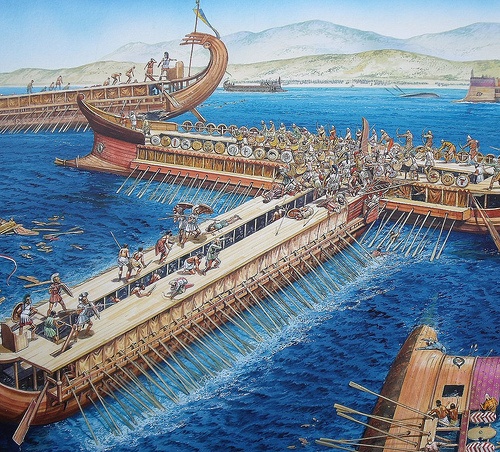


Who fought each other in the Persian Wars?
Sparta and Athens
The Greeks and the Persians
The Romans and the Greeks
The Egyptians and the Spartans
What was the PRIMARY cause of the Persian Wars?
The Greeks wanted to establish more colonies in Asia Minor.
They fought over control of the trade routes of the Aegean region.
The Greeks refused to allow the Persians to participate in the Olympic games.
The Persians wanted to punish the Greek city-states for supporting Ionia's revolt against the Persians.


After Alexander died, what happened to his empire?
His generals continued to expand the empire
His generals carved his empire up into several kingdoms
His son ruled for another fifty years
His wife became queen


What was Socrates main belief, or, what did he encourage his students to do?
Question everything
Know everything
Prove everything wrong


