wayground logo

Free Printable Worksheets

Font size

S
M
L
XL
Worksheets

Waves

Total questions: 67

Worksheet time: 43mins
Name
Class
Date
1.
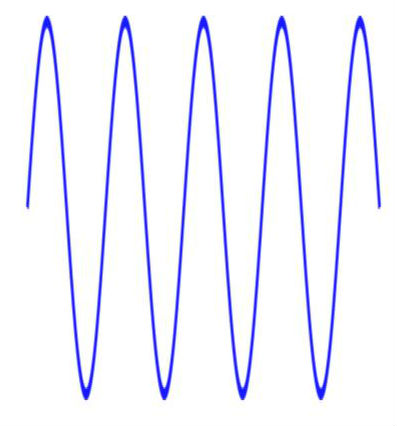
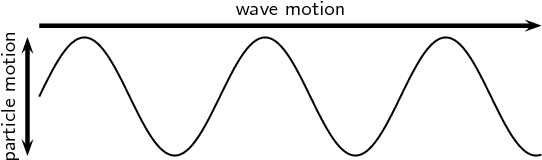
What kind of wave is pictured below?
a)
compressional wave
b)
transverse wave
c)
sound wave
d)
mechanical wave
2.
Waves are a transfer of what?
a)
Heat
b)
Light
c)
Energy
d)
Food
3.
Amplitude reflects the amount of ____________________ in a wave.
a)
energy
b)
compression
c)
rarefaction
d)
speed
4.
The units for frequency are measured in _____________.
a)
hertz
b)
seconds
c)
m/s
d)
m
5.
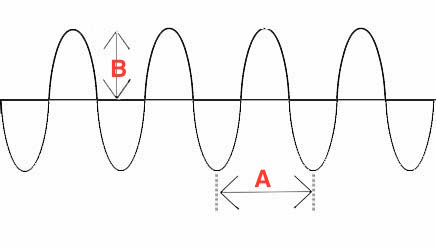
What property of this wave is represented by the letter "A"
a)
amplitude
b)
crest
c)
trough
d)
wavelength
6.
The highest point on a wave is:
a)
the crest
b)
the trough
c)
the top
d)
the coast 
7.
The lowest point on a wave is the:
a)
Amplitude
b)
Crest
c)
Trough
d)
Wavelength
8.
The number of wavelengths that pass a point each per second is:
a)
frequency
b)
period
c)
longitudinal 
d)
transverse wave 
9.
When the frequency of a wave increases, what happens to the wavelength?
a)
The wavelength is not directly affected by the frequency of a wave.
b)
The wavelength increases.
c)
The wavelength decreases.
d)
More specific information is needed to form a conclusion about the wavelength.
10.
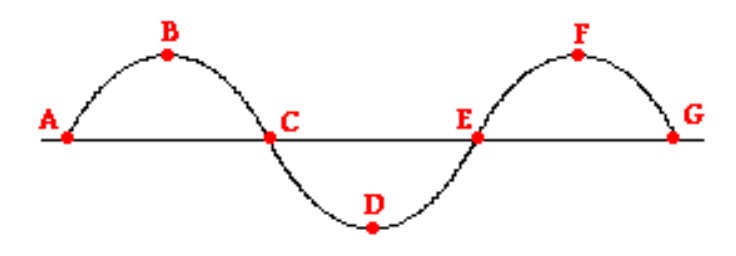
Which letter(s) represent the trough of the wave?
a)
A
b)
B & D
c)
D
d)
C & G
11.
Which letter(s) represent the crest of the wave?
a)
A
b)
B & D
c)
B & F
d)
F
12.
Which of the following can sound travel through?
a)
solid
b)
liquid
c)
gas
d)
all of the above
13.
A wave in which the particles of the medium vibrate parallel to the direction of the wave motion
a)
A. mechanical wave
b)
B. surface wave
c)
C. longitudinal wave
d)
D. wave
14.
 A wave has frequency of 50 Hz and a wavelength of 10 m. What is the speed of the wave?
a)
500 m/s
b)
50 m/s
c)
5 m/s
d)
0.5 m/s
15.
A wave has wavelength of 10 m and a speed of 340 m/s. What is the frequency of the wave?
a)
34 m/s
b)
3400 Hz
c)
3400 m/s
d)
34 Hz
16.

What is the velocity of a wave with a frequency of 1.8 Hz and a wavelength 3.6 m? v = λfv\ =\ \lambda f

17.

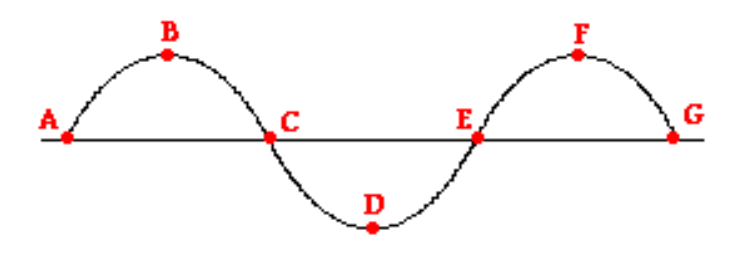
Label the point with an antinode.

18.

Label the point with a node.

19.

Which of the following is NOT a type of mechanical wave?

a)

Transverse

b)

Longitudinal

c)

Ocean

d)

Surface

20.

Match the following definition to the correct explanation.

a)

Law of Superposition

1.

The total amplitude of the waves is equal to the sum of the amplitudes of the individual waves.

b)

Constructive Interference

2.

Two waves with the same frequency and phase.

c)

Destructive Interference

3.

Two waves with the same frequency and opposite phase.

21.

The pitch of a sound is related to the...

a)

amplitude of the sound wave

b)

frequency of the sound wave

c)

speed of a sound wave

d)

reflection of a sound wave

22.

The unit that compares the intensity of sound is called...

a)

bel

b)

hertz

c)

decibel

d)

meter

23.
When the frequency of a wave increases, what happens to the wavelength?
a)
The wavelength is not directly affected by the frequency of a wave.
b)
The wavelength increases.
c)
The wavelength decreases.
d)
More specific information is needed to form a conclusion about the wavelength.
24.

The (a)   Effect refers to the change in

observed frequency during the relative

motion between a wave source and its

observer.

25.

A string is clamped at both ends and plucked so it produces a standing wave as shown above. How many nodes and antinodes are there?

a)

2 nodes, 3 antinodes

b)

3 nodes, 2 antinodes

c)

4 nodes, 3 antinodes

d)

3 nodes, 4 antinodes

26.

Patterns are only created within the medium at specific frequencies/vibration. These frequencies are known as...

a)

timbres

b)

beats

c)

harmonics

d)

fundamental

27.

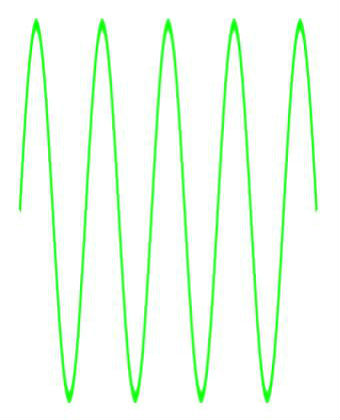
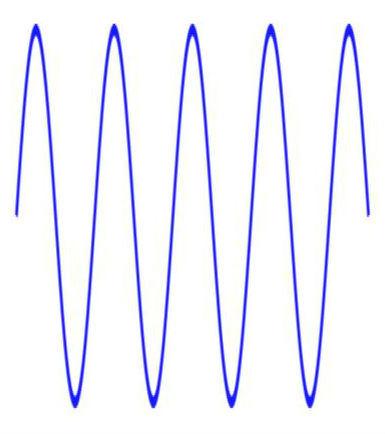
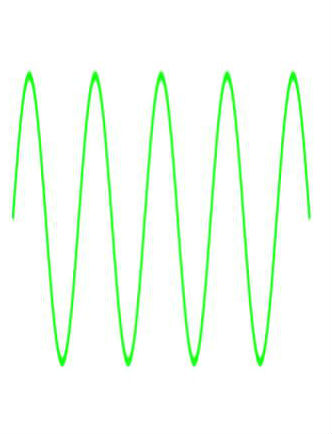
Which transverse wave has the highest frequency?

a)

1

b)

2

c)

3

d)

4

28.

Which image below shows a medium vibrating at its fundamental frequency?

a)
b)
c)
d)
29.
How high or low a sound is; depends on the frequency (greater frequency= higher pitch)
a)
pitch
b)
frequency
c)
sound
d)
medium
30.
When the sound source moves, the frequency changes
ex. police car siren sounding lower pitch after the car passes
a)
pitch
b)
frequency
c)
Doppler Effect
d)
medium
31.
A wave in which the vibration is in the same direction as that in which the wave is traveling; sound waves
a)
longitudinal wave
b)
ocean wave
c)
transverse wave
d)
mechanical wave
32.
A reflected sound wave
a)
frequency
b)
pitch
c)
echo
d)
rarefaction
33.
High Amplitude =__________________
a)
Louder sounds
b)
Quieter Sounds
34.
Low Amplitude = ______________
a)
Quieter Sounds
b)
Louder sounds
35.

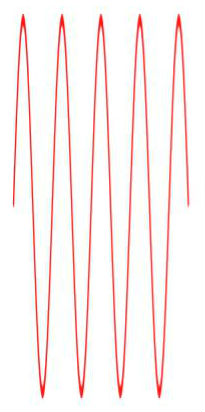
Which sound wave shows the sound with the highest pitch?
a)
b)
c)
36.

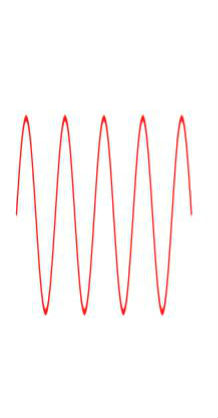
Which sound wave shows the loudest sound?
a)
b)
c)
37.
Which choice below correctly explain frequency?
a)
The frequency is based on how many times per second a wave passes a given point.
b)
The frequency is based on how many seconds it takes for a wave to pass a single point.
c)
The frequency is how many times a wave crests before forming a trough.
d)
The frequency is the wavelength times the speed ofthe wave.
38.
Which three of the following choices are correct units for measuring a frequency? (Choose 3)
a)
Cycles/ Second
b)
Hertz
c)
Wavelengths/Second
d)
Meters/Second
e)
Decibels
39.
What is the period of a wave?
a)
The time of day that the wave is most active.
b)
The time it takes for the wave to pass a single point.
c)
The end of a wave.
d)
The number of waes that pass a single spot in 1 second.
40.
Which three of the following descriptions are true of wave motion? (Choose 3)
a)
Waves involve the movement of matter from one location to another.
b)
Waves involve the transport of energy from on location to another.
c)
As waves pass through a medium, particles of the medium undergo a back-and-forth vibration about a fixed position.
d)
Waves involve periodic and repeated disturbances of the medium.
41.
To be a wave, what 3 properties need to be true? (choose 3)
a)
Energy is traveling
b)
Particles are Oscillating (vibrating)
c)
Energy is being transferred between the particles
d)
The energy is causing the material to permanently deform
42.
Which picture below is showing a transverse wave?
a)
.
b)
..
c)
...
43.
Which picture below is showing a longitudinal wave?
a)
...
b)
..
c)
.
44.
Olive Udadi accompanies her father to the park for an afternoon of fun. While there, she hops on the swing and begins a motion characterized by a complete back-and-forth cycle every 5.0 seconds. This statement provides info about the child's _____.
a)
speed
b)
frequency
c)
period
45.
The speed of a wave refers to
a)
how often it vibrates to and fro.
b)
how high it vibrates
c)
how much time it takes to vibrate to and fro.
d)
how far a given point on a wave (e.g. a crest) travels per unit time
46.
What is a standing wave?
a)
A transverse wave where the energy is moving vertically and the medium is moving horizontally.
b)
A wave pattern that happens when a wave reflects back on itself causing positions of the wave to look stationary.
c)
What you do at a sporting event
d)
A wave frozen in time
47.
What is A pointing at in the diagram below?
a)
Node
b)
Antinode
c)
Wavelength
d)
Harmonic
48.
What is B pointing at in the diagram below?
a)
Node
b)
Antinode
c)
Wavelength
d)
Harmonic
49.
Which picture below is sowing the fundamental harmonic of the standing wave?
a)
...
b)
..
c)
.
50.
When a wave hits a boundary between two different materials, what will happen if the wave is transmitted into the new material?
a)

The wave's path will either bend towards or away from the boundary.

b)

The wave will bounce off the boundary

c)

The wave will split into two different waves and continue traveling through both media

d)

The wave will scatter

51.
The two waves pictured are about to interfere with each other. Which choice below shows what the interference will look like?
a)
.
b)
..
c)
...
d)
....
52.
The two waves pictured are about to interfere with each other. Which choice below shows what the interference will look like?
a)
.
b)
..
c)
...
d)
....
53.
When two waves of the same wavelength meet their amplitudes, for a single wavelength, combine and the resulting wave can have a larger or smaller amplitude. This describes which of the 4 properties of waves?
a)
Reflection
b)
Transmission/Refraction
c)
Diffraction
d)
Interference
54.
When a wave is partially blocked, part of the unblocked wave will continue in a straight line, while the other part of the unblocked wave will bend around the corner of whatever is blocking part of the wave. This describes which of the 4 properties of waves?
a)
Reflection
b)
Transmission/Refraction
c)
Diffraction
d)
Interference
55.
When a wave refracts, the wave will bend towards (imitates) the boundary if what is true?
a)
The wave is leaving a material that it can move fast in into a material that it moves slower in.
b)
The wave leaves a less dense material into a move dense material.
c)
The wave leaves a material that it moves slowly through into a material that it can move faster through
d)
The wave leaves a more dense material into a less dense material.
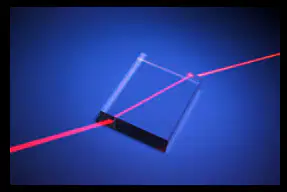
56.
Which property of waves is being demonstrated in the image?
a)
Reflection
b)
Transmission/Refraction
c)
Diffraction
d)
Interference
57.
When a wave hits a surface and changes direction (bounces) back away from the surface which property of a wave is it demonstrating?
a)
Reflection
b)
Transmission/Refraction
c)
Diffraction
d)
Interference
58.
An echo is an example of which of the 4 properties of a sound wave?
a)
Reflection
b)
Transmission/Refraction
c)
Diffraction
d)
Interference
59.
Musicians do their best to sing, play, produce sound waves that are in tune. When in tune, the sound sounds significantly louder than when it is not in tune. Which choice below best explains why this happens?
a)
When musicians are in tune, they are all producing the coherent (in phase) waves that constructively interfere with each other, resulting in a louder sound than if the musicians were playing individually.
b)
When the musicians are in tune, they aer making sure the beat frequency of the tones they are playing are countering each other, resulting in a smoother, louder sound.
c)
When playing in tune, the musicians are effectively interfering with the outside sound and causing the outside wavelngths to be destroyed, which makes what they are playing louder.
d)
It has nothing to do with what they are playing, and everything to do with the listener's ears perfering in tune sound. The listener's brain amplifies the pleasant sounds, while actively dampening the unpleasant, dissonant sounds.
60.
When listening to a musical group, sometimes the sound you hear sounds wavy, or wobbly, making a wah wah sound even though the musicians aren't actually changing note or pitch. What is going on?
a)
The musicians are in tune, and so the frequencies of sound you are hearing a resonating with your body, making you feel the sound waves.
b)
The individual musicians are playing just slightly different frequencies. these frequencies are interfering with each other resulting in loud and soft spots that we experience as beats or a wah wah sound.
c)
The local movements and temperatures of the air are causing the sound waves to diffract before they reach your ear. the different diffracted waves hit your ear and slightly different times, resulting in louder and softer spot or the wah wah sound.
61.
Which image below is showing and example of Light reflecting?
a)
Rainbow Disc
b)
Lovely Landscape
c)
Eau de Canard
d)
Don't open that DOOR!
62.
Which image below is showing and example of Light transmitting and refracting?
a)
Rainbow Disc
b)
Lovely Landscape
c)
Eau de Canard
d)
Don't open that DOOR!
63.
Which image below is showing and example of Light diffracting?
a)

Rainbow Disc

b)

Lovely Landscape

c)

Eau de Canard

d)

Don't open that DOOR!

64.
What type of wave's particles undergo compression and rarefaction?
a)
Transverse
b)
Longitudinal
c)
Ocean
d)
Surface
65.
What is the frequency of the wave if 30 wavelengths pass by a spot in 1 minute?
a)
2 Hz
b)
1.5 Hz
c)
1 Hz
d)
0.5 hz
e)
0.25 Hz
66.
The lowest frequency the average human can hear is 20 Hz. How long would it take for one wavelength to pass by you art this frequency?
a)
20 seconds
b)
5 seconds
c)
2 seconds
d)
0.05 seconds
e)
0.02 seconds
67.
What is the velocity of a wave with a frequency of 50 Hz and a wavelength 0.2 m? v = λf
a)
1
b)
5
c)
10
d)
15
e)
20