wayground logo

Free Printable Worksheets

NEW

Font size

S
M
L
XL
Worksheets

Current and Circuits Review

Total questions: 64

Worksheet time: 3hrs 14mins

Name
Class
Date
1.
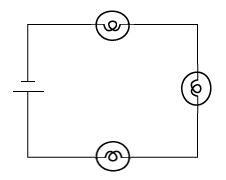
Pick the correct sentence.
a)
This circuit will work because it is a closed circuit.
b)
Energy will freely flow in this circuit.
c)
This circuit will not work because there is no energy source.
d)
This circuit will not work because there is no switch.
2.
What kind of circuit is this?
a)
series
b)
parallel
3.
What type of circuit is show in the image?
a)
Series Circuit
b)
Parallel Circuit
4.
The picture shows an electrical circuit. This circuit is a series circuit because: 
a)
It has 3 light bulbs.
b)
The same current flows through all three light bulbs.
c)
It uses a single battery.
d)
The electrical current has more than one path to flow through
5.
In a Series circuit the more lightbulbs you add the brighter they get 
a)
False 
b)
True 
6.
What is a Parallel circuit? 
a)
Has only one path 
b)
Has more than one path 
c)
Allows energy to travel through easily 
d)
Has only one light bulb
7.
What is a switch's function in a circuit?
a)
to make the current hotter or colder
b)
turn on and off the flow of current
c)
the pathway that current flows
d)
to add more power to the circuit
8.
This instrument can be used to see if materials conduct electricity.  Which of these groups contains items that could all conduct electricity to complete the circuit?
a)
rubber ball, plastic comb, nail
b)
paper clip, penny, screw
c)
cork, dollar bill, tweezers
d)
pencil, eraser, spoon
9.
Find the voltage across R1. (Check the resistance units)
a)
12 V
b)
4V
c)
3V
d)
2K
10.
In order for a circuit to work you need to have
a)
A voltage source
b)
A complete pathway with no breaks in the circuit
c)
A resistor
d)
A voltage source and a complete pathway with no breaks in the circuit
11.
What is the unit for voltage?
a)
volts
b)
amps
c)
ohms
d)
watts
12.
What is the unit for current?
a)
volts
b)
amps
c)
ohms
d)
watts
13.
What is the unit for resistance?
a)
volts
b)
amps
c)
ohms
d)
watts
14.
What is the unit for power?
a)
volts
b)
amps
c)
ohms
d)
watts
15.
What is the total VOLTAGE of the circuit?
a)
10 V
b)
20 V
c)
40 V
d)
4 V
16.
If Georgia Power charges $0.0712/kWhr, how much would it cost to run a 9 kW garage heater for 3 days (72 hours)?
a)
$1.92
b)
$46.14
c)
$0.21
d)
$0.01
17.
Ammeters are connected in _____ to measure amps
a)
parallel 
b)
series 
18.
Voltmeters are connected in _____ to measure voltage
a)
parallel 
b)
series 
19.
The flow of electrons is 
a)
electric current
b)
electric potential
c)
resistance
d)
Power
20.
What does C represent in the circuit shown
a)
the power source
b)
the switch
c)
the resistor
d)
the light bulb
21.
What does B represent in the circuit shown
a)
the power source
b)
the switch
c)
the resistor
d)
the light bulb
22.
What is the total resistance of a 5 ohm, 10 ohm, and 15 ohm resistor hooked up in SERIES?
a)
10 ohms
b)
0.5 ohms
c)
30 ohms
d)
2.7 ohms
23.
What is the total resistance of a 5 ohm, 10 ohm, and 15 ohm resistor hooked up in PARALLEL?
a)
10 ohms
b)
0.5 ohms
c)
30 ohms
d)
2.7 ohms
24.
How much CURRENT does a 1200 W bread maker draw from a 110 V outlet?
a)
132000 amps
b)
0.09 amps
c)
1200 amps
d)
10.9 amps
25.
What is the equivalent resistance of a series circuit with three identical resistors of value 2 ohms?
a)
6 ohms
b)
1.5 ohms
c)
2/3 ohms
d)
8 ohms
26.
What is the equivalent resistance of a parallel circuit with three identical resistors of value 2 ohms?
a)
6 ohms
b)
1.5 ohms
c)
2/3 ohms
d)
8 ohms
27.
A car battery causes a current of 4.0A through a lamp and produces 12V across it. What is the power used by the lamp?
a)
48 W
b)
1/3 W
c)
3 W
d)
3/4 W
28.
How much would it cost to a 4000 Watt central air conditioning unit, 24 hours each day for one year (365 day) if Georgia Power charges $0.10 per kilowatt-hour?
a)
$3,504
b)
$6,083
c)
$4000
d)
$1,460
29.
DC current is found in _______, which means the current flows in ________ direction
a)
Batteries, one
b)
Wall outlet, one
c)
Batteries, both
d)
Wall outlet, both
30.
Conventional current flows from 
a)
high potential to low potential
b)
low potential to high potential
c)
in both directions
d)
in the direction of the electrons
31.
A motor with a resistance of 80Ω is connected to a voltage source. The current is 2.5 A. What is the voltage of the source?
a)
200V
b)
32V
c)
82.5V
d)
80V
32.
What is the voltage between points x and y
a)
6V
b)
4V
c)
2V
d)
3V
33.
Which two resistors have the same total resistance
a)
I and II
b)
II and III
c)
III and IV
d)
I and IV
34.
Which of the following correctly identifies where to place the ammeter and voltmeter
a)
X:Voltmeter
Y: Ammeter
b)
X:Ammeter
Y:Voltmeter
35.
What is the resistance of a lamp that draws a current of 0.20A when connected to a 12V source?
a)
60Ω
b)
2.4Ω
c)
0.017Ω
d)
12Ω
36.
A light bulb uses 40 W when connected to a 120V source. What is the resistance in the light bulb?
a)
4800Ω
b)
c)
1/3 Ω
d)
360 Ω
37.
A wire carries 100 C of charges past a fixed point every 20 seconds. What is the current in the wire?
a)
2,000 A
b)
5A
c)
0.2A
d)
0A
38.
A hairdryer is rated at 3.5kW. How much energy does it use in 3 seconds.
a)
10.5 J
b)
10,500 J
c)
1.17 J
d)
1,177 J
39.
What is the resistance in R2?
a)
12Ω
b)
28Ω
c)
d)
10Ω
40.
What is the value for R2?
a)
b)
c)
d)
18Ω
41.
What is the current through R1?
a)
2A
b)
4.5A
c)
1.5A
d)
0.5A
42.
In a parallel circuit if one light bulb goes OUT; then they ALL go out. TRUE OR FALSE?
a)
TRUE
b)
FALSE
43.
Which of the follow is the same thing as an Amp?
a)
coulomb/second
b)
volt/second
c)
watt/second
d)
Joules/second
44.
Will the light bulbs light or not light based on this circuit design?
a)
The light bulbs will light.
b)
The light bulbs will NOT light.
45.
________________ would be best type of material to use as a resistor.
a)
silver
b)
rubber
c)
ceramic
d)
plastic
46.
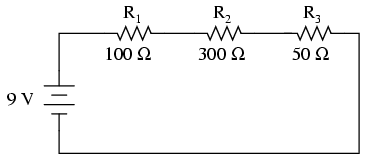
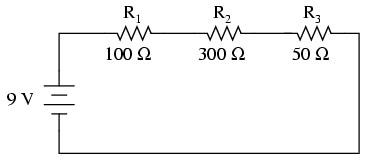
The total resistance in this circuit is 
a)
100 ohms
b)
450 ohms
c)
400 ohms
d)
30 ohms
47.
The total current through this circuit is
a)
0.02 amps
b)
0.09 amps
c)
50 amps
d)
9 amps
48.
The voltage dropped across the 300 ohm resistor is 
a)
6 V
b)
9 V
c)
2 V
d)
30 V
49.

What is the total resistance (RT) across this circuit?

a)

10 kΩ

b)

15 kΩ

c)

13 kΩ

d)

18 kΩ

50.
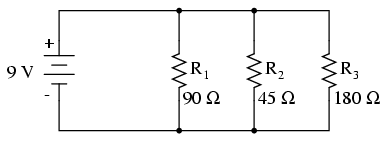
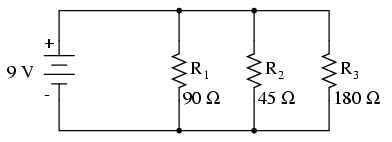
The current going through the 45 ohm resistor is 
a)
0.05 amps
b)
0.2 amps
c)
0.1 amps
d)
5 amps
51.
The total resistance of this circuit is 
a)
25.7 ohms
b)
315 ohms
c)
324 ohms
d)
90 ohms
52.
The total current going through the battery of this circuit is
a)
0.35 amps
b)
0.0286 amps
c)
0 amps
d)
9 amps
53.
What will happen if one light bulb is removed from this circuit?
a)
The other bulbs will go out.
b)
The other bulbs will stay on
c)
The other bulbs will get dimmer.
d)
The battery will become stronger.
54.
Does this diagram represent a series or parallel circuit?
a)
series circuit
b)
parallel circuit
55.

Where should an ammeter be located to correctly measure the total current and where should a voltmeter be located to correctly measure the total voltage?

a)

ammeter at 3 and voltmeter at 4

b)

ammeter at 1 and voltmeter at 4

c)

ammeter at 2 and voltmeter at 3

d)

ammeter at 1 and voltmeter at 2

56.
A class prepared some electrical circuits using battery, connecting wires, and three light bulbs.  Which of these circuits can make the three bulbs light?
a)
A
b)
B
c)
C
d)
D
57.
An incomplete circuit is shown.
To complete the circuit, a wire should be placed from —
a)
Point D to Point C
b)
Point B to Point C
c)
Point A to Point D
d)
Point B to Point D
58.

Which one will still function if one light bulb goes out?

a)

Circuit A

b)

Circuit B

59.

1. Which switch or switches must be closed to make Light A and Light B turn on?

a)

Only switch 1

b)

Only switch 1

c)

Switches 1 and 2

d)

Switches 1 , 2 and 3

60.

Solve for the total resistance of the circuit shown

a)

50 V

b)

1970 ohms

c)

705 K ohms

d)

20 Amps

61.

Solve for total Current in the circuit shown

a)

25 Amps

b)

35 amps

c)

25 milliamps

d)

35 milliamps

62.

Solve for the voltage drop at resistor 1

a)

38 volts

b)

60 Kvolts

c)

50 volts

d)

25 volts

63.

The wattage being dissipated at R3 is ______________________________ W.

a)

18

b)

54

c)

36

64.

Conventional current in a DC circuit flows from the

a)

Positive side of the battery to the negative side of the battery

b)

negative side of the battery to the positive side of the battery

c)

No way to determine