wayground logo

Free Printable Worksheets

Font size

S
M
L
XL
Worksheets

Coulomb's Law, Electric Fields, Electric Potential

Total questions: 68

Worksheet time: 6hrs 40mins

Name
Class
Date
1.

A 5 C and 8 C charge give off a force of 2.5 x 10⁹ N. What is the distance between them?

a)

11 m

b)

12 m

c)

121 m

d)

144 m

2.

A 5 C and 8 C are 8 m apart. What is the force between them?

a)

5.625 x 10⁹

b)

5.625 x 10⁻⁹

c)

4.5 x 10¹⁰

d)

4.5 x 10⁻¹⁰

3.

Select Multiple Answers.


A negative force between two charges mean they:

a)

Attract

b)

Repel

c)

Are the same sign

d)

Are opposite signs

4.

A charge of 4 C and -7 C are 200 m apart. What is the force between them?

a)

6.3 x 10⁶

b)

-6.3 x 10⁶

c)

2.52 x 10¹¹

d)

-2.52 x 10¹¹

5.
Find the magnitude of the force between two charges of 1.0 C each which are 1.0 meter apart?
a)
9E-9 N
b)
9E9 N
c)
1.1E10 N
d)
1.1E-10 N
6.
If each of the charges doubles, what happens to the force?
a)
Quadruples
b)
Doubles
c)
Stays the same
d)
Reduced by half
7.
If the distance doubles, what happens to the force?
a)
Reduced by half
b)
Reduced by 1/4
c)
Stays the same
d)
Quadruples
8.
If the distance is reduced by half, what happens to the force?
a)
Quadruples
b)
Doubles
c)
Triples
d)
Reduces by half
9.
What is the magnitude of the electrostatic force that a charge of +3.0 X 10⁻⁵ coulomb exerts on a charge of +6.0 X 10⁻⁶ coulomb that is 0.30 meter away?
a)
1.8 X 10⁻³ N
b)
5.4 X 10⁻² N
c)
5.4 X 100 N
d)
1.8 X 101 N
10.

A repulsive force exists between which two particles?

a)

Two neutrons

b)

An electron and a neutron

c)

An electron and a proton

d)

Two electrons

11.
The Electric Force is strongest when charges are...
a)
close together
b)
far apart
c)
the electric force is constant everywhere
12.

Coulomb's law says that the force between any two charges depends

a)

directly on the size of the charges

b)

inversely on the square of the distance between the charges

c)

both are correct

13.

The law, governing the force between electric charges is known as

a)

Ampere's law

b)

Ohm's law

c)

Coulomb's law

d)

Faraday's law

14.

Electric lines of force about negative point charge are

a)

Circular, anticlockwise

b)

Circular, clockwise

c)

Radial, outward

d)

Radial, inward

15.

Figure shows the electric lines of force emerging from a charged body. If the electric field at A and B are EA and EB respectively and if the displacement between A and B is r then

a)

EA > EB

b)

EA < EB

c)

EA = EB / r

d)

EA = EB / r2

16.
At which point is the electric field the strongest
a)
A
b)
B
c)
C
d)
D
17.
Which of the following statements is false about electric field lines
a)
electric field lines cannot cross
b)
electric field lines point away from positive charge
c)
electric field lines are always straight lines
d)
electric field lines show how a proton would move in an electric field
18.
At which point is the electric field the weakest?
a)
A because it is the furthest away
b)
A because the field lines are further apart
c)
C because the field lines are further apart
d)
C  because it is the furthest away
19.
Consider the electric field lines shown in the diagram below. From the diagram, it is apparent that object A is ____ and object B is ____.
a)
+,+
b)
+,-
c)
-,+
d)
-,-
20.
Consider the electric field lines drawn at the right for a configuration of two charges. Several locations are labeled on the diagram. Which of these shows the ranking in order of weakest to strongest correctly
a)
A, E, C
b)
D, E, C
c)
D, B, A
d)
A, D, B
21.
Qand Qare two charges creating an electric field. Based on the electric field lines, we can conclude
a)
Qand Qare both positive
b)
Qand Qare both negative
c)
Qis positive and Qis negative
d)
Qis negative and Qis positive
22.

Which of the following is a true statement about the electric field between the two plates?

a)

The field is attractive between the plates and uniform in strength

b)

The field is repulsive between the plates and uniform in strength

c)

The field is attractive between the plates and strongest near the positive

d)

The field is repulsive between the plates and strongest near the positive

23.

Which diagram correctly shows the electric field around a negative charge?

a)

A

b)

B

c)

they are both positive

24.

Which diagram correctly shows the field lines between two like charges?

a)

A

b)

B

c)

Both

d)

Neither

25.
The electric field surrounding a positively charged object is
a)
Away from the charge
b)
Toward the charge
26.

An atom of oxygen has 8 protons and 10 electrons, this means the atom is ____________

a)

positively charged because it has excess electrons

b)

negatively charged because it has excess electrons

c)

positively charged because it has a deficiency of electrons

d)

negatively charged because it has a deficiency of electrons

27.

Coulomb's law also says if distance increases, then force

a)

decreases

b)

disapears

c)

destroyed in a heartbeat

d)

doubles

28.

which is the field for opposite charges

a)
b)
c)
d)
29.
A point charge Q is far from all other charges. At a distance of 2 m from Q, the electric field is 20 N/C. What is the force a charge of 5 Coulombs feels?
a)
4 N
b)
100 N
c)
40 N
d)
10 N
30.
In the diagram below, P is a point near a negatively charged sphere. Which direction best represents the direction of the electric field at point P?
a)
Right
b)
Left
c)
Up 
d)
Down
31.

An electrostatic force of 2 X 10⁻² Newtons is exerted on a charge of 4 micro coulomb at point P in an electric field. The magnitude of the electric field intensity at P is

a)

5 X 10² N/C

b)

5 N/C

c)

50 N/C

d)

5000 N/C

32.
It is observed that Balloon A is charged negatively. Balloon B exerts a repulsive effect upon balloon A. Would the electric field vector created by balloon B be directed towards B or away from B and why?
a)
towards because electric field lines point away from negative charges
b)
towards because electric field lines point away from positive charges
c)
away because electric field lines point away from negative charges
d)
away because electric field lines point toward positive charges
33.
What is the magnitude of the electric field intensity at a point where a proton experiences an electrostatic force of magnitude 2.30 x 10⁻²⁵ newton?
a)
1.44 x 10⁻⁶ N/C
b)
3.68 x 10⁶ N/C
c)
1.44 x 1044 N/C
d)
3.68 x 10-44 N/C
34.
As a proton moves in the direction the electric field lines...
a)
it is moving from low potential to high potential and gaining electric potential energy.
b)
it is moving from low potential to high potential and losing electric potential energy.
c)
it is moving from high potential to low potential and gaining electric potential energy.
d)
it is moving from high potential to low potential and losing electric potential energy.
35.
Two protons are released from rest, with only the electrostatic force acting. Which of the following statements  is NOT true about them as they move apart? 
a)
Their electric potential energy keeps decreasing.
b)
Their electric potential energy keeps increasing.
c)
Their acceleration keeps decreasing.
d)
Their kinetic energy keeps increasing.
36.
Which is a characteristic of most electrical conductors?
a)
They can be cut easily.
b)
Positive charges move easily through them.
c)
Negative charges move easily through them.
d)
They are soft and flexible.
37.

Two plates are 2cm apart, a potential difference of 10 V is applied between them, the electric field between the plates is

a)

20 N/C

b)

500 N/C

c)

5 N/C

d)

250 N/C

38.
A region of space contains a uniform electric field, directed toward the right, as shown in the figure. Which statement about this situation is correct?
a)
The potential at point A is the highest, the potential at point B is the second highest, and the potential at point C is the lowest.
b)
The potential at points A and B are equal, and the potential at point C is lower than the potential at point A.
c)
The potential at all three locations is the same.
d)
The potentials at points A and B are equal, and the potential at point C is higher than the potential at point A.
39.
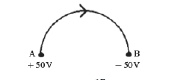
How much work must we do on an electron to move it from point A, which is at a potential of +50V, to point B, which is at a potential of -50 V, along the semicircular path shown in the figure? Assume the system is isolated from outside forces. (e = 1.60 × 10⁻¹⁹ C)
a)
1.60 × 10⁻¹⁷ J
b)
-1.6 J
c)
1.6 J
d)
-1.60 × 10⁻¹⁷ J
40.
A 4.0-g bead carries a charge of 20 μC.  The bead is accelerated from rest through a potential difference V, and afterward the bead is moving at 2.0 m/s.  What is the magnitude of the potential difference V?
a)
400 V
b)
200 V
c)
400 kV
d)
800 kV
41.
In a region where the electric field is uniform and points in the +x direction, the electric potential is -2000 V at x = 8 m and is +400 V at x = 2 m. What is the magnitude of the electric field?
a)
500 V/m
b)
600 V/m
c)
200 V/m
d)
400 V/m
42.

Is work done on the positive charge to move it from point A to point B?

a)

Yes

b)

No

43.

The quantity electric potential is defined as the amount of _____.

a)

electric potential energy

b)

force acting upon a charge

c)

potential energy per charge

d)

force per charge

44.

When work is done on a positive test charge by an external force to move it from one location to another, potential energy _________ (increases, decreases) and electric potential _________ (increases, decreases).

a)

increases, increases

b)

increases, decreases

c)

decreases, increases

d)

decreases, decreases

45.

Electric potential energy is greatest at point...

a)

A

b)

B

46.

Electric Potential (voltage) is greatest at point...

a)

A

b)

B

47.

Is work done on the positive charge to move it from point A to point B?

a)

Yes

b)

No

48.

Electric potential energy is greatest at point...

a)

A

b)

B

49.

Electric potential (voltage) is greatest at point...

a)

A

b)

B

50.

Moving an electron within an electric field would change the ____ the electron.

a)

mass of

b)

amount of charge on

c)

potential energy of

51.

If a battery provides a high voltage, it can ____.

a)

do a lot of work over the course of its lifetime

b)

do a lot of work on each charge it encounters

c)

push a lot of charge through a circuit

d)

last a long time

52.

Compared to point D, point A is _____ electric potential.

a)

12 V higher in

b)

12 V lower in

c)

exactly the same

d)

... impossible to tell

53.

The electric potential energy of a charge is zero at point _____.

a)

A

b)

B

c)

C

d)

D

54.

Energy is required to force a positive test charge to move ___.

a)

through the wire from point A to point B

b)

through the light bulb from point B to point C

c)

through the wire from point C to point D

d)

through the battery from point D to point A

55.

As a + charge moves in the same direction as an electric field, it gains electric potential.

a)

True

b)

False

56.

The direction of electric field lines shows the

a)

direction of the force on a test positive charge.

b)

size of the field.

c)

strength of the field.

d)

all of the above

57.
What variable is a Coulomb the unit for?
a)
Charge
b)
Force
c)
Distance
d)
Mass
58.
What variable do "Newtons" represent?
a)
Electrostatic Charge
b)
Force
c)
Distance
d)
Mass
59.
What happens to the force between two charged objects when you double the distance between them?
a)
2X
b)
1/2X
c)
4X
d)
1/4X
60.
If each of the charges doubles, what happens to the force?
a)
Quadruples
b)
Doubles
c)
Stays the same
d)
Reduced by half
61.
Electrostatic force F is directly proportional to:
a)
r^2 (distance squared)
b)
q1
c)
q2
d)
both q1 and q2
62.
When distance increases, electrostatic force ____________; we call this relationship ____________ proportional
a)
decreases;directly
b)
decreases;inversely
c)
increases;inversely
d)
increases;directly
63.
What variable do Coulombs represent?
a)
Electrostatic Charge
b)
Force
c)
Distance
d)
Mass
64.

The graph shows the relationship between the force of interaction and the magnitude of charge. What type of relationship is this?

a)

Direct

b)

Indirect

c)

Inverse

d)

Reverse

65.
A material in which electrons are not able to move easily 
a)
Circuit 
b)
Insulator 
c)
Resistance 
d)
Conductor
66.
Which of these substances conducts electricity the best?
a)
wood
b)
brick
c)
copper
d)
plastic
67.

The image shows two charged particles with a force of 2.4 N. What would you predict the force of interaction would be when the magnitude of charge on q2 doubles?

a)

9.6 N

b)

4.8 N

c)

1.2 N

d)

.6 N

68.
The Electric Force is strongest when charges are...
a)
close together
b)
far apart
c)
the electric force is constant everywhere