
 Worksheets
Investigation 1: Modeling Motion
Total questions: 70
Worksheet time: 2hrs 20mins

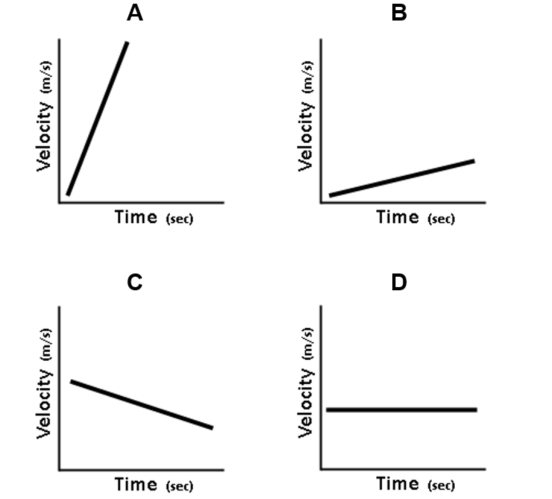
Which is going faster?
A
B

What do the 2 objects have in common when their lines intersect?
ONLY same position
ONLY same velocity
BOTH the same position and same velocity
NEITHER the same position nor the same velocity
A train has a speed of 5 m/s for a time of 10 seconds. How far does the car go?
5 m
10 m
15 m
50 m

What is true about the velocity of the object shown in the x vs. t graph?
Changing
Constant
Constantly changing
Increasing

What is the total distance traveled?
8 m
9 m
10 m
19 m

What is the total displacement?
0.5 m
- 1 m
- 10 m
19 m

Where is the object traveling in the negative direction?
0-2 s
2-5 s
5-7 s
7-10 s

What was the velocity of the object described this graph?
50 m/s
20 m/s
10 m/s
45 m/s

This graph could show someone who...
Walks away, stops for 2 seconds, then comes back
Speeds up, stays at a constant speed for 2 seconds, then slows down
Goes up while slowing down, stops, then speeds up while going down.

Which section of this velocity-time graph shows the man moving the fastest?
Section A
Section B
Section C
Section A and C
None of the sections



A baseball is thrown up into the air. What happens to the acceleration as the ball rises in the air?
the acceleration increases
the acceleration decreases
the acceleration remains constant

A ball is thrown upward with an initial speed of 30m/s. At what location will the ball be moving upward with a speed of 20m/s
A
B
E
F
A ball is thrown upward with an initial speed of 30m/s. At what location will the ball be moving downward with a speed of 20m/s
A
B
E
F
Imagine Oliver, James, and William are having a fun day out in the park. Oliver throws a ball straight up into the sky. At the highest point in its path, what can we say about the ball's velocity 'v' and its acceleration 'a'?
both v = 0 and a = 0
v ≠ 0, but a = 0
v = 0, but a ≠ 0
both v ≠ 0 and a ≠ 0
Imagine this! Our friends Liam, David, and James are on a thrilling adventure in St. Louis, Missouri. They find themselves at the famous Gateway to the West Arch, which stands majestically at about 125 m tall. Suddenly, Sally, a fearless stuntwoman, decides to perform a daring stunt. She plans to release herself off the top of the arch and land on a safety pad at the base. Can you guess what her final velocity would be?
250 m/s
75 m/s
100 m/s
50 m/s

A ball is moving at constant speed around the circle. Which letter represents the acceleration of the ball?
A
B
C
D
Nonsense. The ball can't be accelerating while moving at a constant speed.

A ball thrown straight up takes 8 total seconds to complete its journey all the way up and down. 1 second into its journey and 7 seconds into its journey the magnitude of its velocity will be ______________ and its direction _______________.
opposite, the same
the same, opposite
the same, the same
opposite, opposite
If a ball thrown straight up into the air takes 4 seconds to reach the top (peak), how long will it take to travel from the peak back to the original position?
0s
1s
3s
4s
What is true about the vertical velocity of a projectile launched horizontally?
It is initially at its maximum value.
It increases due to gravity as it falls.
It remains constant throughout its trajectory.
It decreases as it falls due to gravity.

Victor Velocity is standing on top of the roof of his house, firing stones with his slingshot over a level field. He is aiming straight outward, horizontally. If Victor pulls back harder on the sling to shoot a stone, which of the following quantities will be changed?
The vertical displacement of the stone.
The distance the stone travels, and the horizontal velocity.
The time it takes the stone to strike the ground, and the horizontal velocity.
Which of the following statements about the horizontal and vertical components of projectile motion is true?
Changes in the horizontal component occur only when the vertical component changes.
Both the horizontal and vertical components are always constant.
The vertical component changes while the horizontal component stays the same.
The horizontal and vertical components are dependent of each other.

A skateboarder rolls off a bridge into the river as shown. If the skateboarder spent 0.79 s in the air, how far above the river is the edge of the bridge?
5.5 m
0.70 m
1.3 m
3.1 m
Not enough information given.
A projectile is launched with a horizontal velocity of 20 m/s and an initial vertical velocity of 20 m/s. Which graph correctly shows the horizontal velocity of the projectile over time?


A projectile is launched, and its vertical and horizontal velocities are shown in the graph. What is the magnitude of the projectile's initial velocity?
25 m/s
10 m/s
325 m/s
18 m/s
A ball is thrown into the air at some angle, with initial velocities vx (horizontal) and vy (vertical). At the very top of the ball’s path:
What is its velocity in the vertical direction?
vy
Greater than vy
Zero
A volleyball is served at a speed of 8.0 m/s at an angle 35° above the horizontal. What is the speed of the ball when received by the opponent at the same height?
4.0 m/s
8.0 m/s
9.8 m/s
16.0 m/s

A soccer ball is kicked with a 36-degree angle and a velocity of 23 m/s. We know that the time it takes to reach the ground is twice the time it took to reach the peak. So, what is the time that the soccer ball takes to reach the ground?
3.56 s
1.59 s
1.38 s
2.76 s
A ball is launched at an angle of θ and at an initial velocity of v0, how long will it take to take for the ball of reach the peak?
The time at the peak is half the time it takes to reach the x range.
The time at the peak is two times as great at the time to reach the x range
Time at the peak is zero.
None of the above.
A soccer ball is kicked with a 36-degree angle and a velocity of 23 m/s. We know that the time it takes to reach the ground is twice the time it took to reach the peak. So, what is the time that the soccer ball takes to reach the ground?
3.56 s
1.59 s
1.38 s
2.76 s

A soccer ball is kicked with a 36-degree angle and a velocity of 23 m/s. What would be the time that it takes for the soccer ball to reach the peak? vy=voy+ay⋅t ay=−9.8 s2m voy=vo⋅sin(θ)
1.50 s
1.38 s
2.02 s
2.76 s

10. A soccer ball is kicked with a 36-degree angle and a velocity of 23 m/s. Find the vertical component of the ball’s velocity.
voy=vo⋅sin(θ)
13.5 m/s
14.1 m/s
18.6 m/s
33.1 m/s

Which segment shows an object speeding up towards the origin?
A - B above the x-axis
C - D below the x-axis
C-D above the x-axis
D - E

Select the description of motion from A - B.
Slowing down away from the origin
Speeding up away from the origin
Constant velocity away from the origin
Constant velocity towards the origin

Use the picture above to choose the most accurate description of the object's motion
object is speeding up in the negative direction
object is slowing down in the negative direction
object is moving at constant speed in the negative direction
object slowing down in the positive direction
What is a difference between distance and displacement
Distance is measured in seconds and displacement is measured in meters
Distance is always shorter than displacement
Displacement can be equal to zero if the object ends in the place it began in
Distance can be equal to infinite when only a small distance has been travelled

Calculate the displacement traveled in section B. Hint: Remember the area under a v-t graph = displacement!
150 m
50 m
100 m
200 m
An airplane accelerates down a runway from rest at 3.20 m/s2 for 32.8 s until is finally lifts off the ground. Determine the distance traveled before takeoff.
Which equation is appropriate?
vf=vi+a*t
x=vi*t+1/2at2
vf2=vi2+2aX
x=((vf+vi)/2)t
*Sam jumped from a plane. His acceleration was -9.8 m/s2. He hit the ground in 30 seconds. What was his velocity just before he hit the ground?
294 m/s
0.32 m/s
-294 m/s
3.1 m/s
*How long will it take a running horse to travel 260 m and attain a speed of 12 m/s from rest?
1200 seconds
1.2 hours
43 minutes
43 seconds
If a ball is thrown straight up with a velocity of 30 m/s, how long until it can be caught at the same height? (Assume no air resistance)
3 s
6 s
10 s
1.5 s
If you have a hag time of 2s (on Earth) how high did you jump ? Remember hang time is the total time you are in the air (up and down).
10 m
5m
2.5 m
1 m
Mr. S has a vertical jump of 2m, what is his hang time ?
0.5 s
2.5 s
.25 s
1.2 s

What is the displacement from t=4-6s
2m
-4m
-2 m
-6 m

Which xt graph best represents this motion?


An engineer is designing the runway for an airport. Of the planes that will use the airport, the lowest acceleration rate is likely to be 3 m/s2. The takeoff speed for this plane will be 65 m/s. All airplanes will start from rest. Assuming this minimum acceleration, what is the minimum allowed length for the runway?
v=vo+at
d=vot+1/2at2
v2=vo2+2ad
d=1/2(v+vo)t
A rocket started at rest. After initiating the launch, it had an acceleration of 90 m/s2. How long did it take to reach a speed of 2430 m/s?
13.5 s
65610 s
27 s
32805 s
Lisa was walking with her 40 lb dog at 1.5 m/s. The dog saw a squirrel and ran towards it. The dog reached a top speed of 16 m/s. How far did the dog travel if its acceleration was 1.4 m/s2?
181.25 m
90.63 m
6.34 m
3.17 m
10.36 m
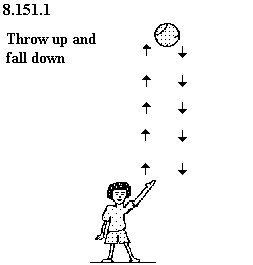
A ball is thrown upwards and caught when it comes back down at the same height. In the absence of air resistance, the speed of the ball when caught would be
less than the speed it had when thrown upwards.
more than the speed it had when thrown upwards.
the same as the speed it had when thrown upwards.
need more information to determine.
A baseball is hit with a baseball bat. The ball will have the largest range when it is hit at an angle of
0 degrees
30 degrees
45 degrees
66.3 degrees
You launch three identical parabolic projectiles from the same cannon. The initial launch velocity for all three projectiles was the same at 30 m/s. The launch angles were different.
Projectile #1 was launched at an angle of 20∘.
Projectile #2 was launched at an angle of 30∘.
Projectile #3 was launched at an angle of 60∘.
Which projectile had the longest time of flight?
Projectile #1
Projectile #2
Projectile #3
All had equal times of flight.
You launch three identical parabolic projectiles from the same cannon. The launch angle for all three projectiles was 30∘. The initial launch velocities were different.
Projectile #1 was launched at 30 m/s
Projectile #2 was launched at 20 m/s.
Projectile #3 was launched at 10 m/s.
Which projectile had the longest time of flight?
Projectile #1
Projectile #2
Projectile #3
All had equal times of flight.
Mark all of the following objects that are actually projectiles.
An object moving through the air and not touching any surfaces
A falling skydiver with an open parachute
Any object falling with no air resistance
A football kicked toward the goal posts
An airplane flying through the air
Two objects are released at the same time. One object is dropped in the vertical direction and one is launched horizontally into projectile motion. Which object hits the ground first?
Both hit the ground at the same time
The object dropped hits the ground first
The object launched horizontally hits the ground first
Unable to determine without further information
The final requirement for a degree in geology is Field Camp, an 8 week field experience in which budding geologists must complete rigorous real-world mapping projects. To celebrate the end of field camp, one student threw his rock hammer off of a 78 m cliff with a horizontal velocity of 34 m/s. He was then reminded that he had one more day of field work, so he needed to go get his hammer. How far away from the cliff did he have to walk in order to find his hammer?
221.78 m
153.23 m
135.65 m
78.98 m
How can you calculate the displacement of an object from a position-time graph?
Multiply the final position by the initial position.
Find the average velocity of the object.
Find the difference between the final position and the initial position of the object.
Divide the final position by the initial position.
What does the area under a velocity-time graph represent?
displacement
acceleration
time
speed
If a position-time graph is a straight line with a positive slope, what does it indicate about the object's motion?
The object is moving with a constant negative velocity.
The object is at rest.
The object is accelerating in the positive direction.
The object is moving with a constant positive velocity.
What does the slope of a position-time graph represent?
velocity
time
distance
acceleration

